Category Archives: Drama

Review – Black Swan (15) [2011]

Star Rating: 4/5

Obsession is a dangerous mindset to fall into. It has the power to consume its victim, and drive him or her to madness. Black Swan may look like it is about ballerinas and Ballet in general, but it is not: it is about obsession, and the psychological effects and the physical strains it can cause someone. Yet, if the film meant to tackle these complex issues acutely, it goes preposterously too far to be taken seriously.

The movie is viewed through the eyes of Nina (Natalie Portman – Star Wars I IIIBrothers, Your Highness), an innocent, pretty but mentally unstable ballerina, who lives with her domineering mother (Barbara Hershey – Falling Down, Hannah and her Sisters). Nina has seemingly devoted her whole life to becoming Odette, the White Swan, in Tchaikovsky’s Swan Lake. But the company she works for has made a slight altercation to the performance: the girl who plays Odette will also have to play her evil twin-sister, Odile, the Black Swan. Whilst Nina fits the role of the White Swan perfectly, she has to learn how to become manipulative and provocative in order to play the Black Swan.
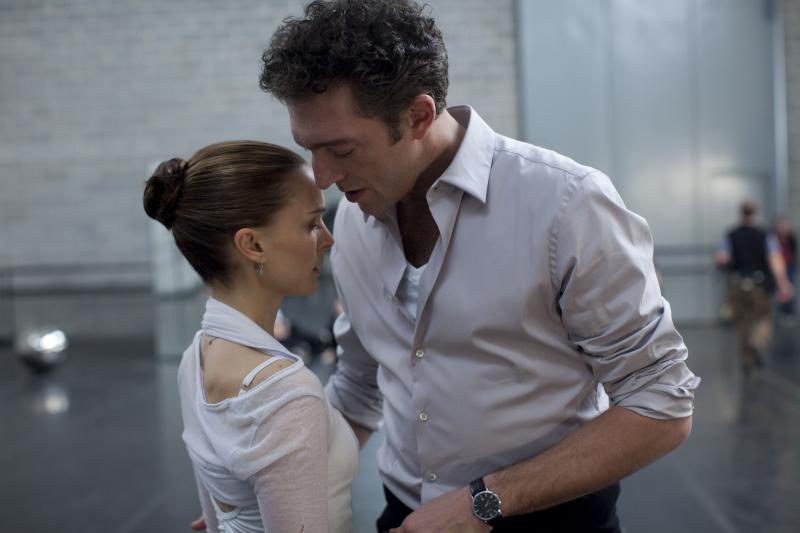
Thomas urging Nina to ‘feel’ and ‘respond’ to his touch as the latter needs to learn how to become the Black Swan.

Nina is determined to play both roles flawlessly. But her obsession with perfection exposes her already fragile mind, as well as her various insecurities. It is not long before reality and Nina’s perceptions of reality (hallucinations?) start to thread together to look like one and the same. Paranoia goes hand in hand with this too. A younger and, perhaps, even more beautiful girl, called Lily (Mila Kunis – Family Guy, Forgetting Sarah Marshall, Friends with Benefits), joins the company making Nina believe that she is going to be replaced as the lead performer. Consequently, Nina works ever harder, pushing herself to the brink (and beyond), in order to please and convince her demanding boss, Thomas (Vincent Cassels – La Haine, Derailed, Trance), that she is right for the dual role. Regardless of the personal cost.

The acting in Black Swan, across the board, is exceptional. Natalie Portman is without a doubt the star of the show. Portman captures the mental anguish that Nina goes through with remarkable consistency and concentration. One is never sure what mental state Nina is in, or what is real and what is not real with her. Portman is solely responsible for this and rightly deserves the credit.

This is not to say that Mila Kunis, Barbara Hershey or Vincent Cassels do themselves an injustice; far from it. But Portman’s performance as Nina is Oscar-winning material. It has also finally enabled her to remove the shackles from her piteous performance as Padmé in Star Wars I, II and III. Yes, Portman’s performances in Closer and Brothers showed us that she had the potential to be a great actor, but in Black Swan she reveals that she has more than just mere potential with stunning effect.

Lily, played by Mila Kunis, looking beautiful despite having done some intense ballet practice.

It is not just the acting that is superb throughout the movie. The director, Darren Aranofsky (Pi, Requiem for a Dream, The Wrestler) has done the choreography and the music brilliantly too. As a result, just like in Pi and Requiem, the disturbing nature of Black Swan has the maximum effect upon the audience. (Think of the masturbation or the lesbian-sex scenes to mention but two.)

The travesty for Black Swan is that it is neither as intense nor as shocking as it should have been. It is certainly not in the same league as Requiem. Whilst Requiem is harrowingly realistic, Black Swan becomes a little farcical towards the end. This is a pity for cast and director alike. It is unlikely that Aranofsky, judging by his previous works, intended to turn this movie into a pantomime.

These are by no means the only flaws in Black Swan either. Although the film hints at how dedicated one must be to become a top ballerina, it fails to detail the positive aspects of the industry. Instead, the movie focuses upon many of the negative stereotypes, such as eating disorders and overbearing parents. (Apparently, much of these are out of date in the West.)

Black Swan is by no means an objective portrayal of the Ballet world. The film also lacks the jaw-dropping, stomach-churning ability of Requiem. Then again, Black Swan is still a very entertaining psychological thriller and is quite distressing. Moreover, the acting is of the highest quality. Few actors will better Natalie Portman’s performance over the coming year, and she rightly deserves the nominations and awards she is receiving. It is just a shame for her and Aranofsky that audiences have laughed more at the absurdity of Nina’s descent, than taken note of the possible consequences of obsession.

PG’s Tips
Review – The King’s Speech (12a) [2011]

Star Rating: 4.5/5

The term ‘born for greatness’ is one often used to describe the life of king. Nevertheless, it is a vague term: one that does not give a remote hint to the strains and struggles that comes with achieving great feats. The King’s Speech illustrates a form of such a challenge with the brilliance of a masterpiece.

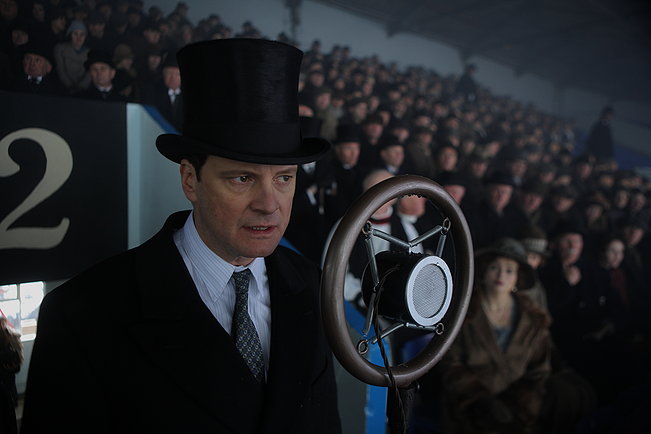
Bertie, played by Colin Firth, gives a speech at Wembley in the mid-1920s that goes awry due to his stammer.

The film centres on Bertie (Colin Firth – Bridget Jones’ Diary, Dorian Gray, Tinker Tailor Soldier Spy), the future King George VI of Britain (1936-52), who has a terrible stammer, and how he must overcome this stammer in order to compete with the other great orators of his era, such as Sir Winston Churchill and Adolf Hitler. When it becomes clear that his older brother, David (Guy Pearce – Memento, The Hurt Locker, Prometheus), the future King Edward VIII (abdicated in 1936), would rather marry Wallis Simpson (Eve Best), a twice-divorced American woman, than take up the throne, the necessity for Bertie to speak more eloquently becomes paramount. After-all, he is next in line.

After trying several therapists for years, Bertie turns to Lionel Logue (Geoffrey Rush – Pirates of the Caribbean I-IV, Shakespeare In Love) and his unconventional methods to help solve the problem. By taking us through stage-by-stage of Logue’s methods, the director, Tom Hooper (The Damned United, Les Misérables), ensures that we see Bertie’s tremendous struggle to complete a sentence without stuttering (something seemingly so effortless for the majority of us). However, we would not be able to realise just how frustrating and aggravating it must have been for Bertie if it weren’t for the exceptional performance of Colin Firth. Never before has an Adam’s Apple been so over-worked or scrutinised as in The King’s Speech.

Yet, it is not just Bertie’s consistent stammering that makes Firth’s act so memorable, but also how it affects Bertie’s general behaviour. Throughout the movie, the future George VI suffers from chronic diffidence. His speech impediment affects everything from the way he walks, talks and looks at people; to his need for emotional support from his wife, Elizabeth (Helena Bonham Carter – Fight Club, Harry Potter V, VI, VII(i) & VII(ii), Alice in Wonderland, Les Misérables), the future Queen Elizabeth II’s mother. And this does not even include his bad temper or his fears; most notably, public speaking. In a first-class display, Firth captures Bertie’s dread superbly as well as his character’s comprehension of the responsibilities of a monarch.

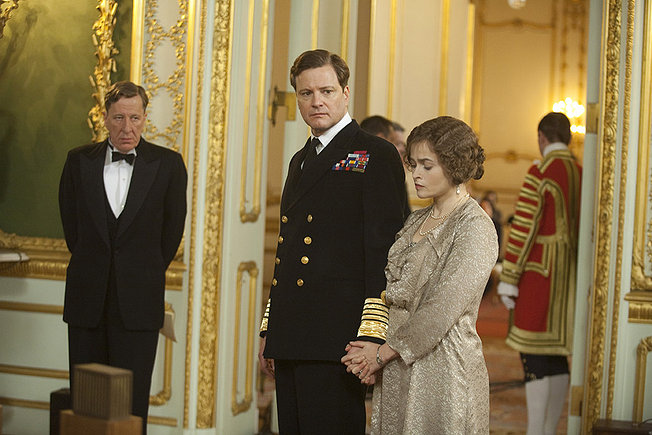
Anxiety reigns supreme as Lionel Logue (Geoffrey Rush), George VI and Elizabeth (Helena Bonham Carter) wait for the king to give his big speech not long after Britain declared war on Germany on 3rd September 1939.

Firth is undoubtedly the stand-out performer of the movie. But that is not to say that Geoffrey Rush or Helena Bonham Carter do the film a disservice. On the contrary, they play their roles very well: the former as the tolerant therapist with a wry sense of humour, who understands how best to deal with the king’s stammer; and the latter, as the supportive wife of a man who feels that he must triumph against all odds in order to carry out his duty as king.

Alas, The King’s Speech does not touch upon the gastric problem that Bertie endured throughout his life. It also wrongly portrays the relationship between Bertie and David. (Not to mention the one between Elizabeth and David too.) Since the film is based on real events (as opposed to a book or an urban legend), historical accuracy is important and is slightly lacking in the movie, even if it is regarding a relatively minor part of the story.

This, though, should not take too much away from The King’s Speech. The film is simple, original and outstanding. In addition, it is funny (albeit in a very English way) and engaging. The acting is fitting for Oscar nominations, and Firth’s ability to make us feel the pain that Bertie’s stammer caused him is right up there with the greatest of performances. That there is no fairytale ending to the film gives The King’s Speech greater credit and more than a twinkle of realism: it makes us appreciate how and why King George VI managed to win over the affections of millions across the world.

PG’s Tips

Review – The American (15) [2010]

Star Rating: 2/5

When one thinks of a spy film, the Bourne series, Munich and Salt spring to mind. Those movies were action packed and fast-paced; and in Salt, one at least watches Angelina Jolie wearing tightly fitted costumes and doing all kinds of interesting stunts and kicks. The American, on other hand, has little of these qualities; and George Clooney (From Dusk Til Dawn, Ocean’s Eleven, The Ides of March), playing the role of an American spy in Italy, fails to appeal to the audience in the same way that Matt Damon, Eric Bana and Jolie do in their respective films.

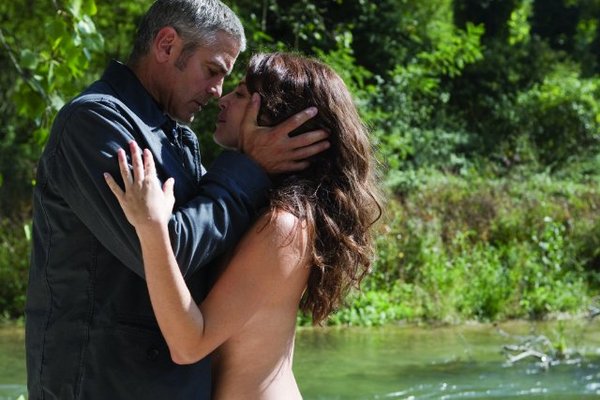
Clooney making out with Violente Placido at a picturesque and secluded stream.

In saying that, the director, Anton Corbijn (Control), has deliberately gone for a very different type of spy film relative to other recent movies within the genre. He has gone for an artistic film. One is forced to admire the beautiful Italian sceneries as well as tolerate the silence that dominates much of the film. The lack of dialogue in The American is reminiscent to Francis Coppola’s Lost In Translation. Consequently, there are numerous (and arguably pointless) scenes of Clooney alone, saying nothing. A lot of the time, the same is true when Clooney is with people. Questions asked to him are often left unanswered, which is poor-show from Corbijn.

Clooney, refreshingly, is not his usual charming self in The American. He cuts a sombre and lonely person throughout much of the film. Even in scenes when he is with people, like when he is with the priest having religious conversations or when he is with the escort/prostitute, Clara (Violenta Placido), Clooney is almost always distant, cold and unable to speak his mind. One imagines this could be indicative of spies in general: they can’t reveal their real jobs as that would most likely endanger their lives, their mission and their country. Occasionally, we see the paranoia that goes through the mind of a spy; for example, the constant look over the shoulder. But Clooney does not capture a spy’s paranoia as well as the actors in Munich do, which is a shame for him. That is not to say that Clooney does a bad job in this film. But devoid of a script, not to mention his smooth-tongue and amiable smile, he is not the same actor.

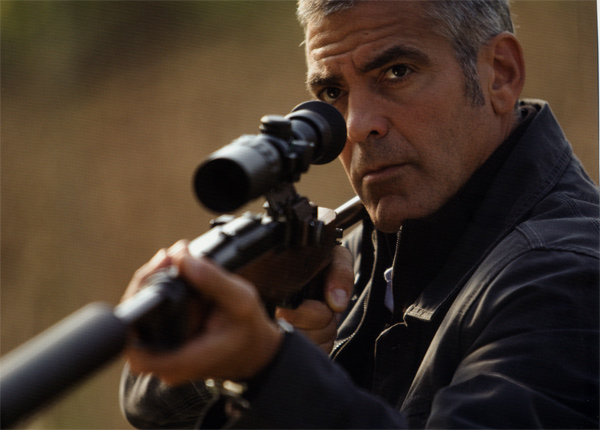
Clooney holding a rifle with a silencer as he practices his shooting accuracy.

Still, Clooney is one of the few bright spots in The American. (Other decent aspects include the gorgeous women he meets and sleeps with.) Irritatingly, the storyline, if there is one at all, has no context. Throughout the film, one wonders: why Clooney is in this small town in Italy; who he’s working for; who he’s targeting; and if he is an asset or a liability to his organisation. If the plot were fast-moving, Corbijn might have gotten away with this. But as it is slow, the movie is disinteresting and boring.

What’s more, The American is not especially entertaining. It does not matter how picturesque the Italian landscapes are or if some of the paranoia’s of being a spy are illustrated; a film’s first job is to entertain. Thus, Corbijn has let down Clooney as well as his audience.

PG’s Tips