Tag Archives: latest film reviews

Review – Rio 3D (U) [2011]

Star Rating: 3/5

In recent times, there have been some exceptional animated films; the pick of the bunch being Toy Story 3. Kung-Fu Panda and Coraline have their merits for humour and horror, respectively; however, they lack the je ne sais quoi of Toy Story 3. For similar reasons, Rio falls short, despite being enjoyable and cute.
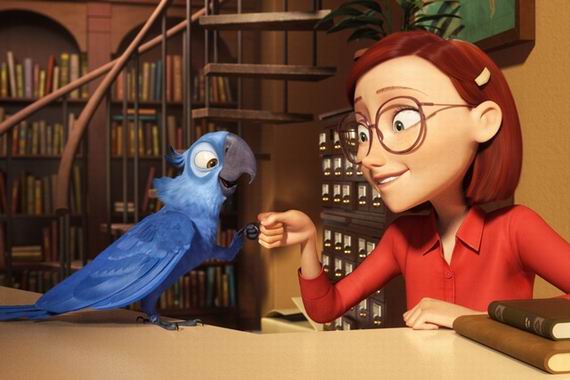
Blu and Linda showing that they are the best of friends

Rio is about a blue McCaw called Blu (voiced by Jesse Eisenberg – The Social Network, Zombieland, Batman v Superman: Dawn of Justice), a shy and dorky bird that can’t fly. At a young age, Blu is taken from his home in the Amazon and finds himself randomly in Minnesota. There, he is looked after by a young girl Linda (voiced by Leslie Mann – The Cable Guy, 17 Again, Knocked Up). Fifteen years later, Tulio (voiced by Rodrigo Santoro – 300, Che I & II, I Love You Philip Morris), a scientist, finds Linda and tells her that Blu is the last of his species. There is only one other blue McCaw and she is in Rio de Janeiro, Brazil. Thus, the only way to save the species is by taking Blu to Rio.

Once in Rio, Blu is put into a cage with the beautiful, but feisty Jewel (voiced by Anne Hathaway – The Devil Wears Prada, Love And Other Drugs, One Day). Yet, dark forces in the underworld of Rio desire these birds for profit. Not long after Blu and Jewel are caged up, they are stolen by smugglers; much to the consternations of Linda and Tulio. Blu and Jewel are determined to get out of captivity: the latter to fly freely through the Amazon; the former to find Linda. It will not be easy and being chained together makes matters harder for them.

There is nothing especially original about Rio’s plot. It moves at the right pace so as to keep its viewers interested, but it gets a bit naff towards the end. Nevertheless, there are many sweet and funny moments in the film; especially, the singing and rapping by Pedro (Will.i.am. – Madagascar 2, Knight And Day, Freedom Writers) and Nico (Jamie Foxx – Collateral, Law Abiding Citizen, Miami Vice). Anne Hathaway also has a surprisingly powerful voice. But, on the whole, Rio is not as funny as the hilarious Kung-Fu Panda (and perhaps Kung-Fu Panda 2, which is released later this year).
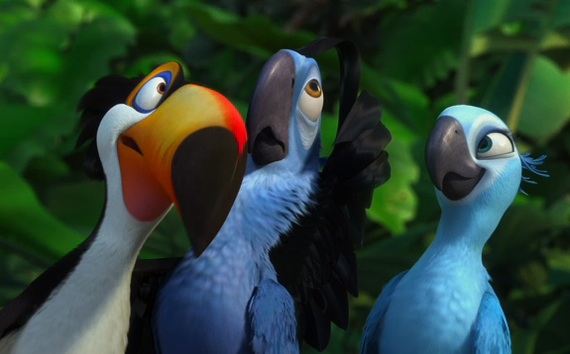
Blu and Jewel being shown the way by another bird who is willing to help them.  Alas, the director and script-writer, Carlos Saldanha (Ice Age I, II, III), has ensured that Rio is not a satire. This could have given the film a sophisticated edge. Additionally, the characters are very two-dimensional: Blu somehow looks and acts just as geeky as Jesse Eisenberg did in The Social Network; whilst Jewel acts throughout like a spoilt princess with no claim to royalty.

On another note, the graphics are fine for what the movie is; although, the 3D effects add little to the film. Indeed, Rio is not Avatar in the sense that, like Legend Of The Guardians and Alice In Wonderland, it was not made to be, primarily, a 3D movie.

All in all, Rio is a movie for children. It is cute and will put smiles on the faces of those who watch it. However, if one thinks that it’s going to be the next Toy Story 3 then disappointment will follow.

PG’s Tips
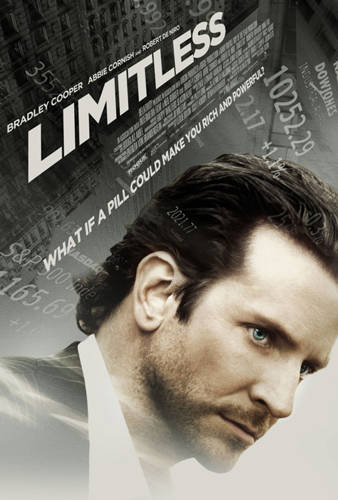
Review – Limitless (12a) [2011]

Star Rating: 3.5/5

It is believed that human beings only use ten to twenty-five per cent of their brainpower most of the time. After hearing this, it is natural for people to contemplate what they might be able to achieve if they could access a hundred per cent of their mind’s capabilities. Well, Limitless gives us a hint of what it could be like and it makes for pleasant viewing.

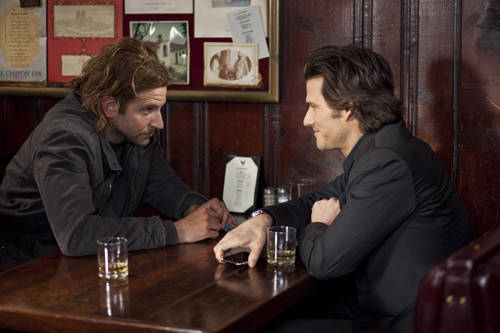
Eddie Morra, left, looking down and out, is offered the 'limitless pill' by his ex-wife's brother.

The movie is centred on Eddie Morra (Bradley Cooper – He’s Just Not That Into You, The Hangover, The A-Team), a messy and disorganized ‘wannabe’ author who has yet to write a word of his novel. His partner, Lily (Abbie Cornish – Elizabeth: The Golden Age, Legend of the Guardians: The Owls of Ga’Hoole, Sucker Punch), has just left him because she sees no future with him.

With his life going nowhere, Eddie bumps into his ex-wife’s brother, Vernon (Johnny Whitworth – Valentine, 3:10 To Yuma, Ghost Rider: Spirit of Vengeance). After buying him a bear in the middle of the day, Vernon offers Eddie a pill that will revitalise him. Reluctantly, Eddie swallows it giving him the clarity of thought and energy that he has lacked his whole life. With this pill, no worldly ambition is beyond him. The problem for Eddie is what happens when his supply runs out and what will others do to have his key to success.

The plot for Limitless is simple to follow, entertaining and strokes one’s ego nicely.

It is not an especially thought-provoking film and several of the side-stories are dropped before they’ve been concluded. This naturally leaves a few things unanswered by the end; but as they are not major parts to the movie, it is easy for viewers to forget that these scenes even took place.

Moreover, things go so well for Eddie that one cannot help but remind oneself that life is full of ups and downs; not just ups. Limitless also doesn’t give much attention to the negative effects of taking the ‘limitless pill’ or drugs unlike, for example, Requiem For A Dream. This is a pity as it would have added a dimension to the film that is sorely lacking.

Since it does not tackle the more serious side of drug addiction, the characters do not have depth. This is a shame; especially for Bradley Cooper. He plays well as a low-life loser and a high-flying, smooth-talking, money making machine. It would have been interesting to see how he would have faired if he’d have been given the opportunity to show us the downside of taking this drug.

Eddie, looking happy with how life has panned out for him since taking the pill, being intimate with his girlfriend, Lily, played by Abbie Cornish.

No other character in the film is given enough time or the script to stamp their mark. In effect, Abbie Cornish, Robert de Niro (Goodfellas, Stardust, Meet The Parents) and Andrew Howard (Transformers II: Rise of the Fallen, Revolver, I Spit On Your Grave) are little more than mere diversions to the story of Eddie Morra’s meteoric rise. This though does not take away much from the film. It is unlikely that they’d have made a significant difference to the movie if they’d have been given more of a role.

The acting on the whole is better than the choreography. The director, Neil Burger (The Illusionist, The Lucky Ones), has not shot the film brilliantly. Some of the scenes are quite dizzying, whilst others do not flow well together. Although this can be disorientating for the audience at times, it does not make the movie hard to watch or undermine its entertainment value.

Ultimately, Limitless is an enjoyable film that enables viewers to switch off as they watch it. It is not a masterpiece and has a handful of minor flaws. Nevertheless, it leaves its audience satisfied, plus makes them think in jest what they could be like if they were able to use their mind to its full potential.

PG’s Tips

Review – The Fighter (15) [2011]

Star Rating: 4.5/5

‘Why do we fall down, Bruce? So we can learn to pick ourselves up.’ Thomas Wayne may have asked his son this question in Batman Begins; yet, the question (and subsequent answer) is an equally valid motto for another excellent movie: The Fighter.

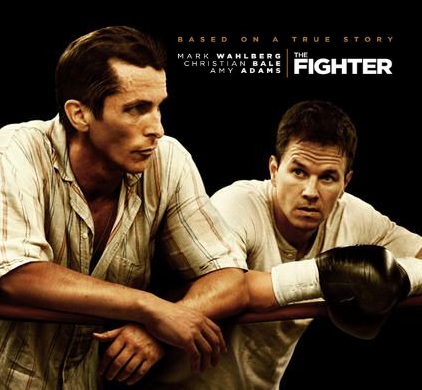
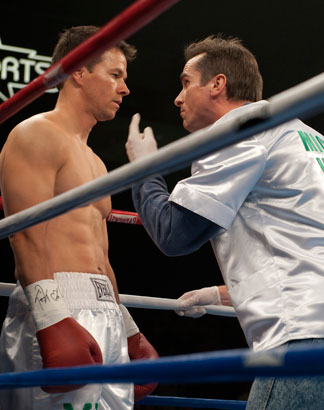
The Fighter is based on a true story. Mickey Ward (Mark Wahlberg – The Lovely Bones, The Italian Job, We Own The Night) comes from a deprived area in Lowell, Massachusetts. He is a street-sweeper by trade and an aspiring boxer on the side, struggling to make an honest buck. Mickey has been taught everything he knows by his older brother, Dickey (Christian Bale – The Machinist, The Dark Knight, 3:10 To Yuma), who is an ex-boxer that never quite made it big. In recent times, Dickey has become a crack-addict. As much as he is Mickey’s best aid, Dickey is also his brother’s greatest liability. Mickey’s mother and manager, Alice (Melissa Leo – Hide and Seek, Conviction, Red State), as well as the rest of this family (possibly minus his father), are not much better either.

Mickey does and, simultaneously, does not have the right kind of support. His confidence is low; he hasn’t done well in his previous fights. He’s struggling. It’s only after he meets Charlene (Amy Adams – Catch Me If You Can, Enchanted, The Master), a not unattractive college drop-out with little going for her; takes a battering against a boxer with twenty pounds more muscle on him; and after he recovers from a broken hand, that Mickey’s fortunes begin to change for the positive. But it does not come without an immense amount of hard work and sacrifice.

The plot may not move at breakneck speed, but it is still quite inspiring and entertaining. The quality of the acting by Mark Wahlberg, Amy Adams and Christian Bale is undoubtedly the best feature of the film. Due to Wahlberg’s performance, one has little difficulty empathising with Mickey. Wahlberg wonderfully captures the timidity of a humble person that suffers from low confidence and dejection, without being melodramatic. Likewise, Wahlberg maintains his character’s dignity admirably when he regains his self-assurance. This is no easy feat. Why Wahlberg was not nominated for an Oscar is a mystery.

One who was nominated for an Oscar is Amy Adams. Here, she plays the role of Mickey’s highly supportive girlfriend splendidly. Charlene has her issues as well, buttressing Adams’ performance because it makes her act more realistically. The only thing that works against Adams is that Charlene does not have an overly challenging personality. This may stop Adams from an Oscar triumph.

The same cannot be said for Christian Bale’s acting in The Fighter. In arguably his finest performance yet, Bale outshines his co-stars. When he’s not on-screen, one almost wishes him to return as he is that good. One could feasibly believe that Bale is a drug-addict from this movie, such is the intensity and energy he puts into the role. (And this is saying something for a man who has played many diverse roles extremely well throughout his career.) If he wins an Oscar for Best Supporting Actor, it will be fully justified.

The cast could not have acted so well without brilliant scripts. For this, credit must go to the script-writer, Scott Silver (8 Mile), and the director, David O. Russell (Three Kings). The scripts may not be as elegant and witty as that in The King’s Speech, or as intelligent as that in True Grit. Still, the dialogue between the characters in The Fighter is indicative of the environment from which Mickey, Dickey and Charlene come from, and, therefore, gives the movie a greater sense of realism.

Charlene (Amy Adams) at the bar where she meets Mickey.

If one were to be ruthless, one could argue that the choreography and the music in The Fighter were not as sublime as the above films. Some scenes did not flow as smoothly as they could have done; and, with regards to the feel-good factor, the music here was not as uplifting as the scores in The King’s Speech. Similarly, it is also a shame for the director that the cinematography could not have been as beautiful as in other films (for example The Way Back), since The Fighter is shot in depressing neighbourhoods. This should not, theoretically, take anything away from the film. Nevertheless, seeing miserable areas is not as aesthetically pleasing as picturesque landscapes. Again though, this is being very harsh (and semi-unfair) on the director.

All-in-all, The Fighter, despite some minor defects, is a fantastic film and has a cast worthy of their nominations; Bale particularly so. The movie also has plenty of moral messages. It illustrates how bad environments can hinder one’s progress and shows us the possible results of drug addiction. But most importantly of all, The Fighter emphasises that when one gets knocked down by life’s challenges, one has to learn how to stand up again and fight on.

PG’s Tips

Review – True Grit (15) [2011]

Star Rating: 5/5

Less than four years since they made the Oscar-winning No Country For Old Men, the Coen brothers, Ethan and Joel (A Simple Man, Burn After Reading), have returned to the ‘cowboy genre’ with a bang (pardon the pun). No Country For Old Men was a brilliant film. True Grit is even better.

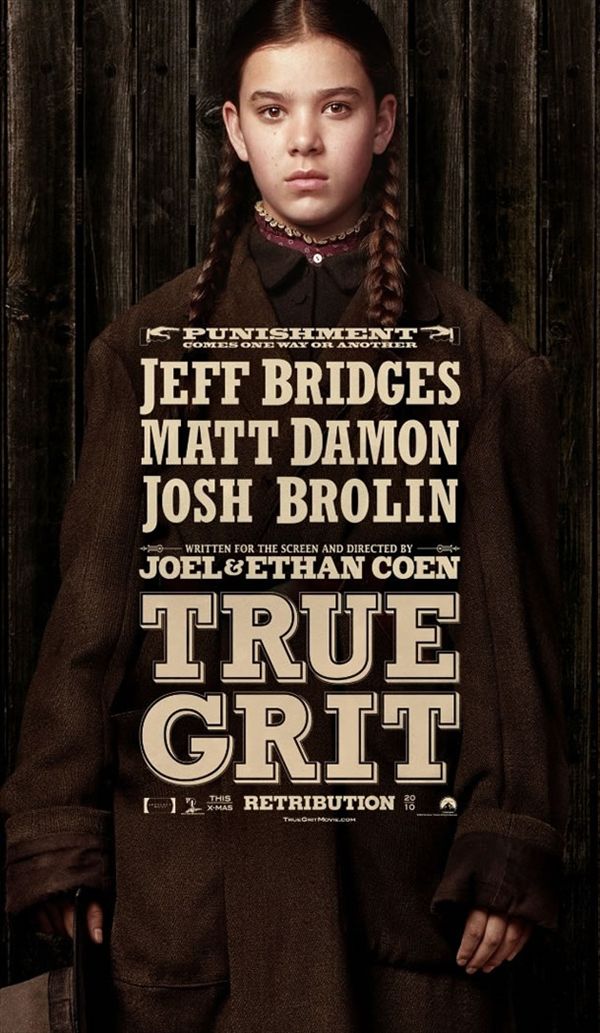
The plot for True Grit is quite straightforward. Based in a small town in Midwest America in the late-nineteenth century, Tom Chaney (Josh Brolin – No Country For Old Men, Wall Street 2, American Gangster) killed Frank Ross in cold murder. Frank’s extremely intelligent, precocious fourteen-year-old daughter, Mattie (Hailee Steinfeld), is determined to have her father’s death avenged. After the local law enforcement agency refuses to chase Chaney, Mattie employs Rooster (Jeff Bridges – Crazy Heart, The Big Lebowski, Seventh Son), a drunk and ruthless cowboy to find Chaney.

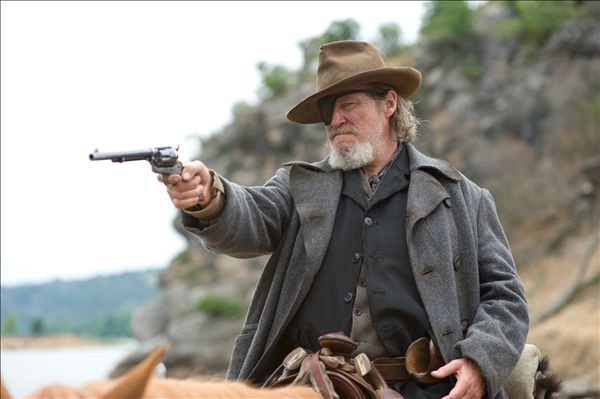
A drunk Rooster, played by Jeff Bridges, trying to shoot accurately on the back of a horse.

As Mattie strikes a deal with Rooster; Laboeuf (Matt Damon – The Bourne Identity, The Departed, Invictus), a dumb but wily Texan Ranger emerges. Laboeuf also wants Chaney. The latter is wanted in Texas for the murder of a senator. Despite some differences on where Chaney should be tried (Mattie wants him to be put to justice in her town, while Laboeuf needs to bring him back to Texas or else he won’t get paid), Mattie, Rooster and Laboeuf head off together in search of their man.

If the storyline does not make one believe that True Grit should have been a five-star film, the flawless and Oscar-worthy acting certainly will. Jeff Bridges splendidly captures the attitude, habits and language of an aging, drunk-but-funny, Midwest, trigger-happy cowboy. Similarly, Matt Damon illustrates that being a far-from-bright ranger on a horseback comes just as naturally to him as being the secret agent, Jason Bourne.

Yet, the performances of Bridges and Damon are cast into the shadows by that of Steinfeld. If the star of No Country For Old Men was the frighteningly serene villain with red-rimmed-eyes, played by Javier Bardem, then Steinfeld is the stand-out entertainer of True Grit. Mattie’s ability to understand the complexities of law; her ability to see through people as if they were opaque, plus her witty tongue are all down to the proficiency of Steinfeld. It almost beggar’s belief that Mattie was played by a fourteen-year-old! Indeed, one will struggle to witness a more assured and mature performance from someone of her age over the coming decade.

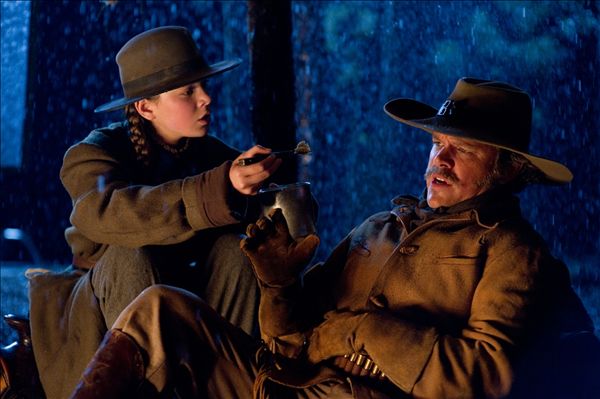
Mattie attempting to feed the ill-tempered Laboeuf beside a campfire one night.

The acting, however, would not be half as impressive if the characters would have been without well-written scripts. They might have got away with it provided they’d have just maintained strong Midwest accents (like Russell Crowe and Christian Bale did in 3:10 To Yuma); but the three main actors do more than that in this movie. Bridges, Damon and Steinfeld adopt a dialogue that one can realistically imagine ‘Middle Americans’ once using (or even still use in some places today). That there are no lapses whilst they talk in this semi-alien tongue makes their performances all the more remarkable.

The magnificent acting and dialogue are matched by the choreography, music and landscapes throughout the film. Each scene smoothly slots in, one after another, without interruption. In addition, the music is always fitting for the scene; as are the differing sceneries the Coen brothers have employed, showing us that Midwest America is more than just a desert with a dozens of cacti.

In short, True Grit is a model of a film and a realistic portrayal of how cowboys used to go about their business. One does not need to be a fan of Western-style movies to appreciate that from the directing; to the production; to the writing of the screenplay and the music scores; to the acting, True Grit is as close to perfect as a film can be.

PG’s Tips

Review – Black Swan (15) [2011]

Star Rating: 4/5

Obsession is a dangerous mindset to fall into. It has the power to consume its victim, and drive him or her to madness. Black Swan may look like it is about ballerinas and Ballet in general, but it is not: it is about obsession, and the psychological effects and the physical strains it can cause someone. Yet, if the film meant to tackle these complex issues acutely, it goes preposterously too far to be taken seriously.

The movie is viewed through the eyes of Nina (Natalie Portman – Star Wars I IIIBrothers, Your Highness), an innocent, pretty but mentally unstable ballerina, who lives with her domineering mother (Barbara Hershey – Falling Down, Hannah and her Sisters). Nina has seemingly devoted her whole life to becoming Odette, the White Swan, in Tchaikovsky’s Swan Lake. But the company she works for has made a slight altercation to the performance: the girl who plays Odette will also have to play her evil twin-sister, Odile, the Black Swan. Whilst Nina fits the role of the White Swan perfectly, she has to learn how to become manipulative and provocative in order to play the Black Swan.

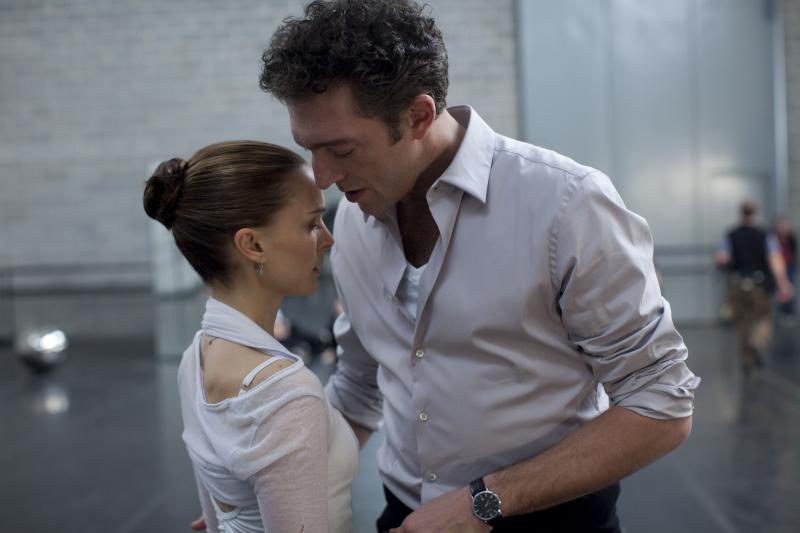
Thomas urging Nina to ‘feel’ and ‘respond’ to his touch as the latter needs to learn how to become the Black Swan.

Nina is determined to play both roles flawlessly. But her obsession with perfection exposes her already fragile mind, as well as her various insecurities. It is not long before reality and Nina’s perceptions of reality (hallucinations?) start to thread together to look like one and the same. Paranoia goes hand in hand with this too. A younger and, perhaps, even more beautiful girl, called Lily (Mila Kunis – Family Guy, Forgetting Sarah Marshall, Friends with Benefits), joins the company making Nina believe that she is going to be replaced as the lead performer. Consequently, Nina works ever harder, pushing herself to the brink (and beyond), in order to please and convince her demanding boss, Thomas (Vincent Cassels – La Haine, Derailed, Trance), that she is right for the dual role. Regardless of the personal cost.

The acting in Black Swan, across the board, is exceptional. Natalie Portman is without a doubt the star of the show. Portman captures the mental anguish that Nina goes through with remarkable consistency and concentration. One is never sure what mental state Nina is in, or what is real and what is not real with her. Portman is solely responsible for this and rightly deserves the credit.

This is not to say that Mila Kunis, Barbara Hershey or Vincent Cassels do themselves an injustice; far from it. But Portman’s performance as Nina is Oscar-winning material. It has also finally enabled her to remove the shackles from her piteous performance as Padmé in Star Wars I, II and III. Yes, Portman’s performances in Closer and Brothers showed us that she had the potential to be a great actor, but in Black Swan she reveals that she has more than just mere potential with stunning effect.

Lily, played by Mila Kunis, looking beautiful despite having done some intense ballet practice.

It is not just the acting that is superb throughout the movie. The director, Darren Aranofsky (Pi, Requiem for a Dream, The Wrestler) has done the choreography and the music brilliantly too. As a result, just like in Pi and Requiem, the disturbing nature of Black Swan has the maximum effect upon the audience. (Think of the masturbation or the lesbian-sex scenes to mention but two.)

The travesty for Black Swan is that it is neither as intense nor as shocking as it should have been. It is certainly not in the same league as Requiem. Whilst Requiem is harrowingly realistic, Black Swan becomes a little farcical towards the end. This is a pity for cast and director alike. It is unlikely that Aranofsky, judging by his previous works, intended to turn this movie into a pantomime.

These are by no means the only flaws in Black Swan either. Although the film hints at how dedicated one must be to become a top ballerina, it fails to detail the positive aspects of the industry. Instead, the movie focuses upon many of the negative stereotypes, such as eating disorders and overbearing parents. (Apparently, much of these are out of date in the West.)

Black Swan is by no means an objective portrayal of the Ballet world. The film also lacks the jaw-dropping, stomach-churning ability of Requiem. Then again, Black Swan is still a very entertaining psychological thriller and is quite distressing. Moreover, the acting is of the highest quality. Few actors will better Natalie Portman’s performance over the coming year, and she rightly deserves the nominations and awards she is receiving. It is just a shame for her and Aranofsky that audiences have laughed more at the absurdity of Nina’s descent, than taken note of the possible consequences of obsession.

PG’s Tips

Review – The King’s Speech (12a) [2011]

Star Rating: 4.5/5

The term ‘born for greatness’ is one often used to describe the life of king. Nevertheless, it is a vague term: one that does not give a remote hint to the strains and struggles that comes with achieving great feats. The King’s Speech illustrates a form of such a challenge with the brilliance of a masterpiece.

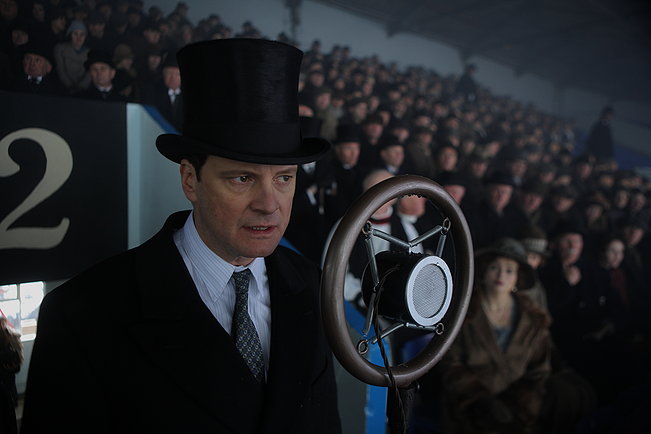
Bertie, played by Colin Firth, gives a speech at Wembley in the mid-1920s that goes awry due to his stammer.

The film centres on Bertie (Colin Firth – Bridget Jones’ Diary, Dorian Gray, Tinker Tailor Soldier Spy), the future King George VI of Britain (1936-52), who has a terrible stammer, and how he must overcome this stammer in order to compete with the other great orators of his era, such as Sir Winston Churchill and Adolf Hitler. When it becomes clear that his older brother, David (Guy Pearce – Memento, The Hurt Locker, Prometheus), the future King Edward VIII (abdicated in 1936), would rather marry Wallis Simpson (Eve Best), a twice-divorced American woman, than take up the throne, the necessity for Bertie to speak more eloquently becomes paramount. After-all, he is next in line.

After trying several therapists for years, Bertie turns to Lionel Logue (Geoffrey Rush – Pirates of the Caribbean I-IV, Shakespeare In Love) and his unconventional methods to help solve the problem. By taking us through stage-by-stage of Logue’s methods, the director, Tom Hooper (The Damned United, Les Misérables), ensures that we see Bertie’s tremendous struggle to complete a sentence without stuttering (something seemingly so effortless for the majority of us). However, we would not be able to realise just how frustrating and aggravating it must have been for Bertie if it weren’t for the exceptional performance of Colin Firth. Never before has an Adam’s Apple been so over-worked or scrutinised as in The King’s Speech.

Yet, it is not just Bertie’s consistent stammering that makes Firth’s act so memorable, but also how it affects Bertie’s general behaviour. Throughout the movie, the future George VI suffers from chronic diffidence. His speech impediment affects everything from the way he walks, talks and looks at people; to his need for emotional support from his wife, Elizabeth (Helena Bonham Carter – Fight Club, Harry Potter V, VI, VII(i) & VII(ii), Alice in Wonderland, Les Misérables), the future Queen Elizabeth II’s mother. And this does not even include his bad temper or his fears; most notably, public speaking. In a first-class display, Firth captures Bertie’s dread superbly as well as his character’s comprehension of the responsibilities of a monarch.

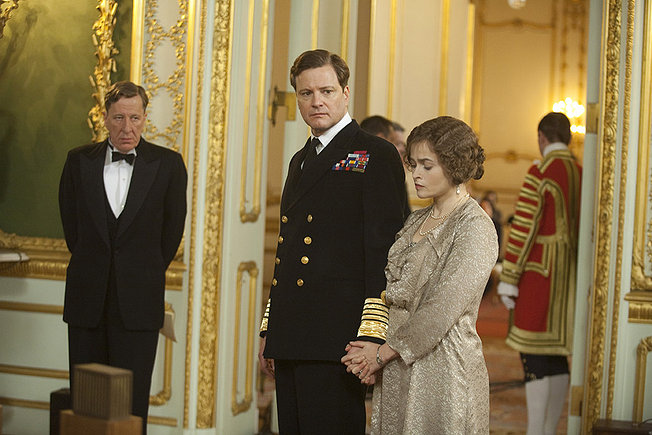
Anxiety reigns supreme as Lionel Logue (Geoffrey Rush), George VI and Elizabeth (Helena Bonham Carter) wait for the king to give his big speech not long after Britain declared war on Germany on 3rd September 1939.

Firth is undoubtedly the stand-out performer of the movie. But that is not to say that Geoffrey Rush or Helena Bonham Carter do the film a disservice. On the contrary, they play their roles very well: the former as the tolerant therapist with a wry sense of humour, who understands how best to deal with the king’s stammer; and the latter, as the supportive wife of a man who feels that he must triumph against all odds in order to carry out his duty as king.

Alas, The King’s Speech does not touch upon the gastric problem that Bertie endured throughout his life. It also wrongly portrays the relationship between Bertie and David. (Not to mention the one between Elizabeth and David too.) Since the film is based on real events (as opposed to a book or an urban legend), historical accuracy is important and is slightly lacking in the movie, even if it is regarding a relatively minor part of the story.

This, though, should not take too much away from The King’s Speech. The film is simple, original and outstanding. In addition, it is funny (albeit in a very English way) and engaging. The acting is fitting for Oscar nominations, and Firth’s ability to make us feel the pain that Bertie’s stammer caused him is right up there with the greatest of performances. That there is no fairytale ending to the film gives The King’s Speech greater credit and more than a twinkle of realism: it makes us appreciate how and why King George VI managed to win over the affections of millions across the world.

PG’s Tips

Review – The Way Back (12a) [2010]

Star Rating: 3/5

Travelling can often be long and boring, regardless of whether it is on a bus down the road or on an aeroplane across the world. Alas, despite one heck of a trek, one feels much the same whilst sitting through The Way Back.

The film is based on true events as described in the book, The Long Walk, by Slawomir Rawicz. (The book, however, has recently been proven to be a work of fiction.) The story centres on six men, who escaped from a Siberian gulag in the winter of 1940 and made their way south to India on foot. The distance alone sounds daunting to even the most determined of souls. The inhospitable terrain and harsh weather conditions make the task Herculean, if not outright impossible.

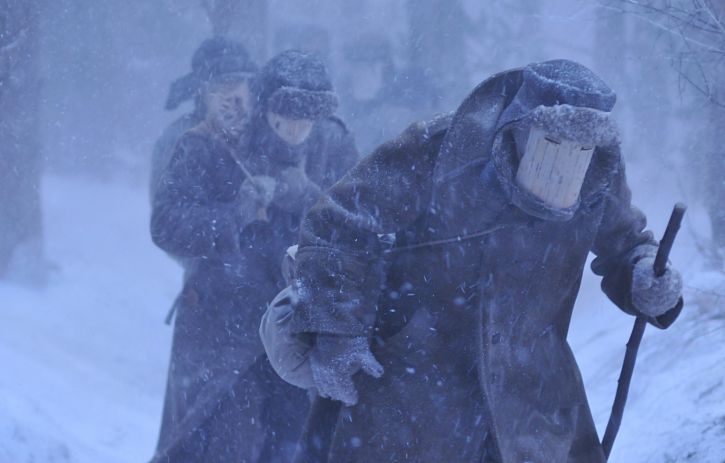
Janusz, played by Jim Sturgess, leads the way through the fierce snow storm. The blizzard is so strong they have to cover their faces in order to see where they're going.

The director, Peter Weir (Master and Commander: The Far Side of the World, The Truman Show, Gallipoli) certainly captures the difficulties the heroes face. From the bitingly cold, white desert of Siberia to the scorching heat of the Mongolian/Chinese one, the struggle to keep on going is vividly portrayed. The lack of food and water is a constant problem. Hunger, thirst, cold and skin problems are a constant reminder of the fragility of mankind against unforgiving mother-nature.

Yet, throughout the movie, one wonders what the goals of the main characters are. Once they have escaped, then what? One gets the impression that escaping from the gulag is the end in and of itself; which, of course, it cannot be.

An even greater travesty for The Way Back is that, whilst the acting is generally good, the key characters do not develop. Worse, Weir fails to make us empathise with the heroes. With the exceptions of the American ‘Mister’ Smith (Ed Harris – A Beautiful Mind, A History of Violence), the criminal Valka (Colin Farrell – Phone Booth, Miami Vice, SWAT), and Irena (Saoirse Ronan – Atonement, The Lovely Bones) for being a woman; the other characters do not stand out: Janusz (Jim Sturgess – Legend of the Guardians: The Owls of Ga’Hoole, 21, One Day), Tomasz (Alexandru Potocean – 4 Months, 3 Weeks, 2 Days, The Paper will be Blue), Zoran (Dragos Bucur – Tuesday After Christmas, The Godmother) and Andrei (Dejan Angelov – Scorpius Gigantus, Until Death) all seem to merge into the same kind-hearted character. Whilst benevolence in such situations is to be admired, it makes it hard to differentiate them; especially as they all look the same dirty, scraggy outlaws.

The accents are also disappointing. Apart from with Colin Farrell, there is little consistency in the actors’ Slavic accents. (Ed Harris uses his American accent throughout the film so is exempt from criticism.) For some of the time, their accents are surprisingly good. But just as one starts to believe that they could actually be Polish or Russian (depending upon where they claim to be from in the vast USSR), out pops their real accents to undo it all. One would have thought that an experienced director, like Weir, would have noticed this during filming. Evidently not.

The party have to endure seemingly endless baron planes during their trek. The baking-hot, sandy deserts of Mongolia and China are just as cruel as snowy Siberia.

Another noticeable thing about the main characters is that none of them make an attempt to violate Irena. This is more than a tad surprising considering that some of these men had been in the gulags for years, and so would not have had the company of a woman for equally as long. Also, bearing in mind the Red Army’s behaviour in Eastern Europe in the latter part of World War II, the characters’ disinterest in Irena appears wholly inaccurate within the historical context. (Not that I am condoning rape amongst former gulag prisoners, of course.)

One thing the film gets right, historically, is the way the gulags were run. Hardened criminals were virtually given carte blanche to terrorise other inmates; especially if they were political prisoners. In addition, the topography throughout the movie, which the National Geographic channel helped to choose, is wonderful.

However, whilst one can appreciate picturesque landscapes, a film that lasts more than two hours has to give its audience more to enjoy than mere terrain. Although The Way Back had to be long to ensure the audience grasps the extent of the distance the main characters walked; not enough happens to them to sustain the viewers’ interest and concentration. Ironically, one comes out of this film thinking that, despite witnessing a journey from Siberia to India, they had not seen much.

PG’s Tips