Category Archives: Based on Real Events

Review – The Iron Lady (12a) [2012]

Star Rating: 3/5

Dementia is a cruel infliction that eats away at what an individual once was. (Lady) Margaret Thatcher, British Prime Minister 1979-90, was a formidable and highly intelligent woman in her day. Yet, rather than focus on her prime, The Iron Lady highlights the crippling effects that the illness has had on Lady Thatcher in her more recent years.
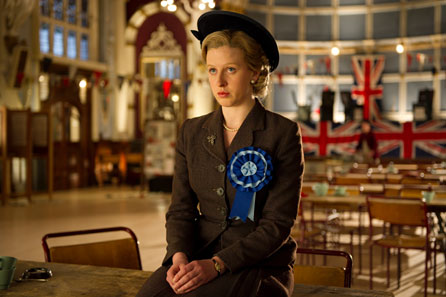
‘Young Margaret’ (Alexandra Roach) standing for election in Dartford (in 1951). She was then the only female Conservative candidate across the country.

The film is about Lady Thatcher (when young played by Alexandra Roach – Private Peaceful; when middle-aged and old played by Meryl Streep – Sophie’s Choice, The Devil Wears Prada, Suffragette), elderly and suffering from delusions and dementia, glimpsing back, at random, at the happy and distressing moments of her life, before she attends the ceremony of the unveiling of her portrait at the Prime Minister’s house.

The movie’s plot is simple, but is not necessarily easy to follow. This is because whenever Lady Thatcher looks back into the past, she does not do so in chronologically and there is nothing to inform viewers of the year they’re watching. Even for those who are historically fine-tuned, this can be confusing. Factually, The Iron Lady is generally accurate; yet, there are several brushes of artistic license in the movie, such as the timing of Denis Thatcher’s (when young played by Harry Lloyd – Jane Eyre, A Game of Thrones, Junk; when old played by Jim Broadbent – Gangs of New York, Harry Potter VI & VII(ii), Cloud Atlas) proposal.
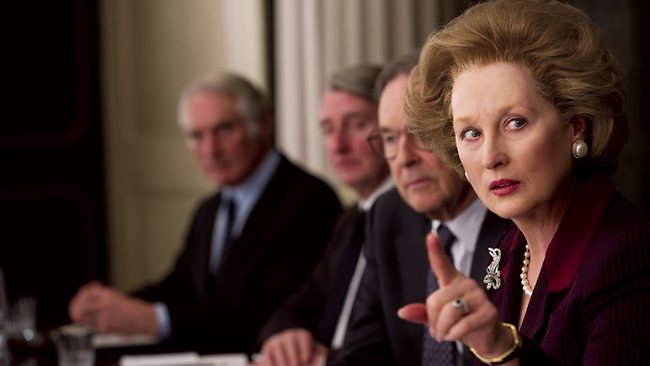
Thatcher, as Prime Minister, in a cabinet meeting, telling a colleague that it is not his time to speak.

More than anything, the storyline’s approach undermines Lady Thatcher. It undermines her as a person, her ideology (the idea that the individual should not depend upon the state and that he/she should determine his/her destiny), and all that she did for the country and for women across the world. First, at 105 minutes, The Iron Lady is too short, since more time was needed for director Phyllida Lloyd (Mama Mia!, Macbeth) to have adequately visualised Thatcher’s life before and after she became a politician. Second, for a woman who sacrificed so much for politics, the film stresses astoundingly little on Thatcher’s rise to the premiership, as well as her time in ten Downing Street and her fall from office. That much of her time in office in the movie is dominated by her hardline policies towards cutting public spending; beating back rioters; and the wars against Argentina, over the Falkland Islands, and the IRA (terrorism), has a familiar chime, as if Ms. Lloyd was trying to (not-so-subtly) force her own views of the current Coalition government upon viewers. Third, to have Lady Thatcher remembering her life via flashbacks, among delusions of her late husband was callous and insensitive; especially, as the former Prime Minister is still alive. If anything, it makes even those who despise Lady Thatcher pity her. (Whoever would have thought that the die-hards on the Left would feel sympathy for Thatcher?)

Irrespective of the plot, there is an exceptional performance from Meryl Streep, which makes The Iron Lady worth watching in and of itself. Throughout the movie, Streep seemingly morphs into Lady Thatcher to the extent that one is likely to forget that they’re not watching the real person.
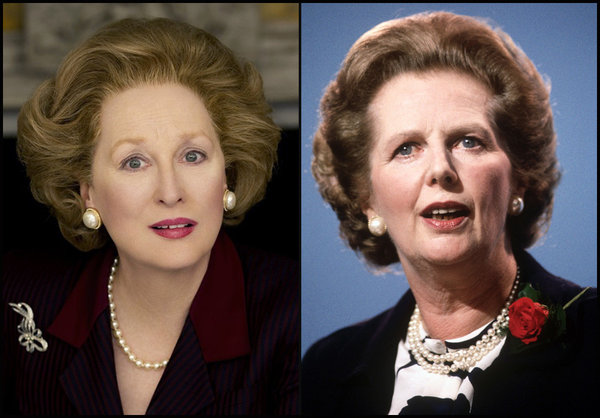
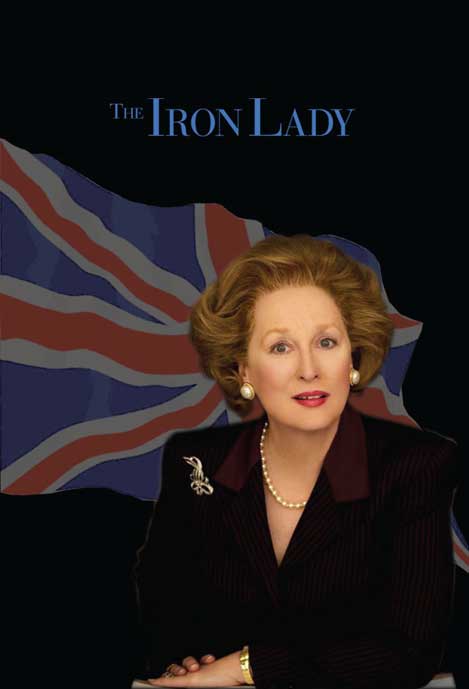
Thatcher in her heyday (right), and Meryl Streep (left) as the brilliant look-alike.

It is a shame for Streep that the supporting cast cannot match her display. Alexandra Roach, as ‘young Margaret’, is distinctly average, as are the two actors who play Denis Thatcher, Harry Lloyd and Jim Broadbent. The rest of the cast, particularly Anthony Head (Buffy The Vampire Slayer, The Inbetweeners Movie, Ghost Rider II: Spirit of Vengeance) and Richard Grant (Twelfth Night, Corpse Bride, Zambezia), impersonating Thatcher’s ministers Geoffrey Howe and Michael Heseltine, respectively, play poorly with the little time they have on screen. Head and Grant do not capture their characters’ personalities accurately. Both actors appear as cowardly critics (with eyes brimming with hawkish ambition) of their leader’s policies at times of supposed crises, and Grant also fails to give Heseltine the ego that drove him to resign as Defence Minister in 1986 and challenge for party leadership in 1990.

All-in-all, Margaret Thatcher was a formidable individual in her day. She was, and still is, a highly polarising figure for many a reason. Therefore, one would expect a biographic film to be about her achievements and shortcomings as a leader, and perhaps a bit about her legacy too. Yet, The Iron Lady shows relatively little of these, preferring instead to let us watch and pity an elderly lady no longer in complete control of her mind. Despite a phenomenal performance from Streep, the film would be an insult to any human being, let alone one of the calibre of Lady Thatcher.

PG’s Tips

Review – My Week With Marilyn (15) [2011]

Star Rating: 2.5/5

Upon seeing the title My Week With Marilyn, one would think it was about a week that an individual spent alone with the mother of all blondes. Yet, the title, like Marilyn Monroe herself, is deceiving. The film is interestingly about Marilyn, and the person behind the icon who, in her day, took Hollywood by storm.

Colin Clark (Eddie Redmayne) taking Lucy (Emma Watson) on a date. Soon Lucy has to compete for Colin’s affection with someone far more glamorous.

The movie is based on true events and on the diary that a twenty-three year man wrote about his week-long affair with Marilyn when she came to England to shoot the film The Prince & The Showgirl in 1957. Colin Clark (Eddie Redmayne – The Other Boleyn Girl, Black Death, Les Misérables) is an Eton-educated young adult, who wants to make his living as a film director, despite his parents’ disapproval. Shortly after moving to London, he gets a job as a third-assistant director, otherwise known as a ‘go-getter’, to Sir Lawrence Olivier (Kenneth Branagh – Henry V, Valkyrie, Wallander) as the latter acts and shoots the film, The Prince & The Showgirl. The movie stars Marilyn Monroe (Michelle Williams – Brokeback Mountain, Shutter Island, Oz: The Great & The Powerful) as Elsie.

Marilyn is problematical on set, which tries Olivier’s patience considerably. As she is frequently late for filming, Olivier regularly sends Colin to find out if she is ill or not. It is from this that a week long relationship develops between an awe-struck Colin and Marilyn.

The plot for My Week With Marilyn is straightforward. The pace of the film moves surprisingly quickly, as the scenes change one after the one rapidly. Yet, the storyline doesn’t really go anywhere. Consequently, the movie fast becomes tedious, making the ninety-nine minutes appear (aggravatingly) longer. That the dialogue, for the most part, is quite contrived does not aid the film either.

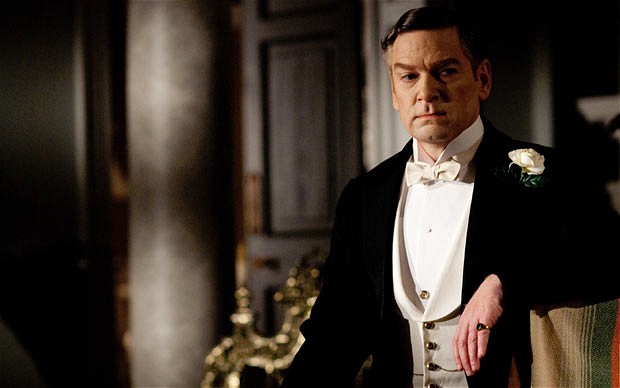
Sir Lawrence Olivier (Kenneth Branagh) impatiently waiting for the perennially late Marilyn Monroe before he can begin filming. Frustration frequently gets the better of him.

Nevertheless, there are some strong performances in My Week With Marilyn, such as Judi Dench (Shakespeare In Love, Notes On A Scandal, Skyfall), Michelle Williams and Kenneth Branagh. Whilst Dench, as ever, plays her standard M-/Queen Elizabeth-type role with authority, Williams captures Marilyn Monroe brilliantly, highlighting her character’s insecurities, her alcohol and drug addictions, and her unhappy marriage with the author, Arthur Miller (Dougray Scott – Deep Impact, Mission: Impossible II, Last Passenger). Yet, at the same time, Williams also shows Marilyn to be witty, intelligent and encapsulating. From Williams’ performance, one can easily see why Marilyn was the sex-object of her day, captivating to watch and far from dumb.

In a similarly decent display, Branagh illustrates the reasons for why Olivier made the movie, The Prince & The Showgirl in 1957. Fearing that the British film industry was falling behind Hollywood (and trying to revive his own acting career), bringing in Marilyn was his way of trying to deal with the problem. Olivier’s apparent exasperation with Marilyn was not born out of her tardiness on set, but rather by his own fears that he was ‘past it’ (and that Marilyn was the glamorous future). Again, Branagh portrays all of this solidly, if not with excellence.

However, whilst the acting from those three characters is worth watching, the same cannot be said for Eddie Redmayne, Emma Watson (Harry Potter I-VII(ii), The Perks Of Being A Wallflower) and Dominic Cooper (Captain America: The First Avenger, The Devil’s Double, Abraham Lincoln: Vampire Hunter).  As the central character, Redmayne gives a weak performance. One does not believe that Colin is in awe of Marilyn throughout the film (much less that he’d worship the ground she walks on), which is a terrible failure on Redmayne’s behalf considering what the movie’s supposed to be about.

Marilyn Monroe (Michelle Williams) playing up to her English audience by doing her trademark pose. No doubt, her fans were dumbstruck by it.

Likewise, Watson (again) flatters to deceive. Her character in the film may not be the inflexible rod that is Hermione Grainger in the Harry Potter series; nevertheless, Watson still comes across as uptight and two-dimensional. (Although, the lack of depth could be attributed more to director Simon Curtis than her.) As for Cooper, his performance as Marilyn’s aid is a great dip in comparison to his displays in The Devil’s Double. In that movie, there was intensity and consistency to his performances as Uday Hussein and Latif Yahia, not least in the Arabic accent. In My Week With Marilyn, Cooper’s character is pathetically shallow and his American accent is poor, often reverting to his normal English, south-London accent.

The acting may vary in quality, but one aspect of the film that cannot be questioned is the character’s 1950s-style clothing, hairstyles and gear. Nothing looks out of place, especially the ridiculously large cameras that the journalists carry. (Whether movie stars were harassed by the populous and the media in the 1950s like they are today is dubious. Then again, Marilyn was not the average celebrity either.)

Over-all, My Week With Marilyn is oddly fast-moving but dull; boring even. The bright spot for the film is undoubtedly Michelle Williams’s reincarnation of Marilyn Monroe. Williams brings forth all the troubles and qualities that her character possessed, illustrating that those who thought (or still think) that Marilyn was nothing more than an air-headed blonde were the real fools.

PG’s Tips

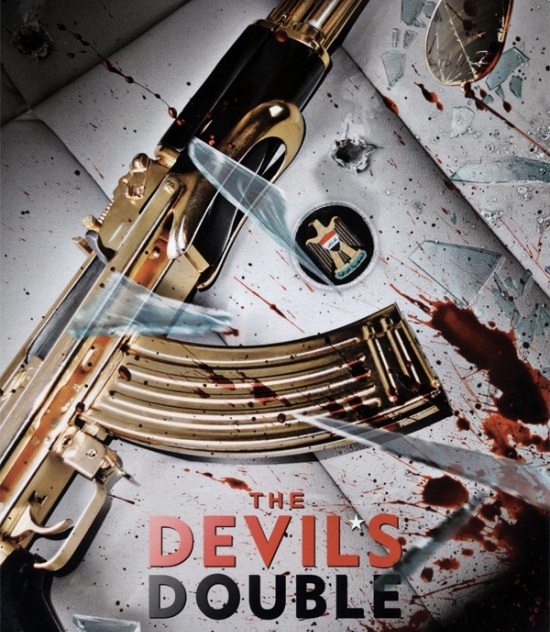
Review – The Devil’s Double (18) [2011]

Star Rating: 3/5

It is common for dictators and those close to them to have doubles (look-alikes), so that they can be in two places at once. (Not to mention making it harder for their opponents to assassinate them). But what exactly do ‘doubles’ do with their days? Well, The Devil’s Double gives viewers a brutal hint.

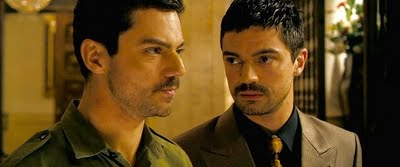
Latif with Uday before he has some minor surgery. Thw two men bear a striking resemblance. After surgery, the two men could be identical twins.

The film is based on the true (but embellished) story of how Latif Yahia (Dominic Cooper – Tamara Drewe, Captain America: The First Avenger, My Week With Marilyn) became a look-alike for Uday Hussein (also Dominic Cooper), the son of Saddam Hussein, the President (dictator) of Iraq, 1979-2003. The film is set between the late-1980s (during the latter years of the Iran-Iraq War, 1980-88) and up to December 1996.

Latif bears a striking resemblance to Uday. After some nasty threats and lashes, Latif agrees to become Uday’s double. Subsequently, Latif, to his disgust (and knowing that he could be shot on a whim at any moment), enters into Uday’s world of sadism, debauchery, drugs and murder. At what point will the ‘nice guy’ Latif draw the line?

The Devil’s Double makes for some gripping, if horrific, viewing. But, most noticeably, the film does not have much of a storyline. More often than not, scene after scene is just Latif following Uday to witness the latter’s next appalling act. Surprisingly though, this does not make the film any less absorbing to watch.

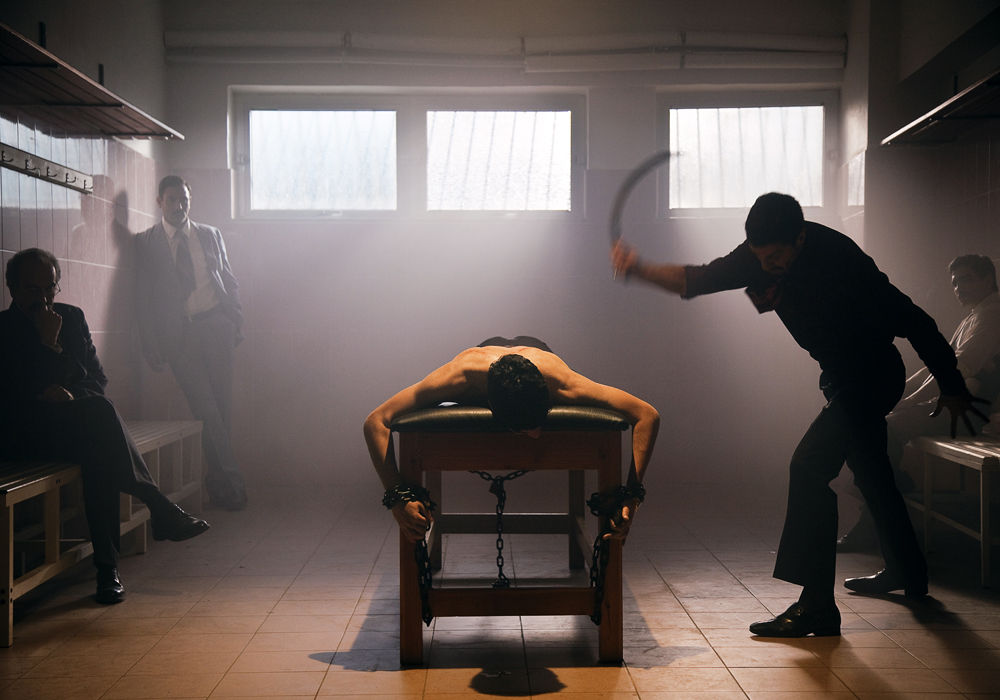
Latif being punished for not initially agreeing to become Uday's double.

The key reason for the movie being so engrossing is Dominic Cooper. The choreography may be jerky; the music may sound cheap and not totally in sync with the scenes; and the women may look distinctly Western and non-Arabic. Yet, particularly as Uday, Cooper makes the audience feel that their money has not been wasted. As Uday, Cooper plays an insane (in the true sense of the word), volatile, spoilt brat with an insatiable appetite for alcohol, drugs, women (of all ages) and malice. In almost every scene, Uday appears drunk, high and unpredictable. Uday makes us feel uneasy every time he appears on screen, which is a testament to Cooper’s acting abilities.

There is no doubt that Cooper plays well as Uday. But his performance is not quite in the same league as Christian Bale’s in The Fighter. This is because in The Devil’s Double, Uday is not given a third dimension. Also, from the film, one has little idea what Uday’s upbringing was like, or what his relationship was like with his father (which was apparently not great) and mother (whom he was supposedly close to), amongst other things. This is a real pity, as this could have shown Uday in a chillingly human light, as opposed to the animal that he is portrayed to be throughout the movie.

Whilst as Uday, Cooper is impressive, he is less so as Latif. This might be because Latif is too nice and normal relative to Uday. Nevertheless, one does not feel much sympathy for Latif, or his predicament. In this respect, Cooper could have done better. Then again, just as Uday has not been given much depth, nor has Latif. This is not Cooper’s fault. Rather, it is the fault of the director, Lee Tamahori (Die Another Day, xXx 2: The Next Level, Next), who should have given his two main characters more depth, even at the expense of making the film a little longer. At only 106 minutes, he had the time to do this.

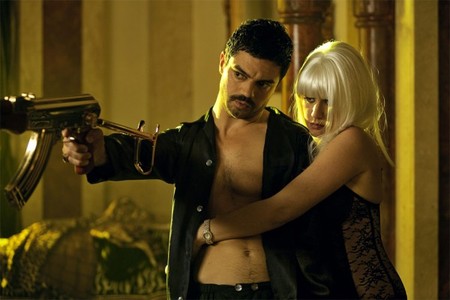
A common sight throughout the film - Uday holding a gun threateningly, with a girl (or two) around his waist. The girl here is Serrab (Ludivine Sagnier), supposedly his favourite.

Just as Uday and Latif lack complexity, so too do the other characters in The Devil’s Double, such as Munem (Raad Rawi – The Kingdom, Green Zone, Conan the Barbarian) and Kamel Hannah (Mem Ferda – Revolver, Legacy: Black Ops, Ill Manors), who are supposedly part of Saddam’s cruel regime. Too many of them, though, appear as ‘good guys in bad positions,’ which could not have been true. Repressive governments don’t exist because they’re packed with ‘good people’ under an ‘evil’ despot. Rather, they survive because they’re filled with murderous psychopaths, who are given positions to abuse (until they become victims of the system, of course). By doing this, Tamahori shamefully forsakes the chance to illustrate the true realities of Saddam Hussein’s Iraq to the detriment of the movie.

All-in-all, The Devil’s Double may be crude and the epitome of its own title, but it gives us a glimpse of what life as a double to a nasty, sadistic individual could be like. Almost by himself, Dominic Cooper, playing two very different people, makes this utterly brutal film worth watching. The Devil’s Double is not one for the feint-hearted, and will leave even the strongest of people feeling uncomfortable by the end.

PG’s Tips

Review – The Fighter (15) [2011]

Star Rating: 4.5/5

‘Why do we fall down, Bruce? So we can learn to pick ourselves up.’ Thomas Wayne may have asked his son this question in Batman Begins; yet, the question (and subsequent answer) is an equally valid motto for another excellent movie: The Fighter.

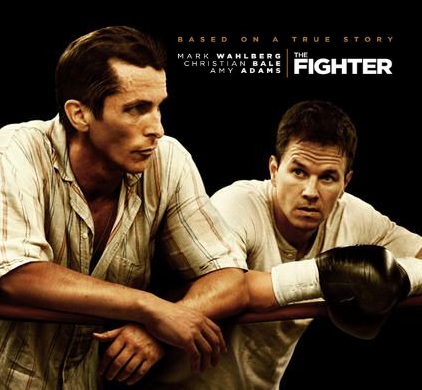
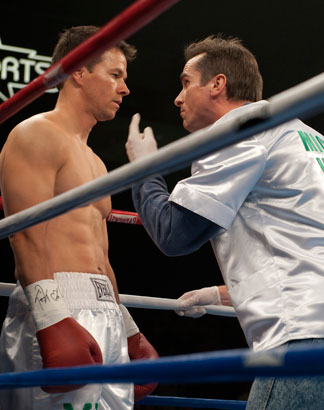
The Fighter is based on a true story. Mickey Ward (Mark Wahlberg – The Lovely Bones, The Italian Job, We Own The Night) comes from a deprived area in Lowell, Massachusetts. He is a street-sweeper by trade and an aspiring boxer on the side, struggling to make an honest buck. Mickey has been taught everything he knows by his older brother, Dickey (Christian Bale – The Machinist, The Dark Knight, 3:10 To Yuma), who is an ex-boxer that never quite made it big. In recent times, Dickey has become a crack-addict. As much as he is Mickey’s best aid, Dickey is also his brother’s greatest liability. Mickey’s mother and manager, Alice (Melissa Leo – Hide and Seek, Conviction, Red State), as well as the rest of this family (possibly minus his father), are not much better either.

Mickey does and, simultaneously, does not have the right kind of support. His confidence is low; he hasn’t done well in his previous fights. He’s struggling. It’s only after he meets Charlene (Amy Adams – Catch Me If You Can, Enchanted, The Master), a not unattractive college drop-out with little going for her; takes a battering against a boxer with twenty pounds more muscle on him; and after he recovers from a broken hand, that Mickey’s fortunes begin to change for the positive. But it does not come without an immense amount of hard work and sacrifice.

The plot may not move at breakneck speed, but it is still quite inspiring and entertaining. The quality of the acting by Mark Wahlberg, Amy Adams and Christian Bale is undoubtedly the best feature of the film. Due to Wahlberg’s performance, one has little difficulty empathising with Mickey. Wahlberg wonderfully captures the timidity of a humble person that suffers from low confidence and dejection, without being melodramatic. Likewise, Wahlberg maintains his character’s dignity admirably when he regains his self-assurance. This is no easy feat. Why Wahlberg was not nominated for an Oscar is a mystery.

One who was nominated for an Oscar is Amy Adams. Here, she plays the role of Mickey’s highly supportive girlfriend splendidly. Charlene has her issues as well, buttressing Adams’ performance because it makes her act more realistically. The only thing that works against Adams is that Charlene does not have an overly challenging personality. This may stop Adams from an Oscar triumph.

The same cannot be said for Christian Bale’s acting in The Fighter. In arguably his finest performance yet, Bale outshines his co-stars. When he’s not on-screen, one almost wishes him to return as he is that good. One could feasibly believe that Bale is a drug-addict from this movie, such is the intensity and energy he puts into the role. (And this is saying something for a man who has played many diverse roles extremely well throughout his career.) If he wins an Oscar for Best Supporting Actor, it will be fully justified.

The cast could not have acted so well without brilliant scripts. For this, credit must go to the script-writer, Scott Silver (8 Mile), and the director, David O. Russell (Three Kings). The scripts may not be as elegant and witty as that in The King’s Speech, or as intelligent as that in True Grit. Still, the dialogue between the characters in The Fighter is indicative of the environment from which Mickey, Dickey and Charlene come from, and, therefore, gives the movie a greater sense of realism.

Charlene (Amy Adams) at the bar where she meets Mickey.

If one were to be ruthless, one could argue that the choreography and the music in The Fighter were not as sublime as the above films. Some scenes did not flow as smoothly as they could have done; and, with regards to the feel-good factor, the music here was not as uplifting as the scores in The King’s Speech. Similarly, it is also a shame for the director that the cinematography could not have been as beautiful as in other films (for example The Way Back), since The Fighter is shot in depressing neighbourhoods. This should not, theoretically, take anything away from the film. Nevertheless, seeing miserable areas is not as aesthetically pleasing as picturesque landscapes. Again though, this is being very harsh (and semi-unfair) on the director.

All-in-all, The Fighter, despite some minor defects, is a fantastic film and has a cast worthy of their nominations; Bale particularly so. The movie also has plenty of moral messages. It illustrates how bad environments can hinder one’s progress and shows us the possible results of drug addiction. But most importantly of all, The Fighter emphasises that when one gets knocked down by life’s challenges, one has to learn how to stand up again and fight on.

PG’s Tips

Review – Sanctum 3D (15) [2011]

Star Rating: 3.5/5

Sanctum had the potential to be a disaster to the point when the cast, director and producers alike would have attempted to revise the fact that they had been apart of the film. But Sanctum is not a catastrophe movie and it is surprisingly gripping.

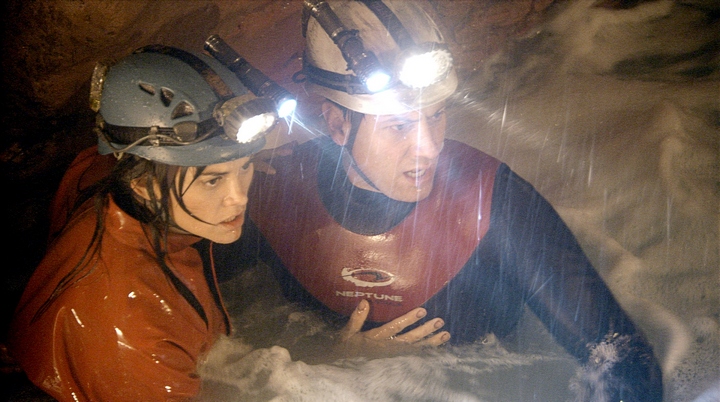
Victoria and Carl begin to panic as they realise that they are trapped and the cave is flooding.

The film is ‘inspired’ by true events. (What this means is anyone’s guess.) A group of cave divers attempt to see the last unknown, underwater cave in the world in Papa New Guinea. The divers, led by Carl the manager (Ioan Gruffudd – Titanic, King Arthur, Fantasic Four I & II), Frank (Richard Roxburgh – Mission Impossible 2, Moulin Rouge, Van Helsing), Josh (Rhys Wakefield – Home and Away, The Black Balloon), George (Dan Wyllie – Chopper, Animal Kingdom) and Victoria (Alice Parkinson – Where The Wild Things Are, X-Men Origins: Wolverine, The Pacific) are slowly but surely revealing the depths of the cave. That is until a storm breaks out above them. Before they know it, the cave is flooding. They are trapped. The only way out is down. Down, through previously unexplored areas.

The plot for Sanctum is simple and fairly predictable. We know that not everyone is going to survive, so it is just a question of who is next to fall. Yet, because the acting is terribly wooden and the dialogue is poor; it is hard to empathise or like any of the main characters. Their predicaments, and the way they behave in certain situations, seem quite realistic. Under such circumstances, survival is the only thing that matters. Everything else goes by the wayside and there is no time for sentiment. Nevertheless, the more the main characters try to be serious, the more pitifully amusing they become. (Also, why is it that the ‘good guys’ in the film never need food or water; but the ‘bad guys’ do?)

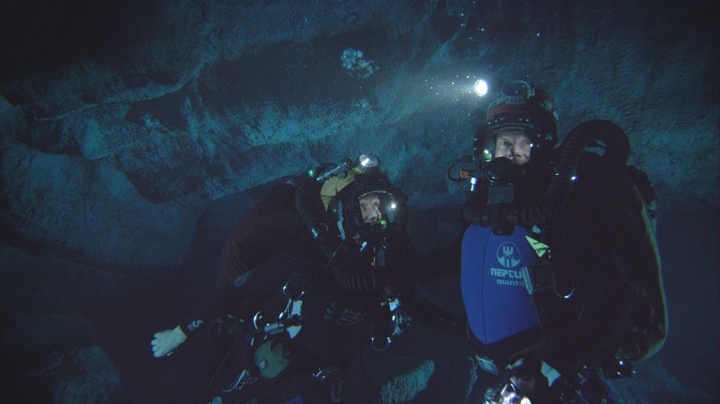
Carl, left, and Frank, right, stay still for a moment to let the others catch up. Behind them, one gets a glimpse of the awesome underwater scenery that is prevalent throughout the film.

The acting, though, was never going to be Sanctum’s attraction. As a thriller, one hopes to feel one’s heart pounding against the chest. While the film takes a bit of time to get going (even though the film is not particularly long), Sanctum achieves this. That the characters go through tight spaces underwater makes one feel claustrophobic; unsettling one almost to the point of panic. (Especially if one does not like being stuck in a small space.)

The 3D feature of the movie has the further effect of making the audience feel as trapped as Frank, Carl, Josh, George and Victoria. This is in no small part due to the executive producer, James Cameron (Titanic, Avatar I, II & III). Just like in his last film, Avatar, Cameron successfully exploits the 3D effects to make one feel like they are in the predicament of those they are watching. In addition, his 3D images of the caves are stunning; seductive enough to make one believe that the potentially fatal dangers of cave digging/exploring are non-hazardous and worthwhile.

Arguably, the visuals and the 3D effects in Sanctum, to a degree, make up for what is lacking in the acting department. The director, Alister Grierson (Kokoda: 39th Battalion), and Cameron make the most out of a bland storyline; and turn it into an unexpectedly entertaining and nerve-shredding movie.

PG’s Tips

Review – 127 Hours (15) [2011]

Star Rating: 4/5

‘Caught between a rock and a hard place’ – we’ve all heard the metaphor at some point in our lives. Usually, it is adopted at a moment of indecisiveness or prevarication. For some of people, the phrase may even define their personality. But in July 2003, Aron Ralston discovered its literal meaning and 127 Hours brings to light his remarkable story in great detail.

Aron, played by James Franco, enjoying a stroll in the Grand Canyon. Little does he know that a slight loss of balance is going to change his life forever.

In the summer heat, Aron Ralston (James Franco – Spiderman I, II & III, Your Highness) goes for a cycle and a hike in the Grand Canyon. Since Aron is a guide, he knows the terrain well. He climbs, jumps and walks around as if he owns the place until a small slip sends him tumbling several metres down a narrow gap in the ground. Worse, a boulder falls with Aron and virtually cements his arm between it and the rocky wall. Aron is stuck and very-much alone. He has little food and water, and no means of contacting the outside world. For one hundred and twenty-seven hours (over five days), Aron remains there until the fear of death forces him to make the painful sacrifice of cutting off his trapped arm with a mere pen-knife (and no anaesthetic!) so as to carry on living.

The plot may sound uneventful as more than an hour of the film is based round a man stuck in a still, but frightening situation. Yet, that is far from true. One watches with anticipation what Aron will do in an attempt to move the bolder. Indeed, some of the innovations he comes up with are very intelligent. That he does these things without the use of a hand makes them all the more impressive.

However, 127 Hours would not be half as decent if it were not for James Franco. Franco illustrates here that he has matured as an actor since his semi-pitiful displays in the Spiderman movies. In this film, it is almost solely up to him to keep the audience stimulated for over ninety minutes, and he easily achieves this. Franco superbly portrays Aron before and, especially, after the fall. The all-too-real look of horror in his eyes when he initially realises the depth of his predicament is one that few will forget in a hurry. The different stages he goes through, before doing the unthinkable, are also very interesting.

Franco’s performance is utterly realistic and the tribute for giving him this platform must go to the director, Danny Boyle (Slumdog Millionaire, The Beach, Trance). One scene in particular, although gory to the point of making one want to vomit (unless one is used to watching the Saw series), is done exceptionally well and with graphic detail.

Aron feeling down and helpess as he can’t move the boulder that has trapped his right arm.

Yet, Boyle also lets himself down a bit. One needs to be brave to make a film like this (especially if he/she wants to make a handsome profit); but, unfortunately, Boyle lacked the courage of Rodrigo Cortés, the director of Buried (which is literally about Ryan Reynolds in a coffin for ninety-odd minutes with a lighter and a mobile phone.) By putting in music and other noises whilst Aron is jammed, Boyle takes away some of the realism in 127 Hours because this would not have happened.

Another criticism of the movie is that one never gets a sense of just how long, boring and lonely it must have been for Aron during those one hundred and twenty-seven hours. One may see the sun rise and fall a few times, or watch Aron gradually run out of water or reminisce over and over again about the mistakes he’s made in his life; but this only captures the length of time he was stuck there for on a superficial level.

Nevertheless, despite these flaws, 127 Hours is entertaining and Franco’s acting fully justifies the nominations that he’s been lined up for. The movie is also truthful and has a nice pseudo-religious dimension to it. Above-all, 127 Hours shows us that, even when caught between a rock and a hard place, mankind’s resilience is extraordinary.

PG’s Tips

Review – The King’s Speech (12a) [2011]

Star Rating: 4.5/5

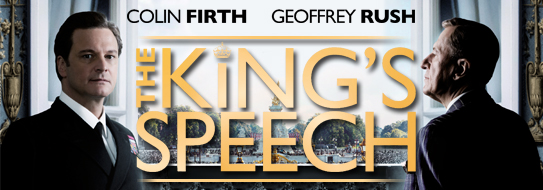
The term ‘born for greatness’ is one often used to describe the life of king. Nevertheless, it is a vague term: one that does not give a remote hint to the strains and struggles that comes with achieving great feats. The King’s Speech illustrates a form of such a challenge with the brilliance of a masterpiece.

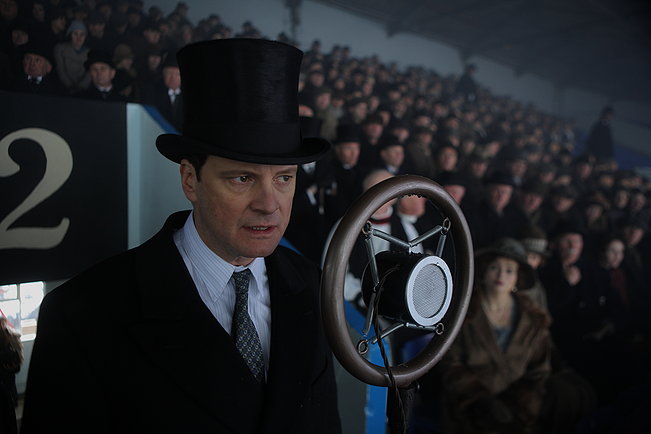
Bertie, played by Colin Firth, gives a speech at Wembley in the mid-1920s that goes awry due to his stammer.

The film centres on Bertie (Colin Firth – Bridget Jones’ Diary, Dorian Gray, Tinker Tailor Soldier Spy), the future King George VI of Britain (1936-52), who has a terrible stammer, and how he must overcome this stammer in order to compete with the other great orators of his era, such as Sir Winston Churchill and Adolf Hitler. When it becomes clear that his older brother, David (Guy Pearce – Memento, The Hurt Locker, Prometheus), the future King Edward VIII (abdicated in 1936), would rather marry Wallis Simpson (Eve Best), a twice-divorced American woman, than take up the throne, the necessity for Bertie to speak more eloquently becomes paramount. After-all, he is next in line.

After trying several therapists for years, Bertie turns to Lionel Logue (Geoffrey Rush – Pirates of the Caribbean I-IV, Shakespeare In Love) and his unconventional methods to help solve the problem. By taking us through stage-by-stage of Logue’s methods, the director, Tom Hooper (The Damned United, Les Misérables), ensures that we see Bertie’s tremendous struggle to complete a sentence without stuttering (something seemingly so effortless for the majority of us). However, we would not be able to realise just how frustrating and aggravating it must have been for Bertie if it weren’t for the exceptional performance of Colin Firth. Never before has an Adam’s Apple been so over-worked or scrutinised as in The King’s Speech.

Yet, it is not just Bertie’s consistent stammering that makes Firth’s act so memorable, but also how it affects Bertie’s general behaviour. Throughout the movie, the future George VI suffers from chronic diffidence. His speech impediment affects everything from the way he walks, talks and looks at people; to his need for emotional support from his wife, Elizabeth (Helena Bonham Carter – Fight Club, Harry Potter V, VI, VII(i) & VII(ii), Alice in Wonderland, Les Misérables), the future Queen Elizabeth II’s mother. And this does not even include his bad temper or his fears; most notably, public speaking. In a first-class display, Firth captures Bertie’s dread superbly as well as his character’s comprehension of the responsibilities of a monarch.

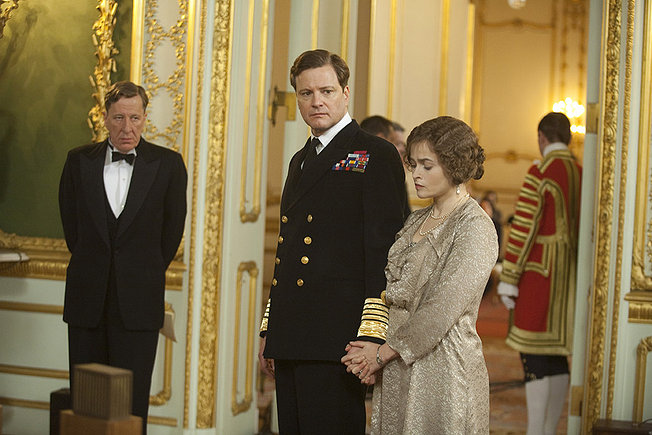
Anxiety reigns supreme as Lionel Logue (Geoffrey Rush), George VI and Elizabeth (Helena Bonham Carter) wait for the king to give his big speech not long after Britain declared war on Germany on 3rd September 1939.

Firth is undoubtedly the stand-out performer of the movie. But that is not to say that Geoffrey Rush or Helena Bonham Carter do the film a disservice. On the contrary, they play their roles very well: the former as the tolerant therapist with a wry sense of humour, who understands how best to deal with the king’s stammer; and the latter, as the supportive wife of a man who feels that he must triumph against all odds in order to carry out his duty as king.

Alas, The King’s Speech does not touch upon the gastric problem that Bertie endured throughout his life. It also wrongly portrays the relationship between Bertie and David. (Not to mention the one between Elizabeth and David too.) Since the film is based on real events (as opposed to a book or an urban legend), historical accuracy is important and is slightly lacking in the movie, even if it is regarding a relatively minor part of the story.

This, though, should not take too much away from The King’s Speech. The film is simple, original and outstanding. In addition, it is funny (albeit in a very English way) and engaging. The acting is fitting for Oscar nominations, and Firth’s ability to make us feel the pain that Bertie’s stammer caused him is right up there with the greatest of performances. That there is no fairytale ending to the film gives The King’s Speech greater credit and more than a twinkle of realism: it makes us appreciate how and why King George VI managed to win over the affections of millions across the world.

PG’s Tips

Review – Unstoppable (12a) [2010]

Star Rating: 4/5

A film about a runaway freight train was never going to be a classic. Like The Taking of Pelham 123, Speed and Gone in Sixty Seconds, to mention three of countless such films, one could only hope that this film would be entertaining and nerve-racking. It is both!

When I first saw the trailer for Unstoppable, it reminded me of an episode from Thomas The Tank Engine, entitled The Runaway. As a kid, seeing Thomas steaming away without his driver and fireman made my heart pound every time. Except, this film is not about a little tank engine with two coaches running down a harmless train line. Unstoppable is based on true events about an unmanned monster freight-train, half a mile long, travelling at such a speed it can demolish anything in its wake. Worse, it is coupled to wagons containing highly inflammable/explosive materials, going through populated areas and heading straight towards a curve at Stanton, a densely populated town in southern Pennsylvania. Worse still, a group of school-children heading for a field trip, are on the same line as the runaway train heading for a collision!

Will and Frank on a siding trying to work out how they are going to stop the train

If the situation is not enough to put one on edge; the director, Tony Scott (Top Gun, The Taking of Pelham 123, Stoker), constantly changes scenes back and forth during conversations between officials, managers and the main characters to induce further panic into the audience. The fast-beats, the crescendos and the sudden silences ensure that viewers will never take their eyes of the screen.

Unlike the plot and the music, the acting is not as dramatic. Indeed, one thing that should be noted is how un-melodramatic and realistic the acting is. Frank (Denzel Washington – American Gangster, The Inside Man) and Will (Chris Pine – Star Trek I & II, This Means War), as normal railway drivers, do not have the most challenging of roles. Yet, they play them well without reverting to cringe-worthy clichés. Despite understanding the gravity of the situation, and reacting to it in the best way they feel they can; Frank and Will spare some time for banter and heart-to-heart conversations. After-all, what else can they do in their train’s cabin whilst they hurry along the line to try and catch the monster freight-train?

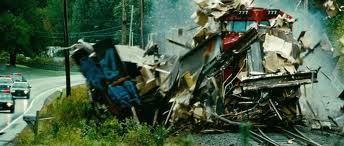
Nothing gets in the way of the monster runaway train.

The realism of their roles is similarly reflected by the behaviour of their manager, Connie (Rosario Dawson – Sin City, Trance), who wants to save as many lives as possible; and her boss, Galvin (Kevin Dunn – Transformers), who has several factors to take into account, such as commercial, financial, damage to infrastructure and, lastly, human life. Connie and Galvin are constantly on the phone to one another (as well as to Frank), trying to solve the problem as to how to stop the train. Whilst on the phone, they speak in a relatively cordial manner; off the phone, the number of expletives they shout about one another is both realistic and funny. Indeed, one could imagine this occurring in an office in an under-pressure situation.

The realistic elements to the film, the music and the plot make for easy and entertaining viewing. By no means is Unstoppable a five-star film; but one’s adrenaline will be doing overtime long before the end of the movie.

PG’s Tips