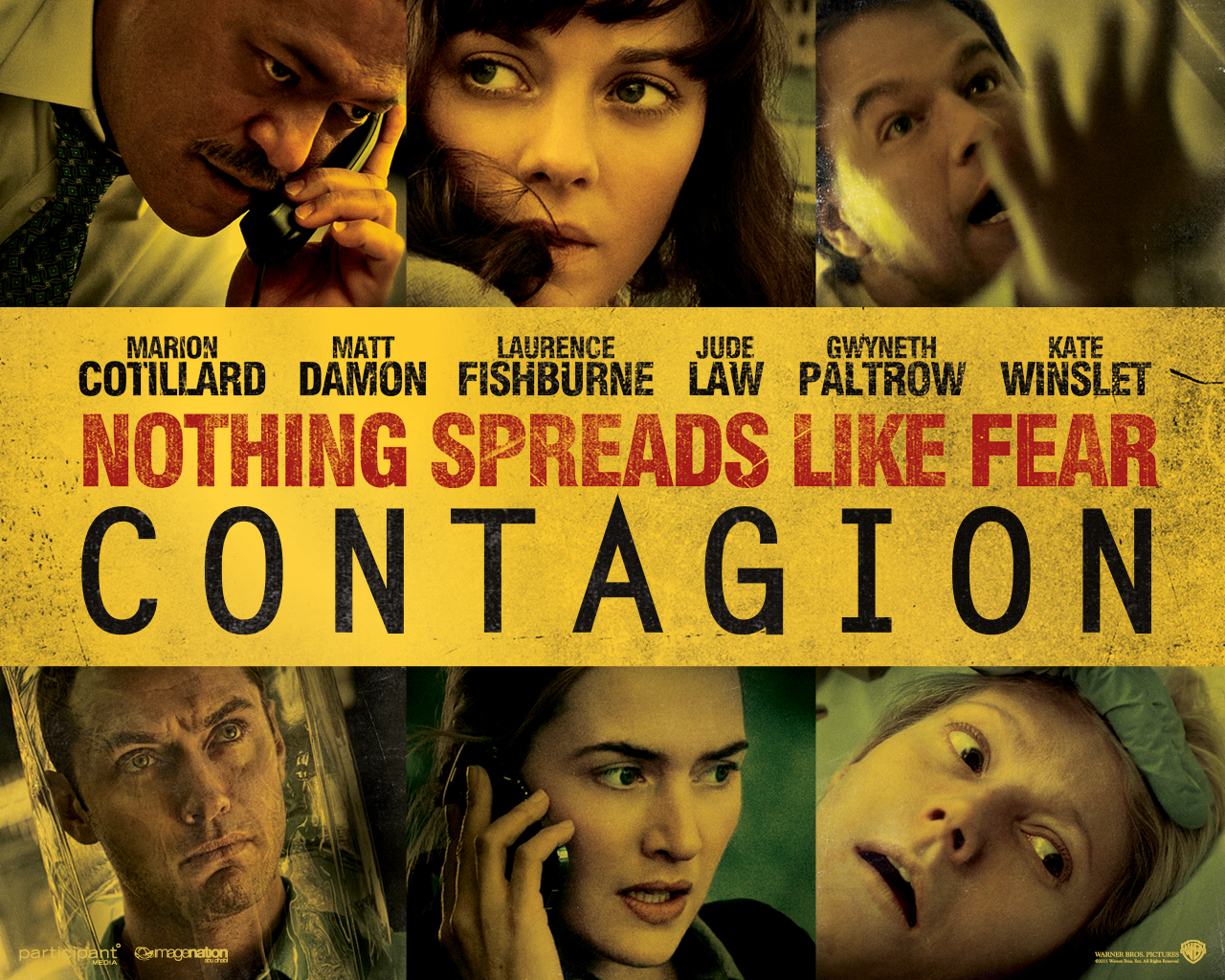
Tag Archives: movie

Review – The Avengers Assemble 3D (12a) [2012]

Star Rating: 4/5

The Hulk, Iron Man I & II, Thor and Captain America: The First Avenger were all made to ready audiences for The Avengers Assemble, the culmination of Marvel’s superhero comic-books turned movies. But could throwing together a bunch of supernaturally-gifted souls work in practice? The Avengers Assemble demonstrates the folly of those who doubted the project.

Nick Fury (Samuel L. Jackson) at SHIELD, puts the Avengers Initiative into motion to save (or avenge) the world from Loki.

The film kicks off with Loki (Tom Hiddleston – Thor, Midnight In Paris, Black Wings Has My Angel) opening up a portal to Earth. After seizing control of the minds of Clint Barton/Hawkeye (Jeremy Renner – The Town, Mission Impossible IV, Mission: Impossible V) and the scientist Erik Selvig (Stellen Skarsgard – Angels & Demons, Thor, Romeo & Juliet), Loki steals the Tesseract, the translucent and supernaturally-powerful cube that belongs to King Odin of Asgard.

Fearing the worst for Earth, Nick Fury (Samuel L. Jackson – Star Wars I-III, Iron Man I-II, Captain America II), the director of SHIELD, reactivates the ‘Avengers Initiative’ to bring together a group supernaturally gifted individuals to save the world against foes beyond man’s conventional capacity. Natasha Romanov/Black Widow (Scarlett Johansson – The Prestige, Iron Man I-II, Her), Bruce Banner/the Hulk (Mark Ruffalo – Shutter Island, The Kids Are Alright, Thanks For Sharing), Tony Stark/Iron Man (Robert Downey Jr. – Iron Man I-III, Sherlock Holmes I-II, Due Date), Steve Rogers/Captain America (Chris Evans – Fantastic Four I-II, Captain America: The First Avenger, Captain America II) and Thor (Chris Hemsworth – Star Trek, Thor, Snow White and The Huntsman) all answer the call.

Despite their differences, the group must co-operate in order to defeat the onslaught upon Earth that Loki shall unleash with the power of the Tesseract behind him.
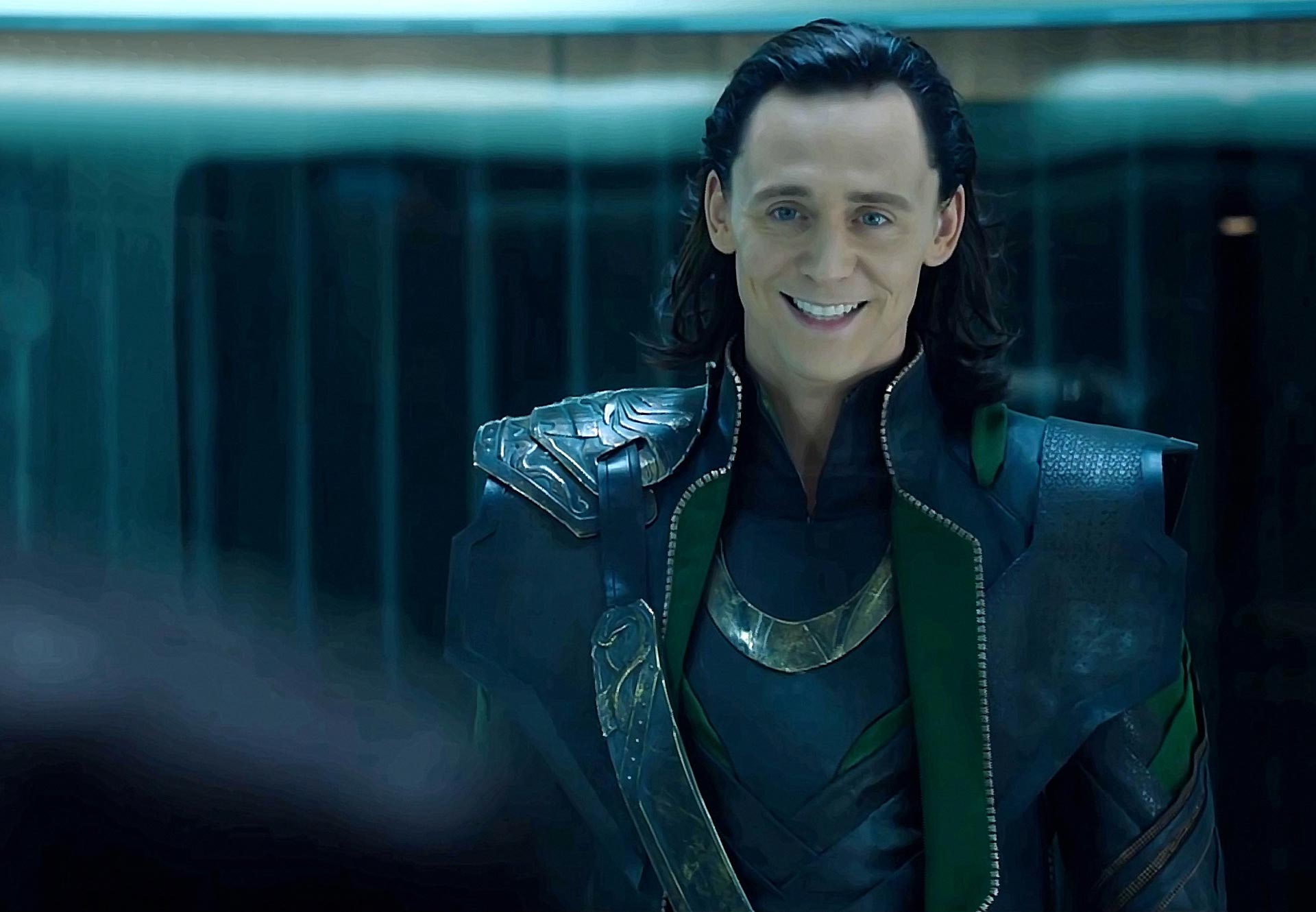
The villain, Loki (Tom Hiddleston), smirking as he tells Nick Fury that nothing can stop his plans from coming to fruition.

There is nothing remotely complex, original or realistic about the storyline for The Avenger’s Assemble. Nevertheless, it is greatly entertaining. It has plenty of action scenes and an amusing clash of egos (of Godly proportion) between Thor and Iron Man.

Without being a comedy, the film is littered with banter and jokes. This is because (thankfully), like in This Means War, none of the actors in The Avengers Assemble take their roles earnestly. Bruce Banner and Tony Stark would have looked utterly preposterous if they had tried to seriously discuss astrophysics before turning into a green beast or donning an iron costume.

The Hulk and Iron Man might be the most dominant characters in the film, but director Joss Whedon gives each member of the cast a chance to shine. He gives them all a back story as well. This does not mean that the protagonists in The Avengers Assemble are any less divorced from the society that they have promised to defend; and nor does it mean that they have the depth of the Bruce Wayne of Christopher Nolan’s Batman trilogy or some of the mutants in X-Men: First Class, such as Charles Xavier, Erik Lehnsherr and Raven. Yet, it ensures that Whedon’s comic-book heroes are not mere kick-busters in ludicrous outfits either.

The Avengers in action. Captain America, the all-American hero wearing the stars and stripes, leads the group as they attempt to defend the world from the metal monsters coming from outer-space.

Irrespective, though, of whether the narcissistic Tony Stark has come to like his assistant, Pepper Potts (Gwyneth Paltrow – Iron Man I-III, Contagion, Thanks For Sharing), as much as he likes himself, or if Bruce Banner explains the injustices that have led to him turning into a green monster when he gets angry, the special effects are consistently brilliant throughout The Avengers Assemble. Again, there is little new to behold (the highly destructive flying caterpillars have become standard among alien invasion movies since last year’s Transformers III), but the effects assist the action scenes remarkably well. Even the 3D works a treat!

Over-all, The Avengers Assemble is a thoroughly entertaining and humorous movie. It has an affable group of protagonists, who all seem to have great chemistry on set, plus fantastic fighting scenes and superb special effects. The film might not be original or complex, and it certainly has no deep moral message. Yet, The Avengers Assemble is everything that a light-hearted, comic-book, superhero movie should be. Bring on the sequel!

PG’s Tips
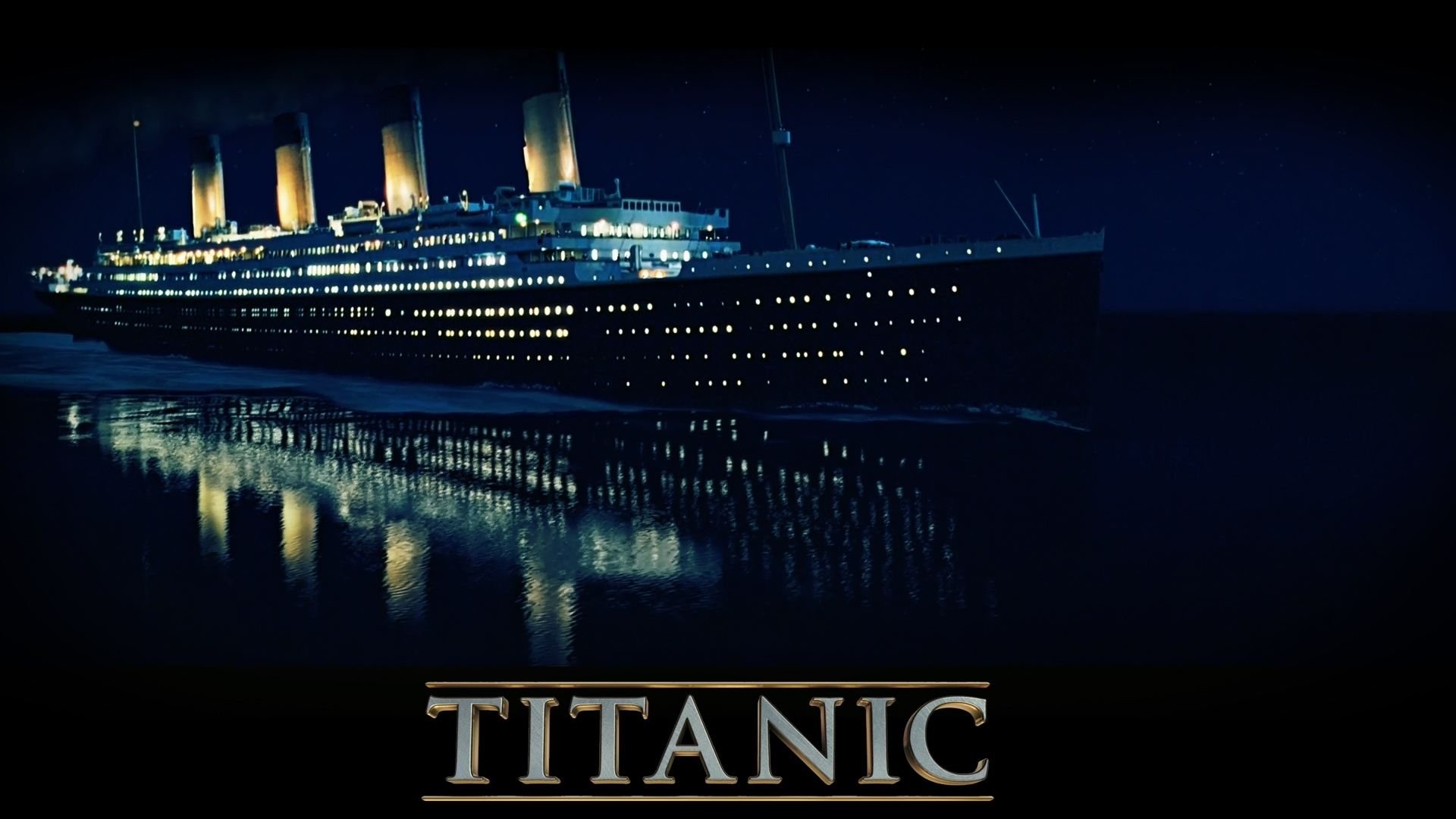
Review – Titanic 3D (12a) [2012; originally released in 1997]

Star Rating: 4/5

A century has passed since the White Star Line’s ‘unsinkable’ Titanic sank on her maiden voyage, taking down 1,503 souls with her to the watery abyss. It was a tragedy, but one that still fascinates people for so many reasons. The absorbing 1997 film, re-released in 3D for the centenary of the disaster, embodies why this is the case.

Titanic’s bow at the bottom of the Atlantic Ocean. Looks little more than a ghost ship now, with rusticles giving it an eerie feel.

Titanic centres round two central characters who board the ship as it takes off from Southampton for New York in April 1912. Rose (when old, played by Gloria Stuart; when young, played by Kate Winslet – Revolutionary Road, Contagion, Steve Jobs) is the daughter of a bankrupt aristocrat and is travelling in the luxuries of first-class. Against Rose’s will, her mother, Ruth (Frances Fisher – The Roommate, The Lincoln Lawyer, The Silent Thief), has set her up to marry Caledon ‘Cal’ Hockley (Billy Zane – Back to the Future I-II, The Roommate, The Employer), a wealthy businessman, to relieve the family of their crippling debts.

Jack (Leonardo DiCaprio – Revolutionary Road, Inception, The Wolf of Wall Street), on the other hand, is a dirt-poor artist journeying in third-class. After spending time in a variety of European cities, he is returning to America for a better life.

Whilst on the decks, Jack spots Rose on the higher levels and is instantly taken by her beauty. Yet, it is not until Rose is on the verge of jumping off the vessel’s stern that they meet. Jack urges her not to plunge to her death in the freezing waters and she follows his advice.

Subsequently, much to the envy of Cal, love blossoms between Jack and Rose… Until a cold, cloudless night when Titanic, running at full steam, strikes an iceberg.

For a film that is predominantly about a love story, Titanic is surprisingly gripping and abetted by a powerful music score, written by James Horner. Astonishingly, the film does not feel like it’s three hours and fifteen minutes long, since director/producer James Cameron (Alien, Avatar I-II, Sanctum) uses the time cleverly.

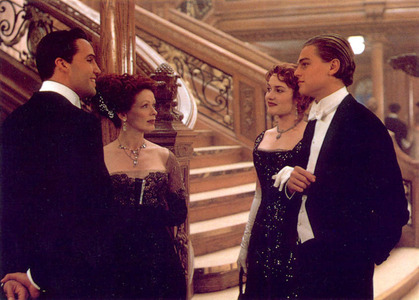
Cal (Billy Zane) and Ruth (Frances Fisher) reluctantly welcome Jack (Leonardo DiCaprio) to dinner in the glorious, first-class dining hall. Rose (Kate Winslet) accompanies him, drawing the ire of her fiancé and mother.

For the two hours or so before Titanic suffers its fatal wound, Cameron ensures viewers believe the false sense of security that passengers undoubtedly felt aboard the ‘unsinkable’ ship (even though audiences know the ship’s doomed fate), and gives the characters a (clichéd) 1912-societal role, depth and humour to maintain one’s interest.

Moreover, Cameron makes the vessel hit the iceberg with (approximately) an hour and a half to go. With Thomas Andrews (Victor Garber – Legally Blonde, Milk, Argo) stating that Titanic has less than two hours afloat, it feels like one watches the ship keel in real time, instead of in a quick, artificial manner. This not only means viewers can realise the anarchy that gripped the ship as she went under; it enables one to appreciate the heroics of individuals on the night, such as the officers who sent out distress signals until Titanic’s power failed, and the life-boat stewards, like William Murdoch (who has been incorrectly portrayed as a murderer by Cameron) and Harold Lowe (Ioan Gruffudd – Fantastic I-II, Sanctum, Mariah Mundi and the Midas Box), who lowered as many boats and got as many people into them as possible, amidst the chaos.

And because Cameron has so much time, he also properly shows us the cowardice of others, like Bruce Ismay (Jonathan Hyde – The Mummy, The Tailor of Panama, Spooks), who wanted headlines so badly he imperilled the ship he named (ironically immortalising Titanic), and Edward J. Smith (Bernard Hill – The Lord of the Rings II-III, Valkyrie, Paranorm), the reckless and dithering captain, who at least had the dignity to go down with the vessel.

On the whole, the actors play their parts well, particularly Kate Winslet (even though she recently came out saying that her acting could have been better and she has a point), Frances Fisher, Gloria Stuart, Billy Zane and Kathy Bates (Misery, Midnight In Paris, Starbright), as the ‘unsinkable’ Molly Brown.

However, the cast’s performances are often undermined by risible dialogue. The worst offender, by a distance, is Leonardo DiCaprio. (Not that Winslet does herself much credit by shrieking “Jack” frequently.) DiCaprio’s ability to spew out contrived lines in a desperate voice is almost an embarrassment to the victims of the disaster.

Dialogue may not be one of Cameron’s specialities (Avatar illustrated that), but as a director he cannot be questioned. The impeccable way Titanic has been filmed and flows are testimony to this. That the movie’s set is huge and that one hardly notices the numerous special effects give clout to this (apart from a couple of poor CGI shots of the bow’s nose).

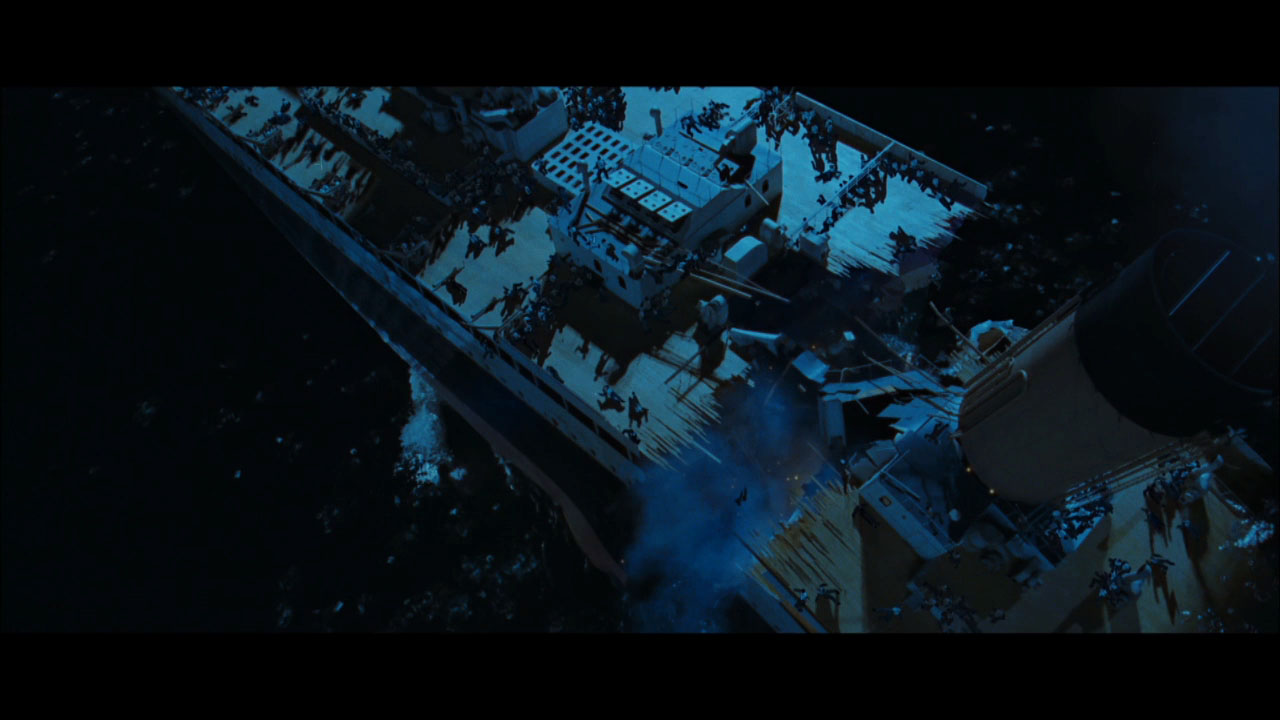
After sounding like a wounded animal as water flooded the bow and lower levels, the weight of the ship’s stern finally takes its toll on the vessel, breaking it in two.

Alas, the 3D does not effectively aid the film. It is not that effort hasn’t been put in. Rather, Titanic is not the type of film wherein the 3D can enhance scenes much, other than when people are falling from the stern as the giant propellers rise monstrously from the water.

All-in-all, Titanic is an enchanting film that gives us a window into a by-gone era. The film brilliantly details many of the complexities of early-twentieth century society, with moving music and special effects that are as magnificent as the ship that left Southampton. But the movie also does the tragedy justice, pointing out the valour of some and the pusillanimity of others. This is why the fate of the ‘unsinkable’ ship will forever have the power to captivate.

PG’s Tips
Review – The Artist (PG) [2012]

Star Rating: 5/5

In recent years, Hollywood has been dominated by films with colossal amounts of special effects, outrageous action scenes, and sequels to entertain viewers. Quality acting (the very factor that enables actors to win the prestigious awards) has seemingly become secondary to the aforementioned features for movies. Refreshingly, the French drama, The Artist, in outstanding fashion, illustrates that audiences can still be wooed by a relic of the past: a silent movie.

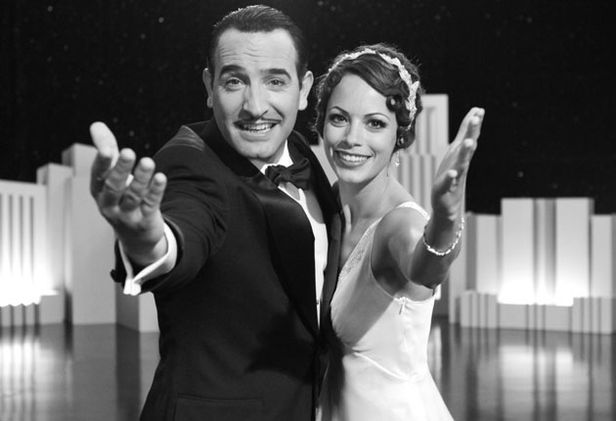
George Valentin (Jean Dujardin) and Peppy Miller (Bérénice Bejo) dancing together for a film. The two actors have great chemistry on set.

The Artist is set in Hollywood between the late 1920s and the early 1930s. It is about George Valentin (Jean Dujardin – OSS 117: Cairo, Nest of Spies, OSS 117: Lost In Rio, The Wolf of Wall Street), a man who has starred in many silent films throughout his acting career. Now though, George is being told by his boss, Al Zimmer (John Goodman – Pope Joan, Red State, 10 Cloverfield Lane), that the times are changing and that cinema audiences want dialogue and fresh faces. (‘Fresh meat’ as Zimmer calls it.)

The fresh faces include an upcoming young, pretty woman called Peppy Miller (Bérénice Bejo – A Knight’s Tale, Prey, The Scapegoat), who had been randomly photographed with George. Rapidly, she is replacing him. Between her and the Wall Street Crash of October 1929, George’s world is rapidly falling apart. He has to adapt to the times, something he’s loathe to do, or he faces the axe.

The Artist’s plot is straightforward and surprisingly easy to follow. Despite the lack of dialogue, one always understands the situation. The performances from the cast throughout the movie are brilliant. Jean Dujardin plays magnificently as the proud and stubborn actor, who is unwilling to be pragmatic. Bérénice Bejo is superb as the ambitious young actress. John Goodman plays well as the ruthless boss, who realises that public opinion has changed. Penelope Ann Miller (Kindergarten Cop, Blonde Ambition, Saving Lincoln) performs commendably as George’s trophy wife, who has no desire to be with a man whose best years are seemingly behind him. James Cromwell (The Green Mile, 24: Day 6, Still) does a fine job of being George’s loyal valet. And George’s dog, which is linked to him seemingly telepathically, adds a cute, sentimental aspect to the storyline.

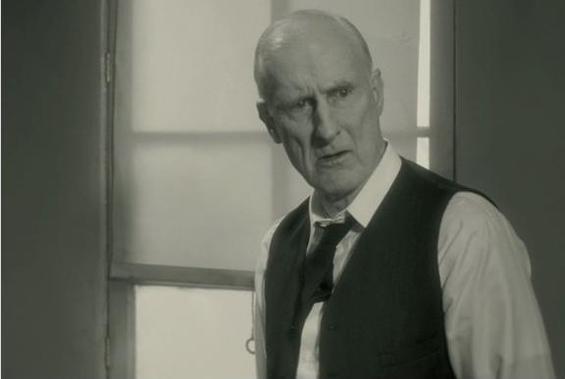
Clifton (James Cromwell), looking concerned for his master, George.

But the brilliance of the acting is very different from other exceptional performances, such as Colin Firth’s in The King’s Speech or Christian Bale’s in The Fighter. Remarkably, using body language and emotion, the actors stunningly demonstrate that words are not necessarily needed to portray human relationships and circumstances. Director Michel Hazanavicius (OSS 117: Cairo, Nest of Spies, OSS 117: Lost In Rio, The Players) does occasionally use bubbles of words to explain the context, which help, but they’re infrequent and hardly worth a mention.

If anything, it is not the words on the screen that aids the audience, but the music. The score greatly aids viewers to empathise with the characters. The 1920s-style music may not be like the enchanting scores of The Lord of the Rings or Inception, but it always captures the mood of the characters in The Artist. Whenever their temperament changes, so does the music to enhance the scene.

The magnitude of the acting and the music are more noteworthy considering that The Artist is a small budget film, which has close to no special effects and action. It is such a wonderful contrast to the (hideous) amount of computer generated images (CGI) and explosions used in most blockbusters today, such as Transformers III and Captain America. Consequently, The Artist feels cleaner and is more pleasant to watch. (Indeed, The Artist almost makes one want to beg Hollywood to fund more movies with fewer special effects and loud bangs.)

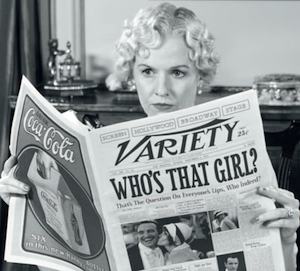
Doris (Penelope Ann Miller), George’s wife, disgusted with her husband for being photographed in the papers with a younger, more beautiful woman than herself.

Similarly, the movie has no breathtaking landscapes to charm viewers, like in The Way Back or True Grit. The Artist though captures its era magnificently, from the clothes the characters wear; to their hairstyles (Bérénice Bejo looks strikingly similar to Marion Cotillard in Midnight In Paris); to their cars; to their cameras; to the interior designs of their houses (which have some resemblance to the First-Class rooms and halls in the sunken Titanic). One could perhaps criticise the film for not depicting the Great Depression of the 1930s adequately. Yet, this was not the purpose of the film either, so one should not blame the director on this matter.

On the whole, The Artist is a work of art. It brings us back to pure cinema and makes viewers realise that when a film has acting of such phenomenal quality, then dialogue, special effects and action are not absolutely necessary to make an entertaining and dazzling film.

PG’s Tips
Review – Coriolanus (15) [2012]

Star Rating: 4/5

<<guest review by KJF>>

William Shakespeare and the filmed medium have an uneasy relationship. Over the years many film-makers have attempted to bring his plays to the silver screen but not all have been successful, with some versions feeling staid and flat. For all the glories of Laurence Olivier’s trilogy of adaptations, in more recent years there have been Kenneth Branagh’s Love Labour’s Lost (2000) and As You like it (2006), which were both poorly received. Ralph’s Fiennes’ Coriolanus bucks the trend, providing an inventive, violent and gripping take on one of the Bard’s later tragedies.

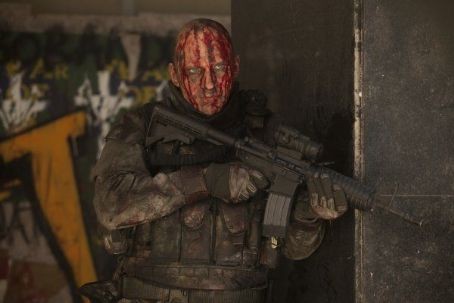
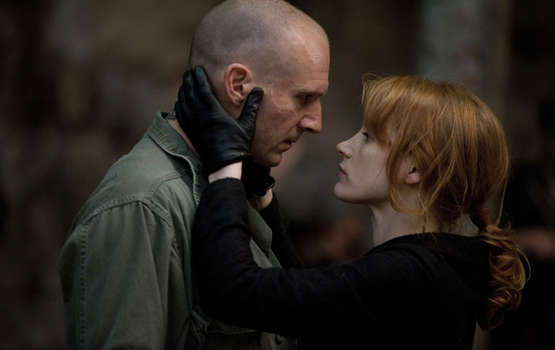
Coriolanus, blood-soaked, in the heat of battle.

The original play is set in the ancient world, during one of the Roman Republic’s endless wars against a neighbouring tribe. Caius Martius (Ralph Fiennes – Schindler’s List, Harry Potter VII(ii), Wrath of the Titans), is Rome’s greatest general. Having just scored a bloody victory against the rebellious Volscians, he returns to his home city and is given the honorific name ‘Coriolanus’, in recognition of his battle prowess at the Volscian city of Corioles. At Rome the populace are starving due to a grain shortage. He tends to hold the people in contempt, and when his election to the consulship collapses, and he gets exiled, the disgruntled general defects to the Volcians and plots his revenge.

Here the story is updated to a modern Balkan setting which is very effective, recalling the wars in the 1990s following the collapse of Yugoslavia. The battles between Romans and Volscians are fought on bomb blasted streets, strewn with the wrecks of cars and buildings with terrified civilians being caught in the crossfire-scenes so reminiscent of modern urban warfare. The bleak, withered, Balkan landscape is a particularly effective back-drop to the bleakness of Coriolanus’ fate in the latter part of the film.

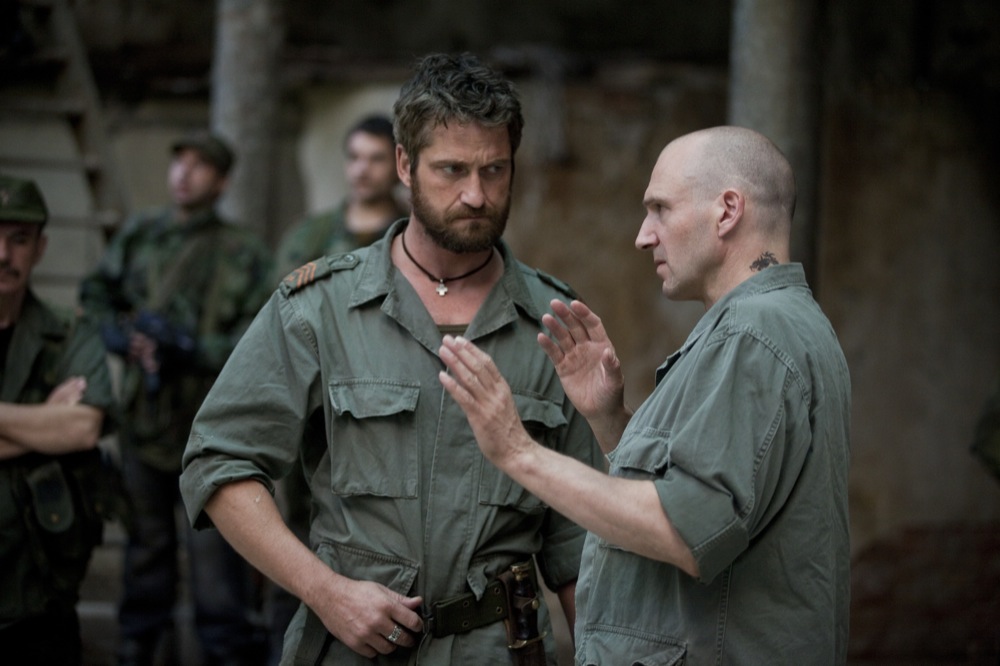
Fiennes in directing mode with Gerard Butler, playing Tullus Aufidius

All the events of the story are told through the prism of rolling news footage, with newscasters and pundits (naturally) spinning everything. (Even Jon Snow gets a look in!) When the grain protests in Rome are depicted, this allows for some fortuitous contemporary resonance as we cannot but think of the Arab Uprisings, particularly all the protesters massing on Tahrir Square. That all the political debating on show is done in the glare of television cameras instantly broadcasting into countless households feels particularly right. In Republican Rome, many political debates were held in public in the Forum.

Fiennes is following in the grand tradition of both Olivier and Branagh as both actor-director, and this is very much his film. The camera likes to linger on his battle-scarred, shaven, bullet-shaped head, which in the heat of battle gets spattered in blood. One needs no convincing that this is a serious warrior. When faced with dealing the people of Rome he so despises, his icy contempt for them is tangible. Fiennes is supported by a fine cast. Vanessa Redgrave (Mary, Queen of Scots, Letters to Juliet, Song For Marion) as Volumnia, Coriolanus’ formidable mother, is truly magnificent. She is a civilian but her martial bearing and control she exudes over her son is emphasised by the military dress she mostly wears. The seemingly ubiquitous Jessica Chastain (The Help, Take Shelter, Zero Dark Thirty) acquits herself admirably as the other woman in Coriolanus’ life, his doting wife, Virgilia. Gerard Butler (300, P.S. I Love You, London Has Fallen) plays a brooding Tullus Aufidius, the leader of the Volscians and nemesis of Coriolanus. There is, perhaps inescapably a touch of Leonidas about his performance but he very much proves the match and the mirror to the Roman general. The Roman politicos here are a conniving bunch, all decked out in slick, expensive suits and Brian Cox (Troy, Rise of the Planet of the Apes, Dog Fight) brings much style to his portrayal of the loquacious, fawning senator Menenius Agrippa, supporter of Coriolanus’ family.

Virgilia (Jessica Chastain) pleading with Coriolanus not to go back to war.

The faults with the film reflect back to the play itself. Coriolanus is the most unsympathetic of Shakespearean ‘heroes.’ He is no Hamlet or King Lear to draw much pathos. We rarely see behind his front of arrogance and hauteur and his loathing of people power, to what makes him a human being. The play itself can be heavy-going at points, punctuated with very long-winded speeches. Thankfully here, Fiennes in collaboration with his screenwriter, John Logan, has done some merciful pruning, to make everything more palatable.

Thus, Fiennes should be commended for bringing a less popular and less well-known Shakespearean play to a much wider audience. Indeed the vigour and imagination on display makes the film a rewarding and thought-provoking experience.

KJF

Review – Take Shelter (15) [2011]

Star Rating: 2.5/5

Often, when it comes to a descent into insanity, one is clueless that he/she is no longer behaving in a ‘normal’ way (whatever that means); it is only those around the ‘crazy’ individual that are aware of his/her madness. This is apparent in films like Shutter Island and Black Swan. The drama Take Shelter, despite being lame in comparison to those aforementioned movies, deals interestingly with the opposite.

Curtis (Michael Shannon) looking at some dark storm clouds with concern. This is what convinces him to build a storm shelter, even if he cannot afford it.

Based in a small town in Ohio, Curtis (Michael Shannon – Vanilla Sky, Machine Gun Preacher, Man of Steel), a man in his middle-thirties, is a construction-site worker. He may live in a decent-sized house and his life might ostensibly look like it is going well, but behind the scenes things are not so rosy. Curtis’s relationship with his wife, Sam (Jessica Chastain – The Debt, The Help, Coriolanus), has become strained due to some financial difficulties, as well as emotional stresses concerning their deaf daughter, Hannah (Tova Stewart).

Soon, Curtis starts having apocalyptic nightmares and visions of a gas storm that will destroy the town and its inhabitants. Fearing for his family, he builds an impenetrable storm shelter. The trouble for Curtis is that no-one else is concerned about this impending storm, and his mother, Sarah (Kathy Baker – Edward Scissorhands, Machine Gun Preacher, Against The Wall), was diagnosed with paranoid schizophrenia in her early thirties. Curtis is aware of this and worries that he is suffering from the same mental illness. But is this the case?

Sam (Jessica Chastain) makng breakfast for her family. She wonders why her husband has become so distant to her in recent times.

The plot for Take Shelter is simple and easy to follow. Audiences will have little difficulty in differentiating when they’re watching reality and Curtis’s dreams, since the dreams tend to be darker than real world (yet surprising not disturbing). However, as a result of needing to fix the film round Curtis, the director, Jeff Nichols (Shotgun Stories, Mud), focuses too greatly upon Curtis at the expense of the other main characters, Sam and Hannah. Indeed, neither Sam’s nor Hannah’s problems are even touched upon, which has the consequence of making them virtually irrelevant to the storyline. This is bizarre and undermines the movie’s realism.

Furthermore, Take Shelter is slow-paced and some parts of the plot go by the way side, such as Sam’s need for (breast?) implants (which would have been a good opportunity to delve into some of Sam’s insecurities), whilst the ending is a cheap stunt to make one rethink the entire movie. Also, considering the music throughout is either an ominous, yet anticipatory, beat or a boding-doom thud, one waits expectantly for the climax, like in Black Swan, or for the revelatory twist, such as in Shutter Island. But it never arrives, which is extremely frustrating.

Viewer’s frustration is likely to be exacerbated by the film’s length. At 121 minutes Take Shelter is quite long, and the movie feels longer still because of the artistic style that Nichols has employed. In theory, there is nothing wrong with this style, but for a film about psychological disorders it may not have been the most sensible method to choose. Too many scenes have little action or dialogue, and when there is dialogue it can often have prolonged gaps and be devoid of emotion. The lack of outburst from any of the two main adult characters seems odd too (and perhaps improbable) considering the emotional strains and financial pressures that they’re under. Maybe if Nichols had taken inspiration from the emotive drama, Revolutionary Road, Take Shelter would have been considerably better.

The family in the shelter after hearing the storm siren. Such is Curtis’s paranoia that he even bought his family the most up-to-date gas masks in the case of a storm.

In Revolutionary Road, Frank (Leonardo Dicaprio) and April (Kate Winslet) had depth and the power to make audiences empathise with their respective feelings and predicaments. In contrast, here, Michael Shannon and Jessica Chastain perform with a remarkable lack of intensity, plus there appears to be no love or antipathy between the married couple (even though they constantly remind us of their love for each other). The acting is not poor and it gets better as the film goes on; yet, it is a far cry from the exceptional performances in any of the aforementioned movies.

Over-all, Take Shelter shows us that people with psychological disorders can realise, to a limited extent, that they are veering towards ‘insanity.’ It is just irritating that the film is quite uneventful, tedious and lacks the strong performances necessary to put it on a par with Black Swan or Revolutionary Road.

PG’s Tips
Review – Immortals 3D (15) [2011]

Star Rating: 2.5/5

300 and Conan The Barbarian had much in common. Both were the ultimate guy’s film, with plenty of action, swordplay and spilt blood (and for women, there were hulking men with CGI-enhanced torsos). Immortals follows the same theme, just being an inferior version of the two aforementioned movies.

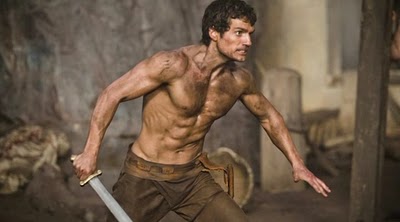
Theseus (Henry Cavill), all ripped and ready to throw himself into the thick of the action.

Set in Ancient Greece, the Heraklion King of Crete, Hyperion (Mickey Rourke – The Wrestler, Iron man 2, The Courier), is hell-bent on destroying the gods, since they failed to answer his prayers to save his family from illness. To do this he needs to unleash the Titans from Mount Tartarus. But he can only set them loose with the Epirus Bow. Yet, the bow is missing and only the gorgeous virgin oracle, Phaedra (Freida Pinto – Miral, Rise of the Planet of the Apes, Black Gold), knows of its location. Thus, King Hyperion marches upon the holy site where she dwells in order to extract the information.

En route, and almost simultaneously, Hyperion’s army pillages a small village where a young peasant, called Theseus (Henry Cavill – Red Riding Hood, The Tudors, Man of Steel) lives with his mother. Theseus has been trained since childhood by an ‘old man’ (John Hurt – Harry Potter I, VII(i) & VII(ii), Tinker Tailor Soldier Spy, In Love With Alma Cogan), who is really Zeus (Luke Evans – Clash of the Titans, Tamara Drewe, The Hobbit I & II) in human form, for a war that will make him immortal. Before long, only Theseus’s abilities will be the barrier between Hyperion and his awful ambitions.

The storyline is simple and easy to follow. One may not come out with a greater understanding of Ancient Greek societies (other than their belief in polytheism), and at 117 minutes Immortals might be a little long; nevertheless, one is unlikely to become bored during the movie. Like in 300 and Conan, it may not be intellectually stimulating. But there is more than enough fighting and bloodshed to keep viewers occupied, even if the combat and battle tactics appear very similar. (And what is it about this genre and men walking around and going into battle bare-chested?)

The beautiful Phaedra (Freida Pinto), dressed for a dinner-date, tending to Theseus’s wounds. Perhaps if he had worn some body armour, his injuries may have been avoided?

However, there is much that Immortals lacks in comparison to those other two films. First, it lacks the (far from subtle) political connotations of 300, entailing that the film has no hidden message (in fairness, nor does Conan). Second, the dialogue in Immortals might be less crude than in 300 and Conan, but it is more contrived, less amusing and more predictable, which never bodes well. (At least the dialogue in the atrocious Season of the Witch was so terrible it was funny!) Third, Immortals lacks the strong, massive main character that Gerard Butler and Jason Mamoa respectively portrayed, and which is needed in a film like this. Despite a muscular (and painted) six-pack, the relatively-small Henry Cavill gives a pitiful and unconvincing display as the hero, Theseus. This does not augur well for him, considering that his next major role is in the upcoming Superman film, wherein he plays the eponymous man of steel himself.

The rest of the cast, in the main, are no better. Worse, they all take their roles seriously, which exacerbates the poverty of their performances, to the extent of making the supporting cast in 300 look like professional warriors. The exception to this in Immortals is Mickey Rourke, since he takes his role as a joke. Consequently, Rourke comes out with some credit, as he puts across Hyperion’s shallowness character and incalculable cruelty well in equal measure. Although, the price Rourke pays is the risk of Hyperion becoming slightly pantomime, in a similar manner to Rodrigo Santoro as Emperor Xerxes in 300 or Stephen Lang as Khalar Zym in Conan. Not that it matters, since none of these movies can be taken remotely seriously.

King Hyperion (Mickey Rourke) pontificating to a defector, before inflciting inhumane cruelty upon him or her. If one looks carefully, one can see the scars over his left eye.

The acting in Immortals may be generally pathetic, but the film has some attributes that are not utterly terrible. The director, Tarsem Singh (The Cell, Mirror, Mirror), has put the movie together smoothly; the music may not be memorable, but it is still fitting for the scenes; and just like with 300 and Conan, one doubts how much of the background sceneries are real in Immortals, but the special effects are quite decent (even if the 3D is virtually non-existent).

On the whole, even those who like the genre may well be disappointed with Immortals. The film may have some worthwhile CGI and combat scenes; nevertheless, one is more likely to go away remembering the weak acting and dialogue. In short, Immortals is just a poor man’s 300 and Conan The Barbarian.

PG’s Tips
Review – The Help (12a) [2011]

Star Rating: 4.5/5

John F. Kennedy (JFK), President of America (1960-63), proclaimed in 1963 that “moral courage is a more rare commodity than bravery in battle or great intelligence.” He was referring to the civil rights movement in America, when African-Americans, particularly in the south (now known as the ‘Bible-belt’), were discriminated against and did not have the right to vote. The Help magnificently brings to light the inequality that African-Americans suffered in Mississippi in the early-1960s, and that there were some people with the moral courage to put an end to it.

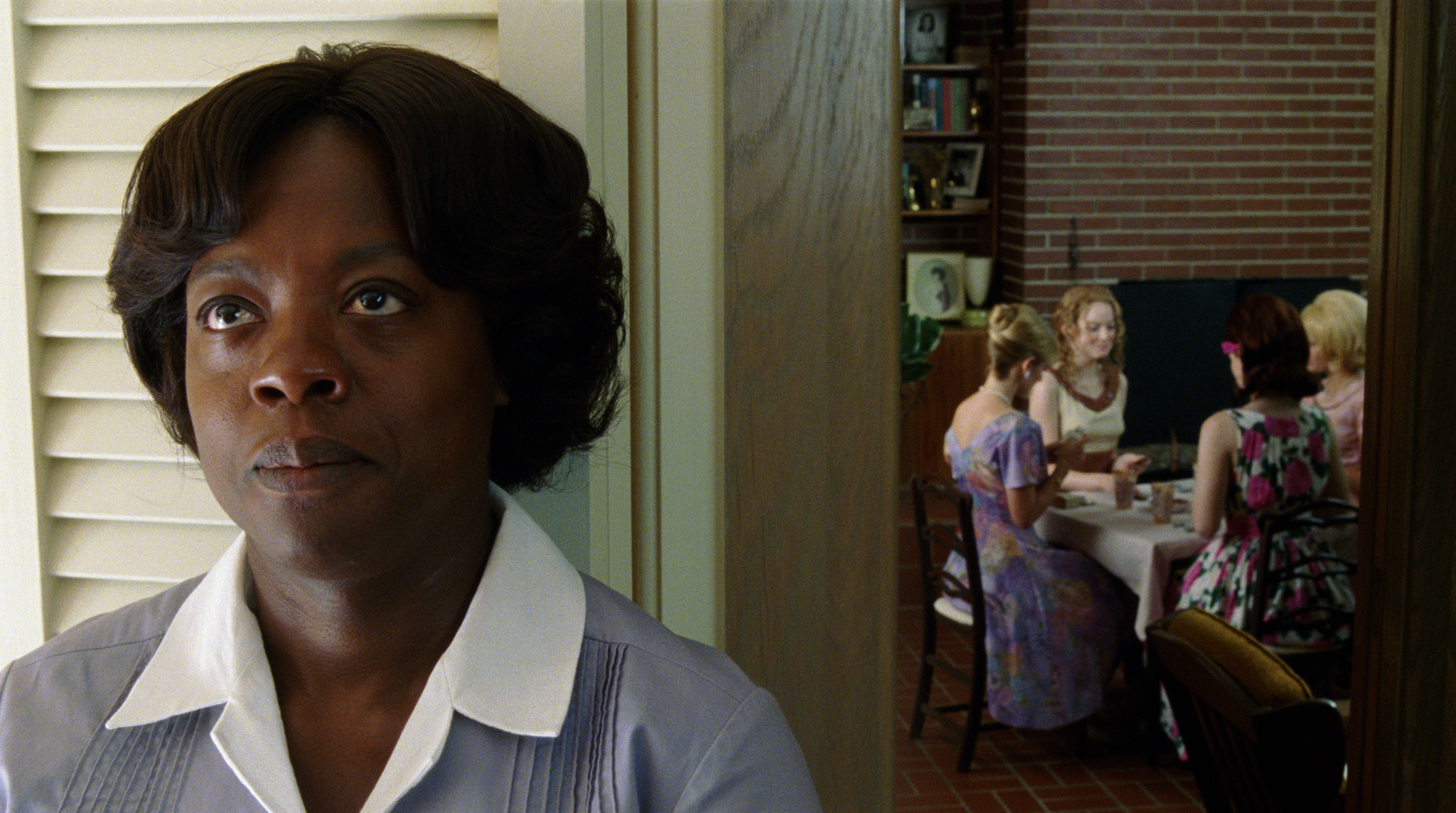
Eugenie ‘Skeeter’ Phelan (Emma Stone) out for a meal with friends, looking fabulous.

The Help is based on the book with the same title, written by Kathryn Stockett. It is not a true story. The film revolves round the aspiring young author, Eugenie ‘Skeeter’ Phelan (Emma Stone – Ghosts of Girlfriends Past, Friends With Benefits, Birdman). At a time when the civil rights movement is picking speed in America, Skeeter has become uneasy by the way her friends treat their African-American maids, and so decides to write a book about it. She decides to write her book from the angle of the help in order to highlight Caucasian maltreatment to them in the home.

Skeeter approaches Abileen (Viola Davis – Law & Order: Special Victims Unit, Eat, Pray, Love, Extremely Loud & Incredibly Close), the maid of her friend Hilly (Bryce Dallas Howard – The Village, Spiderman 3, 50/50), for her opinion and experiences. Abileen is a middle-aged woman who has spent her entire life raising Caucasian children, almost from birth, only to see them turn into their parents. Despite being initially reluctant to speak out, due to the fear of violent reprisals, Abileen lets Skeeter interview her. Soon, Minny (Octavia Spencer – The Soloist, Herpes Boy, Girls! Girls! Girls!), another African-American maid, tells her stories too. Then, many more do the same to give Skeeter an all-round picture of what life is like for African-American maids in Caucasian homes.

The Help may be a very slow and far-from-intense film; yet, it is powerful and emotive. The movie may not be factual, but it is based on much truth and reflects the period accurately. In the same way that the works of Charles Dickens and Theodore Dostoyevsky are seen to be more representative of their respective eras than historical narratives, so too can The Help be seen in the same vein. Despite a few minor historical inaccuracies, such as segregation, one could probably learn more about the innate levels of Caucasian racism towards African-Americans in the Bible-belt in the 1960s from this film, and the variety of ways it manifested itself, than from most factual history books.

Abileen (Viola Davis) eavesgropping on a conversation wherein she hears a torrent of racism towards African-Americans.

But for a film about racism, The Help is surprisingly honest. It shows all sides to be human, meaning that all the characters, whether Caucasian or African-American, have decent and defective qualities. This should be applauded since it would have been easier for the director, Tate Taylor (Pretty Ugly People), to have made one side inherently ‘good’, the other side inherently ‘bad’, and one or two instances of crossovers as a cheap façade. That Taylor doesn’t do this makes The Help plausible.

The realism of the film, however, would not be possible without the actors putting in exceptional performances. Indeed, the entire cast, and their accents, are flawless. The pretty Emma Stone demonstrates that she can play intelligent roles with vigour, enabling her to grow more beautiful and appealing in the process. Viola Davis performs so well, viewers can empathise with Abileen’s predicament and cry because of her awful experiences.

Octavia Spencer may not make audiences weep like Davis does; nevertheless, she too plays marvellously as the feisty, loud-mouth and funny Minny. Furthermore, one can even appreciate the performances of the horrible, racist women, portrayed by Bryce Dallas Howard, Ahna O’Reilly (Herpes Boy, House Under Siege, Girls! Girls! Girls!), Allison Janney (The West Wing, Pretty Ugly People, A Thousand Words), and the other ladies, or the silly, naive Celia, played by Jessica Chastain (Jolene, The Debt, Take Shelter), as they are all performed with brilliant consistency.

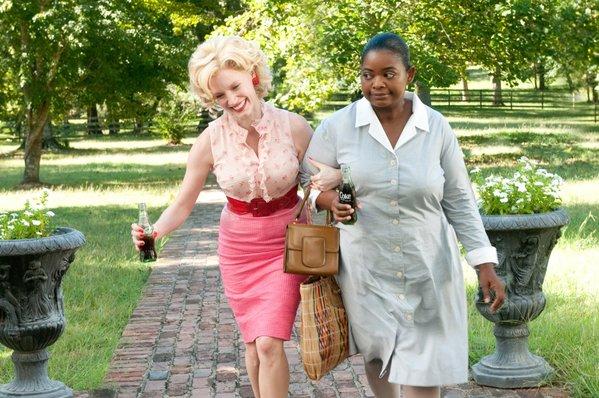
A first day at work for Minny (Octavia Spencer) at the house of the over-excited Celia (Jessica Chastain).

Like the quality of the acting, The Help has been put together superbly. At 146 minutes, the film might feel drawn out, but the choreography has been stitched together smoothly and the cinematography is apt for the locations of the movie. What’s more, the music has been chosen well to enhance the scenes, particularly the heart-rending ones.

All-in-all, The Help might drag, but it is an excellent, touching film. The acting is remarkable and the movie epitomises well the attitudes of people, whether Caucasian or African-American, living in the deep-south of America in the early-1960s. In 1963, JFK proclaimed that the struggle for civil rights “will not be finished in the first 100 days. Nor will it be finished in the first 1,000 days, nor in the life of this administration, nor even perhaps in our lifetimes on this planet. But let us begin.” The Help, therefore, enables us to measure how far we have come in almost fifty years because of people like JFK and Skeeter who had the moral courage to start changing people’s attitudes towards African-Americans.

PG’s Tips

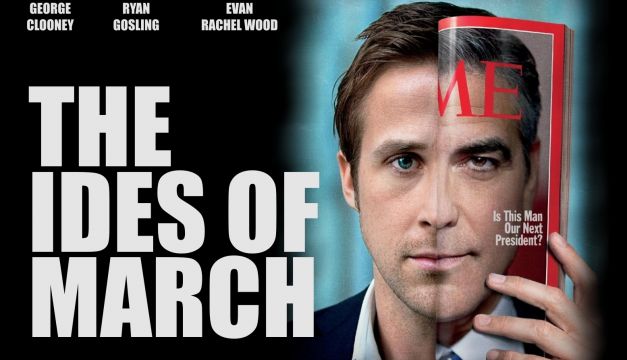
Review – The Ides of March (15) [2011]

Star Rating: 4/5

During the campaign to become the President of America, the public and the media tend to focus so greatly on the candidates and their running-mates that the people behind the campaigns frequently fade into the background. The Ides of March, in fascinating fashion, reveals some of the darker arts that go on behind the scenes in presidential races, and why a term synonymous with the assassination date of Julius Caesar is so apt.

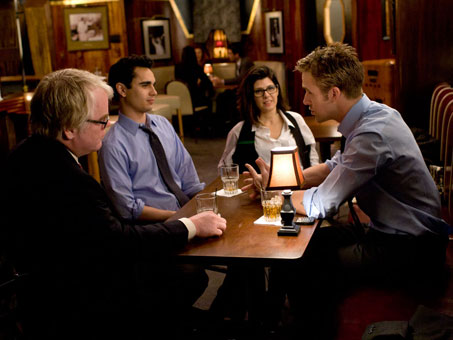
The main men behind Morris’ campaign, Paul (Philip Seymour Hoffman), Ben (Max Minghella) and Steven (Ryan Gosling), sitting and discussing the campaign with the journalist, Ida (Marisa Tomei).

The Ides of March is not a true story. But much of the film, directed by George Clooney (Confessions of a Dangerous Mind, Good Night, And Good Luck, Leatherheads), is based round the unsuccessful run of Clooney’s father, Nick Clooney, for Congress in 2004. The movie centres round Steven (Ryan Gosling – Fracture, Drive, The Big Short), a relatively young and idealistic Junior Campaigns Manager for the Governor of Pennsylvania, Mike Morris (George Clooney – Michael Clayton, The American, Gravity). Morris is in the running for the Democrat presidential nomination, and is up against Senator Ted Pullman (Michael Mantell – A.I. Artificial Intelligence, Ocean’s Thirteen, Ca$h). To gain the necessary number of Democrat delegates for nomination, Steven and his boss, Paul (Philip Seymour Hoffman – Capote, Mission Impossible III, The Master), attempt to court Senator Thompson (Jeffrey Wright – Casino Royale, Source Code, Extremely Loud and Incredibly Close), who holds the delegates for Ohio, a key state for nomination.

However, Tom Duffy (Paul Giamatti – Saving Private Ryan, Cinderella Man, 12 Years A Slave), Pullman’s Campaign Manager, has secretly made an agreement with Thompson, offering the Senator the position of Secretary of State in exchange for his endorsement. For Steven and Paul, the agreement must be broken at any cost. Simultaneously, Duffy pulls a trick or two of his own, with Steven in the thick of it. Thus, the campaign backstabbing begins.

The plot for The Ides of March is not particularly fast-moving, but it is interesting and revelatory. Certain aspects of the storyline might go too far (as some of the scandals would be almost impossible to keep hushed up with the current hawk-like media), but over-all it is plausible. Indeed, it is believable that some campaigners would betray their loyalties for personal gain, hence the film’s title being so fitting.

The pretty intern, Molly (Evan Rachel-Wood), out for a drink with Steven.

Paul and Duffy, the characters played by Philip Seymour Hoffman and Paul Giamatti, respectively, epitomise the modern day Marcus Brutus, the friend-turned-assassin of Caesar. Both, Hoffman and Giamatti, play the ruthless sort of individuals who would use underhand tactics to ensure that their candidate would come to the fore.

Without being outstanding, both actors play very well. Moreover, their characters teach Steven a lesson in the malicious nature of political campaigns and politics in general too. If one leaves the cinema with a bad taste in their mouths about politics, this might reflect the director’s disillusionment with the industry after his father’s failed campaign. Could Steven’s experiences in The Ides of March divulge some of what happened to Nick Clooney in 2004?

Regardless, Steven’s actor, Ryan Gosling, gives a solid performance in the lead role. The changes he goes through, as events around him get nasty, are praiseworthy. It also gives Steven’s personality a third, survival-type dimension that makes his character credible. Yet, Gosling is far from brilliant; he lets himself down when Steven’s with Molly (Evan Rachel-Wood – Thirteen, The Wrester, True Blood), the cute, just-out-of-college intern. Their conversations are, at times, painful to watch, and their exclusion would have benefitted the film.

Surprisingly, George Clooney has only a limited role in The Ides of March. As ever, Clooney’s character, Mike Morris, is smooth-talking and suave (smug as well). But how many times has Clooney churned out this sort of performance? In saying that, Governor Morris also has a shady side, which gives him depth and virtually certifies him as a real (morally dubious) politician. Still though, Clooney’s performance here is one we expect from him, and is, therefore, nothing exceptional.

Governor Mike Morris (George Clooney), looking very presidential, addressing an audience as part of his campaign to become the leader of the free world.

Clooney’s ability to act, direct, produce, and screen-write vary in quality. The directing and the production are fine, even if there is an unexpected amount of silence before and during scenes. The way the movie has been choreographed might seem peculiar as well, since discussions frequently begin a while before the people come together in the scene. That does not make it bad, just unusual. The same is true for the music, which Clooney probably did not use enough to his advantage to enhance scenes or uplift viewers, unlike The King’s Speech.

Nevertheless, Clooney has written the dialogue very well. It may not be on a par with The Social Network, The King’s Speech or True Grit; yet, it is always apt for the scenarios without being melodramatic.

On the whole, The Ides of March is a very decent film about an indecent industry. The world of presidential campaigns is one that often goes unreported, and this movie sheds light (or darkness) upon it. Above-all, just like its title, The Ides of March exposes the ruthless, double-crossing nature of politics and political campaigns, and why it is perhaps not an industry for nice, honest people.

PG’s Tips

Review – Contagion (12a) [2011]

Star Rating: 2/5

In the Middle Ages, pestilence and plague were semi-regular occurrences. Every fifteen years or so, the grim reaper would appear in the form of the Black Death and scythe down a not insignificant percentage of populations across Europe. Again, in 1918, after World War I (WWI), the world was struck by another form of pestilence: the ‘Spanish Flu’, which killed one percent of the then-world population. Despite being over-all quite poor, Contagion shows us once more that mankind is still not immune to new diseases and viruses.

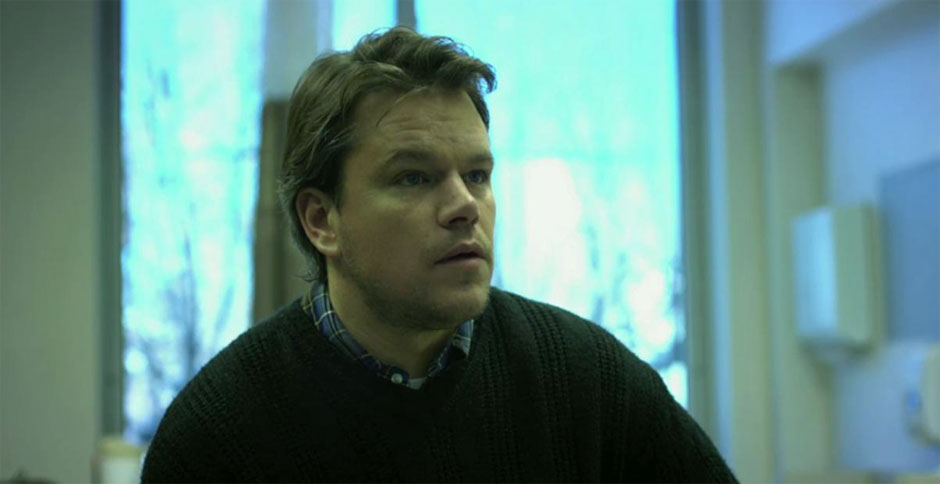
Mitch (Matt Damon) in shock after suddenly losing his wife to the epidemic.

Contagion is a medical thriller about a virus that rapidly spreads across the world. The first known death in America is that of Beth Emhoff (Gwyneth Paltrow – Se7en, Shakespeare In Love, The Avengers Assemble), who returns home to her family and husband, Mitch (Matt Damon – True Grit, The Adjustment Bureau, Elysium), from a trip to Hong Kong only to have a seizure and die soon afterwards. Rapidly, more people become infected. There is no cure for the virus either, and around one in four people are expected to become infected. (Although, one in three people who become infected are expected to survive.)

Scientists, from across the world, led by Atalanta-based Dr. Ellis Cheevers (Laurence Fishburne – Apocalypse Now, The Matrix I-III, Man of Steel) and his team, work hard to find an antidote. Dr. Erin Mears (Kate Winslet – Titanic, The Reader, Steve Jobs) uses her knowledge to try and slow down the spread of the virus, whilst working in the field. Dr. Leonara Orantes (Marion Cotillard – Public Enemies, Midnight In Paris, The Dark Knight Rises) works with a team in Hong Kong to establish where the virus came from in order to facilitate the creation of an antidote.

But until an antidote has been tested sufficiently and is safe, nothing can be distributed. In the meantime, indirectly egged-on by a conspiratorially-inclined blogger called Alan Krumwiede (Jude Law – Enemy At The Gates, The Holiday, Side Effects), social order breaks down.

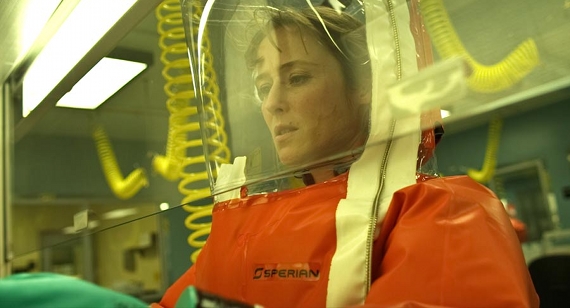
Dr. Ally Hextall (Jennifer Ehle), a scientist under Dr. Ellis Cheevers, working hard in the laboratory to try and create an antidote.

The plot for Contagion has been done in a documentary style, similar to Cloverfield (albeit, without the camera wobbling). This entails that one watches the effects of the virus upon people and societies over a series of days. One images that the director, Steven Soderburgh (Erin Brockovich, Ocean’s Eleven & Ocean’s Twelve, Side Effects), did this to give the film a more realistic feel. If so, he succeeds. As a corollary of the realism, the speed at which the virus transmits and kills people has the impact of frightening the audience (in probably the same way that bubonic plague used to terrify people in Medieval times). Also, the timing of the chaos that subsequently unfolds, as a result of panic by those who have not yet been infected, seems quite natural. It is quite conceivable for law and order to collapse under the pressures that Contagion puts forward.

However, many aspects of the storyline are either left unexplained or fall by the wayside, which undermines the film considerably. Moreover, as the movie has no central protagonist, one cannot build any sympathy or empathy (or care) for any of the characters. Worse, the dialogue, at times, sounds contrived (if not risible) and none of the actors play particularly well. Even the normally excellent Kate Winslet, Marion Cotillard, Laurence Fishburne and Matt Damon do not do themselves justice here.

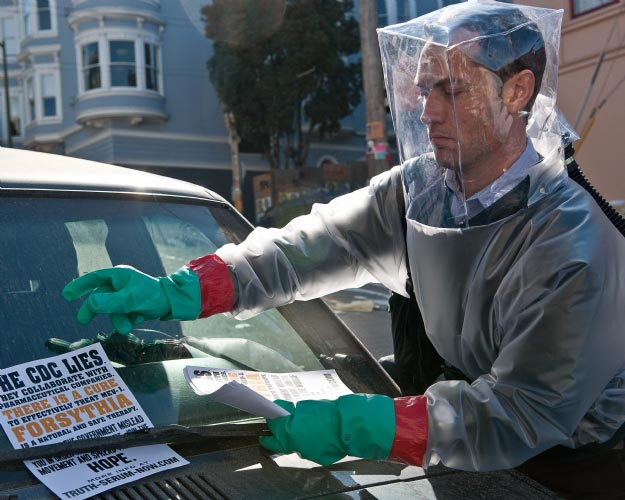
Allan Krumwiede (Jude Law), wearing a ridiculous ‘wannabe’ Buzz Lightyear outfit so he doesn’t contract the virus, spreading his new-found insight about why the government has not distributed the cure as yet onto a random car.

Due to the lack of a dominant performer, the audience may struggle to maintain interest in the film. At 106 minutes, Contagion is an average length for a movie; yet, viewers may find themselves yawning or looking at their watches (long) before it is over, which is never a good sign for a film. Not even the music, which adopts a standard fast beat for much of the movie, has the ability to keep the audience’s eyes concentrated on the screen for long.

On the whole, Contagion has many deficient features, as several of the sub-stories are forgotten about and there is a distinct lack of a central and well-defined character. Nevertheless, Contagion appears scarily realistic and shows us that, irrespective of how advanced medical treatment may be, humanity is still potentially defenceless against new and ever-mutating epidemics.

PG’s Tips

Review – The Lion King 3D (U) [2011; originally released in 1994]

Star Rating: 5/5

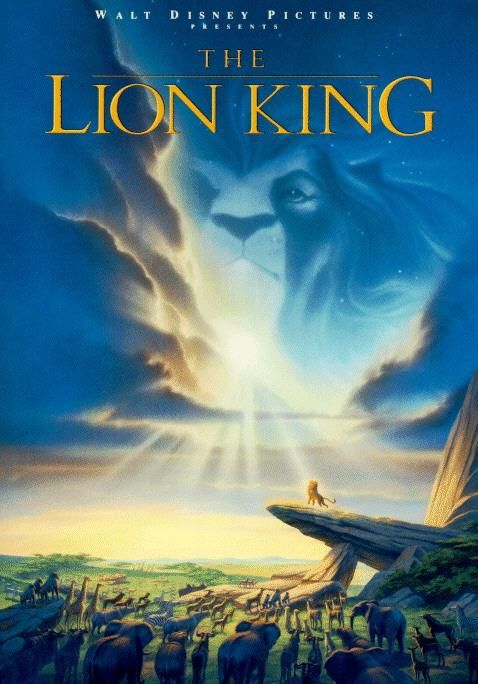
Many argue (and not without justification) that the re-release of old Disney films in 3D is simply a scam to make more money. Well, whether true or not, the magnificent 1994 The Lion King is fully worth paying to see again. (Warning, this review contains spoilers.)

Rafiki holding Simba at the latter’s birth presentation to the kingdom. Sarabi (voiced by Madge Sinclair) and Mufasa, Simba’s mother and father, respectively, watch on proudly.

The movie starts with the presentation of the birth of Simba, the future King of Pride Rock. From early on, cheeky young Simba (voiced by Jonathan Taylor Thomas) learns from his father, King Mufasa (voiced by James Earl Jones – Star Wars IV-VI, Criminal Intent, The Lion King II: Simba’s Pride), about the circle of life and how to become a responsible king. Simultaneously, Scar (voiced by Jeremy Irons – The Man In The Iron Mask, The Borgias, The Words), Mufasa’s younger brother and Simba’s uncle, secretly plots to kill both Mufasa and Simba. Using his three main hyena henchmen, Shenzi (voiced by Whoopi Goldberg – Sister Act I & II, For Coloured Girls, The Muppets), Banzai (voiced by Cheech Marin – From Dusk Til Dawn, Cars I & II, Machete) and Ed (voiced Jim Cummings – Aladdin I-III, Hercules, Zambezio), Scar intends to usurp the throne.

He half succeeds. Scar kills Mufasa, but Simba escapes, fleeing into exile. There, Simba meets a Meerkat, called Timon (voiced by Nathan Lane – The Producers, Stuart Little I & II, The English Teacher), and a Warthog, called Pumba (voiced by Ernie Sabella – The Lion King II & III, Listen To Your Heart). Simba grows up with them and enjoys life, forgetting that he is meant to be ruling the now-ravaged plains of Pride Rock. It is only when Nala (when young, voiced by Niketa Calame; when adult, voiced by Moira Kelly – The Lion King II: Simba’s Pride, Dangerous Beauty, One Tree Hill), Simba’s childhood friend, and Rafiki (Robert Guillaume – The Lion King II: Simba’s Pride), a wise baboon and an old family friend, find him that Simba realises that he must return to the Pride Lands and fight his uncle for the kingdom.

The Lion King’s storyline is easy to follow and gripping. Ostensibly for children, adults can like the movie just as much. (If not even more!) Whilst children may enjoy the sing-along-songs and the funny Timon and Pumba; adults can appreciate the intelligent, wry humour (not to mention how appalling some of Timon’s jokes are), as well as the satire in the film, such as Scar’s Hitler-like moment when he’s standing on a podium addressing his army of goose-step marching hyenas.

The silver-tongued, smiling Scar convincing his young, naive nephew, Simba, to stay and wait in gorge for his father, who has a ‘marvellous surprise’ for him. It’s apparently so good it’s ‘to die for.’ For once, Scar might even be telling the truth.

Adults and children may get pleasure from different aspects of the film; yet, everyone can equally be enamoured with the movie’s beautiful music, composed by Hans Zimmer (Gladiator, Pirates of the Caribbean I-IV, The Dark Knight Rises). Much of the film adopts Zulu-style music, which is not only apt for the setting (after-all, The Lion King is based in South Africa), it enriches every scene wonderfully.

The music, though, would not have the same impact if the characters and the dialogue were not so well defined, written and articulated. All the characters have great depth, from the cunning, forked-tongued, yet cowardly Scar (that he is such an offhandedly sinister villain, rather than a pantomime one gives him an added chilling dimension); to the mischievous-cum-deferent-cum-bold Simba; to the stupid, moaning hyenas; to the funny but sensitive Pumba, to mention four of many.

The fine brilliance of the music and the dialogue is epitomised in the scene following Mufasa’s death. Seldom in Disney films (where death is surprisingly common) have audiences, in general, been reduced to tears. The empathy one has for Simba at that point is heart-breaking. That this is followed by Scar wickedly manipulating the situation to his advantage (as intelligent, psychopathic leaders always do) makes the dosage so much more potent. Since this scene, perhaps only the ending to the excellent Toy Story 3 has come close to making viewers feel the same way again, and for very different reasons.

The music and the dialogue in The Lion King has rightly been praised. Likewise, although it’s easily missed, should the expressions of the characters. Since the majority of the characters are not human-like, since they don’t have arms and legs, the producers/artists had to rely on the characters’ body-language and body-movements to make up for it. Indeed, the way each character moves is indicative of his/her personality and circumstance at any given point. For instance, mischievous little Simba walks (struts) very differently to when he is guilt-riddled in exile. The producers/artists should justifiably take credit for this, as it gives the characters greater subtlety and complexity.

Simba, all grown up now, happily singing, with Timon and Pumba, the joyful ‘Hakuna Matata.’ It means ‘no worries,’ which is exactly how Simba has been living in exile.

Similarly, the hard work that the producers/artists put into the graphics should also be recognised. 2011 viewers may find the graphics antiquated or unsatisfactory. If this is the case, it is most unfair. One has to remember that this film was initially released in the pre-Pixar era, at the time of Beauty & The Beast (1991) and Aladdin (1992), meaning one cannot compare the results of today’s technology with those of the early 1990s. And irrespective of the relative backwardness of the graphics, The Lion King has been converted magnificently into 3D. Unlike recent animations like Rio or The Legend of the Guardians: The Owls of Ga’Hoole, the 3D here makes a difference to the extent of making The Lion King spell-binding; especially, during the fight between Simba and Scar at the end.

All-in-all, The Lion King is a Disney classic for many reasons. Bringing it back to the cinemas in 3D may be a ploy to make more money, but one should see it anyway and treasure this encapsulating masterpiece once again.

PG’s Tips