Author Archives: pgtipsonfilms

Review – In Darkness (15) [2012]

Star Rating: 4.5/5

In Jerusalem’s Holocaust Memorial Museum, Yad VaShem, there is a section honouring the Righteous Gentiles/the Righteous Among The Nations. During World War II (WWII), it is known that almost twenty-four thousand non-Jewish people risked their lives in Nazi-occupied Europe to hide and save Jews from Hitler’s murderous Final Solution. Leopold/Poldek Socha was one such courageous individual. In a powerful but unflattering portrayal of Poldek, the Jews he saved, and the era, In Darkness commemorates the bravery of this unconventional hero.
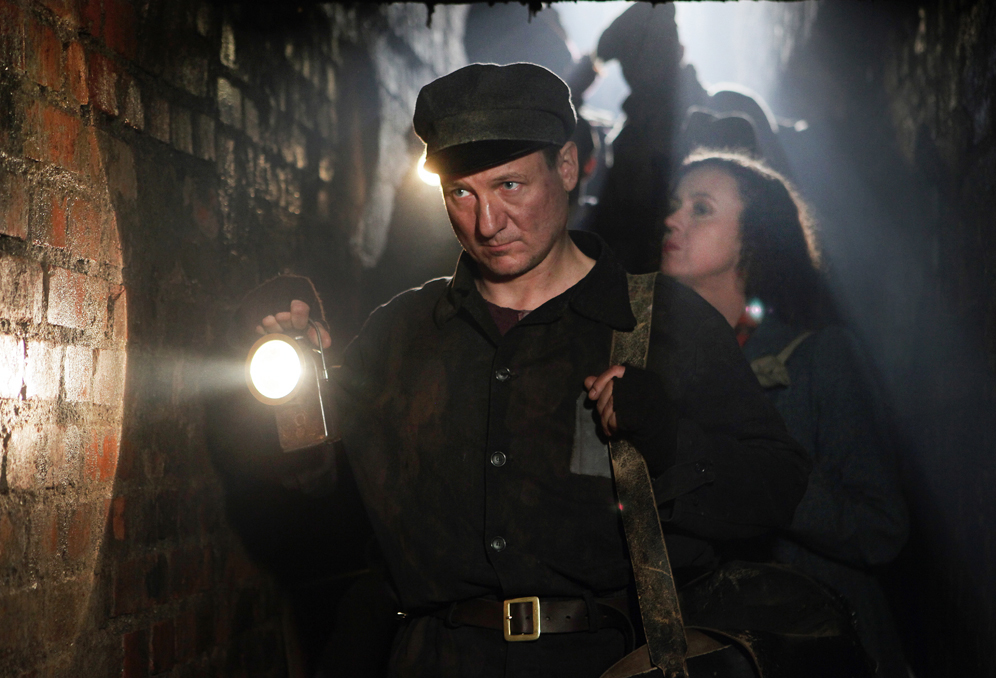
Poldek Socha (Robert Wieckiewicz) leads thirteen Jews through the caverns of the stinking sewers to find them a safe haven from their Nazi persecutors.

In Darkness is a low-budget Polish film that centres round Poldek Socha (Robert Wieckiewicz – The Dark House, Zero, Lech Walesa), a Polish sewer worker in Lvov. Using his extensive knowledge of the town’s sewer system, he hides thirteen Jews in the sewers just before the Lvov Ghetto is liquidated by the Nazis. For fourteen months, Poldek cares for his Jews. He brings them food and other essentials, until the Soviets liberate Lvov in July 1943, when he leads them to safety.

The storyline for In Darkness is straightforward and well put together. At 145 minutes, the film might seem a little long and repetitive, but the distressing nature of the movie ensures that it is not tedious at all.

The intensity of the Jew-hatred, the noise of rapid firing machine-guns and the sight of brutality against innocent people creates an intimidating atmosphere. Like tension in a string, one can feel the Jews’ fear of the Nazis and the local Polish population. The darkness of the sewers and the shaking of the camera enhance the film’s edginess by making the movie seem claustrophobic. At times, notably when Poldek moves the Jews from one excrement-running tunnel to another, the movie becomes almost unbearable to watch.
Poldek's friend, Bortnik (Michal Zurawski). Bortnik is the feared leader of the Ukrainian Nazis in Lvov.

Yet, the ending is probably the most awful and poignant part of the film. As the euphoria of saving the thirteen Jews is at its height, one learns how Poldek died and what was said at his funeral. It should leave anyone with decency sickened! Alas, it’s as unsurprising as it is shocking; a reflection of the profound levels of antisemitism in pre- and post-WWII Poland.

But was Poldek not part of the same society? In Darkness sheds light on his personality and shows him to be a very different kind of hero to Oscar Schindler (played superbly by Liam Neeson in the brilliant 1993 film, Schindler’s List). Whilst Schindler was the dashing businessman who became horrified by the Nazis’ treatment of the Jews, Poldek was not handsome and was quite indifferent to the cruelty dished out by the Nazis. Indeed, director Agnieszka Holland (The Secret Garden, The Wire) reveals on numerous occasions during the film that Poldek was just an ordinary man doing his mundane job and held deep-rooted antisemitic views.

It is not even clear why Poldek ends up hiding and saving the thirteen Jews. Is it because they pay him nicely, so he can afford jewellery for his wife, Wanda (Kinga Preis – The Dark House)? Is it because Poldek knows the unspeakable fate that awaits him and his family if he informs the authorities of the Jews? Or is it out of a sense of moral righteousness? Perhaps not even Poldek, himself, knew. Robert Wieckiewicz vividly captures Poldek’s constant vacillations, as well as his fear of being found out by the local Poles and the Nazis, both of which are always eager to turn in more Jews and their collaborators.
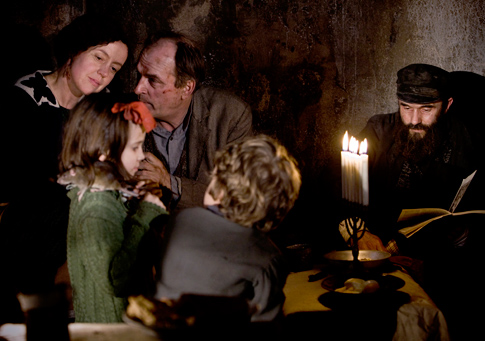
They may be holed up in the dank sewers, but the Jews still manage to celebrate the festival of Hannukkah right under the noses of the Nazis.

Although the cast play very well, Poldek, the people of Lvov and the Nazis are all given critical depictions throughout the movie. But what is more interesting is that Holland has not left the terrified Jews off the hook either. She shows them to be people who are grateful and ungrateful to Poldek; treacherous and edgy among themselves; plus lustful, amongst other things. Hence, In Darkness portrays the thirteen Jews as real people, feeling the pressures of their situation. Again, this is a stark contrast to the Jews in Schindler’s List and other Holocaust movies, like The Pianist or The Boy With The Striped Pyjamas, which depicts them as models of immaculate behaviour.

Over-all, In Darkness is an exceptional but harrowing film. It not only enables us to understand the period, it forces us to experience the torment that the thirteen Jews in the sewers endured for fourteen months. Above-all, In Darkness points out why Poldek Socha should be immortalised among the Righteous Gentiles in Yad VaShem. Despite his antisemitic sentiments and morally dubious reasons for initially hiding the Jews, he showed himself to be a hero. Not a fashionable hero like Oscar Schindler, but one who was willing to stand up to evil and put his, and his family’s, life on the line to save innocent people. Amen!

PG’s Tips
Review – 21 Jump Street (15) [2012]

Star Rating: 2/5

Last year’s The Inbetweeners Movie was a genuinely funny comedy. Whilst lacking in subtlety, it had a fine mix of intelligent and dim-witted humour, as well as realistic characters and a (semi-)plausible storyline. But in recent years many ‘comedies,’ like Due Date and The Hangover: Part II, have lacked much of what made The Inbetweeners Movie so enjoyable. 21 Jump Street, despite a few instances of amusement, very much goes into the latter category of ‘comedies.’

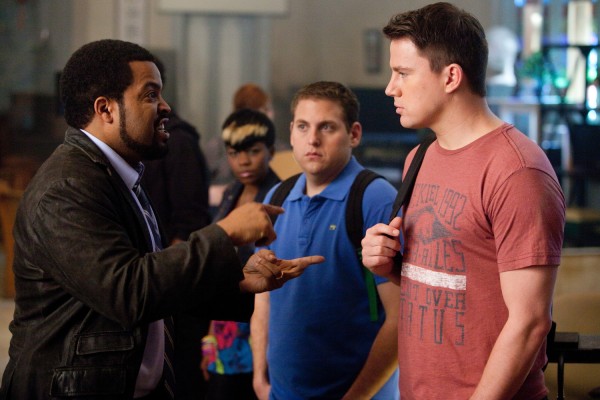
Jenko (Channing Tatum) bullying Schmidt (Jonah Hill) in their high school days. They did not get on at all whilst they were in the same class.

21 Jump Street is loosely based on the 1987-91 TV series with the same title, which starred a young and then-little known Johnny Depp. 21 Jump Street is about two very dissimilar 1980s former high school classmates. Jenko (Channing Tatum – The Eagle, The Vow, Side Effects) was the well-liked, yet brainless jock, whilst Schmidt (Jonah Hill – Superbad, Moneyball, The Wolf of Wall Street) was the smart, but unpopular nerd.

Despite their differences, Jenko and Schmidt quickly become friends after enrolling in the police academy. Once they finish their course, they become partners on patrol.

However, Jenko and Schmidt are hopeless at their jobs. Subsequently, they are sent to an undercover unit, located on 21 Jump Street. It is there that they’re ordered by their new superior, Captain Dickson (Ice Cube – Ghosts of Mars, XXX2, Rampart), to discover who is behind a drug network that is allegedly based in their former high school. So Jenko and Schmidt go back to their old stomping plain (to find, to their shock, that what was popular in the late-1980s is not anymore), posing as students, to bust the drug dealership before it spreads to other schools.

The plot for 21 Jump Street is simple as well as amusing on a couple of occasions. In addition, the friendship between Jenko and Schmidt keeps viewers interested, due to the chemistry that the two actors share; and the shoot-out scenes are a good laugh and surprisingly gory as well.

Schmidt and Jenko, now friends and cops, apparently dressed as teenagers before going undercover into their old high school. Captain Dickson (Ice Cube) ordering them not to get with any school-girls or teachers.

Yet, there are fewer action scenes than one would have predicted; and, alas, the overwhelming majority of the humour revolves round repetitive, mindless jokes between the two main characters; swearing; and vulgarity. Of course all of this can be tolerable and hilarious in moderation. But the directors, Phil Lord and Chris Miller (Cloudy With A Chance Of Meatballs), have taken it all (shamefully) to the point when even the crude Steven Stifler (played by Sean William Scott in the American Pie series) might call a halt.

Combined with such coarseness in 21 Jump Street are the performances of Channing Tatum and Jonah Hill as Jenko and Schmidt,  respectively. The pathetic and overly immature nature of their attempts to behave in a ‘high school manner’ is embarrassingly terrible. Compared to them, Jay Cartwright (played by James Buckley in The Inbetweeners TV series and movie) is a relative grown up! Both Tatum and Hill can do better than this, as the former demonstrated in Coach Carter, and the latter in Superbad and Moneyball.

The poverty of the acting in 21 Jump Street is not Tatum’s and Hill’s alone. Ice Cube; Dave Franco (Superbad, Fright Night, Warm Bodies), playing as Eric, the ‘cool-guy’ of the school; and Brie Larson (Scott Pilgrim vs. The World, Rampart, Relanxious), playing as Schmidt’s love interest, are all insipid and far from funny. The only noteworthy performer is Johnny Depp (Pirates of the Caribbean I-IV, The Tourist, Transcendence), who makes a surprise cameo appearance as his old character, DEA Tom Hanson. That was a clever move by the directors to bring him in. With the film dragging on for a hundred and ten minutes, Depp gives the movie some much needed unpredictability and impetus.

Likewise, it was intelligent of Lord and Miller to alter the dynamics of Jenko’s and Schmidt’s former high school. This entailed that the two main characters had to adapt to virtually new surroundings, which could have given Jenko and Schmidt another dimension to their, otherwise, shallow personalities.

Schmidt sitting with Molly (Brie Larson), the object of his fascination, as he tries to find a breakthrough and unearth who the drug suppliers are.

Yet, the directors badly under-developed these because they give little feel for how the school has changed. Worse, viewers are likely to ascertain almost no appreciation for this particular school or the American high school environment in general; especially, if one compares 21 Jump Street to the excellent Saved By The Bell series, or even the ‘chick flicks’ Mean Girls and John Tucker Must Die. All of those illustrated the different (albeit stereotypical) cliques, and the types of personalities within those cliques, that tend to exist in American high schools. But 21 Jump Street has almost none of it to the detriment of the movie.

Over-all, 21 Jump Street is a light-hearted film with two likeable main actors, who play daftly below their capabilities. The movie has a handful of laughable moments, but they’re overshadowed by the incessant obscene crudity that ruined ‘comedies’ like Due Date and The Hangover: Part II. Neither of those films made audiences cry with laughter as much, or as often as The Inbetweeners Movie. The same can be said for 21 Jump Street.

PG’s Tips
Review – This Means War (12a) [2012]

Star Rating: 3/5

Films like Fantastic Four I & II, Salt and Immortals take themselves preposterously seriously. Whilst watching such movies, one is entitled to think that the films would have been better if the actors had not taken their roles with such (laughable) sincerity. Thankfully, This Means War does not take itself remotely seriously. As a corollary, and for other reasons, the film is highly enjoyable and amusing.

Tuck (Tom Hardy) doing his bit to make sure that Lauren (Reese Witherspoon) chooses him as her man.

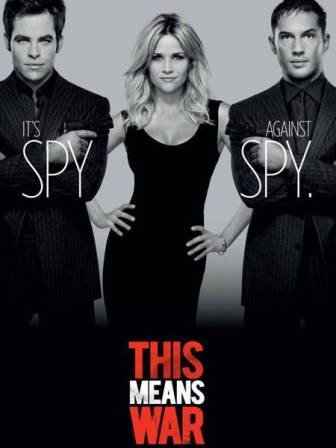
This Means War is about two CIA agents, FDR Foster (Chris Pine – Star Trek I & II, Unstoppable, Rise of the Guardians) and Tuck (Tom Hardy – Tinker Tailor Soldier Spy, Warrior, The Dark Knight Rises). They are the best of friends, work opposite one another, and have fought alongside each other in dangerous operations for America’s secret services.

But then they discover that they’re both dating the same girl, Lauren (Reese Witherspoon – Cruel Intentions, Walk The Line, Mud), who cannot make up her mind on who she likes more. Neither FDR nor Tuck are willing to pass and let the other have Lauren, so they decide to compete against one another to see who will woo her, using all kinds of equipment and tricks to achieve their objective.

Meanwhile, a Russian agent, called Heinrich (Til Schweiger – Inglorious Basterds, New Year’s Eve, The Courier), is on his way to America. Heinrich wants revenge against FDR and Tuck for killing his brother in a mission in Hong Kong.

FDR (Chris Pine) on a date with Lauren to win over her heart and triumph over Tuck, his friend and colleague.

The plot for This Means War is entertaining and easy to follow. There might be fewer action scenes than one might think, and certainly in contrast to the Die Hard series, Black Hawk Down, and Iron Man I & II. But This Means War compensates for this with the hysterically absurd lengths that FDR and Tuck go to so as to win over Lauren’s heart.

Just like with The Expendables, Knight And Day and Mission: Impossible IV, none of the cast take themselves seriously in the slightest. The main difference between those films and This Means War is that the latter movie has much better dialogue; almost every other line is a joke, and the banter between the actors is extremely humorous.

In a similar vein, the acting is ideal for this type of film. It is most unlikely that any member of the cast will get prestigious award nominations come January-February 2013, but all of the actors revel in their disingenuous roles, from the cocky, smooth-talking and good-looking Chris Pine; to the confident, yet level-headed (English CIA agent) Tom Hardy; to the indecisive and cute (noticeably revamped) Reese Witherspoon; to Lauren’s know-it-all, contradictory-advice giving sister, Trish (Chelsea Handler – Cattle Call, Hop, Fun Size).

Trish (Chelsea Handler) advising Lauren, as ever, to make up her mind and choose one of the two men she is simultaneously dating.

Despite the heavy focus on the dialogue and the acting, director McG (Charlie’s Angels, Terminator Salvation, Guilty) adopts conspicuously little by way of special effects. This is not necessarily a bad thing. Many action films, like Wanted, Captain America and Season of the Witch could have done with less CGIs and better dialogue and acting. The only problem for McG is that the few instances of special effects in his movie are done quite poorly; especially, when compared to the quality of those in Mission: Impossible IV.

Over-all, This Means War is a light, amusing and entertaining film. It has a cast that acts well for this type of film; that has great chemistry on screen; and that are easy on the eye. Perhaps directors in the future will learn a lesson from This Means War and inform their casts not to take their roles overly seriously when it is not necessary. Otherwise, audiences are destined to watch more movies where the actors appear unconvincing and hollow, like in Fantastic Four I & II, Salt and Immortals.

PG’s Tips
Review – Star Wars: Episode I: The Phantom Menace 3D (U) [2012; originally released in 1999]

Star Rating: 2.5/5

Star Wars, the saga that revolutionised special effects, has returned to the cinema. Thirteen years after it left the big screens, and now poorly adapted into 3D, Episode I: The Phantom Menace provides viewers with a convenient excuse to review the franchise from the beginning, and once more enjoy enlarged lightsaber v sith duels and mesmerising sci-fi-style battle scenes. (Warning, spoilers in this review.)

Young Anakin (Jake Lloyd). It is hard to see him as the masked villain of the saga at this point.

The Phantom Menace begins with turmoil engulfing the Galactic Republic. The Trade Federation has put up a blockade around the planet Nabu, due to a new taxation in trade routes. The Trade Federation wants to bring Nabu’s queen, Amidala (Natalie Portman – Black Swan, Thor, Lawless), to her knees and make her yield to their demands, using any means at their disposal.

Unknown to the Trade Federation, the Jedi Council have sent two Jedi knights, Qui-Gon Jin (Liam Neeson – The Next Three Days, Unknown, Wrath of the Titans) and his apprentice, Obi-Won Kenobi (Ewan McGregor – Star Wars I-III, Beginners, The Impossible), to rescue Amidala. That way she can bring her case to the Senate. Yet, as they fly past the blockade, their starship is damaged and they are forced to land on Tatooine to repair the ship.

On Tatooine, a planet outside of the republic’s orbit, Qui-Gon and Amidala come across a cute, little slave boy, called Anakin Skywalker (Jake Lloyd – Jingle All The Way, The Pretender, Madison). Qui-Gon sees something in Anakin, believing him to be the one who will bring balance to the Force.

After buying Anakin’s freedom, via the young boy’s pod race success, Qui-Gon takes him to the Jedi Council, where he hopes the council will allow him to train Anakin as his second apprentice. But the council is wary of Anakin. Yoda (Frank Oz – Star Wars I-VI, Sesame Street, Monsters University) and Mace Windu (Samuel L. Jackson – Star Wars I-III, Coach Carter, The Avengers Assemble) sense ‘great fear’ in him. They’re not wrong because Anakin fears for his mother’s survival. But, still, fear can only lead one way: the dark side.

Simultaneously, the unknown (phantom-like) Sith Lord and future emperor, Darth Sidious (Ian McDiarmid – Star Wars I-III & VI, Crime & Punishment, Margaret), urges his stooges in the Trade Federation to find Qui-Gon and Obi-Won. When they fail, Darth Sidious orders his apprentice, Darth Maul (Ray Park – X-Men, Heroes, Avarice), to find and kill the Jedi knights.

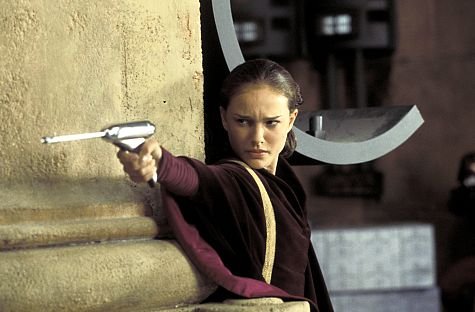
Queen Amidala/Padmé (Natalie Portman) leading from the front in the fight for the freedom of her planet.

The plot for The Phantom Menace is enjoyable and surprisingly intelligent. The film has a thrilling pod race tournament and the second best lightsaber v sith battle of the franchise (second after the epic duel between Obi-Won and Anakin/Darth Vader in Episode III: Revenge of the Sith); yet, the disputes over the trade blockade also make for a fascinating insight into the political workings of the republic.

More than anything, the disagreements in the republic reveal the cunning of Senator Palpatine (also Ian McDiarmid), as he slowly lays down the foundations for his arrogation of power. Behind the scenes, Palpatine commands the Trade Foundation (which will become the Separatist movement later in the series) to declare war on Nabu. To Queen Amidala, though, his advice is to go to the Senate and urge Chancellor Valorum (Terence Stamp – Wanted, The Adjustment Bureau, Big Eyes) to take action against the Trade Foundation. But knowing that the chancellor is incapable of doing that, due to being hamstrung by ‘bureaucrats’ (most likely Palpatine’s cronies), Palpatine recommends Amidala to call for a vote of no confidence in Valorum in the Senate to pave the way for a ‘stronger’ chancellor. (And guess who Palpatine might mean by that? Isn’t it a coincidence that he just happens to be voted in next?)

At the same time, Palpatine promises young Anakin that he will ‘watch over’ his Jedi training and be a father-like figure to him. The kindness of the gesture is unsettling to watch, knowing that Palpatine intends to exploit Anakin’s vulnerabilities to groom him as his long-term apprentice.

Ian McDiarmid plays well as the duplicitous Palpatine, despite the character’s crudeness. Yet, the star of the film is undoubtedly Liam Neeson. Even the most ridiculous of lines seem (almost) plausible when he speaks, and nothing looks (overly) contrived either. The same cannot be said for Natalie Portman or Ewan McGregor, who both give very poor and detached displays; whilst Jake Lloyd’s performance is passable at best. His enthusiasm and confidence (obnoxiousness) is refreshing at first, but becomes repetitive and annoying after a while.

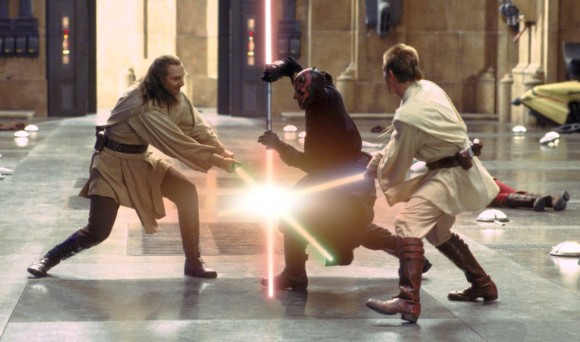
The fantastic three-way fight scene between Qui-Gon, Obi-Won and Darth Maul. Who will not survive?

The acting and dialogue may not be noteworthy, but the special effects are enthralling (even if they’ve been touched up considerably since 1999). It is just a shame that the 3D is hardly visible. The three-way duel at the end would have been even more of a spectacle had it been properly adapted; especially, with the atmospheric theme ‘Duel of the Fates’ for accompaniment.

Although the 3D is inadequate, The Phantom Menace is an entertaining movie. Once more, audiences can enjoy the impressive battle scenes and pod races; be dazzled by the special effects and lightsabers; and be intrigued by the way Palpatine abuses his powers for his ultimate goals. But most importantly of all, The Phantom Menace starts to explain how and why Anakin becomes Darth Vedar.

PG’s Tips
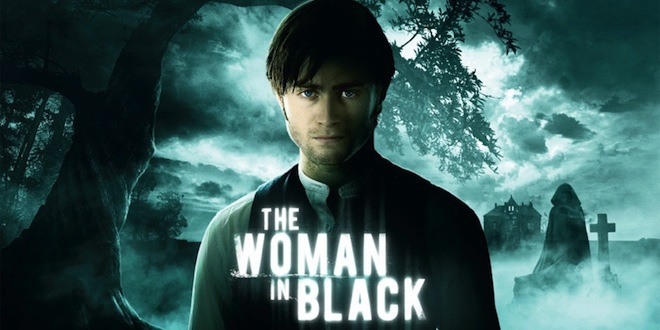
Review – The Woman In Black (12a) [2012]

Star Rating: 2/5

For years now, the horror genre seems to have lost its way. Few horror films, such as Audition, Martyrs and The Orphanage, have been genuinely scary. More often than not, horror movies have been poor excuses for comedy, such as Jennifer’s Body and The Wolfman. The Woman In Black continues this worrying trend for a genre that’s in a crisis.

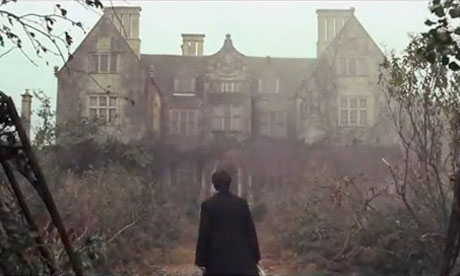
Arthur approaching the derelict Eel Marsh House. Who would want to go in there during the day, let alone stay overnight?

The Woman In Black is based on the book with the same title by Susan Hill, which has also been adapted to the theatre. The film is set at the turn of the twentieth-century. It is about Arthur Kipps (Daniel Radcliffe – Harry Potter I-VII(ii), Kill Your Darlings), a young lawyer and single parent, following the death of his wife, Stella (Sophie Stuckey – Driving Aphrodite, The Dark, Comedown). Arthur is on his final warning at the solicitor’s firm he works for. Consequently, when he is given the task of managing the estate of Alice Drablow, who owned Eel Marsh House, a mansion in the middle of nowhere in the gloomy north-east of England, he cannot say no.

The estate is old and slowly rotting. No-one has lived there for years. Those who dwell in the nearest village, except for Daily (Ciarán Hinds – The Debt, Tinker Tailor Soldier Spy, John Carter), who befriends Arthur, urge Arthur to stay away from Eel Marsh House. The villagers believe that the estate is haunted.

Arthur, though, is determined to see his task through and goes to Eel Marsh House to do his investigation. But whoever goes there sees the woman in black. And whenever she’s seen, children die mysteriously soon afterward…

The movie’s plot is as original as The Wolfman and Fright Night. Alike those laughable films, The Woman In Black has merely a few instances of the shock-factor. One would think that a creepy horror thriller would hold its audience in suspense, as The Shining and I Still Know What You Did Last Summer did so well. But, akin to Jennifer’s Body, The Woman In Black hardly makes the adrenaline pump.

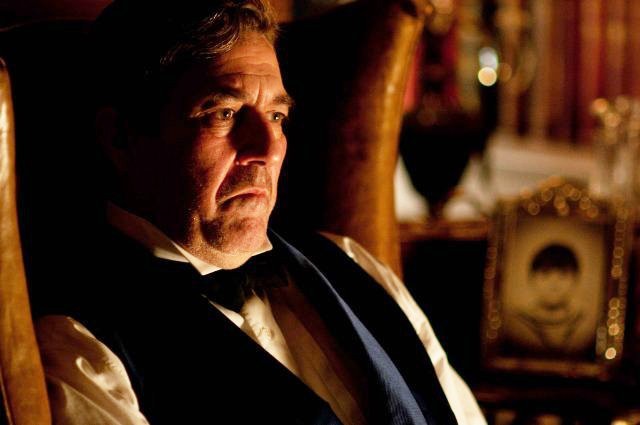
Daily (Ciarán Hinds), sitting in his armchair in his home, listening to Arthur tell him about how he has seen the woman in black over a glass of whiskey.

The Woman In Black’s storyline is made to look even worse because it makes as much sense as John Carpenter’s (abominable) The Ward. By the end of the film, amongst many failings, one knows little more about the woman in black than when he/she started the movie. Viewers are aware that this dead woman has an eye for vengeance, but what drives her? Why does she appear every time a child dies in the local village? (Indeed, why would she limit herself to that small place when she can terrorise all of England or the world?) One cannot help but ask oneself why director James Watkins (Eden Lake) did not at least try to explain the woman in black’s motives.

The plot’s poverty is reflected in the acting (even if the script gives them little chance to shine). Daniel Radcliffe hardly plays better here than he did in the Harry Potter series. He shows little emotion when trying to be affectionate towards his infant son, or when he is grieving for his deceased wife. This entails that viewers cannot feel anything for Arthur when he has to temporarily leave his son to go to Eel Marsh House. Radcliffe is also unable to shirk off his type-cast in The Woman In Black. As a result, whenever phantoms go near Arthur, one secretly believes that Harry – I mean Arthur – will simply pull out the Elder Wand and zap the dark ghosts into oblivion. This undermines Radcliffe’s attempt to be a professional solicitor in this movie.

Similarly, the quality of the acting from the supporting cast fairs equally badly. The usually reliable Ciarán Hinds performs below his normal standards as Daily. Janet McTeer (Tumbleweeds, Island, Albert Nobbs), Daily’s wife, appears little in the film, and when she is given screen-time she plays a two-dimensional mentally unwell person. And the rest of the cast, the villagers, merely play one-dimensional unwelcoming, superstitious freaks, meaning that the audience cannot relate to them or take them seriously.

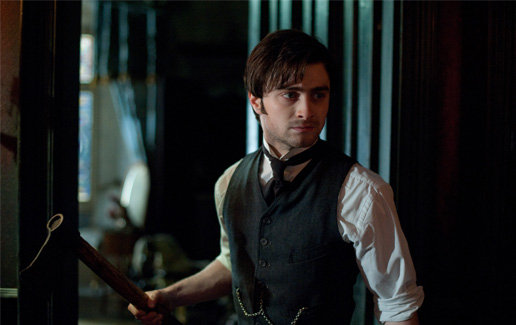
Arthur holding an axe, scared, as he goes upstairs to investigate where the noise is coming from in the abandoned estate.

Just like the acting, the make-up and special effects in The Woman In Black are neither poor nor noteworthy. The woman in black, herself, just looks like a gaunt and hideous doll behind a blurry veil, whilst the dead children look like they have life in them. Additionally, the costumes and the hairstyles don’t look plausibly like they’re from the early-1900s either, which gives viewers more reason to view this movie with contempt.

Over-all, The Woman In Black is (yet) another pitiful horror film. It has few redeeming features, save for a couple of scary moments to justify the movie’s place in the genre. The Woman In Black is not as risible as other recent, aforementioned horror films. But the movie’s inadequacies are symptomatic of a genre that’s in dire need of a revamp.

PG’s Tips
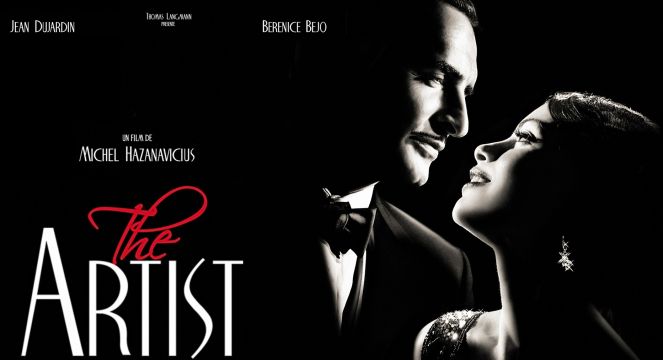
Review – The Artist (PG) [2012]

Star Rating: 5/5

In recent years, Hollywood has been dominated by films with colossal amounts of special effects, outrageous action scenes, and sequels to entertain viewers. Quality acting (the very factor that enables actors to win the prestigious awards) has seemingly become secondary to the aforementioned features for movies. Refreshingly, the French drama, The Artist, in outstanding fashion, illustrates that audiences can still be wooed by a relic of the past: a silent movie.

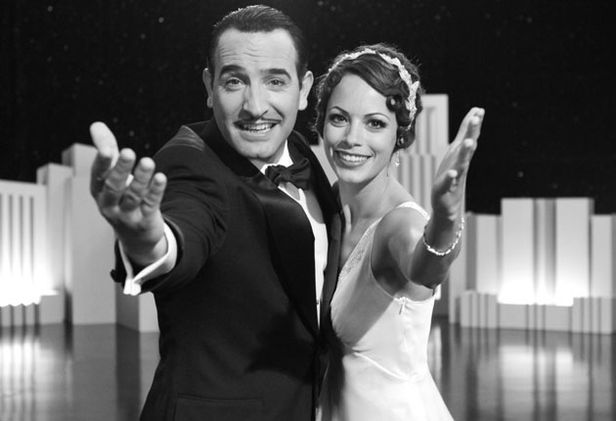
George Valentin (Jean Dujardin) and Peppy Miller (Bérénice Bejo) dancing together for a film. The two actors have great chemistry on set.

The Artist is set in Hollywood between the late 1920s and the early 1930s. It is about George Valentin (Jean Dujardin – OSS 117: Cairo, Nest of Spies, OSS 117: Lost In Rio, The Wolf of Wall Street), a man who has starred in many silent films throughout his acting career. Now though, George is being told by his boss, Al Zimmer (John Goodman – Pope Joan, Red State, 10 Cloverfield Lane), that the times are changing and that cinema audiences want dialogue and fresh faces. (‘Fresh meat’ as Zimmer calls it.)

The fresh faces include an upcoming young, pretty woman called Peppy Miller (Bérénice Bejo – A Knight’s Tale, Prey, The Scapegoat), who had been randomly photographed with George. Rapidly, she is replacing him. Between her and the Wall Street Crash of October 1929, George’s world is rapidly falling apart. He has to adapt to the times, something he’s loathe to do, or he faces the axe.

The Artist’s plot is straightforward and surprisingly easy to follow. Despite the lack of dialogue, one always understands the situation. The performances from the cast throughout the movie are brilliant. Jean Dujardin plays magnificently as the proud and stubborn actor, who is unwilling to be pragmatic. Bérénice Bejo is superb as the ambitious young actress. John Goodman plays well as the ruthless boss, who realises that public opinion has changed. Penelope Ann Miller (Kindergarten Cop, Blonde Ambition, Saving Lincoln) performs commendably as George’s trophy wife, who has no desire to be with a man whose best years are seemingly behind him. James Cromwell (The Green Mile, 24: Day 6, Still) does a fine job of being George’s loyal valet. And George’s dog, which is linked to him seemingly telepathically, adds a cute, sentimental aspect to the storyline.

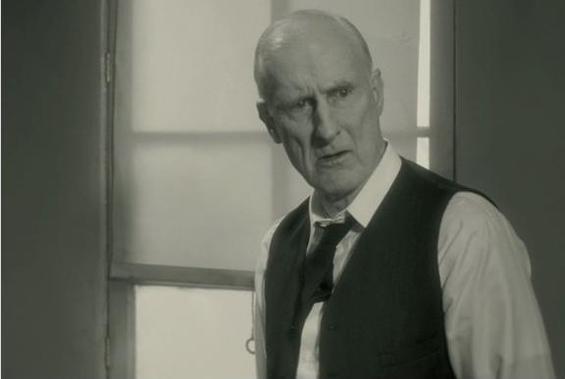
Clifton (James Cromwell), looking concerned for his master, George.

But the brilliance of the acting is very different from other exceptional performances, such as Colin Firth’s in The King’s Speech or Christian Bale’s in The Fighter. Remarkably, using body language and emotion, the actors stunningly demonstrate that words are not necessarily needed to portray human relationships and circumstances. Director Michel Hazanavicius (OSS 117: Cairo, Nest of Spies, OSS 117: Lost In Rio, The Players) does occasionally use bubbles of words to explain the context, which help, but they’re infrequent and hardly worth a mention.

If anything, it is not the words on the screen that aids the audience, but the music. The score greatly aids viewers to empathise with the characters. The 1920s-style music may not be like the enchanting scores of The Lord of the Rings or Inception, but it always captures the mood of the characters in The Artist. Whenever their temperament changes, so does the music to enhance the scene.

The magnitude of the acting and the music are more noteworthy considering that The Artist is a small budget film, which has close to no special effects and action. It is such a wonderful contrast to the (hideous) amount of computer generated images (CGI) and explosions used in most blockbusters today, such as Transformers III and Captain America. Consequently, The Artist feels cleaner and is more pleasant to watch. (Indeed, The Artist almost makes one want to beg Hollywood to fund more movies with fewer special effects and loud bangs.)

Doris (Penelope Ann Miller), George’s wife, disgusted with her husband for being photographed in the papers with a younger, more beautiful woman than herself.

Similarly, the movie has no breathtaking landscapes to charm viewers, like in The Way Back or True Grit. The Artist though captures its era magnificently, from the clothes the characters wear; to their hairstyles (Bérénice Bejo looks strikingly similar to Marion Cotillard in Midnight In Paris); to their cars; to their cameras; to the interior designs of their houses (which have some resemblance to the First-Class rooms and halls in the sunken Titanic). One could perhaps criticise the film for not depicting the Great Depression of the 1930s adequately. Yet, this was not the purpose of the film either, so one should not blame the director on this matter.

On the whole, The Artist is a work of art. It brings us back to pure cinema and makes viewers realise that when a film has acting of such phenomenal quality, then dialogue, special effects and action are not absolutely necessary to make an entertaining and dazzling film.

PG’s Tips
Review – Coriolanus (15) [2012]

Star Rating: 4/5

<<guest review by KJF>>

William Shakespeare and the filmed medium have an uneasy relationship. Over the years many film-makers have attempted to bring his plays to the silver screen but not all have been successful, with some versions feeling staid and flat. For all the glories of Laurence Olivier’s trilogy of adaptations, in more recent years there have been Kenneth Branagh’s Love Labour’s Lost (2000) and As You like it (2006), which were both poorly received. Ralph’s Fiennes’ Coriolanus bucks the trend, providing an inventive, violent and gripping take on one of the Bard’s later tragedies.

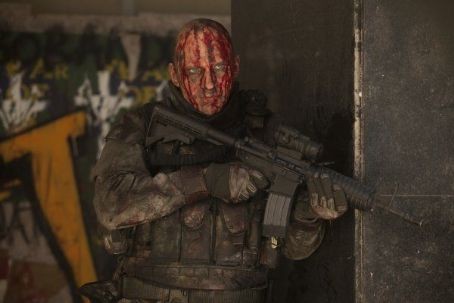
Coriolanus, blood-soaked, in the heat of battle.

The original play is set in the ancient world, during one of the Roman Republic’s endless wars against a neighbouring tribe. Caius Martius (Ralph Fiennes – Schindler’s List, Harry Potter VII(ii), Wrath of the Titans), is Rome’s greatest general. Having just scored a bloody victory against the rebellious Volscians, he returns to his home city and is given the honorific name ‘Coriolanus’, in recognition of his battle prowess at the Volscian city of Corioles. At Rome the populace are starving due to a grain shortage. He tends to hold the people in contempt, and when his election to the consulship collapses, and he gets exiled, the disgruntled general defects to the Volcians and plots his revenge.

Here the story is updated to a modern Balkan setting which is very effective, recalling the wars in the 1990s following the collapse of Yugoslavia. The battles between Romans and Volscians are fought on bomb blasted streets, strewn with the wrecks of cars and buildings with terrified civilians being caught in the crossfire-scenes so reminiscent of modern urban warfare. The bleak, withered, Balkan landscape is a particularly effective back-drop to the bleakness of Coriolanus’ fate in the latter part of the film.

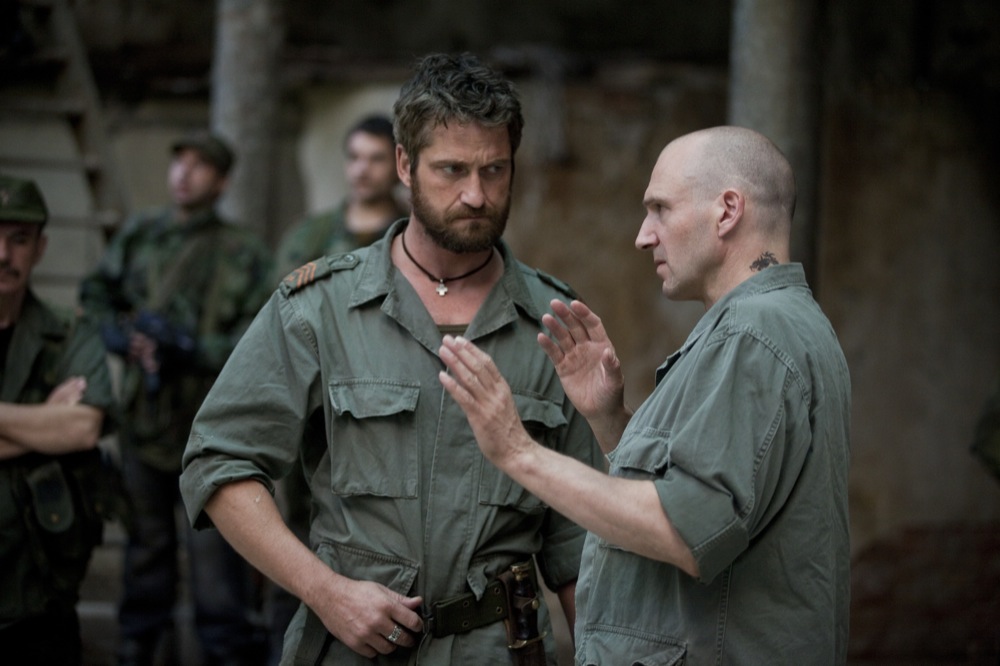
Fiennes in directing mode with Gerard Butler, playing Tullus Aufidius

All the events of the story are told through the prism of rolling news footage, with newscasters and pundits (naturally) spinning everything. (Even Jon Snow gets a look in!) When the grain protests in Rome are depicted, this allows for some fortuitous contemporary resonance as we cannot but think of the Arab Uprisings, particularly all the protesters massing on Tahrir Square. That all the political debating on show is done in the glare of television cameras instantly broadcasting into countless households feels particularly right. In Republican Rome, many political debates were held in public in the Forum.

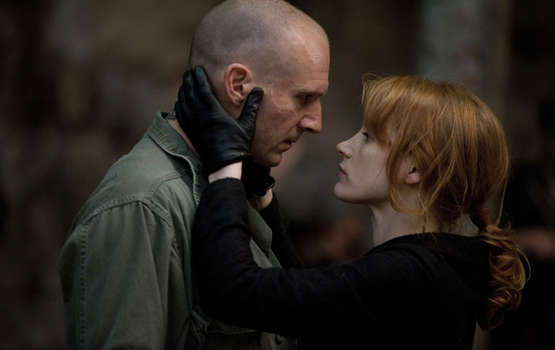
Fiennes is following in the grand tradition of both Olivier and Branagh as both actor-director, and this is very much his film. The camera likes to linger on his battle-scarred, shaven, bullet-shaped head, which in the heat of battle gets spattered in blood. One needs no convincing that this is a serious warrior. When faced with dealing the people of Rome he so despises, his icy contempt for them is tangible. Fiennes is supported by a fine cast. Vanessa Redgrave (Mary, Queen of Scots, Letters to Juliet, Song For Marion) as Volumnia, Coriolanus’ formidable mother, is truly magnificent. She is a civilian but her martial bearing and control she exudes over her son is emphasised by the military dress she mostly wears. The seemingly ubiquitous Jessica Chastain (The Help, Take Shelter, Zero Dark Thirty) acquits herself admirably as the other woman in Coriolanus’ life, his doting wife, Virgilia. Gerard Butler (300, P.S. I Love You, London Has Fallen) plays a brooding Tullus Aufidius, the leader of the Volscians and nemesis of Coriolanus. There is, perhaps inescapably a touch of Leonidas about his performance but he very much proves the match and the mirror to the Roman general. The Roman politicos here are a conniving bunch, all decked out in slick, expensive suits and Brian Cox (Troy, Rise of the Planet of the Apes, Dog Fight) brings much style to his portrayal of the loquacious, fawning senator Menenius Agrippa, supporter of Coriolanus’ family.

Virgilia (Jessica Chastain) pleading with Coriolanus not to go back to war.

The faults with the film reflect back to the play itself. Coriolanus is the most unsympathetic of Shakespearean ‘heroes.’ He is no Hamlet or King Lear to draw much pathos. We rarely see behind his front of arrogance and hauteur and his loathing of people power, to what makes him a human being. The play itself can be heavy-going at points, punctuated with very long-winded speeches. Thankfully here, Fiennes in collaboration with his screenwriter, John Logan, has done some merciful pruning, to make everything more palatable.

Thus, Fiennes should be commended for bringing a less popular and less well-known Shakespearean play to a much wider audience. Indeed the vigour and imagination on display makes the film a rewarding and thought-provoking experience.

KJF

Review – Shame (18) [2012]

Star Rating: 3/5

Few would consider having an active sex-life to be a bad thing. But what if one were to suffer from a compulsive need for sex? Such a problem exists in society. Shame, despite its faults and gloominess, illustrates the torment that this syndrome can cause people.

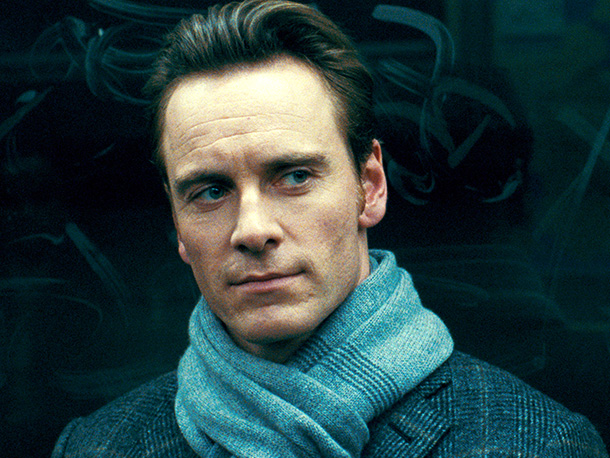
Brandon (Michael Fassbender) eying up a girl on the train like a predator.

The film centres round Brandon (Michael Fassbender – 300, X-Men: First Class, Prometheus), a high-flying manager or executive (in a job that is not defined), who cannot control his urge for sex. In his nice, relatively up-market flat in New York City, he hires prostitutes/escorts or watches pornography endlessly. At work, he watches pornography (to the extent of having his hard-drive removed because it’s filled with viruses) before going to the bathroom to masturbate. Every woman he sets eyes upon is a potential victim of his insatiable lust.

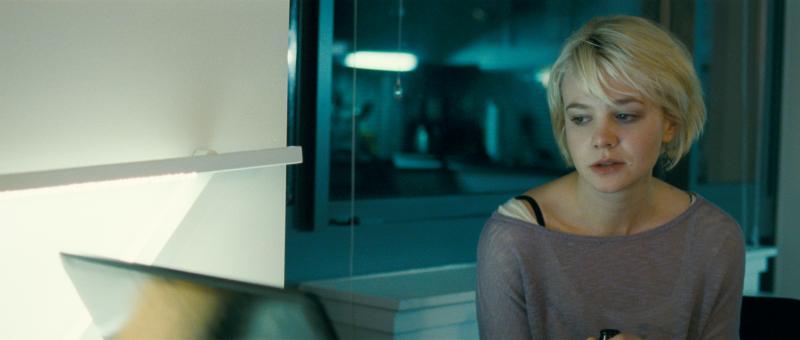
Yet, none of this appears to make Brandon any happier. Soon his sister, Sissy (Carey Mulligan – An Education, Wall Street II: Money Never Sleeps, Suffragette) comes to stay at his apartment, bringing out the worst in his frustrations and temper.

Shame’s plot is simple, but morbid. The mental torture that Brandon suffers from is excruciating (despite having an addiction that many would consider to be pleasurable). Unlike with Oscar Wilde’s Dorian Gray, played by Ben Barnes in the 2009 film, there is no enjoyment in sex for Brandon (or deal with the devil for that matter). Sex is just a constant, agonising thirst that can never be quenched. The threesome scene near the end reveals the degree of pain this addiction causes him. (Although, how Brandon maintains his stamina for so much sex is quite remarkable. One wonders if there are enough hours in the day for work, exercise and all of that sex.)

Sissy (Carey Mulligan) sitting in her brother’s apartment in need of attention. That’s when she notices her brother’s laptop…

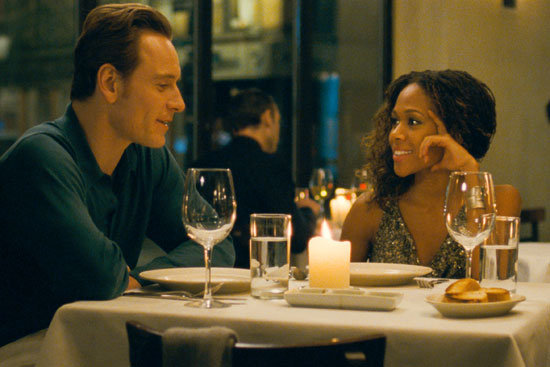
Brandon’s drug-like compulsion for sex and pornography has also come to seemingly destroy any chance of him having a relationship too. When he tries one with Marianne (Nicole Beharie – American Violet, The Express, The Last Fall), a pretty, young work-mate, he finds himself incapable. This is because the idea of love in sex has become an anathema to him.

Yet, apart from Brandon’s uncontrollable lust, Shame’s storyline loses direction quickly. This makes the film’s 101 minutes seem (frustratingly) like it will go on indefinitely. The plot also fails to explain Brandon’s background, as well as badly under-developing his relationships with his messed-up, needy sister; with his amiable and attractive fellow employee; and with his married, but embarrassingly desperate boss, David (James Badge Dale – 24: Day 3, The Departed, The Grey).

If the storyline (even with the explicit sex scenes) doesn’t hold the audience’s attention, Michael Fassbender’s performance certainly will. Fassbender delivers an excellent display that is as intense as it is brave and consistent. His green eyes stare at women like a hawk-bird to its prey. They also hint at an anger and pain, a deep shame, buried within Brandon that he refuses to recognise or counter. Does he do this because his syndrome is apparently humiliating and a taboo subject in society?

Fassbender might be the stand-out performer of the movie, but none of the supporting cast play badly. Carey Mulligan again gives a solid account of herself. She has a very different character here to the ones she played in Wall Street II: Money Never Sleeps and Never Let Me Go. Nonetheless, she demonstrates that she can play a whiny, emotionally-deficient, unstable girl, craving affection, with equal plausibility. Similarly, despite their short and limited roles, neither Nicole Beharie nor James Badge Dale damage their reputations with their performances in Shame.

Brandon out with Marianne (Nicole Beharie), seemingly enjoying her company. But has he told her about his compulsive disorder?

The impressiveness of the acting is enhanced when considering that director Steve McQueen (Hunger, 12 Years A Slave) takes long-held shots for much of the film. Many of the scenes have no breaks or changes in camera angles. This style of filming demands immense concentration from the actors. That they make their acts look natural is credible and significant.

McQueen’s other noticeable technique in Shame is to use silence and little music to ram home to viewers Brandon’s loneliness and internal agony. When McQueen does adopt music, it is generally the main soundtrack which is comprised of long-held notes by stringy instruments and a subtle fast-beat. The main theme tune may lack Requiem For A Dream’s soundtrack’s feel of a crisis that is spiralling out of control, but it helps to compound Brandon’s lack of self-worth and his sense of self-hatred.

Over-all, Shame passably explores a problem that is not discussed much or recognised in present-day society. (After-all, one might think, how could having sex regularly be the cause of a major psychological disorder? It should be the other way round, right?) Shame has its deficiencies, it might appear directionless, and it might make for depressing viewing. Nevertheless, Michael Fassbender’s brilliant and courageous performance forces one to empathise with Brandon’s suffering and self-harm, as well as obliges one to appreciate what the syndrome can do to people in general.

PG’s Tips
Review – The Iron Lady (12a) [2012]

Star Rating: 3/5

Dementia is a cruel infliction that eats away at what an individual once was. (Lady) Margaret Thatcher, British Prime Minister 1979-90, was a formidable and highly intelligent woman in her day. Yet, rather than focus on her prime, The Iron Lady highlights the crippling effects that the illness has had on Lady Thatcher in her more recent years.

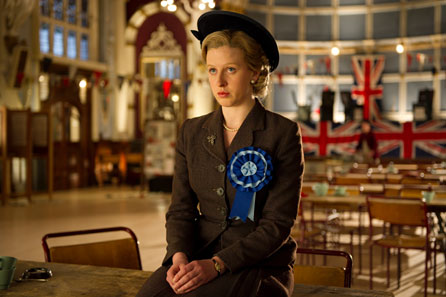
‘Young Margaret’ (Alexandra Roach) standing for election in Dartford (in 1951). She was then the only female Conservative candidate across the country.

The film is about Lady Thatcher (when young played by Alexandra Roach – Private Peaceful; when middle-aged and old played by Meryl Streep – Sophie’s Choice, The Devil Wears Prada, Suffragette), elderly and suffering from delusions and dementia, glimpsing back, at random, at the happy and distressing moments of her life, before she attends the ceremony of the unveiling of her portrait at the Prime Minister’s house.

The movie’s plot is simple, but is not necessarily easy to follow. This is because whenever Lady Thatcher looks back into the past, she does not do so in chronologically and there is nothing to inform viewers of the year they’re watching. Even for those who are historically fine-tuned, this can be confusing. Factually, The Iron Lady is generally accurate; yet, there are several brushes of artistic license in the movie, such as the timing of Denis Thatcher’s (when young played by Harry Lloyd – Jane Eyre, A Game of Thrones, Junk; when old played by Jim Broadbent – Gangs of New York, Harry Potter VI & VII(ii), Cloud Atlas) proposal.

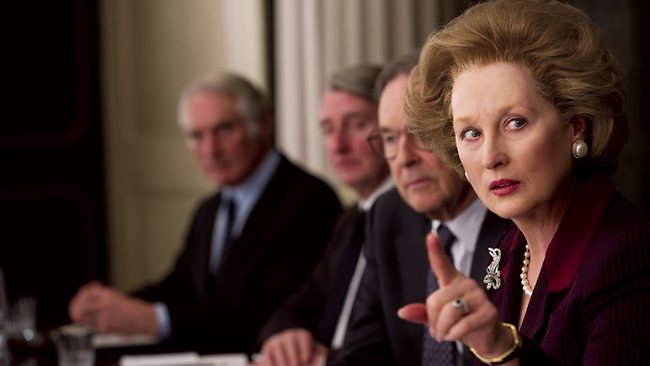
Thatcher, as Prime Minister, in a cabinet meeting, telling a colleague that it is not his time to speak.

More than anything, the storyline’s approach undermines Lady Thatcher. It undermines her as a person, her ideology (the idea that the individual should not depend upon the state and that he/she should determine his/her destiny), and all that she did for the country and for women across the world. First, at 105 minutes, The Iron Lady is too short, since more time was needed for director Phyllida Lloyd (Mama Mia!, Macbeth) to have adequately visualised Thatcher’s life before and after she became a politician. Second, for a woman who sacrificed so much for politics, the film stresses astoundingly little on Thatcher’s rise to the premiership, as well as her time in ten Downing Street and her fall from office. That much of her time in office in the movie is dominated by her hardline policies towards cutting public spending; beating back rioters; and the wars against Argentina, over the Falkland Islands, and the IRA (terrorism), has a familiar chime, as if Ms. Lloyd was trying to (not-so-subtly) force her own views of the current Coalition government upon viewers. Third, to have Lady Thatcher remembering her life via flashbacks, among delusions of her late husband was callous and insensitive; especially, as the former Prime Minister is still alive. If anything, it makes even those who despise Lady Thatcher pity her. (Whoever would have thought that the die-hards on the Left would feel sympathy for Thatcher?)

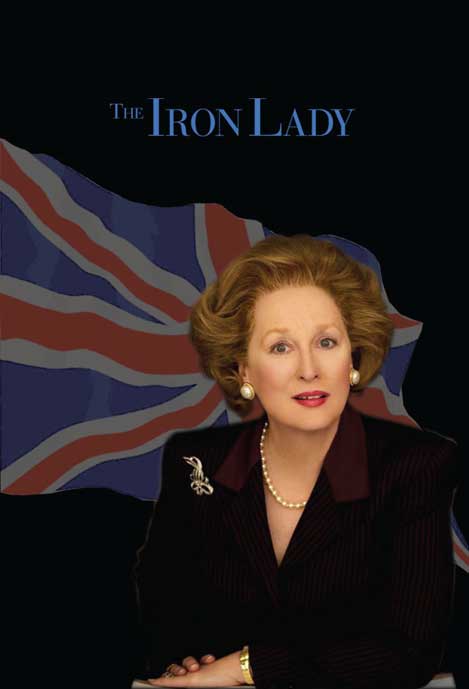
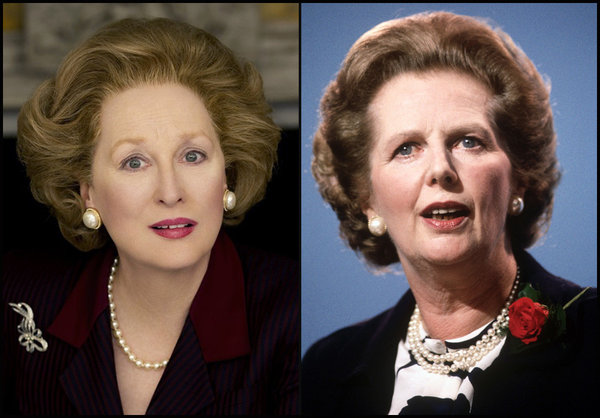
Irrespective of the plot, there is an exceptional performance from Meryl Streep, which makes The Iron Lady worth watching in and of itself. Throughout the movie, Streep seemingly morphs into Lady Thatcher to the extent that one is likely to forget that they’re not watching the real person.

Thatcher in her heyday (right), and Meryl Streep (left) as the brilliant look-alike.

It is a shame for Streep that the supporting cast cannot match her display. Alexandra Roach, as ‘young Margaret’, is distinctly average, as are the two actors who play Denis Thatcher, Harry Lloyd and Jim Broadbent. The rest of the cast, particularly Anthony Head (Buffy The Vampire Slayer, The Inbetweeners Movie, Ghost Rider II: Spirit of Vengeance) and Richard Grant (Twelfth Night, Corpse Bride, Zambezia), impersonating Thatcher’s ministers Geoffrey Howe and Michael Heseltine, respectively, play poorly with the little time they have on screen. Head and Grant do not capture their characters’ personalities accurately. Both actors appear as cowardly critics (with eyes brimming with hawkish ambition) of their leader’s policies at times of supposed crises, and Grant also fails to give Heseltine the ego that drove him to resign as Defence Minister in 1986 and challenge for party leadership in 1990.

All-in-all, Margaret Thatcher was a formidable individual in her day. She was, and still is, a highly polarising figure for many a reason. Therefore, one would expect a biographic film to be about her achievements and shortcomings as a leader, and perhaps a bit about her legacy too. Yet, The Iron Lady shows relatively little of these, preferring instead to let us watch and pity an elderly lady no longer in complete control of her mind. Despite a phenomenal performance from Streep, the film would be an insult to any human being, let alone one of the calibre of Lady Thatcher.

PG’s Tips
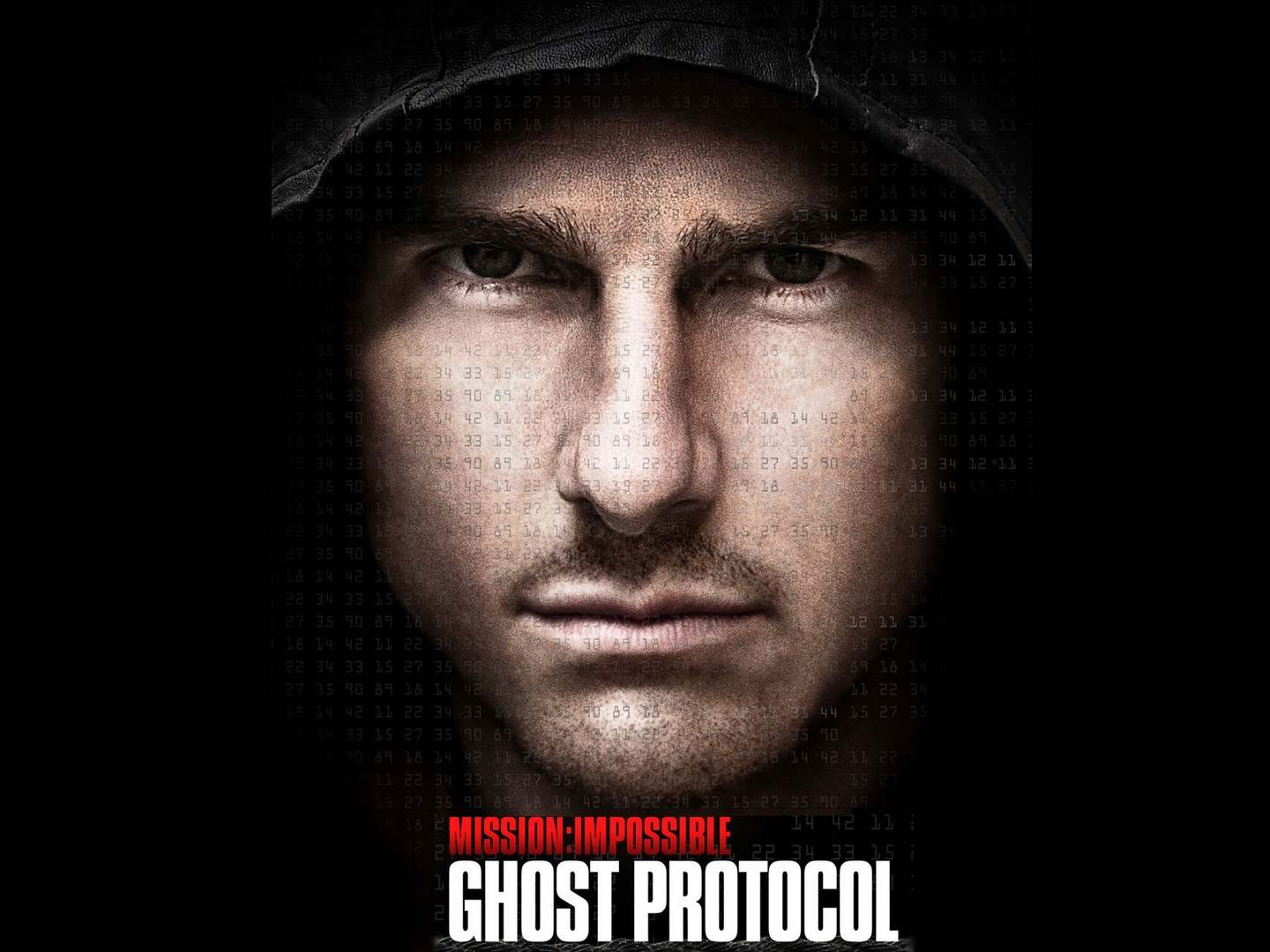
Review – Mission: Impossible IV – Ghost Protocol (12a) [2011]

Star Rating: 3.5/5

The accomplishments of Ethan Hunt, America’s most implausible secret agent, throughout the Mission: Impossible franchise, have been nothing short of incredible (in the true sense of the word). Whether it is dodging bullets and explosions; going down elevator shafts; removing countless different face-masks; procuring files from encrypted computer systems; or tracking down his enemies across the world and killing them, Ethan has never let his country down. In entertaining fashion, Mission: Impossible IV – Ghost Protocol is more of the same, just with the latest technological gadgets.

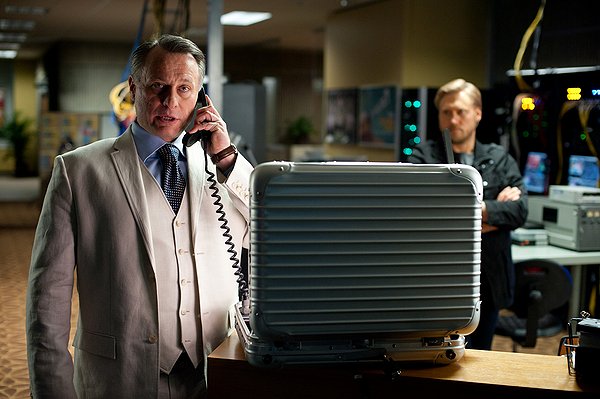
The villian, ‘Cobalt’ (Michael Nyqvist), talking on the phone to execute his orders to launch a missile.

After a failed mission in Budapest to get hold of Russian nuclear missile codes, the Impossible Missions Force (IMF) Secretary (Tom Wilkinson – Shakespeare In Love, The Debt, Denial) launches the mission ‘Ghost Protocol’ and sends Ethan Hunt (Tom Cruise – Mission Impossible I-III, Valkyrie, One Shot) into the field with a team, consisting of Benji (Simon Pegg – Mission Impossible III, Paul, Star Trek I & II), Jane (Paula Patton – Déjà Vu, Precious, Disconnect) and Brandt (Jeremy Renner – S.W.A.T., The Hurt Locker, The Avengers Assemble). The IMF needs to find an agent known by the codename ‘Cobalt’ (Michael Nyqvist – Arn: The Knight Templar, The Girl With The Dragon Tattoo, Disconnect), who has apparently got access to the codes, and stop him from launching nuclear war.

In the meantime, the Kremlin is threatened by a bomb attack and believes that the Americans are behind it. Thus, Ethan and his team, in a mission that will take them to many countries, must go rogue if they are to succeed.

The storyline for Ghost Protocol is quite simple at its core. It undoubtedly lacks the realism of Munich and The Debt (and even makes James Bond films appear plausible). Nevertheless, director Brad Bird (The Incredibles, Ratatouille, 1906) gives one what he/she would want to see in a film like Ghost Protocol, such as plenty of explosions (although nowhere near as many as in the colossal Transformers III), and stunts that are so ludicrous one needs a sack of salt to believe what he/she is watching (for a pinch of the stuff would not be enough).

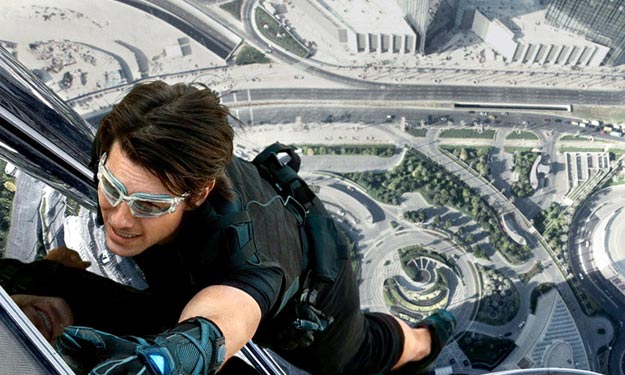
If he’s not jumping down an a shoot, Ethan (Tom Cruise) is climbing the tallest skyscraper in Dubai.

Yet, as has been typical with the Mission: Impossible series, Ghost Protocol’s plot has a convoluted nature that differentiates this franchise from the Bond films and the Bourne series. Consequently, Ghost Protocol may not be so easy to follow. Whilst audiences are likely to realise that Ethan and his team are hunting ‘Cobalt’, the various other characters that flow in and out of the movie, as well as the subplots, complicate the storyline unnecessarily.

Moreover, the film’s plot is not aided by the dialogue. Viewers with a brain would be advised not to scrutinise the conversations held by the characters. Rarely do the discussions make sense to the extent that it’s remarkable that the protagonists can even contribute to their conversations. (That they understand their instructions is nothing short of miraculous!)

At least none of the actors take their roles overly seriously; if they had done, their performances would have been as pitiful as those in Fantastic Four I & II and in Captain America. However, since there is little pretence on behalf of the protagonists of the ludicrous nature of the film, all of the actors give decent and humorous, if unmemorable, displays: Tom Cruise plays (probably himself) with the same arrogance and ingenuity that he is so accustomed to playing; Simon Pegg makes his usual goofy jokes, and is the same IT-wizard of Mission: Impossible III; Jeremy Renner reprises the skills he learned in S.W.A.T., without adding much more to the movie; and Paula Patton looks good and has a surprisingly large role (especially considering that the Mission: Impossible franchise has been dominated by Cruise showing the world that he is the latest version of Action Man).

The only one who loses out is the villain played by Michael Nyqvist, since he appears so little on screen. As a corollary, Nyqvist does not get the opportunity to show audiences of his capabilities as an actor, which he illustrated so well in the Swedish adaptation of The Girl With The Dragon Tattoo and its sequels.

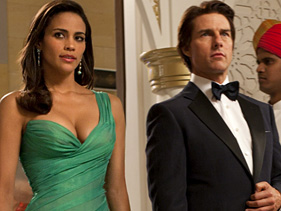
Ethan and Jane (Paula Patton) dressed very nicely for a lavish party. Jane is hoping to catch someone’s eye.

Lastly, the special effects and the technical gadgets used throughout Ghost Protocol are outstanding. The effects may not look as spectacular as in Harry Potter VII: Part II, but they are certainly convincing. Similarly, the gadgets are fully up-to-date and employed as impressively as when Ethan used the then-new tool, called the internet, in Mission: Impossible I. (Oh how far we have advanced!)

Over-all, Ghost Protocol gives (Tom Cruise as) Ethan Hunt another chance to achieve the unachievable and save America (and the world) from catastrophe. The film throws in more explosions, impractical objectives and improbable scenarios, as well as the latest technology, to a franchise that has always made for senseless and outrageously far-fetched, but enjoyable viewing.

PG’s Tips