
Category Archives: Thriller

Review – Rise of the Planet of the Apes (12a) [2011]

Star Rating: 3/5

In the last two hundred and fifty years, there have been revolutions in America, France and Russia, to name three of many. Now, due to the entertaining, if flawed, Rise of the Planet of the Apes, there has been an ‘Ape revolution’ to add to that (tragically) long list.

Baby Caesar, the future leader of the ‘Ape revolution.’

The film’s plot centres round Will (James Franco – 127 Hours, Your Highness, Sausage Party) and his incredibly bright pet chimpanzee, Caesar (played by Andy Serkis – The Lord of the Rings I, II & III, Burke & Hare, The Hobbit I ). Will is a scientist, who believes that he has found the cure for Alzheimer’s. He uses data readings from apes – Caesar in particular – to prove it. The cure also increases brain function and intelligence considerably. This enables Caesar to communicate with Will, as well as facilitate the former’s ability to learn compassion and love; not to mention help set up Will with the beautiful Caroline (Frieda Pinto – Slumdog Millionaire, You Will Meet A Tall Dark Stranger, Immortals).

Nevertheless, the cure also makes Caesar realise that he is different from humans. After being taken into captivity, and being maltreated by Dodge (Tom Felton – The Borrowers, Harry Potter I-VII(i) & VII(ii), The Apparition), Caesar uses his brain to the maximum. Then, in a Lenin-like moment, he calls upon all the apes of San Francisco (rather than the workers of the world) to unite and fight back against human rule. Thus, begins the ‘Ape revolution.’ But where will it end?
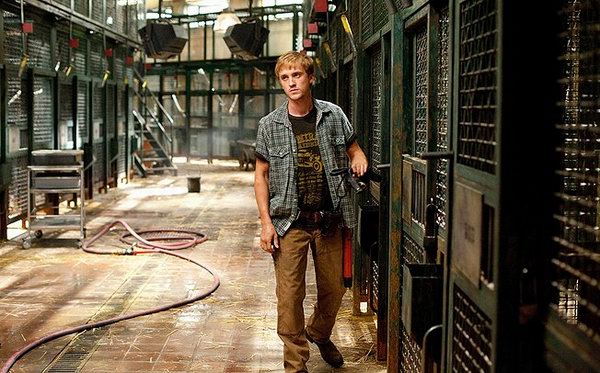
Dodge (Tom Felton) making sure that all the apes are locked in their cages.

For a little over an hour, the storyline and the dialogue for Rise of the Planet of the Apes is easy to follow, engaging and intelligent. Christopher Wyatt’s (The Escapist) film appears to hold great promise, but, alas, it goes badly off on a tangent for the last forty minutes. Several elements of the movie are left incomplete and unexplained; for example, at the sanctuary there are at most two dozen apes, but when Caesar leads the revolution there are hundreds. Where did they all come from, and how did they all become so intelligent?

The plot may have its flaws, but the acting by Andy Serkis makes the film worth watching. Serkis, in another Gollum-like role (albeit without the schizophrenia and dual-personality disorder), delivers another impressive performance. Using facial expressions, gesticulations and sign language, Serkis gives Caesar some very human characteristics that force viewers to empathise with Caesar’s situation (at least for the majority of the film).

Serkis’ performance is undoubtedly the best of the cast. Nevertheless, James Franco and John Lithgow (Shrek, Dreamgirls, New Year’s Eve), who plays Will’s father, don’t play badly either, even if their roles are not especially challenging. The same, though, cannot be said for Freida Pinto, Tom Felton and David Oyelowo (Derailed, The Last King of Scotland, The Help), who plays as Will’s boss at the laboratory. Again, none of their roles are challenging and they may not have much screen time. But when they do appear, they all have two-dimensional characters that sound awfully contrived. And, in Felton’s case, if he plays a character similar to Draco Malfoy once more he risks being type-casted.

Brotherly love between the fully grown Caesar (played by Andy Serkis) and Will.

With the exception of Serkis, the acting may not be notable. Nevertheless, the music is uplifting and apt for every scene, thereby making the movie that bit more gripping. Similarly, the special effects throughout the film are pretty decent. More often than not, one would believe that it is a real chimpanzee climbing through the trees, rather than it being part-Serkis, part-CGI.

Rise of the Planet of the Apes is an enjoyable movie. Serkis delivers another sterling performance. With the aid of some brilliant CGI, he is able to give his ape a very human feel. It is a shame for him that most other aspects of the movie are not on the same level. In many ways, Rise of the Planet of the Apes epitomises revolutions in general. It loses its way.

PG’s Tips

Review – Transformers III: Dark of the Moon (12a) [2011]

Star Rating: 2.5/5

In a recent Daily Mail article, Brian Clark Howard accuses Transformers director, Michael Bay (Transformers I & II, Armageddon, The Rock), of using footage from his previous films, Pearl Harbour and The Island, in the latest Transformers movie. Of course, Transformers III: Dark of the Moon is not entirely made of recycled parts of other films. Then again, whilst watching the last volume of the Transformers saga (although, one can never rule out a fourth instalment these days), one does get the impression that he/she has seen it all before, much to the film’s detriment.

Optimus Prime (voiced by Peter Cullen), the leader of the Autobots, fighting to defend the city of Chicago from the Decepticons.

Dark of the Moon begins with America launching the first shuttle into space in 1961, and continues with the first man landing on the moon in 1969. It is on the moon that a party of astronauts discover the ruins of a lost Autobot space shuttle, called the Ark. Inside the remains of the Ark are the Pillars, energy fuel in a cylindrical containing the power to open a bridge to Cybertron, the Transformers’ lost-world; and Sentinel Prime (voiced by Leonard Nimoy – Star Trek), the lost leader of the Autobots.

After finding out about the mission, Optimus Prime (voiced by Peter Cullen – Transfomers I & II), the leader of the Autobots in the absence of Sentinel, leads an expedition to rescue his wise master. Only Sentinel understands how to manipulate the Pillars to forge the bridge between Earth and Cybertron. (The bridge can travel through time too.) Optimus hopes to use Sentinel to bring good to Earth and, perhaps, force the victorious Decepticons out of Cybertron. However, Megatron (voiced by Hugo Weaving – The Matrix I-III, Lord of the Rings Trilogy, The Hobbit I), the leader of the Decepticons, has other ideas. He intends to use Sentinel to his own advantage.

Meanwhile, Sam Whitwicky (Shia Labeouf – Transformers I & II, Disturbia, Fury) has finished college and is unemployed. As he looks for a job, he finds himself embroiled once more in the war between the good Autobots and the evil Decepticons.

A mean-looking Decepticon flying through Chicago as the bridge to Cybertron is being activated.

Whilst the film’s plot may appear decent, the pace is slow and quite dull. It is strange to think that a film with loud booms, explosions and a super-gorgeous girl would be tedious. But Transformers III is tedious! That the storyline loses its way less than half way through the film (some would say twenty minutes) and the movie is two and a half hours long, may have something to do with it.

But what is more surprising is that the film’s second-half descent into a chaotic over-indulgence of action and destruction seems quite ordinary. The music is epic and up-lifting, and the CGI is undoubtedly awesome. Yet, those are things that viewers of Transformers III have heard and seen in volumes I & II. (In addition, the mass assault of the Decepticons upon the city of Chicago looks like scenes from the recent far-from-spectacular alien invasion movies, Battle: Los Angeles and Skyline.)

Nevertheless, the action scenes in Dark of the Moon have not been done well at all. The scenes are badly choreographed and don’t follow on from one another, leaving gaping holes in the storyline. (How Steven Spielberg, one of the film’s executive producers, did not notice this is remarkable.)

Sam’s stunning new girlfriend, Carly Spencer (Rosie Huntington-Whiteley), stepping out of an expensive Mercedes.

The structure of the film is not the worst part of Dark of the Moon by a long stretch. That award goes to, once again in the Transformers saga, the dialogue and the acting. The former is laughably appalling and the latter, almost as a consequence, is pathetic. If a brilliant actor like John Malkovich is made to look poor (and he did not even achieve such a feat in the disaster movie Eragon), then there is virtually no hope for the rest of the cast, such as Shia Leboeuf and Megan Fox’s replacement, Rosie Huntigton-Whiteley. (And yes, Bay can’t help but take a not-so-subtle swipe at Fox for comparing him to Hitler.)

So Dark of the Moon has dreadful acting and dialogue; the same old war between the Autobots and the Decepticons, and the usual inspiring music to go with it; as well as exceptional CGI. Does that mean one has seen it all before in the Transformers franchise? The tedium would suggest so, but with one difference: a sexy brunette bimbo has been replaced by a sexy blonde bimbo.

PG’s Tips

Review – Pirates of the Caribbean IV: On Stranger Tides 3D (12a) [2011]

Star Rating: 2.5/5

When it comes to a fourth movie in a franchise, a sceptic might wonder if it is merely an easy excuse to rake in money, ahead of taking a risk and dreaming up something innovative. Other fourth instalments, such as Die Hard 4 and Fast 4 (not to mention Fast 5), have lacked creativity in favour of the familiar themes and characters that audiences have come to love. The same can be said for Pirates of the Caribbean: On Stranger Tides. Despite director Rob Marshall’s (Memories of a Geisha, Nine, Chicago) attempts to spice up the Pirates of the Caribbean series, On Stranger Tides illustrates that it might have been better just to have ended the series after the third instalment, At World’s End.

Captain Barbossa (Geoffrey Rush), the reformed pirate, dressed admirably as a respectable Royal Navy Officer.

On Stranger Tides is based on the book by Tim Powers and centres once again on Captain Jack Sparrow (Johnny Depp – Pirates of the Caribbean I, II & III, Charlie & The Chocolate Factory, The Tourist), as the droll pirate with warped logic and a twisted moral complexion. This time around, he is out to find the Fountain of Youth. The Spanish and the English are also in a race to find this place, and only Sparrow knows the way. (Although, whether Sparrow has actually been to the Fountain of Youth is, of course, a little dubious, due to his canny nature.)

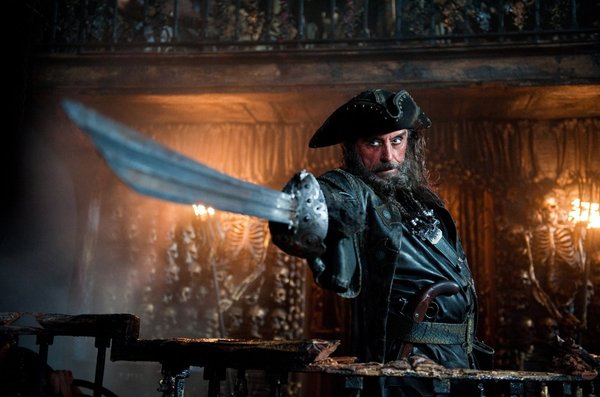
But to enter the fountain requires certain things that will not be simple to acquire. Plus, the feared and ruthless pirate, Blackbeard (Ian McShane – Kung Fu Panda, Coraline, The Golden Compass), is also hell-bent on reaching the fountain in order to preserve his life for many more years.

The plot is filled with twists and deceptions that have become a predictable feature of the series. The storyline is at times ridiculous; yet, one accepts it knowing that he/she has not gone to watch a serious or realistic film.

One of the new characters in the series, the feared pirate, Captain Blackbeard (Ian McShane).

However, the most disappointing aspect of On Stranger Tides is the script. It hampers the film and, primarily, sells the two main stars short. Whilst Johnny Depp gives another fine performance as Captain Sparrow, he lacks his trademark wittiness and oddities. Even his outrageous stunts no longer appear so outrageous anymore. Maybe we are too used to ‘witty Jack’ and expect too much from him. In fairness, it is almost impossible to light up the scene all the time with a brilliant comeback line. Nevertheless, the script for this movie is a far cry from that of Part I, The Curse of the Black Pearl, which had some fantastic lines.

Just as Depp has been let down, so too has Geoffrey Rush (Pirates of the Caribbean I, II & III, The Tailor of Panama, The King’s Speech). Rush returns as Captain Barbossa, who has now seemingly given up the life of a pirate for that of a respectable English naval officer. Barbossa’s character is a pale shadow of the one who entertained us so magnificently in the first three films. This is a real shame, as his rivalry with Sparrow in the past has made for terrific entertainment.

Captain Sparrow taking the beautiful Angelica to the Fountain of Youth via a river in the jungle.

Despite being conspicuously absent from this film, the characters played by Orlando Bloom and Keira Knightley are certainly not missed. Their performances in the series deteriorated with each movie. Alas, their replacements, Blackbeard and Angelica (Penélope Cruz – Vanilla Sky, Sahara, Nine), are hardly much better. McShane does not perform badly, even though Blackbeard’s character does not have the depth to be the ‘next Davie Jones’ (played by Bill Nighy in parts II, Dead Man’s Chest, & III in the series); whilst the sexy Cruz offers so much and delivers agonisingly little.

The special effects at least give the film a semi-redemptive feature. With the exception of one or two instances, they are pretty decent throughout the movie. Again though, they look hardly any different from scenes in the other films in the franchise, so viewers are unlikely to give producer Jerry Bruckheimer (Pirates of the Caribbean I, II & III, Black Hawk Down, National Treasure) much credit. The 3D is virtually non-existent too.

Over-all, On Stranger Tides continues the worsening trend of the Pirates of the Caribbean series, and of over-extended franchises in general. The fourth instalment appears tired and out of ideas, to the extent that not even Captain Sparrow can make us enjoy, or think much of the film. But hey, fans of the series will flock to cinemas worldwide in great numbers to see their favourite characters again, enabling those involved in the movie to make a fortune once more. And fans will probably do the same again when the fifth part comes out in a few years time.

PG’s Tips

Review – Limitless (12a) [2011]

Star Rating: 3.5/5

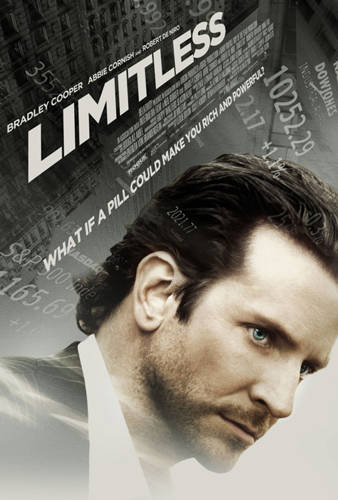
It is believed that human beings only use ten to twenty-five per cent of their brainpower most of the time. After hearing this, it is natural for people to contemplate what they might be able to achieve if they could access a hundred per cent of their mind’s capabilities. Well, Limitless gives us a hint of what it could be like and it makes for pleasant viewing.

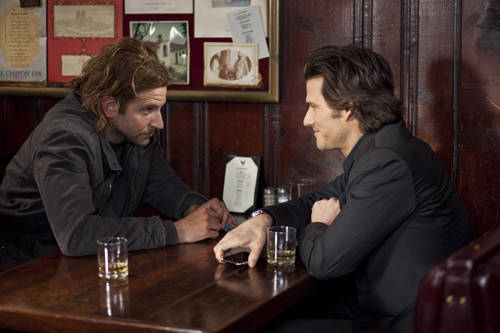
Eddie Morra, left, looking down and out, is offered the 'limitless pill' by his ex-wife's brother.

The movie is centred on Eddie Morra (Bradley Cooper – He’s Just Not That Into You, The Hangover, The A-Team), a messy and disorganized ‘wannabe’ author who has yet to write a word of his novel. His partner, Lily (Abbie Cornish – Elizabeth: The Golden Age, Legend of the Guardians: The Owls of Ga’Hoole, Sucker Punch), has just left him because she sees no future with him.

With his life going nowhere, Eddie bumps into his ex-wife’s brother, Vernon (Johnny Whitworth – Valentine, 3:10 To Yuma, Ghost Rider: Spirit of Vengeance). After buying him a bear in the middle of the day, Vernon offers Eddie a pill that will revitalise him. Reluctantly, Eddie swallows it giving him the clarity of thought and energy that he has lacked his whole life. With this pill, no worldly ambition is beyond him. The problem for Eddie is what happens when his supply runs out and what will others do to have his key to success.

The plot for Limitless is simple to follow, entertaining and strokes one’s ego nicely.

It is not an especially thought-provoking film and several of the side-stories are dropped before they’ve been concluded. This naturally leaves a few things unanswered by the end; but as they are not major parts to the movie, it is easy for viewers to forget that these scenes even took place.

Moreover, things go so well for Eddie that one cannot help but remind oneself that life is full of ups and downs; not just ups. Limitless also doesn’t give much attention to the negative effects of taking the ‘limitless pill’ or drugs unlike, for example, Requiem For A Dream. This is a pity as it would have added a dimension to the film that is sorely lacking.

Since it does not tackle the more serious side of drug addiction, the characters do not have depth. This is a shame; especially for Bradley Cooper. He plays well as a low-life loser and a high-flying, smooth-talking, money making machine. It would have been interesting to see how he would have faired if he’d have been given the opportunity to show us the downside of taking this drug.

Eddie, looking happy with how life has panned out for him since taking the pill, being intimate with his girlfriend, Lily, played by Abbie Cornish.

No other character in the film is given enough time or the script to stamp their mark. In effect, Abbie Cornish, Robert de Niro (Goodfellas, Stardust, Meet The Parents) and Andrew Howard (Transformers II: Rise of the Fallen, Revolver, I Spit On Your Grave) are little more than mere diversions to the story of Eddie Morra’s meteoric rise. This though does not take away much from the film. It is unlikely that they’d have made a significant difference to the movie if they’d have been given more of a role.

The acting on the whole is better than the choreography. The director, Neil Burger (The Illusionist, The Lucky Ones), has not shot the film brilliantly. Some of the scenes are quite dizzying, whilst others do not flow well together. Although this can be disorientating for the audience at times, it does not make the movie hard to watch or undermine its entertainment value.

Ultimately, Limitless is an enjoyable film that enables viewers to switch off as they watch it. It is not a masterpiece and has a handful of minor flaws. Nevertheless, it leaves its audience satisfied, plus makes them think in jest what they could be like if they were able to use their mind to its full potential.

PG’s Tips

Review – Source Code (12a) [2011]

Star Rating: 3/5

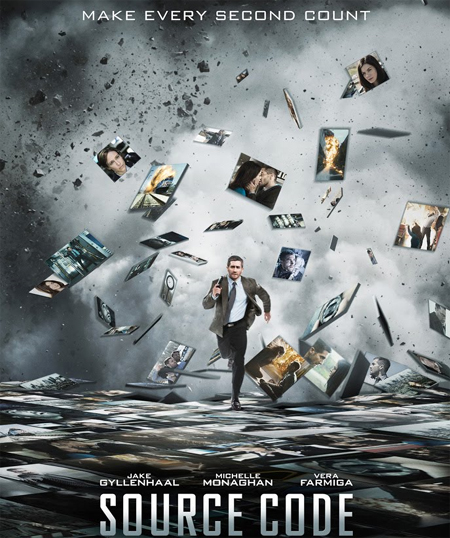
A friend of mine billed Source Code as ‘The Matrix meets Minority Report.’ While this may be a tad broad, it is not an entirely inaccurate explanation of Source Code. Although a Sci-fi film at its core, Source Code is more enjoyable to the general public than many other titles in its genre and will leave one thinking afterwards too.

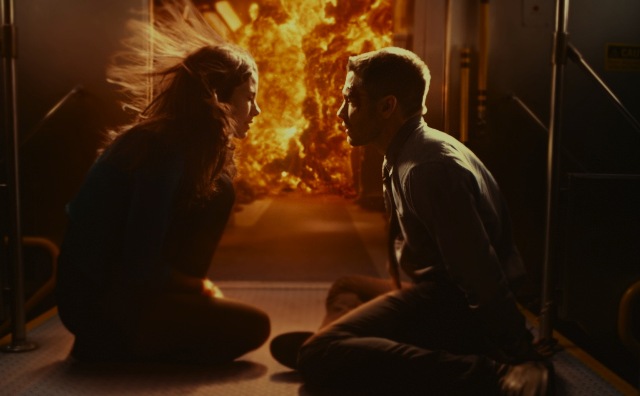
Source Code is about sending someone into a computer-regeneration of a specific incident in the past in order to find out (useful) information. Throughout the movie, Colter Stevens (Jake Gyllenhaal – Rendition, Brothers, Nocturnal Animals), a US soldier in a helicopter unit, is constantly sent into the Source Code for an eight-minute stint. Each time, Colter finds himself on a train sitting opposite the cute-looking Christina (Michelle Monaghan – Mission Impossible III, Eagle Eye, Due Date); and at the end of the eight minutes, the train blows up. Himself included.

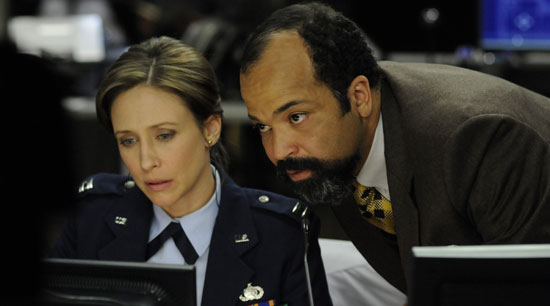
Earlier, a bomb went off on a train in Chicago and it is rumoured that another one will go off in the middle of the same city later that day. Colter’s task is to find the bomb and discover information about the bomber. His superiors, the pretty Captain Colleen Goodwin (Vera Farmiga – The Boy in the Striped Pyjamas, Up in the Air, The Judge) and Dr. Rutledge (Jeffrey Wright – Casino Royale, W., The Ides of March) believe that the information could be crucial in deterring the next attack. Yet, after going into the Source Code a few times, Colter’s motives change. He intends not only to complete his mission; but also to save the passengers on the train and ask out Christina.

Source Code’s plot has numerous holes that one can pick at without difficulty. It can also feel quite repetitive at times. The director, Duncan Jones (Moon), a relative novice to the industry, puts forward some interesting ideas that bring to mind tenuous comparisons to The Matrix for de facto teleporting someone into a computer-generated world; and Minority Report for preventing an incident from occurring by using highly futuristic and technologically advanced methods. Yet, Jones also leaves several aspects of the plot with a lot of explaining to do; most notably the paradox of time-travelling and the ending.

One thing, however, that works in Source Code’s favour is that it does not descend into a mushy love-story like so many other films. The dialogue is not bad either and there are humorous moments too. Again, Jones fails to explain the quantum physics behind the invention of the Source Code; but, speculatively-speaking, he has done this deliberately knowing that the majority of the film’s viewers will neither understand nor be interested in such terminology.

Captain Colleen Goodwin and Dr. Rutledge urging Colter to go back into the Source Code so as to unearth more information about the bomb and the bomber.

That Jake Gyllenhaul plays well as the main character gives the movie the credence the plot lacks. He is not given a particularly challenging role, but he still performs decently enough. The same can be said for the other members of the cast. Michelle Monaghan, Vera Farmiga and Jeffrey Wright may act competently; however, they are not given enough screen-time for their characters to be anything other than two-dimensional.

Alike the acting, the choreography is fine. For a movie that is cyclic and teleports the main character suddenly and regularly, it does not feel overly jerky to watch. This takes some skill and credit must go to Jones for this.

All-in-all, Source Code is a surprisingly entertaining film. It has a decent cast, some good jokes and clever ideas. Nevertheless, the storyline is deeply flawed and the ending rubber-stamps it. Ironically though, the film’s very flaws are what will keep viewers thinking long after the film finishes.

PG’s Tips

Review – The Lincoln Lawyer (15) [2011]

Star Rating: 4/5

There have not been many legal-thrillers made in recent years. The Reader and The Social Network are two that spring to mind. The Lincoln Lawyer is not, over-all, as good as those two films, but it certainly gives one value for money.

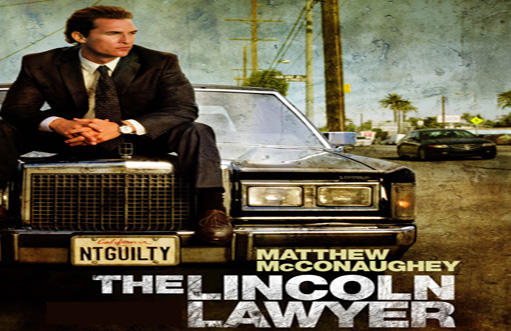
The Lincoln Lawyer is based on the book by Michael Connelly. It is about a smooth-talking, alcoholic defence lawyer, Mick Haller (Matthew McConaughey – Ghosts of Girlfriends Past, How To Lose A Guy In Ten Days, The Wolf of Wall Street), whose job is to keep criminals on the street. He’s quite good at it too – and knows it – which is why Lewis (Ryan Phillippe – Cruel Intentions, Breach, Flags of our Fathers), a thirty-two year old man from a wealthy family, demands that Mick represent him. Lewis has been charged with violent assault and rape against a prostitute; although, Lewis is adamant that he has been set up. Yet, no sooner does Mick agree to represent Lewis when things begin to get murky and twisted.

The prostitute giving Lewis her address, before he allegedly beats her up and rapes her at knife-point.

For a film that is dominated by courtrooms and legal technicalities, The Lincoln Lawyer is surprisingly interesting even to those who care little for the law. The plot is gripping and relatively simple to follow, provided the viewer is concentrating. At times, one may wonder which law-case Mick is referring to. The storyline also has a couple of flaws and things always seem to work out coincidentally well for Mick (as they tend to do for main characters in films), but not to the extent that the movie becomes ridiculous by any stretch of the imagination.

The plot is aided by very good choreography and a dialogue that is generally well-written. The director, Brad Furman (The Take), and the script-writer, John Romano (Intolerable Cruelty, Prodigy), have certainly done their homework and appear to have quite a solid knowledge of American federal law as well as Californian state law. (I do not know enough about such matters to be able to pass a proper judgement. I can only get a feel for the American legal system based on what has been said throughout the film.) There are a handful of sensationalist lines that obviously would not be said in a real court; yet, this does not take too much away from the script’s over-all quality.

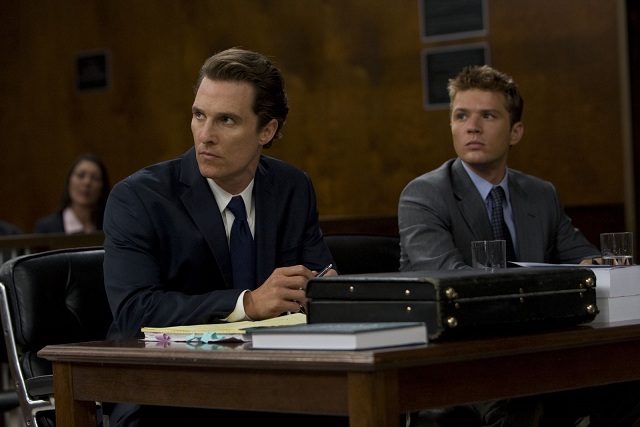
Mick representing Lewis in court.

The script’s main beneficiary is Matthew McConaughey. McConaughey plays very well as a conceited barrister. (One should be aware that a common theme in movies is to make the main character look good by placing him/her next to or against weaker actors. In The Lincoln Lawyer, particularly in the courtroom scenes, McConaughey comes up against a less competent barrister than himself. The director also gives McConaughey the last word in the vast majority of the scenes, which makes him stand out more than he should.) Although McConaughey’s performance is not quite worthy of an Oscar nomination due to a lack of depth in Mick’s character; he illustrates that he is versatile and far from doomed to solely play hopeless-romantic roles like the one he did in How To Lose A Guy In Ten Days.

Without a doubt, McConaughey outshines Ryan Phillippe, the main supporting actor in The Lincoln Lawyer. Philippe does an alright and competent job; but has not really enhanced his reputation as an actor much here. Just like in Cruel Intentions, he plays here a spoilt rich kid needing to get his way. In all of his films, including Breach (wherein he plays a spy), Philippe conveys the same passion. In addition, he has the same scrunched-up facial expression that does him no favours. In Philippe’s defence, one can argue that he is not given the tools or the time to express himself in order to make the audience empathise with Lewis’ situation. But this is not a convincing argument; especially considering that Melissa Leo won an Oscar for Best Supporting Actress after having less time on the screen in The Fighter than Phillippe did here.

All-in-all, The Lincoln Lawyer is certainly worth watching. It is entertaining and, seemingly, portrays the American legal world quite accurately; despite being a little theatrical on occasions. Indeed, by the end one should leave the movie feeling very satisfied.

PG’s Tips

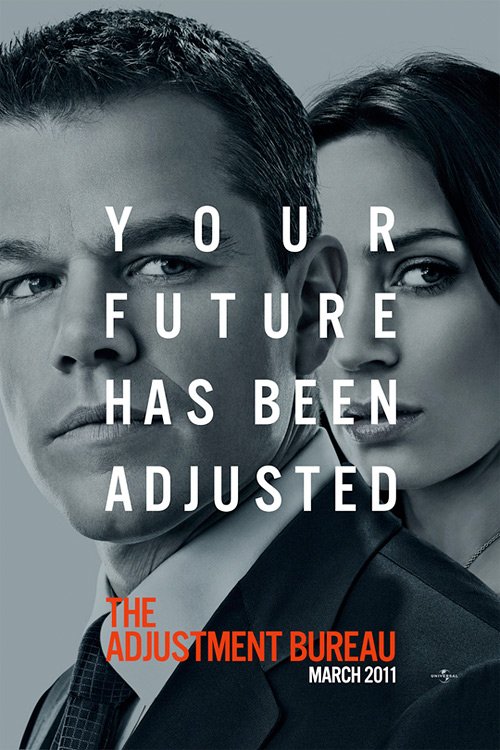
Review – The Adjustment Bureau (12a) [2011]

Star Rating: 2/5

Some critics proclaimed that The Adjustment Bureau was a fine amalgam between the Bourne series and Inception. Well, it bears no resemblance to either film. Moreover, it is a poorly executed movie in just about every sense.

The Adjustment Bureau begins with Congressman, David Norris (Matt Damon – The DepartedTrue Grit, Contagion), running for a seat in the Senate. On election night, he goes to the toilet to prepare a speech when he bumps into Elise (Emily Blunt – The Devil Wears Prada, Young Victoria, The Wolfman). Attraction is instant, but Elise leaves without giving David her contact details.

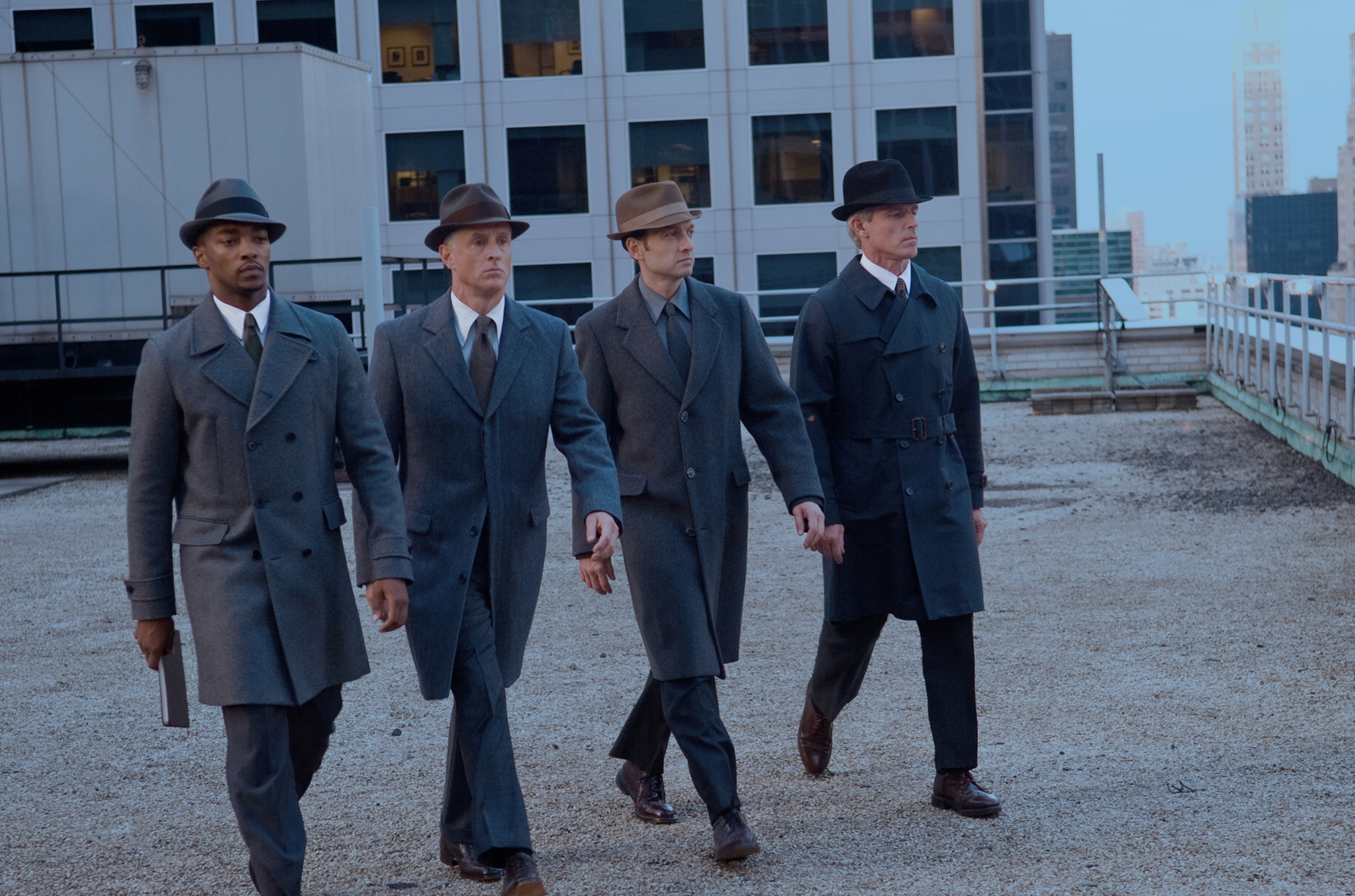
The agents who work for the Chairman. It is their job to 'adjust' peoples' fates to ensure they fit in with the Chairman's grand design for humanity.

Coincidentally, soon afterward in the film, they meet again on the bus; and this time David acquires her number. Yet, after leaving her, David comes across some people he was not expecting to meet. These men are agents who ‘adjust’ people’s futures in order to follow the plans set forth by the Chairman (God?). They inform David that he was not supposed to have met Elise for a second time and that he can never see her again. But David is determined to be with Elise; even if it means forfeiting his political ambitions. This, in turn, sets him on a collision course with powers greater than mankind.

The plot for this movie rapidly descends into a cliché love-story that tests the patience of those who believed that they were going to watch something a little more original and intellectually stimulating. The director, George Nolfi, to some extent tries to play to a more academic-minded audience by including the debate of free-will vs. God’s divine master-plan in the film. (Although, if anyone thinks that this debate is new, let’s bear in mind that it has been discussed regularly since the Middle Ages or, even more likely, since the Bible was written.) Yet, by only dealing with this debate vis-à-vis the love-story, Nolfi has ensured that all highly complex discourse on the subject appears only at a superficial level. It could have and should have been done better; especially when one bears in mind that this is the same man who wrote a well-crafted script for The Bourne Ultimatum.

David and Elise running frantically from the Chairman's agents so that they can be together.

Alike the debate, the dialogue is equally vain throughout The Adjustment Bureau. The acting is not much better either. Matt Damon gives his role a decent punt. Nevertheless, one questions why he chose to do this role in the first place. For the lesser known Emily Blunt, it is obvious why she has been chosen. But apart from looking pretty and having an over-all good physique, her performance is little better than her showing in the dreadful film, The Wolfman. Indeed, if it were not for her above-mentioned featured, plus her striking blue eyes and wonderful English accent; it is hard to see how she will ever be able to reach the dizzying heights that Natalie Portman has achieved in recent times.

The rest of the cast, particularly the Chairman’s agents, are woeful. Similarly, the special effects are pitiable because they look unreal. (Special effects have to at least give the façade of looking like they might be genuine.) The cinematography is not worth commenting upon as it is virtually non-existent. The choreography, on the other hand, has been pieced together smoothly, which enables the viewer to follow the plot easily.

How The Adjustment Bureau has been advertised as ‘Bourne meets Inception’ is beyond belief and nothing more than a marketing con. The Adjustment Bureau looks like it has been done on the cheap. It may try to be intelligent; yet that does not mean that it warrants comparisons to the aforementioned high-class films. The Adjustment Bureau needs a more original storyline; plus better acting, dialogue, special effects and care as a starting-point before it can be put into in the same bracket as the Bourne series or Inception.

PG’s Tips

Review – Unknown (15) [2011]

Star Rating: 3/5

After viewing the trailer for Unknown, one gets the impression that they’ve seen this type of action film before. One knows the movie won’t be great, but will probably be worth the watch. On this premise, Unknown does not let the audience down.

The car crash that leaves Dr. Martin Harris, played by Liam Neeson, in a coma for four days.

The film revolves around Dr. Martin Harris (Liam Neeson – Schindler’s List, Star Wars I, The Dark Knight Rises), a researcher/lecturer who is in Berlin for a conference, with his wife, Liz (January Jones – Madmen, American Pie: The Wedding, Anger Management). Martin realises, once he’s at the hotel he’s due to stay at, that he has left a suitcase at the airport. On his way back to the airport, an accident occurs. A fridge-freezer falls out of the van in front of the cab. The cab driver, Gina (Diane Kruger – Troy, National Treasure I & II, Inglorious Basterds), swerves out of the way; but loses control of the vehicle. The car smashes into a boundary on a bridge and crashes into the lake.

When Martin wakes up, he’s in hospital after spending four days in a coma. No-one has come to look for him, including his wife. Martin releases himself early from hospital so as to find Liz. However, when he finds her, she maintains that she’s never seen him; plus she is with another man who also claims to be Dr. Martin Harris (Aiden Quinn – Wild Child, Legends of the Fall, Frankenstein). Without ID ‘the real’ Dr. Martin Harris has no way of proving his identity. To compound matters for the ‘real Martin’, he soon discovers that people are after him and he has no clue why.

The plot for Unknown is entertaining and fast paced, despite having many loose-ends. It also has car chases so far-fetched that those in The Fast And The Furious series may not look so ridiculous anymore. The twist is not unpredictable either, but this does not ruin the film.

The ‘real Dr. Martin Harris’ being taken away by security after his wife, Liz, claims that she doesn’t recognise him.

The quality of the acting is about as good as the storyline. Liam Neeson plays decently enough as usual; although this is far from his most challenging role. As January Jones and Aiden Quinn don’t appear much on screen, it’s hardly fair to judge them. The same can be said for Bruno Gantz (who plays Adolf Hitler in Downfall; The Reader) and Frank Llangela (Superman Returns, Frost/Nixon, Wall Street 2).

The only other actor with a notable role in Unknown is Diane Kruger. Despite looking pretty (and skinny) throughout the movie, her Bosnian accent is hardly plausible. It is interesting that the director, Jaume Collet-Serra (Orphan, House of Wax, Goal II: Living The Dream), chose to play her as a Bosnian when filming in her native country. Then again, one does suppose that actors are paid to act. If that is the case then Kruger’s performance is not much better than her Bosnian accent. It is also hard to imagine one behaving in the way Gina does; especially once she grasps the reality of Martin’s situation.

All in all, Unknown is a distinctly average movie that is fun and entertaining. It is a light film devoid of complexity and quality; yet, filled with action and a solid performance from Liam Neeson.

PG’s Tips

Review – Sanctum 3D (15) [2011]

Star Rating: 3.5/5

Sanctum had the potential to be a disaster to the point when the cast, director and producers alike would have attempted to revise the fact that they had been apart of the film. But Sanctum is not a catastrophe movie and it is surprisingly gripping.

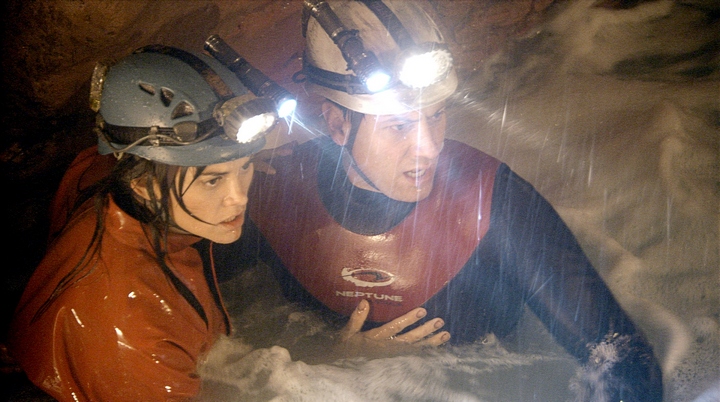
Victoria and Carl begin to panic as they realise that they are trapped and the cave is flooding.

The film is ‘inspired’ by true events. (What this means is anyone’s guess.) A group of cave divers attempt to see the last unknown, underwater cave in the world in Papa New Guinea. The divers, led by Carl the manager (Ioan Gruffudd – Titanic, King Arthur, Fantasic Four I & II), Frank (Richard Roxburgh – Mission Impossible 2, Moulin Rouge, Van Helsing), Josh (Rhys Wakefield – Home and Away, The Black Balloon), George (Dan Wyllie – Chopper, Animal Kingdom) and Victoria (Alice Parkinson – Where The Wild Things Are, X-Men Origins: Wolverine, The Pacific) are slowly but surely revealing the depths of the cave. That is until a storm breaks out above them. Before they know it, the cave is flooding. They are trapped. The only way out is down. Down, through previously unexplored areas.

The plot for Sanctum is simple and fairly predictable. We know that not everyone is going to survive, so it is just a question of who is next to fall. Yet, because the acting is terribly wooden and the dialogue is poor; it is hard to empathise or like any of the main characters. Their predicaments, and the way they behave in certain situations, seem quite realistic. Under such circumstances, survival is the only thing that matters. Everything else goes by the wayside and there is no time for sentiment. Nevertheless, the more the main characters try to be serious, the more pitifully amusing they become. (Also, why is it that the ‘good guys’ in the film never need food or water; but the ‘bad guys’ do?)

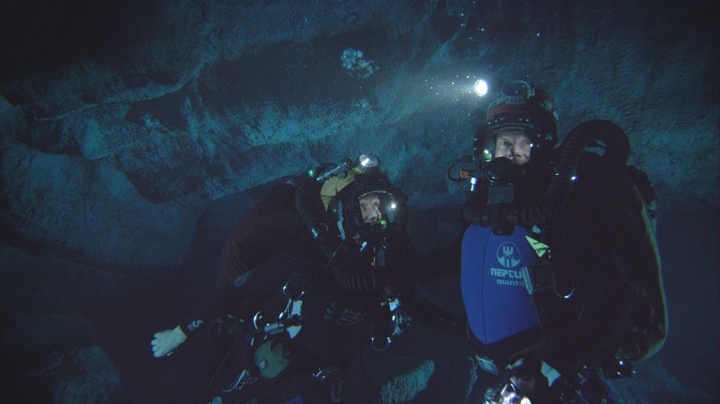
Carl, left, and Frank, right, stay still for a moment to let the others catch up. Behind them, one gets a glimpse of the awesome underwater scenery that is prevalent throughout the film.

The acting, though, was never going to be Sanctum’s attraction. As a thriller, one hopes to feel one’s heart pounding against the chest. While the film takes a bit of time to get going (even though the film is not particularly long), Sanctum achieves this. That the characters go through tight spaces underwater makes one feel claustrophobic; unsettling one almost to the point of panic. (Especially if one does not like being stuck in a small space.)

The 3D feature of the movie has the further effect of making the audience feel as trapped as Frank, Carl, Josh, George and Victoria. This is in no small part due to the executive producer, James Cameron (Titanic, Avatar I, II & III). Just like in his last film, Avatar, Cameron successfully exploits the 3D effects to make one feel like they are in the predicament of those they are watching. In addition, his 3D images of the caves are stunning; seductive enough to make one believe that the potentially fatal dangers of cave digging/exploring are non-hazardous and worthwhile.

Arguably, the visuals and the 3D effects in Sanctum, to a degree, make up for what is lacking in the acting department. The director, Alister Grierson (Kokoda: 39th Battalion), and Cameron make the most out of a bland storyline; and turn it into an unexpectedly entertaining and nerve-shredding movie.

PG’s Tips

Review – The Next Three Days (12a) [2011]

Star Rating: 2.5/5

I’ve heard that some men will die (or kill) for their woman (metaphorically, at least). However, I’ve never heard anyone say that they’ll study every weakness in the government’s prison system in order to get their lover out of jail. There is probably a reason for it and The Next Three Days illustrates why this might be the case.

John, being a good husband, visits his wife in prison.

Early on in the film, Lara (Elizabeth Banks – Zack and Miri make a Porno, Spiderman IIII), is arrested by the police and sentenced to jail for life for murdering her boss. This leaves John (Russell Crowe – Gladiator, A Beautiful Mind, Les Misérables), her husband and philosophy teacher/lecturer, to look after their son, Luke. Convinced that his wife is innocent, John seeks the advice of Damon (Liam Neeson – Schindler’s List, Star Wars I, Unknown), a man who has escaped from prison a staggering seven times, to find out a way of getting Lara out illegally. John learns from Damon what he must do to free her and how difficult it will be to beat the counter-measures the state-police have in place to stop escapees from running beyond their reach. For three years, John plans every step and waits for the right moment to strike.

Whilst perhaps a little far-fetched for it to be realistic, the plot makes for The Next Three Days to be full of pulsating tension. Yet, it fails to deliver on this for much of the movie. Part of this is because the fast-beating music is inadequate and, mostly, incorrectly timed. Additionally, the film is too long. There is no need for it to last two hours and twenty minutes. If it would have been half an hour shorter, it would have made for a much better film as only the last forty-five minutes is particularly interesting.

The plans are complete and John, loading up his James Bond-like pistol, is ready to put them into effect to save his wife from a life-time behind bars.

The storyline has its exciting moments; but there are many holes in it. One cannot help but ask oneself why John’s work as a teacher is not affected by his excessive (or, rather, obsessive) workings at day and night? Or why no-one notices his plans to free his wife from prison which are on a wall in a room in his house? Or why John never questions his own sanity? Also, escaping is not an end in of itself. One still has to go with mundane, daily chores after escaping. But, unfortunately, the director, Paul Haggis (Million Dollar Baby, Casino Royale, The Quantum of Solace), does not deal with these issues.

Despite the gaps in the plot, the actors do not do their credentials harm. Indeed, the acting is consistently average throughout the movie: neither especially bad nor great. Nor are they ever tested, which is a bit of a shame because it could have added another dimension (and possibly a realistic element) to the storyline. Instead, we have to watch Russell Crowe kill the dregs of society to give the film some (cheesy) action in a vain attempt for entertainment.

Thus, all in all, The Next Three Days is a disappointment. Whilst, at first glance, the film may look thrilling, if unoriginal (after-all, how many times have we seen a movie about a prison breakout?); it is not as fascinating as it should have been. It might also explain why there is no colloquial expression for someone to free another person from jail. It is far simpler just to say you’ll die (or kill) for them.

PG’s Tips