Tag Archives: review

Review – Lincoln (12a) [2013]

Lincoln - title banner

Star Rating: 4/5

Director:

  • Steven Spielberg – Saving Private Ryan, War Horse, Indiana Jones I-V

Cast:

  • Daniel Day-Lewis – Gangs of New York, There Will Be Blood, Nine
  • Sally Field – Mrs Doubtfire, ER, The Amazing Spider-Man I & II
  • Joseph Gordon-Levitt – The Dark Knight Rises, Looper, Sin City II
  • Tommy Lee Jones – No Country For Old Men, Captain America: The First Avenger, Emperor, Bourne V
  • Jackie Earle Haley – Watchmen, Shutter Island, Robocop
  • David Strathairn – LA Confidential, The Whistleblower, The Bourne Ultimatum & Legacy
  • James Spader – Boston Legal, The Office, By Virtue Fall
  • David Oyelowo – The Last King of Scotland, Rise of the Planet of the Apes, The HelpInterstellar
  • Michael Stuhlberg – Steve Jobs

Music Composer:

  • John Williams – Star Wars I-VI, War Horse, Indiana Jones I-V

All democratically-elected state leaders, whether they are presidents or prime ministers, have an ambition for reaching their respective position. For some, it is about power and/or aggrandisement; for others, it is about putting their names down in the history books. But for an exceptional few, it is about being uniquely in the right place at the right time and enabling their ideologies and actions to make them stand out from among their peers. President Abraham Lincoln (1860-65) belongs to the last category, and Steven Spielberg’s admirable biopic, Lincoln, illustrates why this is the case.
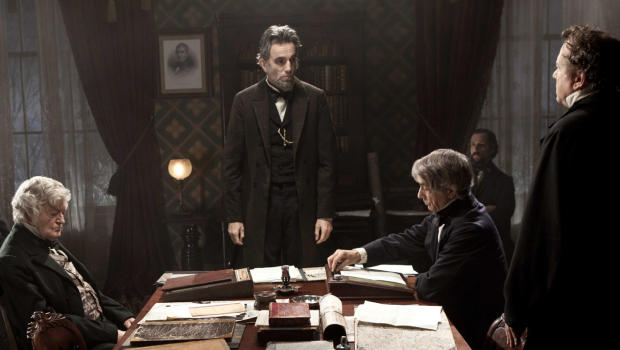
President Lincoln (Daniel Day-Lewis) forcefully telling his cabinet that he intends to proceed with the amendment and that they must help him.

President Lincoln (Daniel Day-Lewis) forcefully telling his cabinet that he intends to proceed with the amendment and that they must help him.

Lincoln revolves round events in America during January 1865. At the time, no-one was certain as to how long the Civil War (1861- April 1865) would continue. The Unionists, led by President Lincoln (Daniel Day-Lewis) and the armies of the north, are in a strong position. But the rebel Confederacy, led by Jefferson Davis and the armies of the south, are not about to surrender either.

The latter’s resolve is further stiffened upon hearing that, despite the war raging on, President Lincoln intends to push through Congress the highly contentious Thirteenth Amendment (the abolition of slavery) before the legislature ends its session at the beginning of February. The Confederacy’s hatred of black people and their slavery-based economy cannot allow for it. But will their attempts to block the proposed amendment succeed?

Lincoln’s storyline is intelligent; yet, slightly lacking in depth and, at 150 minutes, drawn out. Despite being potentially confusing for someone who has no knowledge of the era, the political wranglings going on behind the scenes throughout the film are great to watch because they are amusing and appear realistic. They also indicate that there was more than an element of corruption in American politics in the 1860s. (Then again, does The Ides of March show us that American politics is significantly different today?)

Moreover, the debates on slavery and freedom throughout Lincoln are intellectually stimulating. In the present era, it defies belief to learn that President Lincoln was a ‘radical,’ even among his key allies, for wanting the abolition of slavery. The Thirteenth Amendment was a measure that America (apparently) wasn’t yet ready for in 1865 (almost sixty years after Britain and France had abolished the Slave Trade, and four years after Tsar Alexander II had passed the emancipation of serfdom in Russia).

However, one only has to read Harriet Beecher Stowe’s 1852 novel, Uncle Tom’s Cabin, to realise that Lincoln fails to illustrate the inherent racism towards black people that existed even among abolitionists. Similarly, the movie says nothing of the four Union states that permitted slavery, which is strange as those four states could have been portrayed as a thorn in President Lincoln’s side.
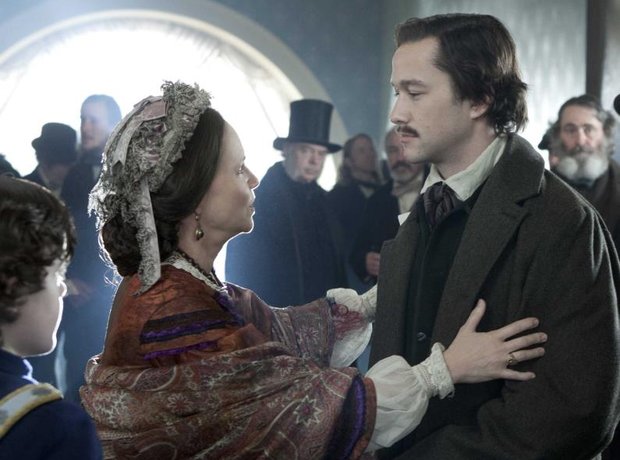
Mary Lincoln (Sally Field) welcoming home her eldest son, Robert (Joseph Gordon-Levitt).

Mary Lincoln (Sally Field) welcoming home her eldest son, Robert (Joseph Gordon-Levitt).

Furthermore, the film only deals seriously with two issues: the amendment and the Civil War. While they understandably dominated Lincoln’s presidency, surely there were other matters for the president to consider, such as the annual budget and foreign relations? None of these are ever mentioned, which has the indirect effect of making President Lincoln appear almost two-dimensional.

But to say that the ex-president was anything less than a highly-complex and gifted man serves to undermine him, and Daniel Day-Lewis exemplifies this with a performance of remarkable consistency. He captures the former president’s quirkiness, social awkwardness and witty humour fantastically, as well as his indefatigable zeal and reason for his ideals.

Day-Lewis undoubtedly dominates Lincoln, but that does not mean that the supporting cast should be ignored. With the exception of Joseph Gordon-Levitt, who is average at best and whose role, as the ex-president’s son, Robert Lincoln, could easily have been shelved, Sally Field as the ex-president’s worrisome and frenzied wife, Mary Lincoln; Tommy Lee Jones as the savvy Republican Congressman, Thaddeus Stevens; David Strathairn as the cautious Secretary of State, William Seward; Jackie Earle Haley as Alexander Stephens, the racist Vice-President of the rebel Confederacy; and even James Spader, as the underhand Mr. Bilbo (no, not Baggins) are all superb.
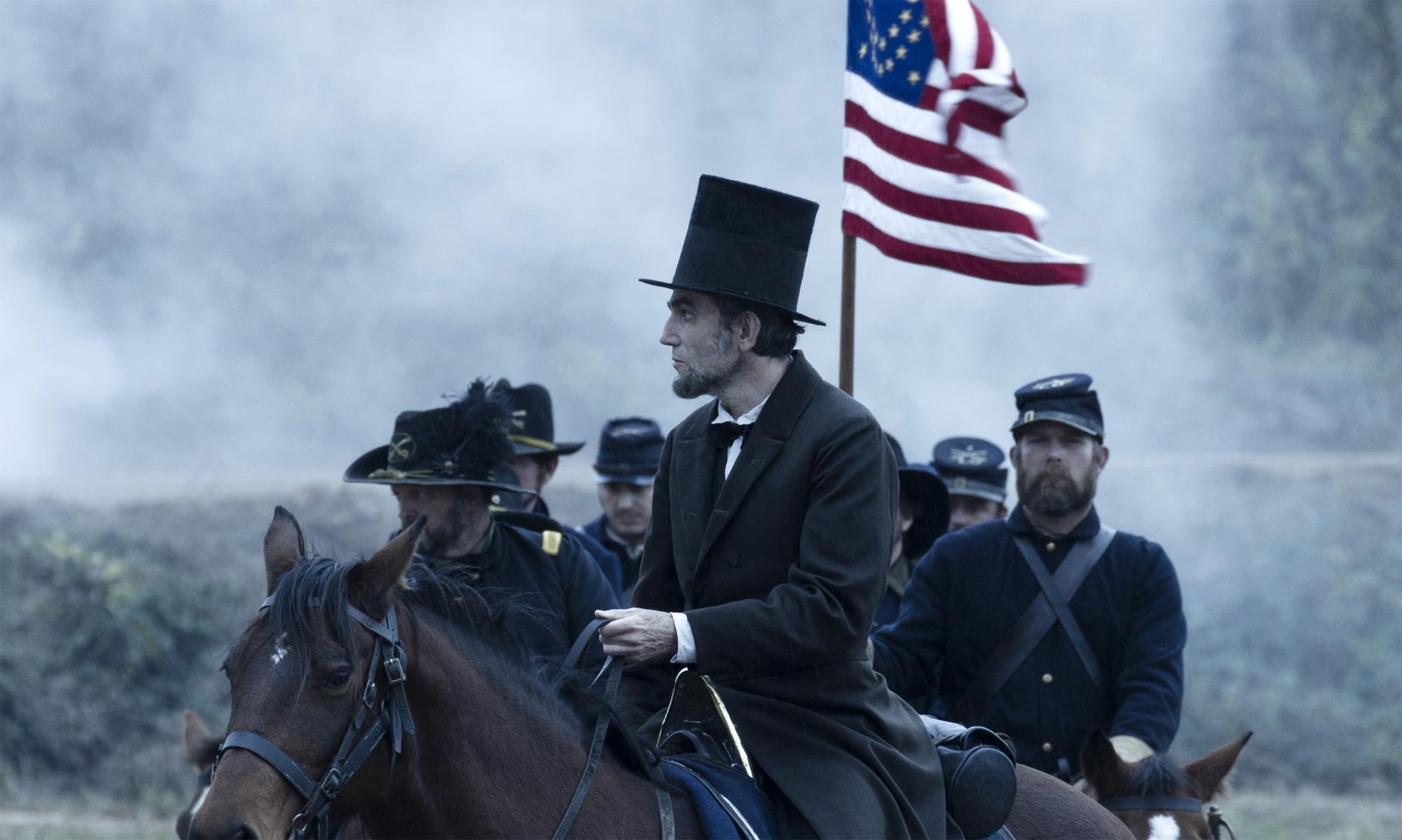
President Lincoln exploring the aftermath of a battlefield, knowing that his decisions have cost many Americans their lives.

President Lincoln exploring the aftermath of a battlefield, knowing that his decisions have cost many Americans their lives.

Equally good are the costume and make-up designs, which truly bring the 1860s to life. Likewise, John Williams should be praised for writing a soundtrack that does not sound remotely like Star Wars, Home Alone or Indiana Jones. Indeed, Williams’ score here is more subtle in nature. It adds a touching element to Lincoln that makes the movie that bit more poignant when it matters most.

Over-all, Lincoln is a venerable film with clever dialogue, a beautiful set and enchanting acting. The movie might be a little long and simplifies some of the historical issues, but this should not negate that President Lincoln was one of the rare few leaders who have managed, almost single-handedly, to change the course of history. He understood the uniqueness of his epoch and acted upon his conscience, despite knowing the storm it would cause (as well as unknowingly making him pay the ultimate price for it). Lincoln demonstrates all of this wonderfully and shows us why President Abraham Lincoln is rightly regarded as the archetypal president that so many of his successors have tried (and often failed) to emulate.

PG’s Tips
Review – The Hobbit I: An Unexpected Journey HFR 3D (12a) [2012]

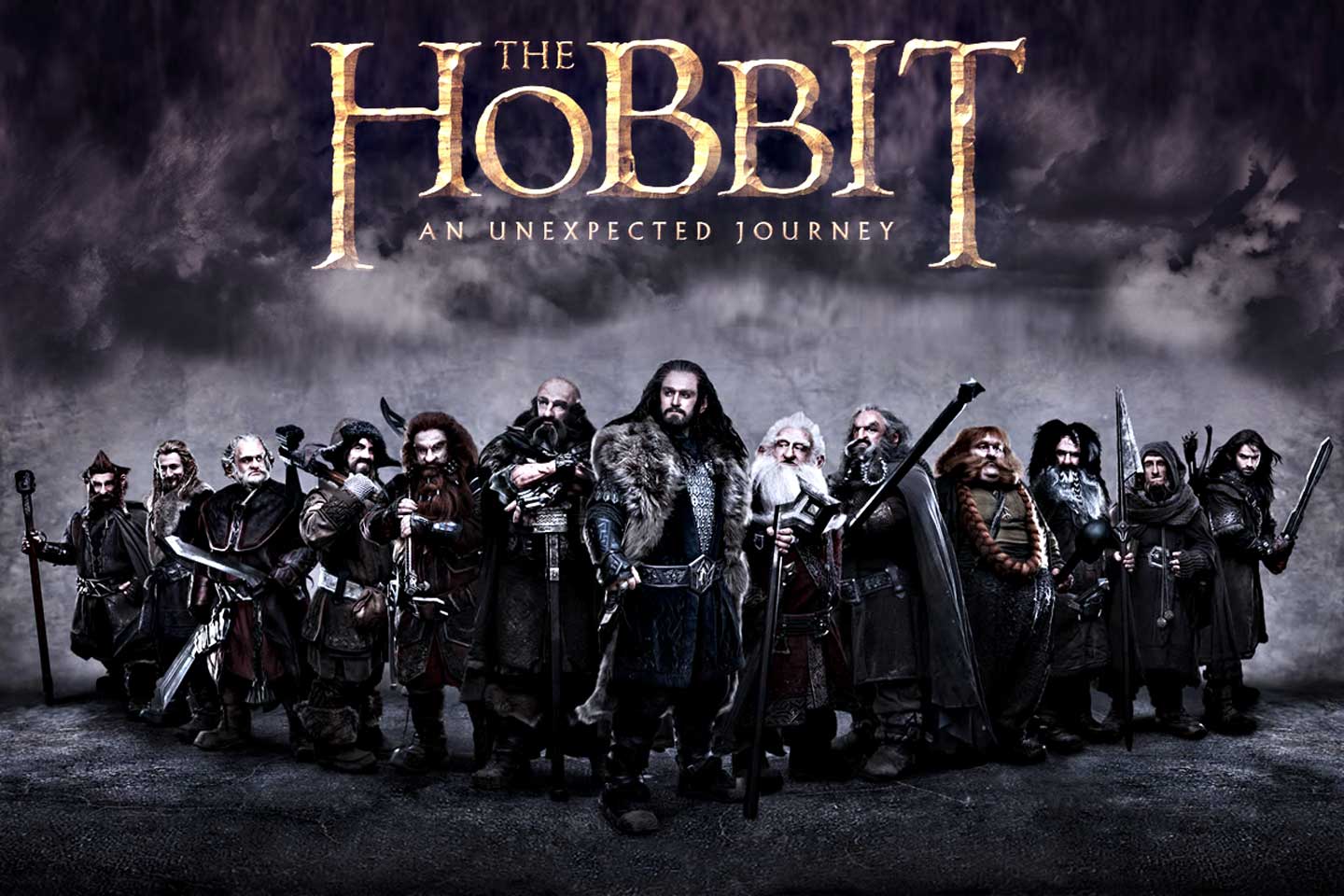
The Hobbit - title banner

Star Rating: 2.5/5

Director:

  • Peter Jackson – Brain Dead, Lord of the Rings Trilogy, King Kong, The Hobbit II & III

Cast:

  • Martin Freeman – The Office, Love, Actually, Svengali
  • Ian McKellen – Apt Pupil, Lord of the Rings Trilogy, X-Men I-III, X-Men: Days of Future Past
  • Cate Blanchett – Elizabeth: The Golden Age, Lord of the Rings Trilogy, Blue Jasmine
  • Barry Humphries – The Dame Edna Treatment, Finding Nemo, Justin & The Knights of Valour
  • Hugo Weaving – The Matrix Trilogy, Lord of the Rings Trilogy, Captain America: The First AvengerTransformers I-III
  • Christopher Lee – Lord of the Rings Trilogy, Season of the Witch, The Girl From Nagasaki
  • Richard Armitage – Spooks, Captain America: The First Avenger, Black Sky
  • Ian Holm – Lord of the Rings I & III, Lord of War, Ratatouille
  • Elijah Wood – Lord of the Rings Trilogy, Green Street, Open Windows
  • Andy Serkis – Lord of the Rings Trilogy, King Kong, Rise of the Planet of the Apes

Music Composer:

  • Howard Shore – Lord of the Rings Trilogy, Hugo, The Hobbit II & III

<<guest review by KJF>>

Eleven years after the first of Peter Jackson’s magnificent two Lord of the Rings-related trilogies hit our screens, its prequel has finally arrived. What has alarmed many viewers even before getting into auditoriums to see The Hobbit:  An Unexpected Journey is that it is three hours long, and only the first of a proposed nine-hour trilogy covering the events of JRR Tolkien’s beloved, but not particularly lengthy children’s book, first published in 1937. The result is that An Unexpected Journey is a lengthened, over-indulgent spectacle that will be welcomed by Middle Earth addicts, but might alienate the average cinemagoer.

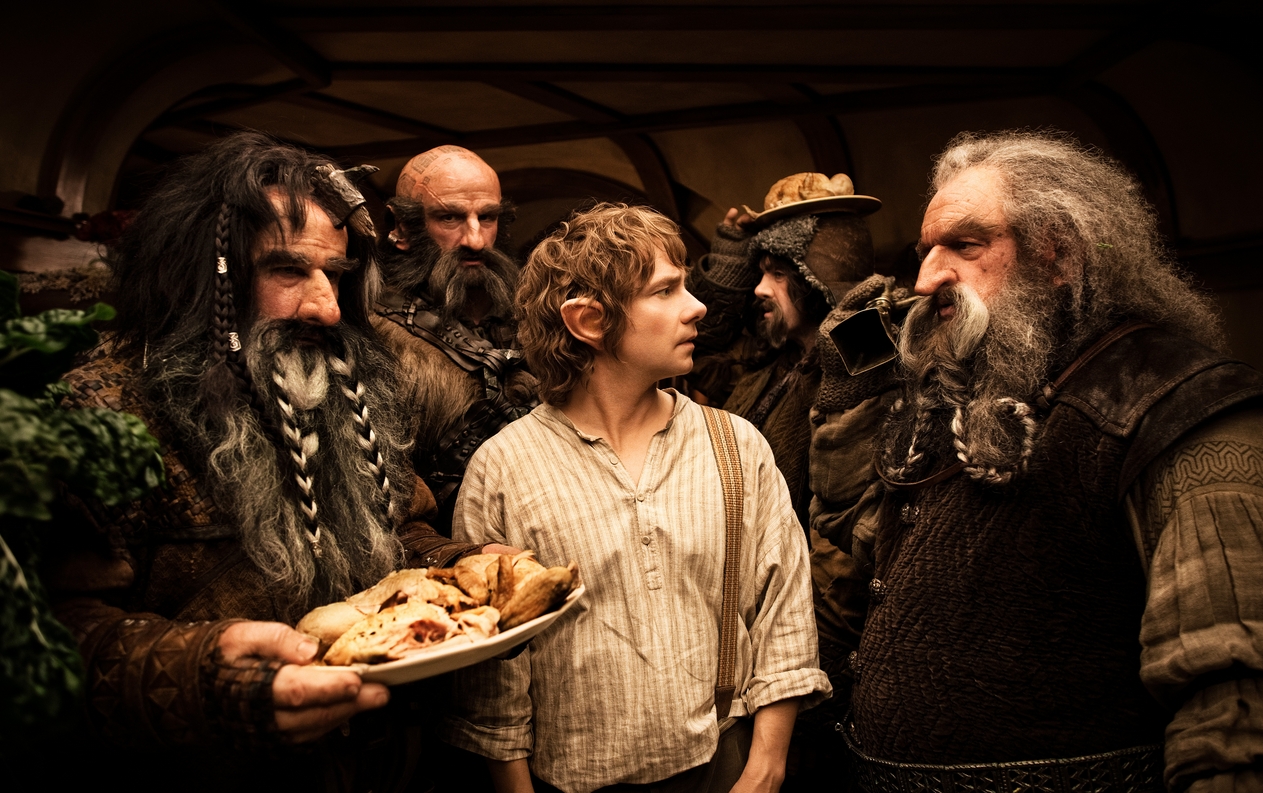
Bilbo (Martin Freeman) bewildered as the dwarves invade his home unexpectedly and immediately make themselves at home by gobbling down his food and liquer.

Bilbo (Martin Freeman) bewildered as the dwarves invade his home unexpectedly and immediately make themselves at home by gobbling down his food and liquor.

Bilbo Baggins (Martin Freeman) is the home-loving hobbit of the title, living in a cozy hole in the ground in the Shire, a rural idyll in the western part of Tolkien’s vast imaginary world. Bilbo’s part of a community of small beings with hairy feet who love the good life, preferring nothing better than eating, drinking, smoking and sleeping.

Bilbo’s personal tranquility is interrupted by the arrival of the wizard, Gandalf ‘the Grey’ (Ian McKellen), followed hot on his heels by a gang of dwarves, led by Thorin Oakenshield (Richard Armitage). The dwarves are desperate to recover their homeland, the kingdom of Erebor, from the clutches of the evil dragon, Smaug, who rather inconsiderately destroyed it all, and who now spends his days drenched in all its treasure. So Bilbo is recruited into the party – as a ‘burglar’ of all things – and the adventure begins.

The early part of the film manages, quite successfully, to recreate the gentle humour of the book. Freeman, so good at playing the everyman (as in TV’s The Office), is an inspired choice as Bilbo, looking on in wondrous, mostly wordless amazement as Gandalf and the dwarves take over his home; the latter gang eating him out of house and hole. But then as events progress (at the aggravating pace of a snail), spectacle and action take over and the early charm is lost.

Yet, the spectacle is truly spectacular! The detailed recreation of Smaug’s attack on Erebor is a wonder to behold, filling the screen with the terrifying destruction he reaps, while only tantalisingly giving us a glimmer of what the monster looks like. There’s much else to goggle at with all the scrapes Bilbo and the party get into: dodging trolls, wargs and orcs overground; as well as goblins underground in the depths of the MistyMountains.

Jackson has, of course, been here before and it’s to be expected that the mise-en-scene of Middle Earth has been beautifully and lavishly re-created. Jackson again fully utilises the picturesque New Zealand landscapes to his advantage.

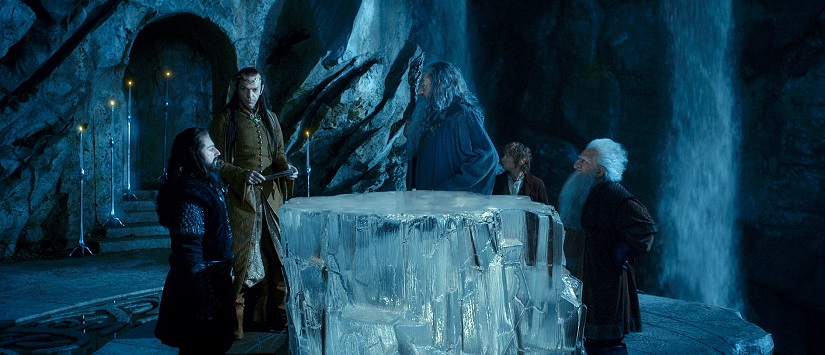
Bilbo attending a secret council in Rivendell, the home of the elves, along with Thorin (Richard Armitage), Elrond (Hugo Weaving), Gandalf (Ian McKellen) and another dwarf.

Bilbo attending a secret council in Rivendell, the home of the elves, along with Thorin (Richard Armitage), Elrond (Hugo Weaving), Gandalf (Ian McKellen) and another dwarf.

Nevertheless, unlike with Lord of the Rings, Jackson has shot The Hobbit: An Unexpected Journey at 48-frames-per-second, known as the Higher Frame Rate (HFR), rather than the standard 24-frames-per-second. Although the HFR was meant to make everything appear more realistic, it is more likely to bring about the peculiar feeling of watching a TV programme with a substantially greater budget. Actors might appear very clearly in the foreground, but the computer-generated backgrounds come across as just that: computer-generated! This sadly lessens the ‘reality’ that Jackson was aiming for, and the 3D element doesn’t add much either (other than a few quid onto the ticket price).

It’s a shame that with all the technical innovations Jackson hasn’t focused more on ramping up his creative approach. There are some nice sops to Lord of the Rings fans, particularly having the elder Bilbo (Ian Holm) and Frodo (Elijah Wood) appear at the beginning. After a while though, a sense of déjà-vu creeps in, whether it is in the use of musical riffs from the original trilogy, or the overlong focus on the re-introduction of Gollum (Andy Serkis).

What further acts as a ballast for the film’s 169-minute running time are events and characters not in the original narrative, but picked out from other of Tolkien’s writings. One would have thought that if Jackson had wanted to be so cavalier with the original source material, he would have done something that was truly necessary, such as putting in some more prominent female characters to spice up the narrative. Yet, aside from Cate Blanchett’s brief reprisal as a more-youthful Galadriel, other women in the movie are virtually non-existent. Indeed, Jackson has seemingly forgotten to even put them in the background for the orcs and goblins (which naturally prompts some interesting questions on procreativity).

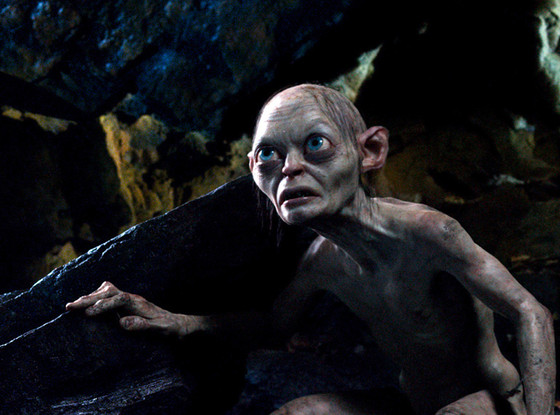
Gollum (Andy Serkis), enhanced thanks to modern technology, playing a game of riddles with Bilbo.

Gollum (Andy Serkis), enhanced thanks to modern technology, playing a game of riddles with Bilbo.

In all of this, it is also hard to pick out distinctive characters throughout the film. Martin Freeman is superb as Bilbo, Ian McKellen once again gives a magisterial performance as Gandalf, and Barry Humphries is great as the voice of the Goblin King. Yet, aside from grumpy Thorin ‘wannabe-Aragorn’ Oakenshield, it’s hard to tell one dwarf from another, since they all seem as one-dimensional, hairy and gruff as the next. Considering that The Hobbit is about the dwarves trying to reclaim their homeland, this is not sufficient.

Thus, Part I of The Hobbit has started us on another unexpected journey through Middle Earth. Already though, after almost three hours (and with another six to go), it feels like we are on a long and bloated trek that possibly has the power to undo all that was good about Lord of the Rings.

KJF

Review – The Master (15) [2012]

Star Rating: 4.5/5

Director:

  • Paul Thomas Anderson – Boogie Nights, Magnolia, There Will Be Blood

Cast:

  • Joaquin Phoenix – Gladiator, We Own The Night, Her
  • Philip Seymour Hoffman – The Ides of March, Moneyball, A Most Wanted Man
  • Amy Adams – Charlie Wilson’s War, The Fighter, Man of Steel
  • Ambyr Childers – Playback, Crossfire, Gangster Squad
  • Jesse Plemons – Paul, Battleship, Flutter

Tom Cruise and John Travolta are two of the most well-known members of the Church of Scientology. Following the former’s divorce to Katie Holmes earlier this year, the nature of the quasi-religion/cult, founded by L. Ron Hubbard in 1952, was came under media scrutiny, and not without some bad press. Yet, one key element that was not addressed during the Cruise-Holmes divorce was the type of individual who would join such a movement. The Master gives us some ideas in excellent fashion.

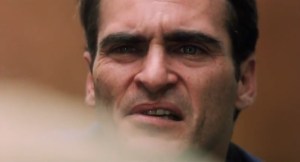
Freddie Quell (Joaquin Phoenix) looking like he needs to be seen by the men in white coats.

The Master is set during the 1950s, centred round Freddie Quell (Joaquin Phoenix). Freddie is a naval veteran who is yet to find peace with himself after World War II (WWII). He is suffering from a multitude of psychological issues and drinking anything to excess that he can get his hands on.

Randomly, he finds himself aboard a ship that is being borrowed by a movement, called The Cause. There, he finds himself mesmerised by Lancaster Dodd (Philip Seymour Hoffman), the charismatic leader of the cult, believing that Lancaster has the cure to his problems.

The Master is a 144-minute art-house film with a peculiar atmosphere. The 1950s-style music has been adjusted, weirdly, yet aptly, to make one feel uncomfortable in almost every scene as we explore the nature of this bizarre cult through Freddie’s eyes.

One watches with bewilderment as The Cause’s followers lap up Lancaster Dodd’s (bonkers) ideology, as well as their aggressive reactions to those who dare to question any aspect of the dogma, even if it is illogical and contradictory. Moreover, one sees the 1984-style, brainwashing techniques that some cults adopt not only to allow people to join the movement, but to ensure that they are ‘committed’ to the cause.

Lancaster Dodd (Philip Seymour Hoffman) giving one of his fantastic, if crazy, speeches about how one is connected to previous and future existences.

The alarming craziness of The Cause’s ideology makes up for the slowness of The Master and the lack of activity in the plot. The quality of the acting does the same. Joaquin Phoenix delivers a master-class performance as someone suffering from Post-Traumatic Stress Disorder and alcoholism (paint-thinner and lighter fluid included). He always looks exhausted, distressed, and like he’s about to blow a fuse. Additionally, his speech is consistently slurred, entailing that viewers will believe that Freddie is on the verge of a psychotic breakdown.

Whilst Phoenix is the stand-out performer in the film, the rest of the cast do their roles with equal capability, even if their ones are less challenging. Philip Seymour Hoffman plays exceptionally plausibly as the captivating, yet mad and flawed leader of the cult. Hoffman’s aura and charisma, as Lancaster Dodd, indicates why so many people in 1950s America were drawn to (the self-declared human-deity) L. Ron Hubbard. In addition, Dodd’s magnetic personality hints at how Hubbard managed to found the Church of Scientology and accrue millions of dollars from his followers. That all of this can be encompassed in one performance is testament to Hoffman’s acting skills.

Phoenix and Hoffman dominate The Master, thereby leaving little room for the rest of the cast to showcase their abilities. Nevertheless, Amy Adams plays very well as Lancaster’s wife, whose devotion to the movement is scarily absolute; similar things can be said for Ambyr Childers, who plays as Lancaster’s daughter, and who spends much of the time she is on screen teasing Freddie; and Jesse Plemons does a decent enough job as Lancaster’s son, who ultimately knows that his father is a phoney making it all up as he goes along.

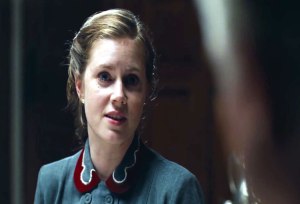
Peggy Dodd (Amy Adams), Lancaster’s wife, appeaing to her husband to do something about Freddie due to his drinking problems.

Much praise should rightly go to the cast. But director Paul Thomas Anderson should also get credit for making The Master look like one is reliving 1950s America. The clothes, the hair-styles and the music all seem to perfectly fit into place. Furthermore, there is no mention of the term ‘Post-Traumatic Stress Disorder’ in the movie. This is because the term did not exist in those days. Still, it would have been easy for Anderson (even if it would have been patronising on the audience) to have had someone in the film state the obvious and make a factual error. After-all, in Gladiator Ridley Scott made Lucilla, the sister of Emperor Commodus, played coincidentally by Phoenix, outlive her brother when in fact she predeceased her brother; and in the 2009 Dorian Gray, Oliver Parker inserted the Suffragettes into the narrative, even though when Oscar Wilde wrote the book in 1890 the Suffragettes had yet to be formed. Anderson, therefore, should be complimented for not falling into such a trap.

All-in-all, The Master is a brilliant, but strange movie. The film might be slow, long and devoid of a linear plot. However, with superb acting and analogies to real-life cults, like Scientology, one is likely to be mesmerised whilst watching the movie from the point of view of the messed-up Freddie. Freddie might have ostensibly little in common with the likes of Tom Cruise and John Travolta but, through Freddie, The Master can give one an understanding for the sorts of people who join cults.

PG’s Tips

Review – Rust And Bone (15) [2012]

Star Rating: 3.5/5

Director:

  • Jacques Audiard – Read My Lips, The Beat That My Heart Skipped, A Prophet

Cast:

Music Composer:

In August 2012, London held the Paralympics event. More than anything, the paralympians illustrated that people with crippling injuries can be full of life and can excel in the face of much adversity. Yet, the tournament did not display the hardships that such people face on a daily basis. Rust and Bone does so, and in a particularly gritty and unglamorous way.

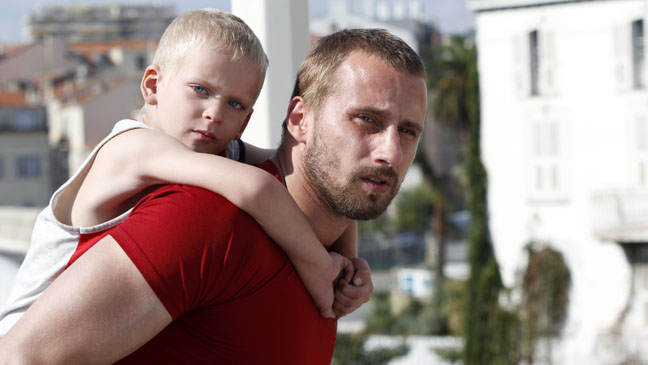
Ali (Matthias Schoenaerts) giving his young son, Sam (Armand Verdure), a piggy-back. Ali, however, is not necessary the most responsible of parents.

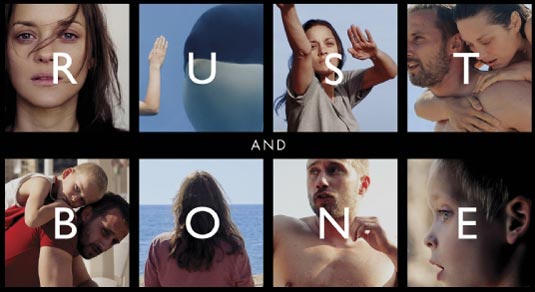
Rust and Bone is a French film based on the book by Craig Davidson with the same title. The movie centres round Alain (Matthias Schoenaerts), a man of dubious morality, who is seemingly in sole custody of his young son, Sam (Armand Verdure). As Alain is unemployed, he leaves Belgium to go to live with his sister, Anna (Corinne Masiero), in the Antibes, where he hopes to find work. Using his skills as a former bare-fist boxer, he gets a job as a bouncer at a nightclub.

There, Alain meets a drunken Stephanie (Marion Cotillard), a killer-whale stunt trainer. After she falls over and cuts herself badly outside the club, he takes her home. Yet, it is not until Stephanie loses both her legs when a stunt goes horribly wrong that she and him form a close relationship.

Rust and Bone is a 120-minute unhurried, art-house film with a very serious atmosphere. Much of the movie is played out in under-privileged dismal areas, akin to those in Harry Brown. The aesthetics, as well as the silence (with the exception of the loud and brash Katy Perry song, Firework, for the Killer Whale stunts) emphasise the severity of the movie’s tone.

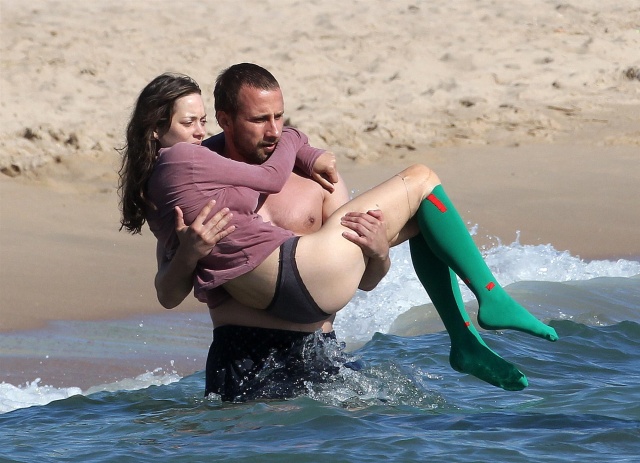
Ali carrying Stephanie (Marion Cotillard) into the sea, following her crippling injury, wherein she had to have her legs amupatated from the knee.

The stark manner of Rust and Bone is reflected in the generally unpleasant characters in the film. Due to a lack of action or intrigue in the plot, the movie relies heavily on the characters, and the relationships that they have with one another, to maintain viewers’ interests. This is not an issue, per se, but as none of the characters are particularly amiable, it is hard for one to truly empathise with their situations.

Alain, for one, is a scummy and untrustworthy individual, with a violent side as well. Indeed, if it were not for his (almost) wonderful treatment toward Stephanie after her injury, Alain would have no redemptive qualities and would be utterly detestable. Despite the nature of Alain’s character, though, credit must go Matthias Schoenaerts. It would have been easy for Schoenaerts to turn Alain into a stereotypical thug. Yet, Schoenaerts doesn’t do this. Rather, he makes Alain unlikeable, but at the same time human, realistic and understandable, which is far from a simple task.

Similarly, Marion Cotillard does a good job as Stephanie, an ordinary girl coming to terms with a crippling injury. Cotillard’s performance in the wheel-chair leaves out nothing, including the struggle of doing something as mundane as making a coffee or going to the bathroom. Cotillard truly makes viewers sympathise with Stephanie’s predicament. Furthermore, and arguably what makes Rust and Bone so unique is that director Jacques Ardiard is not scared to have Stephanie discuss (and perform) sex or swimming in the sea. By doing these, and making Stephanie feel better for it, Audiard demonstrates that Stephanie, and anyone else with a crippling injury for that matter, is a human being. It is a tribute to Cotillard’s skills that she is able to illustrate Stephanie’s feelings so naturally, and without it seeming odd either.

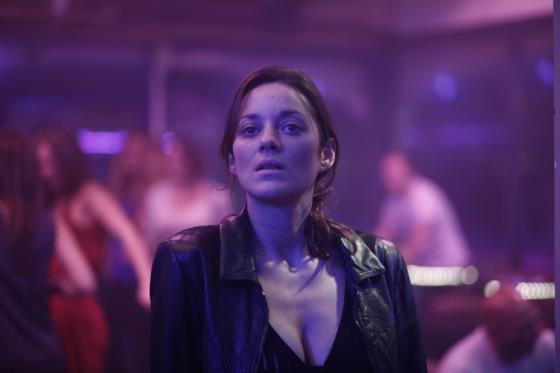
Stephanie looking good and enjoying herself in a nightclub, demonstrating that amputatees know how to have a good time like the rest of us.

Unlike with Schoenaerts and Cotillard, it is hard to overly praise or fault the rest of the cast for their performances. Since the film is dominated by Alain and Stephanie, and how their relationship develops, Armand Verdure, Corinne Masiero and Bouli Lanners (who plays as Martial, Alain’s friend and part-mentor, who is also a gambler of unofficial violent sports among the underclasses) are not given much time on screen. What little we see of them shows us, plausibly, that they are normal people with problems, facing the issues that normal people face, while living in a terrible area.

Over-all, Rust and Bone is a slow-paced and sombre film, but an impressive one in its own right. The movie may not be shot in aesthetically pleasing places, and it may not contain particularly nice characters either. Nevertheless, the film does not do what the authorities of the London 2012 Paralympic games did, and shy away from tackling the harsh realities that arise from crippling injuries. Marion Cotillard’s Stefanie embodies how difficult it can be for people with such injuries to pick themselves up. What’s more, Cotillard’s performance emphasises that a little support from even the most improbable of individuals can help to steer an injured person onto the path of becoming more comfortable with their new and forced lifestyle.

PG’s Tips
Review – Skyfall (12a) [2012]

Star Rating: 3.5/5

Director:

  • Sam Mendes – American Beauty, Road To Perdition, Revolutionary RoadSpectre

Cast:

Music Composer:

The 1990s was a pretty decent era for James Bond. Goldeneye, Tomorrow Never Dies and The World Is Not Enough were all very acceptable Bond films. But then, in 2002, Die Another Die ruined it all. Subsequently, MGM, the owners of the 007 franchise, completely changed the direction of Bond to make it more original, as Casino Royale (2006) and The Quantum of Solace demonstrate. Skyfall cleverly continues this trend, but not without hitches.

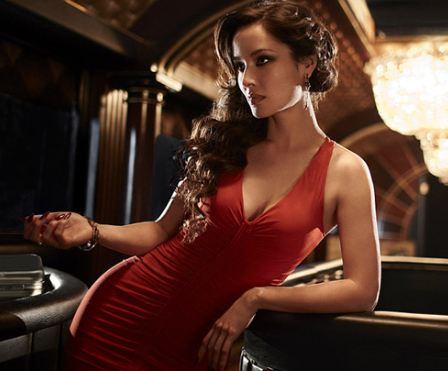
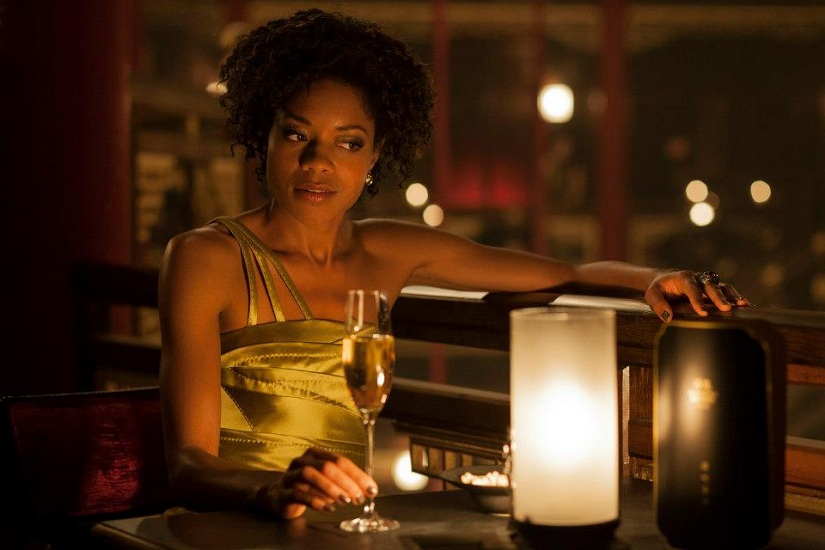
The stunning and enigmatic Sévérine (Bérénice Malohe). Her style and dangerous background make her an apt fit for Bond’s affections.

Skyfall begins with M (Judi Dench) coming under intense pressure to resign, following a failed mission in Turkey. After meeting with Gareth Mellory (Ralph Fiennes), the British Intelligence and Security Committee Chairman, M discovers that the computer in her office in MI6 has been hacked and a bomb explodes in MI6 headquarters. M subsequently turns to her secret agents, Eve (Naomi Harris) and James Bond (Daniel Craig), who is suffering from psychological problems following events in Turkey, to find out who was behind the attack.

There is much to admire about Skyfall. That a significant proportion of it is filmed in Britain is bold; it gives us a hint at how MI6 might work in the event of war on British soil; and the last scene of the movie is very clever. Also, for the first 100 minutes or so, the plot is logical and intelligent. Cyber-terrorism is a very current issue, and director Sam Mendes conveys the threat well.

It is just a shame that the last 44 minutes drag and has only a tenuous link to the first part of the film. Indeed, it renders the purpose of going to exotic Shanghai pointless (not that that was ever more than a cynical attempt to tap into the Chinese market) and, worse, it throws up plagiarism issues with the exceptionally magnificent Batman Begins.

Eve (Naomi Harris) dressed classily, while in the midst of an MI6 operation.

Moreover, Skyfall appears to be torn in several directions. Sir Ian Fleming wrote James Bond as a satire on the British secret service. Yet, because MGM now want Bond to be more grounded (and even bleed), the fundamental element of 007 has been lost. Additionally, if MGM truly want to make Bond plausible, they should look toward Tinker Tailor Soldier Spy and Shadow Dancer, and remove the Expendables-/Mission: Impossible-style stunts and action scenes. Those always look ridiculous and undermine all attempts at realism. (Besides, those scenes have become so clichéd that one is unlikely to miss them.)

The change of direction for 007 movies has also greatly impacted upon the appearance and character of James Bond, himself. Nevertheless, it is not Craig’s blond hair and lighter features that differentiate him from his predecessors, Roger Moore and Pearce Brosnan. Rather, it is his black humour, as well as his lack of suave and touché lines. That is not to say that Craig performs badly as the Bond he’s been asked to perform; actually, he’s rather good. But that doesn’t make him seem any more like the James Bond of old.

Yet, it is not just Craig’s Bond that has been given a new lease of life; the villains have too. Silva, embraced whole-heartedly and delightfully by the Oscar-winning Javier Bardem, is by far the most flamboyant and hilarious Bond baddie. However, it is blatantly obvious that Sam Mendes drew his inspiration from the villains in Christopher Nolan’s The Dark Knight (and he didn’t need to spell it out in an interview either). Mendes should have been aware that stepping onto the haloed territory of the Joker and, to a lesser extent, Two-Face is like trying to win a game of ice-hockey while skating on thin ice. Can anyone really say with conviction that Bardem’s Silva was on a par with Heath Ledger’s Joker?

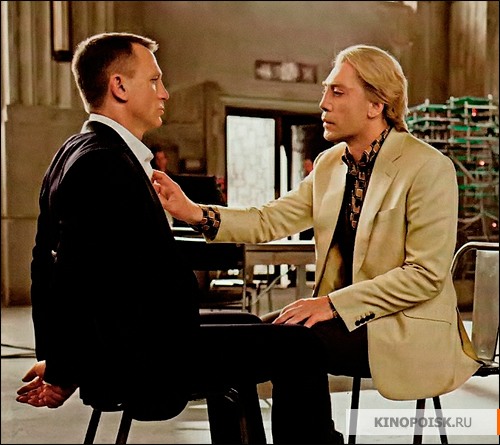
The blond-haired villain, Silva (Javier Bardem), teases Bond, while the latter is tied up. Haven’t we seen such a scenario before?

Craig and Bardem aside, the performances from Ralph Fiennes and Judi Dench are typically strong and down to earth. The same can be said for Ben Whishaw, who plays the young, new Q with much spirit and humour to make himself, potentially, the long-term successor to the late Desmond Llewelyn.

Conversely, Naomi Harris, as Eve, never convinces that she’s a secret agent, unlike Jessica Chastain in The Debt or Julia Roberts in Duplicity. Harris’ Eve also lacks chemistry with Craig’s Bond. Maybe both of those things are deliberate, but if that is true then MI6 would never have sent her into the field, thereby revealing another flaw in the movie’s attempt at realism.

All-in-all, Skyfall is not a bad film and continues the interesting trend of Casino Royale and The Quantum of Solace. Skyfall has intelligence and a cast that does justice to the more credible, if unconventional direction that MGM have taken Bond toward. This does not mean that the film is problem-free, aside from being too long and recycling parts of Nolan’s Dark Knight Trilogy. No, if MGM truly wish for 007 to depart from the approach of the 1990s Bond films, they must not stand half-way as they have here: they must make James Bond chillingly realistic.

PG’s Tips
Review – The Imposter (15) [2012]

Star Rating: 4.5/5

Director:

  • Bart Layton – Breakout, Banged Up Abroad

Cast:

  • Adam O’Brian
  • Anna Ruben – Eternal, The Fallow Field
  • Frédéric Bourdin (himself)
  • Beverley Dollarhide (herself, Nicolas’ mother)
  • Carey Gibson (herself, Nicholas’ sister)
  • Codey Gibson (himself, Nicholas’ brother-in-law)
  • Charlie Parker (himself, FBI official)
  • Nancy Fisher (herself, FBI official)

The disappearance of children is nothing new, as Changeling and the case of Madeleine McCann can attest. Vanishing children is a deeply disturbing part of society and one that is not as rare as good people would like it to be. In the case of Nicholas Barclay, however, there were a series of unusual twists that would be too far-fetched for a soap opera. In brilliant fashion, The Imposter sheds light on this peculiar affair.

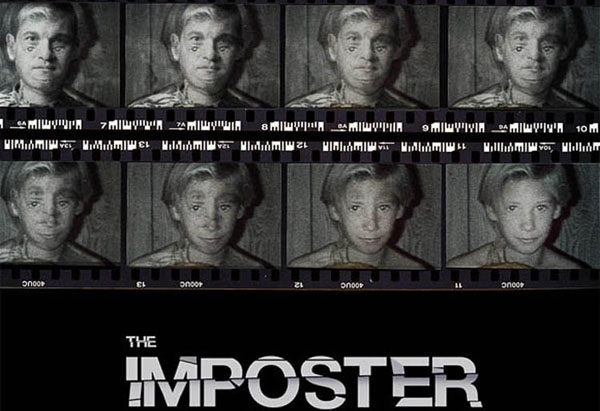
Nicholas Barclay, aged thirteen. This picture was taken shortly before he disappeared without trace after playing basketball with friends.

The Imposter is a documentary-style film about the vanishing of Nicholas Barclay in San Antonio, Texas, in June 1993. After no news for more than four years, in November 1997 the Barclay family received a call from Spain telling them that Nicholas had been found. Yet, when ‘Nicholas’ returned to America, he was no longer fair-skinned, blond-haired and blue-eyed. Rather, he had dark Arabic features, brown eyes, looked older than sixteen, and spoke with a distinctly French accent.

Nevertheless, the Barclay family took him in. They looked after him as if he were part of the family, unaware that ‘Nicholas’ was really Frédéric Bourdin (played by Adam O’Brian to depict ‘Nicholas’ when young).

The Imposter is a surprisingly gripping film that feels significantly shorter than its 99 minutes. Despite being neither a drama nor a thriller nor a horror movie, the film is dramatic, thrilling and unnerving (indeed, more so than many thrillers and horror movies). This is because The Imposter has been put together magnificently by Bart Layton by predominantly using old film footage of the actual events; few re-enactments, all of which are grounded; eerie music that gives the film an odd air of surrealism; and question-less interviews with the living members of the Barclay family, embassy officials and FBI-agents involved in the case, as well as Frédéric Bourdin, himself.

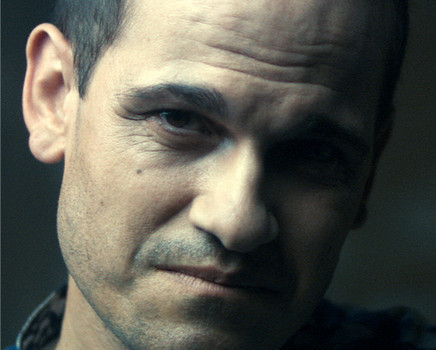
Frédéric Bourdin, whilst being interviewed during the film. Even though he is thirty-eight now and balding, with his dark features it is still incredible to believe that he managed to fool the Barclay family, the Spanish authorities, American embassy officials, and some FBI agents into thinking that he was Nicholas Barclay in 1997.

By putting the cameras directly in front of the interviewees, Layton has cleverly made the audience feel as if they are interviewing the cast themselves. Moreover, as the interviews and the storyline follow a logical/chronological order, viewers are able to feel a rare intimacy with the interviewees as well as with the events as and when they unfold.

Layton has also given each member of the cast a fair amount of time to explain his/her reasoning. This ensures that one can understand and empathise with the characters for why they behaved and reacted in the way they did.

That is not to say that all questions arising from the case are satisfactorily answered in The Imposter. (I won’t go into them as that would spoil the film.) It is also bizarre that little is mentioned of Nicholas’ older brother Jason, who died mysteriously of a drug overdose in 1998 not long after meeting ‘Nicholas.’ Surely, Layton could have interviewed some of Jason’s friends (assuming he had any) to get Jason’s side of the story or to get an idea of the sort of relationship Nicholas had with his older brother?

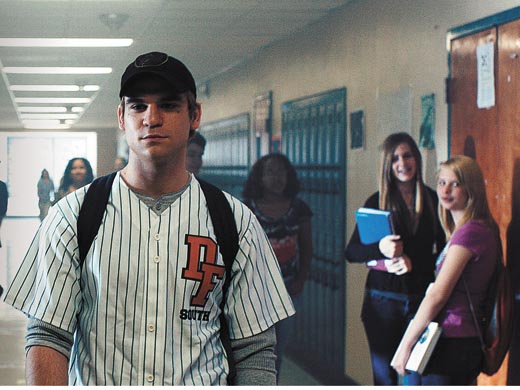
‘Nicholas’ (Adam O’Brian) back in school after returning from Spain. Did it not occur to Nicholas’ friends and teachers that he looked darker than he should have done and much older than a sixteen year old boy?

But the lingering question throughout the movie is: how did Nicholas’s mother, Beverley, not realise that it was not her son who arrived from Spain? Or, alternatively, did she know that ‘Nicholas’ wasn’t her son, yet played along with it for other reasons? It seems somewhat implausible that a mother, regardless of her intelligence, would fail to recognise her son in an instant, as Christine Collins (played superbly by Angelina Jolie) conversely illustrated in Changeling.

All-in-all, The Imposter elucidates admirably upon the weird ‘reappearance’ of Nicholas Barclay. The film powerfully makes one feel close to the events in an impressive, yet utterly unsettling way. This is not merely because of Bart Layton’s bold and well-executed documentary-style approach to the movie. It is because The Imposter is a non-dramatised true story, and deals with a disconcerting issue that is very pertinent to present-day society.

PG’s Tips
Review – The Possession (15) [2012]

Star Rating: 1/5

Director:

  • Ole Bornedal – Nightwatch, Deliver Us From Evil, 1864

Producer:

  • Sam Raimi – Xena: Warrior Princess, Spiderman I-III, The Evil Dead

Cast:

  • Jeffrey Dean Morgan – Watchmen, Grey’s Anatomy, Red Dawn
  • Natasha Calis – Donovan’s Echo, The Firm
  • Madison Davenport – Jack and the Beanstalk, Shameless, Noah
  • Kyra Sedgwick – Man on a Ledge, The Closer, Chlorine
  • Grant Show – Melrose Place, Marmalade, All Ages Night
  • Matisyahu

In my review of The Woman in Black, I spoke of the urgent need for the horror-genre to be revamped. Too often, so-called ‘horror’ films have become formulaic and a joke. Well, unbelievably, the genre has sunk even lower due to The Possession.

Em (Natasha Calis), unaware of the evil held within the container, purchasing the ‘Dibbuk box’ at a yard sale not far from her father’s home.

The Possession is a supernatural horror movie based on a true story. (Yeah right.) Em (Natasha Calis) and Hannah (Madison Davenport) are two young girls, whose parents are divorced. While staying with their father, Clyde (Jeffrey Dean Morgan), they go to a yard sale to purchase some new things for their father’s new house.

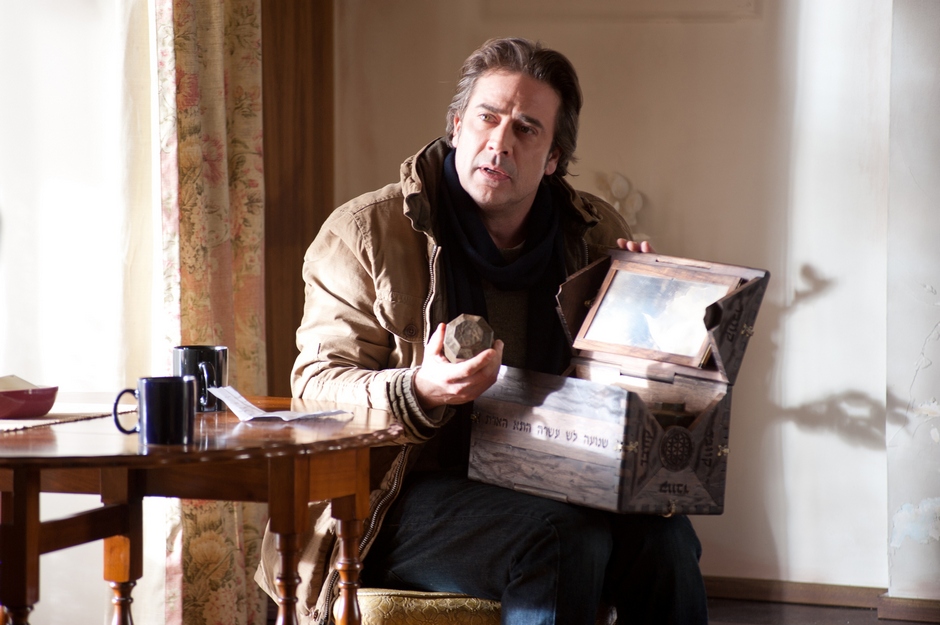
At the sale, Em comes across an old wooden box with an inscription of Hebrew writing and buys it. Little does she know, though, that the box contains a Dibbuk (Hebrew for an ‘evil spirit’). Em doesn’t find out until after she opens it. But by then it is too late, as the Dibbuk is already consuming both her soul and her flesh.

The Possession is neither scary nor interesting, thereby making the film feel a lot longer than its 92 minutes. Also, starting the movie with ‘based on a true story’ just renders the film stupid. One is generally not going to take a film seriously after watching human beings fly upside down across rooms, before smashing into walls and denting the brickwork. (Because that happens in real life, doesn’t it?)

Clyde (Jeffrey Dean Morgan) holding the ‘Dibbuk box’ while his daughters are with their mother and her new boyfriend. Clyde is trying to work out what is inside the box that could have harmed Em.

It is not as if those scenes are unique to The Possession either, as the recent The Exorcism of Emily Rose, The Rite and The Devil Inside attest. Like all of those films, The Possession suffers from an embarrassing number of clichés, which seem to be endlessly recycled in (bad) horror movies. Seeing (poorly-made CGI) insects coming out of someone’s throat or hearing a young girl talking with the voice of a nasty old hag has been done so many times that it ceases to shock or scare.

Combined with these standard techniques is the reprocessed music. Usually these unoriginal scores at least make viewers’ hearts flutter and pump up their adrenaline. In The Possession, however, it doesn’t even do that. The music sometimes threatens to make one feel that he/she will be jumping out of their skin by the end of the scene. Yet, because the film builds up to a climax that invariably doesn’t happen, the non-atmospheric music is reduced to pointlessness to the extent that the scenes would have been tenser with silence.

Matisyahu, donned in full chassidic gear, reading out holy verses, hoping to exorcise the evil spirit that has possessed Em.

And in case The Possession isn’t pathetic enough, the acting is terrible and the script is even worse. Indeed, it is all so dreadful that it almost forces one to question how a donor or Sam Raimi (whose reputation has plummeted since the much-maligned Spiderman 3) could have been duped into thinking that The Possession was a film worth making. At least The Woman in Black was an adaptation from a successful theatre production, so there was an excuse for it to be made. The Possession, on the other hand, has no such strong foundation and is almost solely the result of (the lack of) imagination on behalf of Stiles White and Juliet Snowden (both of whom helped to write Knowing, an appalling movie that was all over the place).

Over-all, The Possession is yet another wretched and stereotypical horror film. It adds nothing new to the genre, is neither funny nor frightening, and is remarkably dull. How many more ‘horror’ movies like this can Hollywood make before donors, directors and producers alike gain some dignity and pull the plug on this woeful genre?

PG’s Tips
Review – Shadow Dancer (15) [2012]

Star Rating: 3.5/5

Director:

  • James Marsh – Man on Wire, Project Nim

Cast:

  • Andrea Riseborough – Brighton Rock, W.E.Birdman
  • Clive Owen – Derailed, Inside Man, Blood Ties
  • Gillian Anderson – The X-Files, Johnny English Reborn, Mr Morgan’s Last Love
  • Aiden Gillen – Game of Thrones, The Dark Knight Rises, Calvary
  • David Wilmot – Intermission, The Guard, Calvary
  • Dohmnall Gleeson – Never Let Me Go, Harry Potter VII(i) & VII(ii)Ex Machina
  • Brid Brennan

Last year’s Tinker Tailor Soldier Spy (TTSS) was a wonderful example of the capabilities of the British Film Institute (BFI). The acting, the dialogue and the settings were noteworthy, plus it gave audiences a true sense of the machinations of the British secret services. Similarly, in Shadow Dancer, the BFI has come up again with another quite impressive film about the murky world of intelligence and underground movements.

Collette (Andrea Riseborough) waiting somewhat apprehensively to speak with Kevin Mulville, one of the most senior activists in the IRA’s ‘military wing.’

Shadow Dancer is based in Belfast between 1993-94, at the time of the Anglo-Irish Treaty, and revolves round Collette (Andrea Riseborough). She is an Irish Republican Army (IRA) activist, who gets arrested for attempting to blow up Mile End underground station in London.

Her interrogator from MI5, Mac (Clive Owen), gives her a stark choice: either face prison and the loss of her son, or become an informant. Mac believes she is a useful person since she has close ties to the most important people in the IRA’s ‘military wing,’ in particular with its leader, Gerry Adams (Aiden Gillen), and his henchman, Kevin Mulville (David Wilmot). Reluctantly, Collette agrees.

Shadow Dancer is a slow-moving, tense thriller. In the same vein as TTSS and Harry Brown, the settings are gritty, non-theatrical and reflective of the era which help to set the tone of the film; in this case, some late-eighties hair-styles and the cream-coloured, box-like computers. Yet, unlike the two aforementioned films, Shadow Dancer runs out of steam, turning to an eclectic mix of predictability and vagueness that undermines much of what is good about the movie.

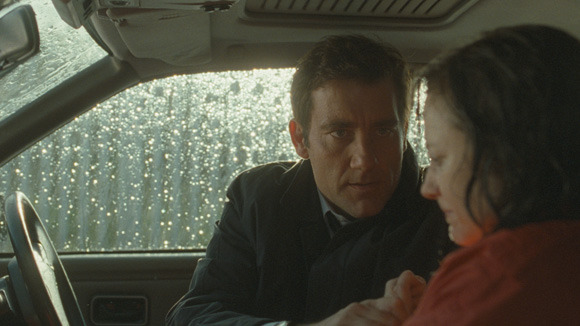
Collette meeting with her MI5 boss, called Mac (Clive Owen), to discuss the IRA’s latest plans.

Aided by a well-written, realistic script and solid acting, Shadow Dancer illustrates the tough life of a militant activist and the dangers of being a double-timer for a movement like the IRA. This is all exemplified astoundingly by Andrea Riseborough as the vulnerable Collette. Without doubt, Riseborough is the star of the film and enhances her growing reputation, after emerging as the only actor to come out unscathed from W.E., the atrocity directed by Madonna. Riseborough makes us empathise with Collette’s difficult and mentally-strenuous situation without appearing weak or cowardly. And her Northern Irish accent is flawless. All of this is no small achievement.

Furthermore, Collette’s position in the IRA enables viewers to see the men and women of the IRA’s ‘military wing’ for what they are. While it shows instances of their malevolence, it also has the effect of humanising them, especially Gerry Adams. (Aiden Gillen, with no less distinction, playing a quieter and much less charming role than as Lord ‘Littlefinger’ Petyr Baelish, the king’s slimy and untrustworthy advisor, in Game of Thrones.)

Moreover, Collette’s situation allows audiences to gain an understanding of the IRA’s internal disagreements over the treaty, between the ‘military wing and the ‘political wing,’ the latter headed by Ian Gilmour (Stuart Graham).

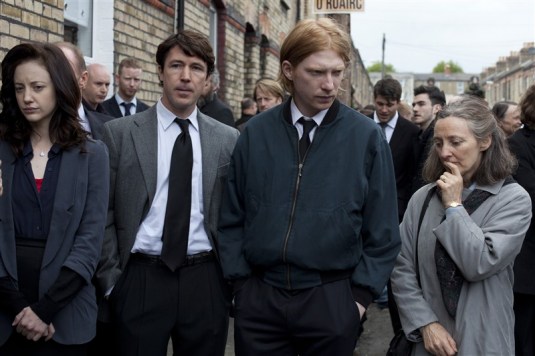
Collette looking on sadly at a funeral, standing alongside with Gerry Adams (Aiden Gillen), her brother Connor (Dohmnall Gleeson), and her mother (played by Brid Brennan). The red haired man in the background.

Yet, surprisingly, Shadow Dancer does not do the same for the inner workings of the British secret services, vis-à-vis the IRA. Whereas TTSS was layered with intrigue, Shadow Dancer falls into a (depressing) cliché wherein Mac plays the ‘good operative,’ since he backs the main character, in contrast to Kate (played by a steely Gillian Anderson), his main (villain-like) adversary, who has an ulterior motive and isn’t given the time to justify herself.

All-in-all, Shadow Dancer is another worthwhile movie made by the BFI. Like TTSS and Harry Brown, it has a grounded and harsh feel that is only lightened by the remarkable performance of Andrea Riseborough. It is just a pity for Riseborough that Shadow Dancer’s storyline lacks the complexity and plausibility that is so striking about her display.

PG’s Tips
Review – The Dark Knight Rises (12a) [2012]

Star Rating: 5/5

Director:

Cinematographer:

Cast:

Music Composer:

Once in a decade, perhaps, are audiences treated to a trilogy wherein the three films are not only worthy of five stars each, but also raise the bar over the movie that preceded it. Ten years ago, it was Peter Jackson’s The Lord of the Rings, which culminated beautifully in the epic The Return of the King. Now, it is the turn of Christopher Nolan and his Dark Knight Legend saga, which has climaxed spectacularly with The Dark Knight Rises.

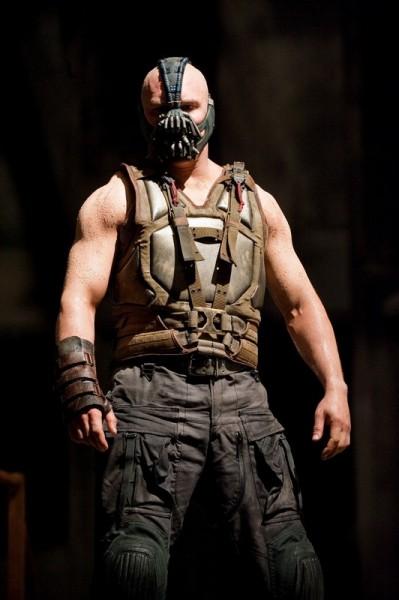
The monstrous-looking, hulking Bane (Tom Hardy). Ra’s Al Ghul’s successor intends to finish off Gotham once and for all, forcing Batman to come out of his virtual retirement.

Eight years have passed since Bruce Wayne/Batman (Christian Bale) defeated the Joker, killed the District Attorney, Harvey Dent, and disappeared. Since then, Gotham has branded Batman an enemy, after he took responsibility for Dent’s crimes to uphold the reputation of the ‘White Knight.’ Whilst away from his former exploits, Bruce has been a recluse, investing some of his considerable wealth in peaceful nuclear energy and the Wayne Foundation, where he uses the expertise of Miranda Tate (Marion Cotillard) to good effect.

However, Gotham now faces a new threat. The League of Shadows has returned and is led by the masked, super-strong Bane (Tom Hardy), who is out to destroy Gotham and Batman with it. After Commissioner James Gordon (Gary Oldman) is wounded trying to take out Bane, leaving the police almost solely in the hands of the young idealist officer, John Blake (Joseph Gordon-Levitt), Bruce feels that the time has come to don the bat-gear again. But how will Gotham take to his return? And what will Batman do with the criminal Selina Kyle/Catwoman (Anne Hathaway), who has a mysterious interest in Wayne Manor and Wayne Enterprise?

Rises’ plot might be slow-moving for the first hour and it certainly requires great levels of concentration for the entire 164 minutes; yet, the film is intellectually-stimulating, absorbing and multi-layered. It also builds up to a stunning, well-thought-through climax, ensuring that those who give the movie their full attention will be rewarded.

One of the most satisfying aspects of the storyline is that Nolan cleverly links Rises with Batman Begins and The Dark Knight, the two previous instalments in the series. He does this by making the caped crusader rise to a new mental and physical challenge, which is a direct result of his prior victory over the League of Shadows; and by illustrating the relevance of Batman and Harvey Dent as symbols of hope against injustice and corruption. (Not to mention demonstrating how susceptible the fabrics of society are to implosion when the symbols are smashed.)

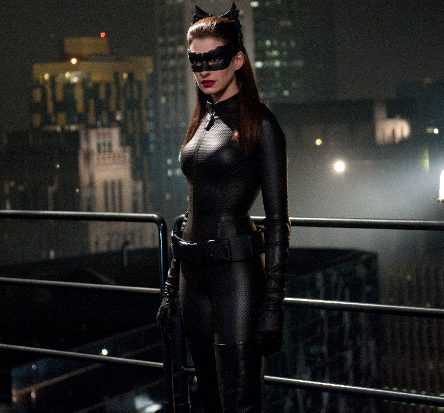
Selina Kyle (Anne Hathaway) wearing her figure-revealing ‘cat’ outfit while she steals what she needs at night and fights her way out of trouble.

Furthermore, Nolan intelligently incorporated genuine, present-day issues and analogies into the previous two films to make them relatable to the epoch. He does it again in Rises. Like in The Dark Knight, he throws in moral and ethical dilemmas here to illustrate just how tough and messy decisions can be for our political leaders (in the war on terror). And, like in Batman Begins, Nolan underlines how sophisticated, scientific technology can be used as weapons. In the first film in the series, it was the dangers of microwave emitters. In the third, it’s the threat posed by ‘peaceful’ nuclear programs (Iran) and what happens should they fall into the wrong hands.

Arguably, Rises lacks a character with the charisma of the Joker, especially as he is Batman’s traditional nemesis. Nevertheless, the astuteness of the plot and the excellence of the cast make up for this absence. Christian Bale superbly reveals the psychological torment and the multifaceted nature of Bruce Wayne that makes all other comic-book based protagonists, such as those in Fantastic Four, The Avengers Assemble and Spiderman appear immature and superficial by comparison; Anne Hathaway looks as eye-catching in tightly-fitted latex as she plays; Michael Caine again gives a touching performance as Alfred, Bruce’s wise fatherly butler, as does Morgan Freeman as the humorous Lucius Fox, the head of Wayne Enterprise; and, lastly, Tom Hardy is terrifying as Bane.

Just as Nolan did with the villains Scarecrow, the Joker and Two-Face in the other movies, he’s turned Bane from a pantomime fool (as was seen in the unwatchable 1997 Batman & Robin) into a complex and sinister character, with a distressing backstory. It is not merely Bane’s brute strength and intelligence that’s scary, it’s also the glint of frightening fanaticism in his eyes which was probably last seen with Ayatollah Khomeini, the late leader of the 1979 Iranian Revolution.

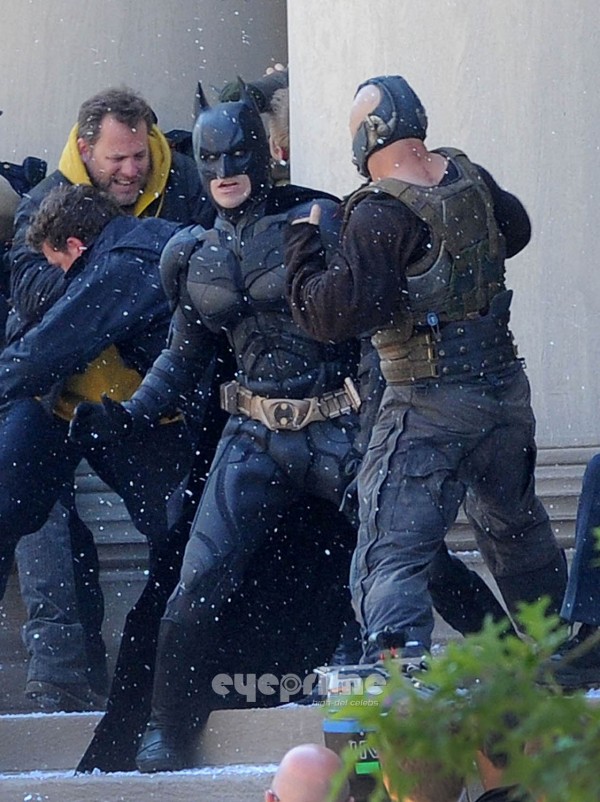
Batman (Christian Bale), with renewed vigour, battling it out with Bane to save Gotham from destruction.

While the actors do their parts splendidly, so too do the special effects team and Hans Zimmer. The effects look so real, viewers have to remind themselves that CGI was used. Similarly, the score may not be as grand or uplifting as the one composed by Howard Shore for The Lord of the Rings; nonetheless, the dark disposition of Rises entails that Zimmer’s gothic-style music is apt and augments the scenes exponentially.

Over-all, The Dark Knight Rises is an engrossing and special conclusion to an exceptional trilogy. Christopher Nolan has transformed the Batman story from a joke into a dark and very human tale that has relevance to the current era, making all other comic-book based movies seem light and casual in contrast. Once more, Nolan has used intelligence and a phenomenal cast to outdo himself in the same way that Peter Jackson did almost a decade ago. Heaven knows, it might be another ten years before we see a series of such brilliance again.

PG’s Tip

Review – Snow White and the Huntsman (12a) [2012]

Star Rating: 2.5/5

Hollywood has a thing for bastardising stories. With varying enjoyment, films like Troy, Kingdom of Heaven and Eragon all had little to do with their original narratives to the extent that one might be surprised that their respective creators bothered to keep the right names for the characters. Similarly, Snow White and the Huntsman might be entertaining, but it has little to do with the German folklore tale, ‘Snow White and the Seven Dwarves’, that was first written down by Brothers Grimm in 1812.

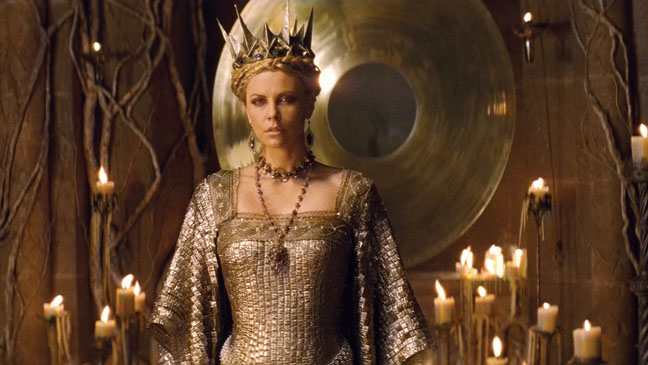
Queen Ravenna, in all her splendour, furious to learn that there is one fairer than her.

The film opens with three drops of blood falling onto snow after Queen Eleanor (Liberty Ross – Thinly Veiled, W.E.) pricks herself. Eleanor is praying for a beautiful and fair daughter with raven-black hair, and the strength of a red rose against snow. Yet, not long after she gets her wish and gives birth to Snow White (when young played by Raffey Cassidy – Dark Shadows; when of age played by Kristen Stewart – Twilight I-V, On The Road, Still Alice), Eleanor dies. Shortly afterward, King Magnus (Noah Huntley – The Chronicles of Narnia I, Your Highness, Jappeloup) marries Ravenna (Charlize Theron – Monster, Prometheus, Hancock I & II), a woman with terrible supernatural powers to keep her forever looking young and strikingly attractive.

No sooner is the king betrothed to Ravenna she usurps the throne and locks up her young step-daughter. As the years go by, Queen Ravenna regularly turns to her magic mirror to remind herself that she is the fairest of them all. That is, until one day when the mirror tells her that Snow White is fairer. It is then that Ravenna orders her brother, Finn (Sam Spruell – The Hurt Locker, Defiance, Enemy of Man), to bring her the imprisoned princess.

But it is then that Snow White escapes, fleeing to the Dark Forest where Ravenna has no power. So Ravenna hires Eric the Huntsman (Chris Hemsworth – Thor I & II, The Avengers Assemble, Red Dawn) to find and kill her…

Snow White and the Huntsman is an enjoyable movie. Set in a medieval-like world (even though the story originates from around the eighteenth-century), the sceneries are fitting, and the towns and villages, not to mention their inhabitants, are filthy in a realistic way for the period.

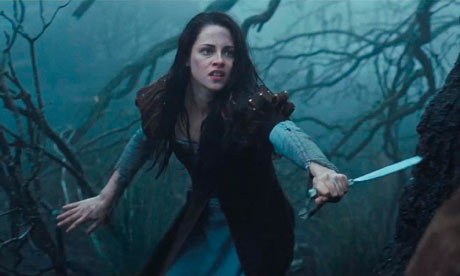
Snow White, wet and filthy, trying to defend herself against Eric the Huntsman in the Dark Forest.

Nevertheless, the plot has as much accuracy to the Grimm Brother’s tale as Patroclus does being Achilles’ cousin in Troy (when he is meant to be his lover) and Arya having reddish-brown hair in Eragon (when she is meant to have raven-black hair). Indeed, Snow White and the Huntsman has a multitude of storyline deviations, such as Queen Eleanor shedding three drops of blood (since that comes from another folklore story, called ‘Snow White and Rose Red’) and the huntsman being hired by the evil queen to find Snow White (since in ‘Snow White and the Seven Dwarves’ he helps Snow White escape to the Dark Forest to save her from Ravenna).

Ravenna as the ‘evil queen’ is one of many clichéd characters in the film. On screen, Ravenna rules in a typically cruel manner and is invariably screeching wicked commands at her advisers; Snow White is an idyllic (dull) angel who hardly knows how to hold a knife, let alone kill someone with it; the huntsman is the stupid, axe-wielding, drunken lout turned noble protector of the princess; and the seven dwarves (at least that stays true to the original story) are almost as one-dimensional as in the 1937 Disney cartoon animation.

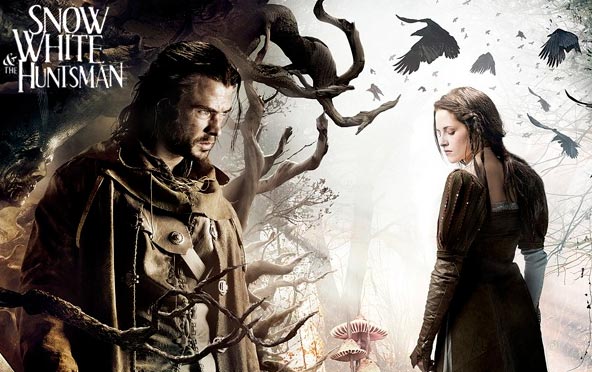
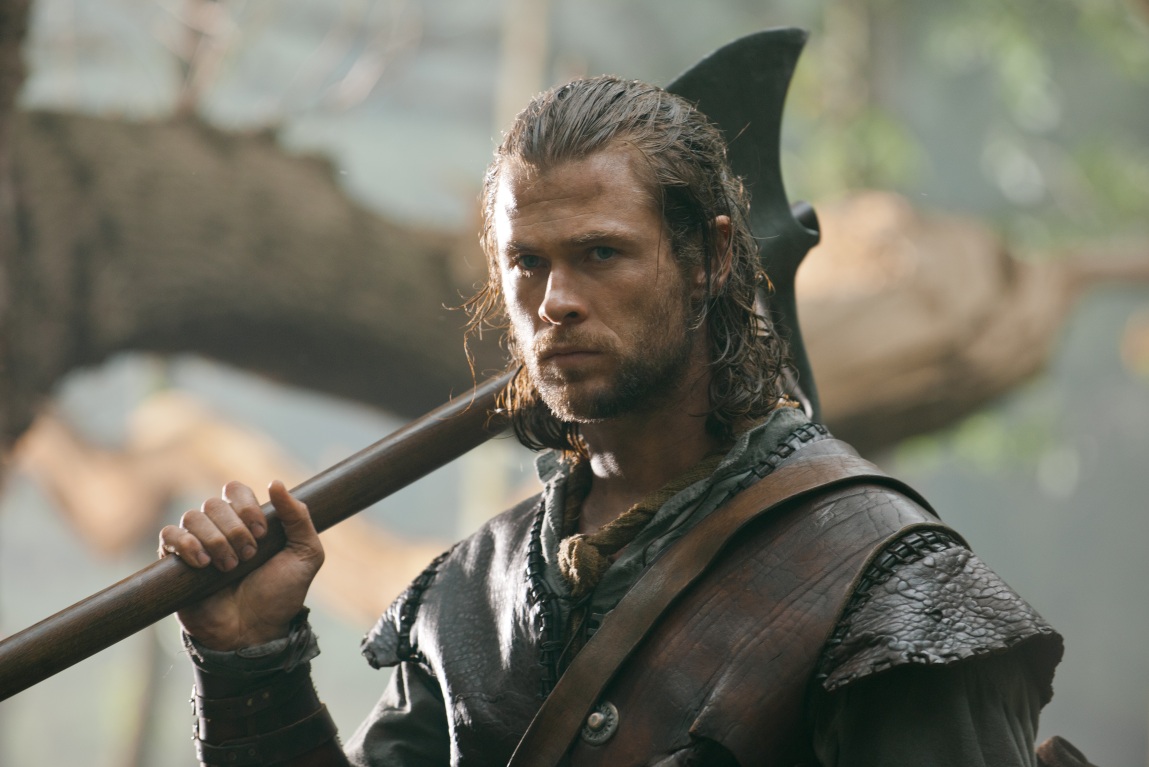
Thor… Eric the Huntsman ready to bury his axe into anyone attempting to hurt Snow White.

Due to the lack of depth in all of the characters, the cast has little room to show their talents. Oscar-winner Charlize Theron gives a distinctly ordinary performance as Ravenna; Sam ‘Anders Breivik lookalike’ Spruell is nothing short of wimpish and pitiful; Kristen Stewart gives a stronger performance than she does in the Twilight saga, but she only ever has one expression on her face throughout the film, and her pre-battle speech is laughably appalling; Chris Hemsworth’s display is ostensibly the same as his hammer-swinging one in Thor and The Avengers Assemble, just with a humorous Scottish accent and minus the overt arrogance; and Ian McShane (The Golden Compass, Pirates of the Caribbean IV, Jack the Giant Killer), Bob Huskins (Hook, Made In Dagenham, Aleksander Rouge), Ray Winstone (The Departed, Edge of Darkness, The Sweeney), Nick Frost (Shaun of the Dead, Paul, Cuban Fury) and Toby Jones (Tinker Tailor Soldier Spy, The Hunger Games, The Girl) are all funny as the gruff dwarves, but they pale in comparison to Peter Dinklage’s performance as the deeply complex, witty Tyrion Lannister from Game of Thrones.

All-in-all, Snow White and the Huntsman is an enjoyable film with decent settings and an attractive cast. The actors might give average performances and the characters they portray might be over-simplistic caricatures of good and evil, but it is the movie’s drift away from the original tale that is most striking. Just like with The Iliad, the history of the Third Crusades, and Eragon, Hollywood has shredded a good story in an attempt to make it fit a narrative supposedly more suitable to modern day audiences with a derisible outcome.

PG’s Tips