Tag Archives: film

Review – London Has Fallen (15) [2016]

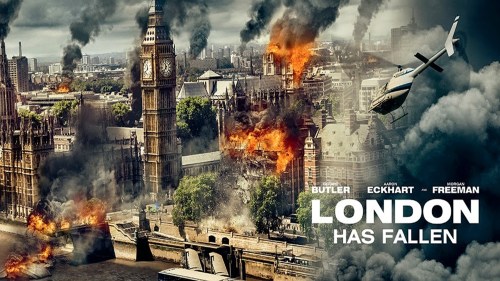
London Has Fallen - title banner

Star Rating: 1.5/5

Director:

  • Babak Najafi – Sebbe, Easy Money II: Hard To Kill

Cast:

  • Gerard Butler – 300, Coriolanus, Olympus Has Fallen, Hunter Killer
  • Aaron Eckhart – Paycheck, The Dark Knight, Olympus Has Fallen, Bleed For This
  • Morgan Freeman – Conan The Barbarian, The Dark Knight I-III, Transcendence, Olympus Has Fallen, Ben-Hur
  • Alon Aboutboul – Rambo II, Body of Lies, The Dark Knight Rises, Harmonia
  • Waleed Zuaiter – Sex And The City II, The Men Who Stare At Goats, The Free World, Billionaire Boys Club
  • Shivani Ghai – Bride & Prejudice, Cleanskin, Eastenders, London Life
  • Radha Mitchell – Finding Neverland, The Crazies, Olympus Has Fallen, Fugly, The Darkness

Music Composer:

  • Trevor Morris – The Tudors, Immortals, Olympus Has Fallen, The Borgias, Goon: Last of the Enforcers

2013’s Olympus Has Fallen was the (laughable) rehash of Die Hard, just in the White House and with North Koreans as the villains. It was loud, shouty, clichéd, and full of explosions and shoot-outs to save the President, with Gerard Butler playing the role John McClane. London Has Fallen is exactly the same, but in London instead of the White House.

The London Eye, one of the capital's known landmarks, is blown up in the terror attacks.

The London Eye, one of the capital’s known landmarks, is blown up in the terror attacks.

The British Prime Minister, James Wilson, has died. US President Benjamin Asher (Aaron Eckhart) feels obliged to go to the funeral in London, along with all the other leading dignitaries of the world. But Mike Banning (Gerard Butler), the President’s top secret serviceman, is apprehensive about the President going to London. He fears that terrorists will spring a surprise or two.

(And wouldn’t you know it?) Banning is right. During the funeral, terrorists start shooting at the world leaders and blowing up London’s known landmarks. (Forget the unknown ones: they’re not worth blowing up.) President Asher is in the thick of the attacks and it is up to Banning to get him out of London and save him again.

London Has Fallen is exactly what one would expect, and enjoyable for it. The plot has all the (laughable) pros of its prequel, just with more swearing, more (nauseating) self-references to how great America is, no White House, and Muslim fundamentalists instead of North Koreans. What’s more, the special effects crank up the enjoyment factor to eleven as they are as good as the N64 game Goldeneye (which came out in 1997).
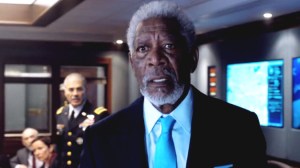
Vice President Trumbull (Morgan Freeman) watching in horror as the known landmarks of London going up in smoke.

Vice President Trumbull (Morgan Freeman) watching in horror as the known landmarks of London going up in smoke.

With a plot so clichéd and special effects so pitifully bad, it is hard to believe that the main cast members could take this film seriously. Yet, it appears they do. No-one looks embarrassed to be on-screen (unlike Charles Dance in Ali G: In Da House and in Your Highness, or the entire cast of Seventh Son). In fact, they all look like they are taking the film as seriously as if London really had been hit by multiple terror attacks.

Morgan Freeman plays his usual, charming self as the safe-handed stand-in President. (It helps when one has played the President in Deep Impact and God in Bruce Almighty). Aaron Eckhart is giving everything he’s got to play his first credible role since Harvey Dent in 2008’s The Dark Knight. And Gerard Butler is… well, doing what Gerard Butler does best. Since 300 came out in 2007, Mr. Butler has forged a (preposterous) career out of being an immortal, warrior king (300); a Hollywood hunk who ladies swoon over, and who all men want to be like (PS I Love You, The Bounty Hunter, and especially Playing For Keeps); and now an action hero (Olympus Has Fallen). In short, Mr. Butler is trying again to be all things for all peoples to add to his magazine of self-aggrandisement. (When is Mr. Butler going to say that enough is enough of this absurd self-propaganda? When is he going to do a proper role where he is not the flawless envy of the world?)

Mike Banning (Gerard Butler) running through the evacuated London underground trying to get President Asher (Aaron Eckhart) to safety.

Mike Banning (Gerard Butler) running through the evacuated London underground trying to get President Asher (Aaron Eckhart) to safety.

As for the villains and their performances… yeah, there is really not much to say about them. The villains are one-dimensional, bad, anti-Western Jihadis. That’s all there is to them and the sooner they are forgotten the better. Much like the film they’re in, really.

All-in-all, London Has Fallen is a laughably entertaining film for all the wrong reasons. It is loud, sweary, clichéd, and full of explosions and shoot-outs to save the President from Jihadis, with Gerard Butler playing the role John McClane. The special effects are contemptible. Then again, so is the serious nature of the acting and Gerard Butler’s insatiable need to be loved on screen.

PG’s Tips
Review – Goodnight Mommy (15) [2016]

Goodnight Mommy - title banner

Star Rating: 4/5

Directors:

  • Severin Fiala – Kern
  • Veronika Franz – Kern

Cast:

  • Susanne Wuest – Antares, Thank You Mr President, Judas Goat, A Cure For Wellness
  • Elias Schwarz
  • Lukas Schwarz

Music Composer:

  • Olga Neuwirth – The Long Rain, Erik(A), Kill Daddy Good Night

Since the turn of the century, the horror genre has been dominated by the ‘found-footage’ and the paranormal subgenres. Seemingly, film-makers have often forgotten how to make horror films devoid of hand held cameras and/or ghosts going boo to scare audiences, with a couple notable exceptions (The Babadook and The Gift). Well, like those two exceptions, the Austrian film Goodnight Mommy gives viewers a different type of horror film.

The modern, art-deco Austrian countryside, next to a lake, a cornfield and a forest. How could something so tranquil feel so ominous?

The modern, art-deco Austrian countryside, next to a lake, a cornfield and a forest. How could something so tranquil feel so ominous?

Goodnight Mommy is about nine-year-old twins, Elias and Lukas (Elias and Lukas Schwarz) and their mother (Susanne Wuest), who are on summer holiday in their modern, country retreat in the Austrian countryside. The twin’s mother has had some cosmetic surgery done to her face and wears bandages to conceal all but her eyes.

However, she starts to act in strange and increasingly erratic ways. Apparently, she was never like this before and the twins begin to suspect that this woman may not be their mother at all…

  Goodnight Mommy is a horror film in the true sense. It is enigmatic, thought-provoking, violent and tense, sucking viewers deeper and deeper into the odd circumstances surrounding the three main characters. Some kind of trauma has happened, that is obvious. But what is it? Where is the father? And why does the mother only speak to Elias and not to Lukas?

The film has an art-house feel to it since it does not rely on jump scares (i.e. quiet, quiet, quiet, quiet, BANG!) to frighten audiences. Rather, Goodnight Mommy relies on silence, atmosphere and the elements to create a genuinely tense and unnerving experience for the entirety of its 100-minute running time. Never has a kid turning on a tap or a mother munching on a biscuit been so quiver-inducing before. It is quite astonishing that the directors, Severin Fiala and Veronika Franz, manage to maintain this level of terror and tension when so little happens for much of the movie.

The dorable twins, Elias and Lukas, entering into their mother's room... where they shouldn't be entering.

The dorable twins, Elias and Lukas, entering into their mother’s room… where they shouldn’t be entering.

Central to their success is the setting. The remoteness of the countryside retreat, with its lake, forest and corn fields gives the film a naturally ominous feel. The weird, hazy pictures of the mother that adorn the walls in the house add creepiness to the already ominous setting. It must also be noted that film has been shot in 35mm camera and with stunning precision, capturing the gorgeously haunting nature of the location.

Nevertheless, Goodnight Mommy could have gone the same way as It Follows had it not been for the strong performances by the three main cast members. The mother, played with wonderful sincerity by Susanne Wuest, comes across as strict, strange, cold and vulnerable all at once, with a regal blue-eyed glare to give her petrifying edge. In contrast, the twins come across as normal, active cherubs who are always playing together, while being forced to live under the pressure of their OCD, disciplinarian mother.

However, aspects of the twin’s behaviour are enough to raise brows. This makes viewers question whether there is more to them than meets the eye. Whenever one sees twins in horror films, one is subconsciously reminded of the creepy twins in The Shining, and that raises further suspicions about Elias and Lukas here. That Goodnight Mommy has (unfair) comparisons with Michael Haneke’s Funny Games (due to both being Austrian horror films) ensures that viewers are constantly wondering what the twins are going to do next. And how unsettling it will be when they do.

The mother (Susanne Wuest), her face bandaged up, but for her piercing blue eyes, looking outside creepily to see what her sons are up to.

The mother (Susanne Wuest), her face bandaged up, but for her piercing blue eyes, looking outside creepily to see what her sons are up to.

Goodnight Mommy’s ability to keep viewers guessing is part of the film’s appeal and its chief asset. Yet, this also leads to its chief flaws. For one, the opening sequence has no bearing on the rest of the film when it seems like it is a scene from somewhere in the middle of it. This is puzzling. Also, there is a lot of ambiguity within the movie, some which are not properly explained while others are never explained at all. Again this is puzzling.

All-in-all, Goodnight Mommy is a terrific and genuinely scary horror film. The movie employs no jump scares or hand-held footage or phantoms. Rather, it skilfully trusts in its setting and in the circumstances that the three main protagonists find themselves in to induce tension and terror into viewers. The movie is not perfect. But it is unnerving and disturbing. It is also tense, mysterious, violent and psychologically challenging. Thus, Goodnight Mommy is everything that horror film should be and certainly worth a watch.

PG’s Tips

Review – Deadpool (15) [2016]

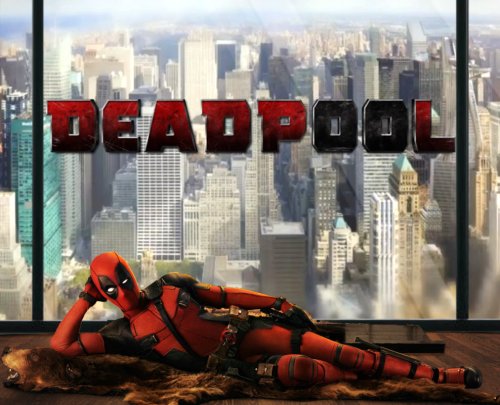
Deadpool - title banner

Star Rating: 3.5/5

Director:

  • Tim Miller

Cast:

  • Ryan Reynolds – X-Men Origins: Wolverine, The Proposal, Buried, Truth In Advertising
  • Karan Soni – Supremacy, Goosebumps, Other Space, Ghostbusters
  • Ed Skrein – The Sweeney, Game of Thrones, The Transporter Refueled, The Model
  • Stefan Kapicic
  • Brianna Hildebrand – Prism, First Girl I Loved
  • Gina Carano – Haywire, Fast & Furious 6, In The Blood, Scorched Earth
  • Morena Baccarin – The OC, Homeland, Gotham, Malevolent

Music Composer:

Ryan Reynolds has wanted to play Deadpool since 2005. In 2009’s (forgettable) X-Men Origins: Wolverine, he got his wish; although, it was an insignificant role and did such an injustice to the foul-mouthed, raunchy character that has lit up Marvel comics since 1991. Well, now, Reynolds has finally got his wish and has made a Deadpool standalone film. But is the movie any good? Does the movie do justice to the character?

Wade (Ryan Reynolds) with Vanessa (Morena Baccarin). The two of them hit it off quickly.

Wade (Ryan Reynolds) with Vanessa (Morena Baccarin). The two of them hit it off quickly.

Deadpool centres round Wade Wilson (Reynolds). Wade is a former US special forces operative who works as a mercenary in New York City. One day, he finds out that he has multiple and terminal cancer(s). Not wanting to die, Wade goes to a special, underground clinic that claims to be trying a new cure for cancer, which could potentially save him.

However, when Wade arrives at the dodgy clinic, he learns that Ajax (Ed Skrein), the one performing the experimental cure on him, is not trying to cure him at all. Rather, Ajax is attempting to create a mutant, super-slave and disfigures Wade. Wade escapes, but does not manage to kill Ajax before the latter gets away. Wade is out for revenge and puts on the red spandex for good measure.

Deadpool is an entertaining film. It is action-packed, rude and raunchy. Wade/Deadpool is also the antithesis of what a superhero should be. Spiderman, the X-Men, Fantastic Four and Captain America are modest, selfless and caring individuals, while Iron Man and Thor are egotistical maniacs yet altruistic characters at heart. Deadpool, on the other hand, is irredeemably arrogant and selfish, and Reynolds looks like he is revelling in it all. (And fair play to him too. If one generally waits a decade to play a role, one should enjoy every moment of it when it finally comes around.)

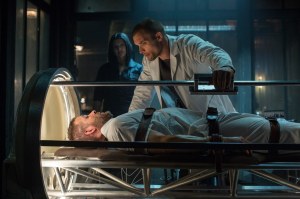
Wade about to undergo an experimental procedure, with Ajax (Ed Skrein) looking over him and telling him so much that he would not want to hear.

Wade about to undergo an experimental procedure, with Ajax (Ed Skrein) looking over him and telling him so much that he would not want to hear.

The film’s filthy dialogue reflects the character. Possibly the best element of the movie is the numerous, inappropriate jokes. Not only are they genuinely funny, they keep audiences entertained when the action is not taking place. Nevertheless, due to the way Tim Miller has put the film together, one is never more than ten minutes away from a shoot-out or an explosion. The movie starts on an over-the-top chase scene. It keeps cutting out/back in time during this chase scene to explain the background, with the (unneeded) aid of a voiceover from Wade, until the movie catches up with the chase scene. Then, the film continues with the action.

As one can imagine, this style of directing can become grating after a while; particularly as Wade/Deadpool is so unapologetically full of himself. Equally grating are the constant (and unsubtle) references to other comic-book films, such as The Wolverine and the X-Men franchise. (We get it, Deadpool, you were in X-Men Origins: Wolverine and the studio did not want to pay for the entire X-Men cast. You don’t need to ram it down our throats every fifteen minutes.)

Furthermore, the plot is silly and the villain is clichéd. Indeed, the silliness of the plot and the clichéd nature of the stereotypical British villain (played with unrepentant glee by Ed Skrein) should have fans wondering if the creators of Deadpool could have been any lazier in their planning.

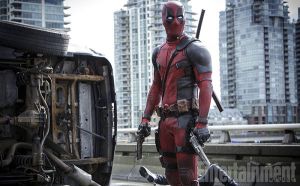
Wade in his Deadpool spandex, taking out those who are either after him or who disfigured him.

Wade in his Deadpool spandex, taking out those who are either after him or who disfigured him.

The women add nothing to the film too. They are either there to be the (hackneyed) damsel-in-distress or to kick some arse. These are comic-book tropes that have been done repeatedly since Sam Raimi’s Spiderman came out in 2002. All the same, if done well they make for entertaining viewing. And Deadpool is undoubtedly entertaining viewing.

Over-all, Deadpool is a fun film. It has action aplenty and enough genuinely funny jokes to render it better than most comedies. Of course the movie is silly, referential to other comic-book movies, filled with tropes from the genre, and annoying. Yet, that is all pars for the course with the character and the movie certainly does our rude, crude and foul-mouthed super anti-hero justice. Thus, Deadpool has exorcised the pale imitation that appeared in X-Men Origins: Wolverine and is the film that Ryan Reynolds and fans of the comics have been waiting for.

PG’s Tips

Review – Room (15) [2016]

Room - title banner

Star Rating: 4/5

Director:

  • Lenny Abrahamson – Adam & Paul, Garage, What Richard Did, Frank

Cast:

  • Brie Larsson – Scott Pilgrim Vs The World, 21 Jump Street, Don Jon, The Glass Castle
  • Jacob Tremblay – The Smurfs 2, Shut In, Before I Wake, The Book Of Henry
  • Joan Allen – Face/Off, The Notebook, Bourne II-IV, A Good Marriage
  • Sean Bridgers – Sweet Home Alabama, Deadwood, Dark Places, The Magnificent Seven
  • William H Macy – Fargo, Psycho, Sahara, ER, Blood Father

Music Composer:

  • Stephen Rennicks – Garage, Eden, What Richard Did, Frank, L’accabadora

The Woman In Black, The Possession, Mama and It Follows have illustrated the general paucity of horror films in recent years and how the paranormal subgenre isn’t scary because it cannot happen in real life. In contrast, Misery, Requiem For A Dream, We Need To Talk About Kevin and The Gift have demonstrated that when films portray situations that can happen to people, it can be infinitely scarier and more unnerving to watch. Add Room to the latter category.

Joy (Brie Larsson) and Jack (Jacob Tremblay) playing with a snake they have made out of string and egg-shells.

Joy (Brie Larsson) and Jack (Jacob Tremblay) playing with a snake they have made out of string and egg-shells.

  Room is adapted from the book with the same title by Emma Donohue. The film begins with Joy (Brie Larsson) and her five year old, feral-looking son, Jack (Jacob Tremblay), in a small, squalid shed. It transpires that Joy was abducted by a man known only as ‘Old Nick’ (Sean Bridgers) seven years ago and has been locked in the shed ever since. Jack has never been outside it and believes the shed (or ‘Room’ as he calls it) to be the entire world. However, Joy wants to get out of the shed. She thinks up a plan and, for it to succeed, it will involve Jack experiencing the outside world for the first time.

Room is an engaging film that succeeds in many ways. Immediately, people can empathise with Joy’s predicament. One may not find the threat of silly Gollum-like monsters and/or evil spirits attacking (imbecilic) individuals realistic or scary. Yet, the threat of being abducted and locked up in some hell-hole is a very real and terrifying one. The cases of Natascha Kampusch, Elizabeth Smart and Gilad Shalit emphasise this and highlight how harrowing the experience can be for the abductee and their families. Room effectively shows some (and implies others) of the horrors that the abductee may suffer in a mature, non-gratuitous way. This quite rightly makes for uncomfortable viewing.

Viewers, however, would not feel the abductee’s pain if it were not for Brie Larsson’s acting. She powerfully shows us the different stages that abductees can suffer from and, for this, she fully deserves the acclaim she is receiving. The only surprise is that Larsson is the only one receiving the plaudits and awards, as her main co-star, Jacob Tremblay, is also brilliant. For one so young, his acting is remarkable and completely realistic of how a five year old would see the world and behave under such traumatic circumstances. And his/Jack’s relationship with Brie Larsson/Joy is life-assuring and overwhelming for all the right reasons.

Joy desperately trying to explain to Jack that there is more to the world than 'Room,' despite Jack's protestations.

Joy desperately trying to explain to Jack that there is more to the world than ‘Room,’ despite Jack’s protestations.

Nevertheless, despite Room’s terrifying premise and outstanding acting, the film is not flawless. Joy’s plan to escape is fanciful at best (and unrealistic at worst). Additionally, the events leading up to Joy’s abduction are never fully expounded upon, and the same can be said about Joy’s family and the effects that her abduction have had on them. These two issues are particularly frustrating as it would not have been difficult for director Lenny Abrahamson to have elucidated upon them to make the movie more complete.

Over-all, Room is a very convincing film. The acting is wonderful and enables audiences to understand the characters and their predicaments, whether it be how an innocent child would see the world if he/she had only lived in a small shed, or how the torment of being abducted effects adults.

Nevertheless, Room is not an enjoyable movie. It is harrowing. What happens to Joy can happen to anyone. Thus, Room is a real horror film: one that upsets and unsettles viewers to the core.

PG’s Tips

Review – The Big Short (15) [2016]

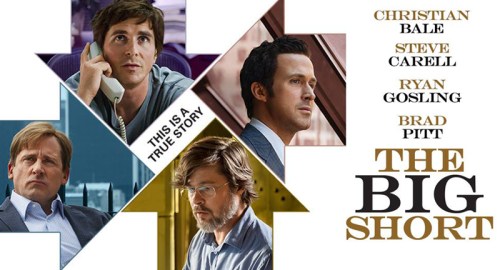
The Big Short - title banner

Star Rating: 3/5

Director

  • Adam McKay – Step Brothers, The Other Guys, Anchorman I & II

Cast:

Music Composer:

  • Nicholas Britell – Gimme The Loot, The Seventh Fire, A Tale of Love And Darkness, Tramps

In 2007, a financial crisis rocked the world. Akin to the Wall Street Crash of October 1929, tens of thousands of people lost their jobs and homes. Additionally, Lehman Brothers imploded, and the US Congress and the UK Parliament bailed out the rest of the big banks to (allegedly) ensure that the crisis did not worsen. How did it all happen? The Big Short highlights some of the factors.

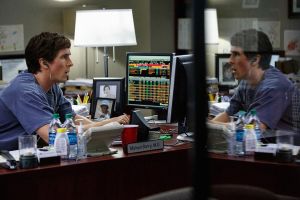
Dr Michael Burry (Christian Bale), in his office, listening to music whilst working out that the US property market would collapse in 2007.

Dr Michael Burry (Christian Bale), in his office, listening to music whilst working out that the US property market would collapse in 2007.

The Big Short is a dark comedy based on the book with the same title by Michael Lewis. The film follows three separate but parallel stories which reveal the duplicity and the fraud of US bankers and brokers with regard to the US property market; in particular, to the business of subprime mortgages, to the buying and selling of (junk) BB ratings, and to schemes like collateral debt obligations (CDOs). However the film also shows us that were some people who predicted the collapse of the US property market several years in advance, such as Dr Michael Burry (Christian Bale) and Jared Vennett (Ryan Gosling). The movie is as much about them trying to take on the big banks (and make billions in the process), as it is about the general fraud that was (is) taking place at every level of the financial sector.

The Big Short is an interesting film. It impressively explains in simplistic terms why the US property and financial markets imploded so spectacularly in 2007/08. The film captures the horror of the upcoming catastrophe by, chiefly, showing us the mind-set and attitude of the people working in Wall Street at the time (and at the present too) in a non-flashy and unglamorous way.

Nevertheless, as interesting as that is (and it is genuinely interesting), the overwhelming majority of the characters in The Big Short are just horrible, greedy and selfish individuals with few (if any) redeeming traits. Of all the people in the film, Steve Carrell’s Mark Baum is the most empathetic and likeable as he has a conscience. Carrell plays well, but his character’s hot-headedness comes across as cartoonish and silly (like it did in Bruce Almighty) when it is supposed to be funny at times and serious at others. Similarly, Christian Bale plays very well and deserves his OSCAR nomination. Yet, his character is weird and socially awkward. This makes him/Michael Burry difficult to root for. (And it does not help that Bale looks miscast in the role. With his huge biceps, one does not expect him to behave weirdly, but rather to don the Bat-gear again and beat every banker and broker to a pulp.)

Mark Baum (Steve Carrell, sitting down in the centre), contemplating the horror about to unravel, as his associates shout at Jared Vallett (Ryan Gosling, sitting down, right).

Mark Baum (Steve Carrell, sitting down in the centre), contemplating the horror about to unravel, as his associates shout at Jared Vallett (Ryan Gosling, sitting down, right).

As for the rest of the cast, their crassness guarantees that bankers and brokers are going to be hated for some time to come yet. Even if one can admire one or two of them for their foresight and intelligence, e.g. Jared Vallett and Charlie Geller (John Magaro), one is almost certainly going to be put off by their arrogance, rudeness and avarice. There is only so much one can endure of watching arseholes behaving so unscrupulously. One becomes bored by it and disinterested in the film’s subject matter; and 130 minutes of it is just too much. That one has seen deplorable bankers and brokers behaving in such an amoral manner before (Wall Street II: Money Never Sleeps, Margin Call and The Wolf of Wall Street) adds to the boredom and disinterest.

Yet, what is worse is the frustration one feels with The Big Short. The film has been billed as a satirical comedy, but to smile wryly only twice throughout the movie is not enough to justify such a billing. Plus, some of the movie’s (alleged) humour is just downright misogynistic. How is a cameo of Margot Robbie (as herself!) naked and in a bathtub explaining subprime mortgages funny? How is having a female stripper explaining the hazards of having loans on multiple houses, whilst lap-dancing, funny? Both just seem wrong in so many ways and not funny.

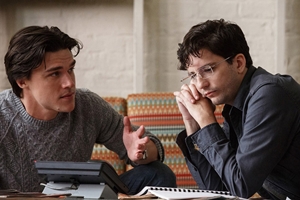
Charlie Geller (John Megaro, left) and Jamie Shipley (Finn Wittrock, right) speaking with Ben Rickert (Brad Pitt) about making investments.

Charlie Geller (John Megaro, left) and Jamie Shipley (Finn Wittrock, right) speaking with Ben Rickert (Brad Pitt) about making investments.

The sense that the film seems wrong is not just limited to its humour. The directing is extremely ill-disciplined. At certain points, the movie is linear; at other points, it is a music video; at others, the scenes change so suddenly and often, one can get a seizure; and, randomly, the film stops, so we can see a profile of a character or so that a character can face the audience and explain something. All of this makes for quirky viewing at best and ADD at worst. It also begs the question why Adam McKay has been nominated for an OSCAR in the Best Director category, considering that Ryan Coogler has not when the latter directed Creed so much better.

Over-all, The Big Short is a frustrating film. It is not particularly funny and it lacks focus in numerous ways. Yes, the movie successfully elucidates upon why the US property market and the world economy collapsed in 2007-08, which is no mean feat. But by The Big Short merely shouting at its viewers that it all happened because bankers and brokers are two-faced wankers is not only going down a well-trodden path, it also makes for repellent viewing.

PG’s Tips

Review – Creed (15) [2016]

Creed - Title banner

Star Rating: 4.5/5

Director:

  • Ryan Coogler – Fruitvale Station

Cast:

  • Sylvester Stallone – Rocky I-VI, Judge Dread, Escape Plan, The Expendables I-IV
  • Michael B. Jordan – Chronicle, Fruitvale Station, That Awkward Moment, Fantastic Four
  • Tessa Thompson – Heroes, Periphery, Selma, Salt Water
  • Phylicia Rashad – Cosby, Just Wright, The Cleveland Show, Gods Behaving Badly
  • Graham McTavish – Secretariat, Colombiana, The Hobbit I, II & III, The Finest Hours
  • Tony Bellew

Music Composer:

  • Ludwig Göransson – Fruitvale Station, Community, We’re The Millers, New Girl

In recent weeks, there has been much controversy about the lack of diversity regarding the OSCAR nominations. Other than Alejandro Iñarritu (who is Mexican), not a single non-white person has been nominated for any of the major awards for the second year running. How was this possible when some fantastic work has been done by non-white people over the course of the last year? Creed is an excellent example of how wrong the OSCARs have got it this year.

Rocky (Sylvester Stallone, right), giving his pupil, Adonis Creed (Michael B. Jordan, left), some advice on how to defeat a foe in the ring.

Rocky (Sylvester Stallone, right), giving his pupil, Adonis Creed (Michael B. Jordan, left), some advice on how to defeat a foe in the ring.

Creed is the seventh film in the Rocky franchise and centres round Adonis Creed (Michael B. Jordan). Adonis is the illegitimate son of Apollo Creed, who died in Rocky IV. After having a good education and holding down a solid job in the financial sector, Adonis wants a career change. He decides to take up professional boxing and follow in his illustrious father’s footsteps.

To reach those heights, Adonis needs a coach. So he turns to his father’s former rival-cum-friend, Rocky (Sylvester Stallone), to train him. Despite being in his late-sixties and having quit boxing, Rocky agrees.

Creed is a very engaging film. It has nostalgic borrowings from previous Rocky films, but more importantly it is a thriller and a drama in its own right. Thus, it does not matter if one has watched the other Rocky films or not. One can greatly enjoy the movie due to the quality of the (often humorous) script, as well as the depth of the characters and the chemistry between them; principally, Rocky (Stallone), Adonis Creed (Jordan) and Bianca (Tessa Thompson).

Adonis Creed out with Bianca (Tessa Thompson).

Adonis Creed out with Bianca (Tessa Thompson).

Stallone plays his joint-most iconic role (with Rambo) with tremendous nuance, charm and realism. He fully justifies his OSCAR nomination. This is not the egotistical Stallone/Rocky in his pomp, trying to take down all his foes to be the all-American hero. (Watch The Expendables franchise for that ludicrous nonsense.) No, time (and life) has taken its toll on Rocky and one feels this in every line he delivers (even when he is being funny). It remains to be seen if this performance is enough to win Stallone the OSCAR for Best Supporting Actor. But having won the Golden Globe for it, he stands a good chance.

Whether he wins it or not, at least Stallone has received OSCAR recognition for his efforts. The same cannot be said for Michael B. Jordan, Tessa Thompson and director Ryan Coogler. Jordan is terrific as the titular Creed and it is scandalous that he has not been nominated. His role is so demanding; yet, he handles it with aplomb, whether it is in the (gruelling) boxing ring, or in his relationships with his mentor or his love interest, Bianca. And in fairness to Bianca/Tessa Thompson, she holds her own against Creed/Jordan. She is not merely in the film for eye-candy or to advance Creed’s plot arc. Rather, Bianca exists in her own right, as a three-dimensional character and with a promising career to match, both of which make her very interesting to watch.

For all this, Ryan Coogler must be credited. He has done a superb job in reinvigorating a tired franchise and his directing is outstanding. He captures the upper- and lower-class areas from where boxers come from with class, and has managed to turn a (bog-standard) boxing training montage into something serious and amusing at the same time. Nevertheless, it is how Coogler has handled the boxing fights that highlight his skill as a director. He adopts close-up, continuous shots with no cuts, enabling viewers to feel as if they are part of the fights. That the fights are raw and brutal amplify this sensation.

Adonis Creed in the ring, still standing, despite having taken a battering from his opponent.

Adonis Creed in the ring, still standing, despite having taken a battering from his opponent.

If Coogler can be criticised at all for Creed, it is that the film has some predictable and cliché scenes. Some of these scenes, the movie would have been (marginally) better off without because they are a mixture of rehashing of old Rocky territory and because other boxing films (such as The Fighter, Warrior and Southpaw to name three) have covered similar ground. Then again, if these are the only problems with Creed, they should be mostly overlooked.

All-in-all, Creed is a fantastic boxing thriller and drama. It has a great and funny script, some brutal boxing fights, and some OSCAR-worthy performances. Stallone is a joy to watch in this older, more-nuanced version of his familiar character. He is deserving of his OSCAR-nomination and it would not be a shock if he were to win the OSCAR next month. No, the real shock is that Stallone is the only person nominated from this film. For their parts, Michael B. Jordan, Tessa Thompson and Ryan Coogler should also have been nominated, if not at the head of the queue to win OSCARs themselves. One can only hope that it was not because of the colour of their skins that they did not make the shortlist.

PG’s Tips

Review – The Revenant (15) [2016]

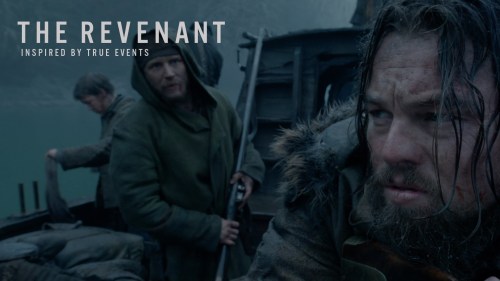
The Revenant - title banner

Star Rating: 4/5

Director:

  • Alejandro Iñárritu – 21 Grams, Babel, Biutiful, Birdman

Cast:

Music Composer:

  • Carsten Nicolai
  • Ryuichi Sakamoto – The Last Emperor, Snake Eyes

With the awards season under way and, in particular, with the OSCARs coming up, one invariably asks: what does it take to win the most prestigious award in the film industry? An exceptional performance is unquestionably a prerequisite. But what differentiates one exceptional performance from another? Alejandro Iñárritu’s The Revenant gives a compelling answer.

Hugh Glass (Leonardo DiCaprio) being mauled by a bear during the expedition.

Hugh Glass (Leonardo DiCaprio) being mauled by a bear during the expedition.

The Revenant is (loosely) inspired by the real-life story of Hugh Glass (played by Leonardo DiCaprio). While on a hunting expedition in midwest America in the 1820s, Glass is mauled by a bear. Injured and, after having watched the murder of his son, Hawk (Forrest Goodluck), Glass is left for dead by his fellow expeditioners. Thirsty for revenge, Glass treks through the wilderness to get back to his base to seek his vengeance.

The Revenant is an astonishing tale of survival. The film cuts no corners and shows mother-nature in all her brutal severity. From the grisly effects of an attack by a wild animal, to putting men in situations wherein their worst personality traits thrive, to fearsome wintry weather, to harsh and seemingly endless terrain, to hunting for food without strength, The Revenant makes one suffer and tests a one’s endurance to the limit.

Certainly, our central protagonist, Hugh Glass/Leonardo Dicaprio, is tested to the limit and made to suffer. He suffers unimaginable physical and emotional pain throughout the movie, and it is for this that DiCaprio is the front-runner to win the OSCAR for Best Actor in a Leading Role. If there is a formula to win an OSCAR, it is that an actor/actress must suffer. In 2011, Natalie Portman, Colin Firth and Christian Bale won their respective OSCARs by suffering; in 2013, Anne Hathaway won hers for suffering; and, in 2014, Matthew McConaughey and Jared Leto won their OSCARs for the same reason in Dallas Buyer’s Club. Now that DiCaprio has (sufficiently) suffered, he will almost certainly win his first OSCAR; especially, as he has suffered years of being over-looked (Saving Gilbert Grapes, The Aviator, Revolutionary Road, Shutter Island and The Wolf of Wall Street to name but five), and because none of his rivals for the fabled prize (Bryan Cranston, Michael Fassbender, Matt Damon and Eddie Redmayne) appear to have suffered much (if at all) in their respective roles, despite their respective performances.

John Fitzgerald (Tom Hardy), on the expedition with Hugh Glass.

John Fitzgerald (Tom Hardy), on the expedition with Hugh Glass.

DiCaprio undoubtedly suffers considerably in his role in The Revenant and will deserve his OSCAR if he wins it. Ironically, though, he is outshone by his co-star Tom Hardy; yet, it is not a given that Hardy will win the OSCAR for the Best Supporting Actor. Hardy, as John Fitzgerald, has a much meatier role than DiCaprio. DiCaprio spends much of his screen-time grunting, walking, falling or crawling (oh, and surviving); while Hardy devours the screen with his (incomprehensible) southern accent and his amoral nature. Even if one disagrees with Fitzgerald’s sociopathy, one can understand why he behaves in the manner he does under the circumstances. This is testament to Hardy’s ability to convey Fitzgerald as a human being. Whether it will be enough for Hardy to win the OSCAR, though, is another matter.

DiCaprio and Hardy are not the only ones nominated for OSCARs for this film. Director Alejandro Iñárritu has been nominated in the Best Director category. No-one will argue if he wins that OSCAR for the second year running, following Birdman. The directing in The Revenant is spectacular. The opening melee is filmed so well, viewers feel part of the skirmish. Similarly, the way the bear attack is shot is so well (and raw) it induces tension into the audience; plus, the way the landscapes and the north American winter are captured, shows their beauty and brutality in equal measure (even if the filming was done in Canada and Argentina).

Glass trekking through the stunning (and unforgiving) terrain in order to make it back to base and get his revenge.

Glass trekking through the stunning (and unforgiving) terrain in order to make it back to base and get his revenge.

Nevertheless, the fact that one spends much of The Revenant admiring the cinematography highlights one of its problems. One, the film is not particularly engaging. It lacks humour and a character to root for (or against). Two, at 156 minutes, it is a long movie. Maybe that is the film’s point: to make audiences feel as if they are trekking across the endless wilderness with Glass/DiCaprio. If so, it succeeds. But the movie also makes for tedious and repetitive viewing.

Over-all, The Revenant is a masterfully-designed examination of endurance. It may not be the most enjoyable film to sit through. Yet, the acting, the directing and the cinematography are outstanding and worth the watch in and of themselves. They give one a true appreciation for how tough it must be to survive the harshest of conditions, and hints at the types of characters required to survive them. Seeing actors/actresses go through such conditions and suffering is what sways OSCAR judges into handing out the much-coveted award. Leonardo DiCaprio: you have suffered; you have earned your OSCAR.

PG’s Tips

Review – The Danish Girl (15) [2016]

The Danish Girl - title banner

Star Rating: 3/5

Director:

Cast:

Music Composer:

2015 was the year that the Lesbian, Gay, Bisexual and Transgender (LGBT) movement took on global significance. Thanks to Bruce Jenner’s successful transition into Caitlyn, the world took note of the LGBT movement and the problems that many transgender people sadly face. The release of Director Tom Hooper’s The Danish Girl, therefore, could not have come at a more opportune moment. But does the film grab the moment with both hands?

Einar Wegener (Eddie Redmayne), before his transformation, painting a view of his small hometown area.

Einar Wegener (Eddie Redmayne), before his transformation, painting a view of his small hometown area.

The Danish Girl is a biopic based on a true story about Einar Wegener (Eddie Redmayne). Einar is a talented artist living with his artist wife, Gerda (Alicia Vikander), in Copenhagen in 1926. One day, Gerda asks Einar to put on women’s shoes and a dress so she can paint him as a woman called Lili Elbe. This awakens another side of Einar. Within five years, Einar decides to be the first known man to undergo transgender surgery.

The Danish Girl begins in engaging fashion. Eddie Redmayne’s and Alicia Vikander’s characters have excellent on-screen chemistry. They enjoy witty, provocative conversations that show how much they are in love with one another. Indeed, the dialogue throughout the first thirty minutes of the film is filled with sexually tantalising lines that will enable audiences to warm to the characters.

However, the rest of the film’s two-hour runtime is not half as engaging. Tom Hooper does not have much story to work with and (unbelievably) it is when Redmayne/Einar starts to cross-dress that the problems with the movie begin. Problem one is that the provocative dialogue comes to an abrupt halt. This means that everything one came to love about the characters ends at once. That the dialogue turns soppy makes one want to cry with despair. (Some of what is said in the film is allegedly true, but it is still awfully slushy. Also, Hooper adjusts the story to suit his ends, so couldn’t he have at least kept the provocative dialogue?)

Einar holding a dress as his wife, Gerda (Alicia Vikander), draws him as a woman. Holding the dress, however, awakens Lili.

Einar holding a dress as his wife, Gerda (Alicia Vikander), draws him as a woman. Holding the dress, however, awakens Lili.

Problem two with the movie is that Eddie Redmayne starts over-acting. This makes it look like lunacy is taking hold of him; yet, this same over-acting also makes him look noticeably wooden, especially when he transforms into Lili.

And problem three is that Redmayne’s Lili is not a particularly likeable or sympathetic person. She becomes totally self-absorbed, selfish and utterly uncaring for the hurt she causes Gerda, despite having been married to her for many years. Lili’s behaviour has the effect of pushing viewers away from her and the issues she embodies. (Seriously, if a normal man behaved as Lili does, he would be deemed a selfish prick and rightly so; and if a normal woman behaved like that, she would be called a horrible bitch and rightly so. Just because Lili is a transgender person does not exempt her from behaving in a considerate manner.) At a time when the LGBT movement is trying to gain steam to diminish the discrimination and violence that transgender people unfortunately suffer, Lili’s behaviour could be detrimental to the movement’s cause.

Lili’s behaviour also raises another matter unwittingly: the effect that changing gender can have on those whom the transgender person loves. Whether it be a parent or sibling (as was the case for Bruce/Caitlyn Jenner), or a partner (as it was for Gerda), the effects can be emotionally tough, if not crushing. For Gerda, as portrayed in the movie, it is heart-breaking as she loses the man she loves. Alicia Vikander portrays the hurt that Gerda must have felt with raw force. Surprisingly, it is her and Gerda who come out with the most credit from this movie. Thanks to Vikander, Gerda’s pain is real and understandable; whereas Redmayne cannot convincingly convey Lili’s pain, since her emotional pain seems contrived and unnecessary by comparison, like the stroppiness of an adolescent youth.

On the left, Eddie Redmayne's Lili as seen in the film; and on the right, the real Lili Elbe.

On the left, Eddie Redmayne’s Lili as seen in the film; and on the right, the real Lili Elbe.

How much one can blame Redmayne for this is debatable. He is, after-all, being directed by Tom Hooper and this is not Hooper’s finest film. Yes, it is shot decently, but the stance the film takes toward Lili is confusing. Is The Danish Girl supposed to be a sympathetic, objective, positive or critical portrayal of Lili (and of transgender people on the whole by extension)? If it is trying to achieve all four, Hooper can claim mediocre success at best and a mediocre mawkish muddle at worst.

Over-all, The Danish Girl is a disappointing film. Alicia Vikander is brilliant and the movie starts off in promising fashion with exceptional dialogue. But before long, the film loses its way and turns into a pitiful sop story; one that is enough to test the patience of even the most tolerant of viewers.

Central to the testing nature of the film is the titular Danish girl, herself: Lili Elbe. She might have been the first man to undergo transgender surgery and she might be a pioneer for the LGBT movement today. But she was neither a nice nor considerate person in real life. It can only be hoped that most transgender people are not like her. Otherwise, the momentum that Caitlyn Jenner and the LGBT movement have gathered over the last year will be undone and smothered for a generation.

PG’s Tips
Review – Steve Jobs (15) [2015]

Steve Jobs - title banner

Star Rating: 4/5

Director:

Writer:

  • Aaron Sorkin – The American President, The West Wing, The Social Network, The Newsroom

Cast:

Music Composer:

  • Daniel Pemberton – Big Kiss, The Awakening, The Counsellor, The Man From UNCLE

In 2011, Steve Jobs, the co-founder of Apple, died from pancreatic cancer at the age of 56. At the time of his death, he was hailed as a great man, a genius, an innovator, and a man who had stayed loyal to his dreams and fulfilled them. Yet, there was another side to Steve Jobs that was largely ignored in the obituaries. Danny Boyle’s Steve Jobs focusses on this side of the man to paint a very different portrait of him.

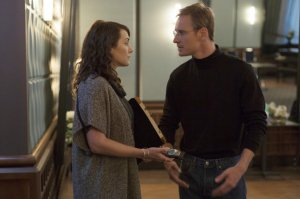
Young Steve Jobs (Michael Fassbender, left) talking through his business plans with his friend and co-founder, Steve 'Waz' Wazniak (Seth Rogen, right, playing decently and in a non-comedic role for a change).

Young Steve Jobs (Michael Fassbender, left) talking through his business plans with his friend and co-founder, Steve ‘Waz’ Wazniak (Seth Rogen, right, playing decently and in a non-comedic role for a change).

Steve Jobs is a dramatised biopic of the titular character (played by Michael Fassbender). It centres round events behind the scenes at the launch of the Apple Macintosh in 1984; at the launch of NeXT in 1988; and at the launch of the iMac in 1998. With each launch, we get to see Jobs’ true nature, and the changes in his relationships with his assistant Joanna Hoffman (Kate Winslet); with his friend and fellow co-founder Steve ‘Waz’ Wazniak (Seth Rogen); with the original CEO of Apple, John Sculley (Jeff Daniels); as well as with his former girlfriend, Chrisann Brennan (Katherine Waterston), and their daughter, Lisa (played by Mackenzie Moss at five, Ripley Sobo at nine, and Perla Haney-Jardine at nineteen).

Steve Jobs is a neat and engaging film about the man Steve Jobs actually was as opposed to the myth many believe in. The movie is told via three separate acts that are more theatrical in tone than cinematic. Between Danny Boyle’s excellent directing and Aaron Sorkin’s brilliant fast and witty dialogue, the movie is delivered via long expositions with few editing cuts. This gives the film a genuine feel of continuity and realism that is typical of other films Sorkin has worked on e.g. The Social Network.

Through the three acts, we learn about the sort of man that Steve Jobs was in real life. Yes, he was ambitious and a great innovator. But he was also unreasonable; treated his staff appallingly (with the possible exception of Joanna Hoffman); alienated his friends and colleagues without remorse; denied paternity to his daughter, Lisa; and did not give a cent to his ex-girlfriend, Chrisann Brennan, for child maintenance for Lisa without a court order forcing him to do so (and even then, Jobs only gave the minimal amount; a pittance of what he was earning).

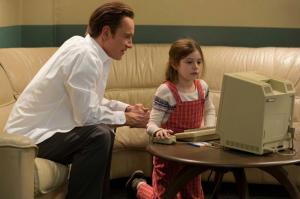
Steve Jobs playing on the Apple Macintosh with his daughter, Lisa (at aged five, played by Makenzie Moss).

Steve Jobs playing on the Apple Macintosh with his daughter, Lisa (at aged five, played by Makenzie Moss).

Why was Jobs like this? God only knows. But Steve Jobs at least attempts to explain the unexplainable. It does this in two different ways: one is by a telling us about an event in Jobs’ early childhood and the effect this had on him; and the other is through Michael Fassbender’s terrific acting. Indeed, the former goes hand-in-hand with the latter. Fassbender’s tight-faced rage, his acerbic belittling of others, and his pathological drive to create better, awe-inspiring products illustrates how hurt (damaged) Jobs was by his childhood.

How true this explanation is (in respect of Jobs’ behaviour) is contentious. Several people who knew him well claim that the film is inaccurate, including Edwin Catmull, the head of Pixar (a company that Jobs was a board member of); Tim Cook, the current Apple CEO; and Waz, himself. Catmull claims that the film’s story is ‘wrong’ (although he does not give a reason for this), and Waz has said that ‘everything in the movie did not happen’ since he never spoke to Jobs before the events that the film portrays. Now, granted, Danny Boyle’s movie does take (considerable) artistic licence. One could never believe that the events happened in real life as they are portrayed in the film because that would have been unrealistic and impossible. But that does not mean that the events did not happen; they just happened at different times and Boyle has put them into his film at certain points to give the movie a solid and satisfying narrative arch.

An older Steve Jobs talking with his long-time business assistant, Joanna Hoffman (Kate Winslet, with a decent if at times dodgy eastern European, New York accent). Joanna was known as the only person to ever stand up to Jobs and he respected her for it.

An older Steve Jobs talking with his long-time business assistant, Joanna Hoffman (Kate Winslet, with a decent if at times dodgy eastern European, New York accent). Joanna was known as the only person to ever stand up to Jobs and he respected her for it.

Nevertheless, the film’s tight, solid and satisfying arch comes at a cost. In some respects it is too tight. Boyle misses out plenty of moments and events in Jobs’ life that could have altered the perceptions of Jobs. Adding a couple of key moments/events (or even mentioning them) about his family and about the long, protracted manner of his death could have given the film a more complete feeling and enabled viewers to make better informed judgements on Jobs. Yet, even without these moments, one can still form strong conclusions on the man.

Over-all, Steve Jobs is an enjoyable and interesting film about an almost mythical man. In an objective manner, with superb acting, dialogue and directing, we see Steve Jobs for what he was like as a person, how he changed over the years, and the events that shaped him into the man he became, for better and for worse. It is debatable how close to the truth this film is to reality. More than anything, though, Steve Jobs highlights that a person can be a genius and create phenomenal products, but that his/her products can be greater than the person who created them.

PG’s Tips

Review – The Martian (12a) [2015]

The Martian - title banner3

Star Rating: 4.5/5

Director:

Cast:

Music Composer:

  • Harry Gregson-Williams – Shrek I-IV, Kingdom of Heaven, Unstoppable, Blackhat, Life Briefly

On this blog, much has been made of the paucity of Ridley Scott’s films over the last fifteen years. For a director who once made Alien, Blade Runner and Gladiator, it is astonishing that Scott has made terrible film after terrible film since Gladiator was released in 2000. So going into The Martian, what was one to expect? Another terrible film to add to Scott’s bloated collection? Actually, nothing of the sort: a pleasant surprise.

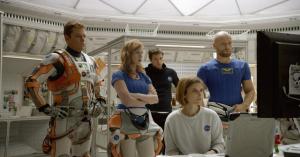
Mark Watney (Matt Damon) with the NASA crew, led by Melissa Lewis (Jessica Chastain, sitting down), before they go out to explore.

Mark Watney (Matt Damon) with the NASA crew, led by Melissa Lewis (Jessica Chastain, sitting down), before they go out to explore.

The Martian is based on Andrew Weir’s 2011 novel with the same title. Mark Watney (Matt Damon) is exploring Mars with a NASA team, led by Melissa Lewis (Jessica Chastain). The team are out on the Red Planet when a freak storm occurs, knocking Mark away. Believing that he is dead, and fearing that the storm will destroy the team’s means of getting home, Melissa orders an evacuation.

However, Mark is not dead and wakes up to find that the team have left Mars without him. Considering that the next NASA flight mission to Mars is not for another four years, Mark knows he’s going to be stuck on his own on Mars for a while. Yet, he only has enough food for a few months. So how will he survive?

At its core, The Martian has a simple premise: how Mark, all on his own, is going to keep himself alive. One might ask oneself how interesting such a plot could be. Yet, surprisingly, The Martian is an entertaining, innovative and engaging movie. Undoubtedly, it is Ridley Scott’s finest film since Gladiator! (Then again, with Kingdom of Heaven, Prometheus, The Counsellor and Exodus among his recent films, that is not saying much at all.)

The sudden (contrived) storm that knocks Mark away.

The sudden (contrived) storm that knocks Mark away.

Part of the reason why The Martian is so good is because the desert scenery of Mars (or, rather, of Jordan, where the movie was filmed) is beautifully shot. Seeing the landscape of this foreign planet is as wondrous as any awe-inspiring place on Earth, as evidenced in The Way Back, True Grit, Sanctum and Macbeth, to name but four. Moreover, The Martian is an extremely interesting film. Our main character, Mark, is a (genius) botanist, and it is fascinating watching him carry out scientific experiments using natural elements in order to survive.

But while the scenery is wondrous and the experiments are ingenious, The Martian would not have been half as engrossing without really good acting. Matt Damon has such a magnificent screen presence that he, alone (quite literally), can hold audiences’ attentions. Sean Bean is good as the honourable (Ned Stark-like) man, as is Chiwetel Ejiofor. Jeff Daniel’s is also decent as the NASA director, with the (legitimate) counter-arguments to Bean’s and Ejiofor’s suggestions. And, lastly, the crew (headed by Jessica Chastain) play decently enough with the little time that they’re given on screen.

Assisting the cast, however, is a really good script, which ensures that The Martian surpasses recent, phenomenal space films such as Gravity and Interstellar. This is because the former was let down by a B-movie script, while the latter suffered from an incoherent storyline. The Martian, by contrast, has all the best elements of those movies, plus humour. The humour, in itself, warrants that viewers empathise with the characters and (cleverly) enables audiences to ignore the scientific technicalities if they don’t understand them.

Upon waking up and returning to the base, Mark sits alone and wonders what he is to do. Not least, what will he do about food as his supplies are low?

Upon waking up and returning to the base, Mark sits alone and wonders what he is to do. Not least, what will he do about food as his supplies are low?

Scott gets a lot right with The Martian. Nevertheless, that is not to say that the movie is not without its faults. First, the storm at the beginning of the film is massively contrived to get the plot moving. And, second, the movie is predictable and the ending is an utter cliché. Yet, if these are the main flaws of the film, they are quite trivial, thereby emphasising just how well Scott has done with this movie.

All-in-all, The Martian is a very entertaining film. It has no significant faults, it is innovative and it is funny. To think that the movie is predominantly about a man stuck on Mars on his own, trying to survive against the elements, underlines how impressive The Martian is. It also highlights that Ridley Scott still can direct excellent movies, despite his atrocious recent record. Let’s hope that The Martian can inspire Scott to cease making films of the poverty of Prometheus and Exodus, so that he can return to making films of the brilliance of Alien, Blade Runner and Gladiator.

PG’s Tips