Tag Archives: movie

Review – Birdman (15) [2015]

Birdman - title banner

Star Rating: 4/5

Director:

  • Alejandro Gonzalez Iñarritu – 21 Grams, Babel, Biutiful, The Revenant

Cast:

  • Michael Keaton – Batman, Jackie Brown, Need For Speed, Spotlight
  • Noami Watts – The Ring, 21 Grams, Eastern Promises, Diana, While We’re Young
  • Andrea Riseborough – W.E., Shadow Dancer, Oblivion, Nocturnal Animals
  • Zach Galifianakis – Into The Wild, The Hangover I-III, Due Date, Tulip Forever
  • Emma Stone – Easy AFriends With Benefits, The Help, The Amazing Spiderman I-II, La La Land
  • Edward Norton – American History X, Fight Club, The Illusionist, Sausage Party
  • Amy Ryan – Gone Baby Gone, The Wire, Escape Plan, Goosebumps
  • Lindsay Duncan – Under The Tuscan Sun, Rome, About Time, Alice In Wonderland I & II

Music Composer:

  • Antonio Sanchez

Movie trailers are designed to give viewers a feel for the film and whet one’s appetite for the film. The trailers for Gone Girl and Whiplash were mouth-watering and suggested that those movies were of the highest quality and had to be watched. In contrast, Birdman’s trailer makes the film look unappetising, strange and worth skipping. But the film has been awarded with multiple Oscar nominations. So, is Birdman better than its trailer suggests? Is it deserving of its Oscar nominations?

Zach Galifianakis (Jake) reassuring Riggan (Michael Keaton) and Leslie (Naomi Watts) that the production is going well when it's not.

Zach Galifianakis (Jake) reassuring Riggan (Michael Keaton) and Lesley (Naomi Watts) that the production is going well when it’s not.

Birdman is about Riggan Thompson (Michael Keaton), a former super-hero actor, whose career has been going downhill for two decades. Now, Riggan is trying to rejuvenate his career by writing, directing and acting in a Broadway adaptation of John Carver’s short story What We Talk About When We Talk About Love. The problem is that the show is a shambles, which puts untold pressure on Riggan, who is also battling his own, inner demons.

Birdman is an original film and something different. It may not entertain viewers for its entire 119-minute running time and vast swathes of the movie may seem purposeless. Additionally, some of the storylines go nowhere and the final scene is incongruent with the rest of the movie.

Nevertheless, Birdman is a unique film. Alejandro Gonzalez Iñarritu deserves his Oscar nomination for best director due to his exceptional editing and choreography. He has made Birdman appear as if the whole movie has been filmed in one, super-long shot without any cuts. That is simply an amazing feat, especially as so much happens in each scene and the camera never keeps still. (Although, for viewers the editing feels strangely like being under water for too long. Before long, one is gagging for Iñarritu to make a cut so viewers can take a breath and relax in the knowledge that a scene has ended.)

Yet, Birdman has not been Oscar nominated solely for its directing. It has also been nominated in the cinematography, best actor in a leading role (Michael Keaton), best actor in a supporting role (Edward Norton), best actress in a supporting role (Emma Stone), and best original screenplay categories.
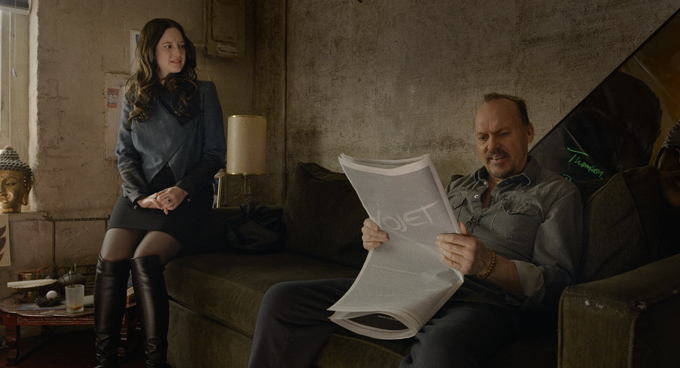
Riggan reading criticism of the production and ignoring the attentions of his sort of girlfriend, Laura (Andrea Riseborough), much to her angst.

Riggan reading criticism of the production and ignoring the attentions of his sort of girlfriend, Laura (Andrea Riseborough), much to her angst.

The cinematography is simple and apt. The movie is set predominantly in the (grotty) behind-the-scenes areas of the Broadway Theatre. It all looks plausible and builds on the shambolic atmosphere of the theatre production because it adds layers of insecurity and stress onto the characters; not least Michael Keaton’s Riggan.

Keaton is outstanding as the volatile, selfish and unstable Riggan. He fully deserves his Oscar nomination. Nonetheless, is Keaton not essentially playing himself in Birdman, the same way Matt Le Blanc did in Friends and Mickey Rourke did in The Wrestler? Riggan last played the fictional superhero Birdman in 1992 and has done little else of note since. How convenient that 1992 is the same year Keaton last played Batman in Batman Returns and has done little else of note since. No, it is not convenient. Yet, because one knows Keaton’s predicament going into Birdman, one genuinely pities Riggan’s situation and hopes that he (like Keaton) does something extraordinary to revitalise his (/their) floundering career(s).

But Keaton is not the only actor who seems to be playing himself in Birdman to acclaim. Edward Norton plays an arsehole with an inflated ego, and behaves in a manner that is difficult to work with. Funny that: Norton has a reputation for being arrogant and a difficult actor to work with. All the same, Norton is great in Birdman. He justifies his Oscar nomination and reminds viewers of his talents that have been lying dormant since his last Oscar nomination back in 1999 for American History X. That Norton plays himself is beside the point.

Not all of the cast, though, play themselves in Birdman. Emma Stone doesn’t. Stone seems like a balanced person in real life. But, in Sam, Stone plays Riggan’s messed up, unstable daughter in terrific and passionate fashion. The scene (part of which can be seen in the trailer) where she vents her frustrations at Riggan earns her her Oscar nomination as audiences feel her pain, the pain she inflicts on Riggan, as well as the guilt she feels afterward for what she says. That is quite an achievement. It also helps that her character is multifaceted and Stone demonstrates this throughout the movie.

Sam (Emma Stone) exploding at her father, Riggan, for being a useless dad. But is this true?

Sam (Emma Stone) exploding at her father, Riggan, for being a useless dad. But is this true?

Alas, the other two main female characters, played by Andrea Riseborough and Naomi Watts, are not as properly fleshed out. It is a shame as both actresses are talented. Moreover, they are not assisted by their storylines being as messy as their changing rooms, which is strange considering how well Birdman is written and choreographed. Yet, if this is Birdman’s major glitch (after the ending), it should be somewhat overlooked. The film deserves its Oscar nomination for best original screenplay as its script is, in the main, highly impressive.

All-in-all, Birdman is a quirky film. It is not the most enamouring of movies and some of the plots go unfulfilled. However, Iñarritu’s style of editing is distinctive and innovative. This, in addition to the exceptional cinematography, acting and script illustrate that Birdman’s trailer is, to some extent, misleadingly unappetising and that the film is worthy of its Oscar nominations.

PG’s Tips
Review – Ex Machina (15) [2015]

Ex Machina - title banner

Star Rating: 4/5

Director:

  • Alex Garland

Writer:

  • Alex Garland – 28 days Later…, Sunshine, Never Let Me Go, Halo

Cast:

Music Composer:

  • Geoff Barrow
  • Ben Salisbury

For decades, mankind has had a continuing urge to create and enhance artificial intelligence (AI). This has been reflected and taken to all kinds of extremes and dangers in science fiction films, such as the Terminator franchise, A.I., i,RobotHer and Transcendence. Ex Machina, Alex Garland’s directorial debut, smartly deals with the issue of AI again and the possible consequences of it.

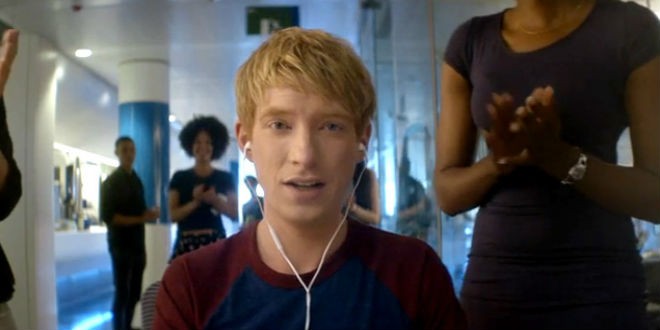
Caleb (Domhnall Gleeson) finding out at work, to his delight, that he has won the competition to be part of a break-through experiment.

Caleb (Domhnall Gleeson) finding out at work, to his delight, that he has won the competition to be part of a break-through experiment.

Ex Machina is about a programmer called Caleb (Domhnall Gleeson), who wins a competition at work to go to a remote facility to be part of an experiment. Nathan (Oscar Isaac), the man behind the experiment, wants Caleb to find out if his human-looking robot, Ava (Alicia Vikander), can pass the Turing Test. But neither the experiment nor Nathan is what they seem.

Ex Machina is an interesting and stylish movie. Alex Garland successfully contrasts the beautiful and open nature of a remote location, with the claustrophobic feel of being based there. This creates a natural tension that never truly leaves viewers. It might be allayed for parts of the film, but at the slightest change in circumstance, this tension (re-)tightens one’s muscles, reminding viewers of how terrifying remote locations can be.

In addition to this natural terror, Garland, who has written a superb script, tackles some thought-provoking (and disquieting) topics concerning AI, to augment one’s terrors. Some of the topics have already been done with varying levels of success in Transcendence and Her which dealt with the (disturbing) issues of consciousness within AI and having a relationship with AI, respectively. But Ex Machina arguably takes these issues to higher (and more alarming) levels by blurring the lines between people and machines; notably, by giving AI robots sexual desires and the capability to act on and enjoy them.

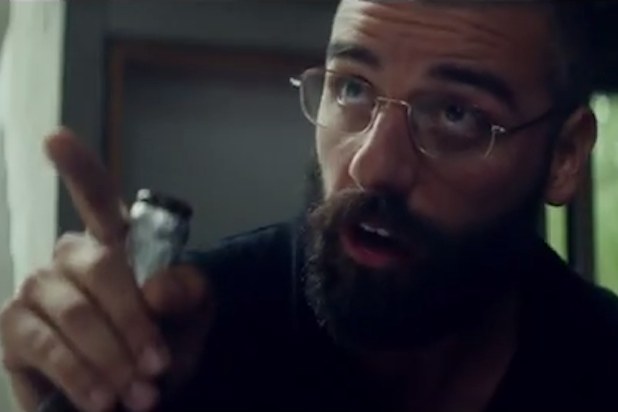
Nathan (Oscar Isaac, unrecognisable with a beard) talking with Caleb about the purpose of the experiment.

Nathan (Oscar Isaac, unrecognisable with a beard) talking with Caleb about the purpose of the experiment.

Ostensibly, the issue of sexual desire within an AI robot may seem far-fetched and ludicrous. But watch the documentary series Through The Wormhole, plus appreciate the intelligent ways that modern technology can respond to requests, and it might dawn on audiences that what we see in Ex Machina is not so far-fetched or ridiculous and that the lines between people and machines is genuinely being distorted. Bearing all this in mind, Ex Machina enables audiences to believe in this distortion because of Alicia Vikander’s astonishing performance as the AI robot, Ava. Ava’s (arousing) physique and general movements are robot-like. But her facial features and her observational and intellectual sharpness are so human-like that one almost forgets they’re watching an AI robot.

Yes, it helps that Ava/Vikander is an attractive woman and that the special effects on her are outstanding. Equally, though, it helps that Caleb and Nathan, played well by Domhnall Gleeson and Oscar Isaac, respectively, buy into Ava’s supposed realness and respond to her (human?) personality in differing but very human ways. Indeed, their responses say something about their personalities. Yet, while audiences learn about Caleb’s background and why he is the way he is, the same cannot be said for Nathan. This is unfortunate as there is undoubtedly more to Nathan than he lets on; his brooding face, alone, tells us that.

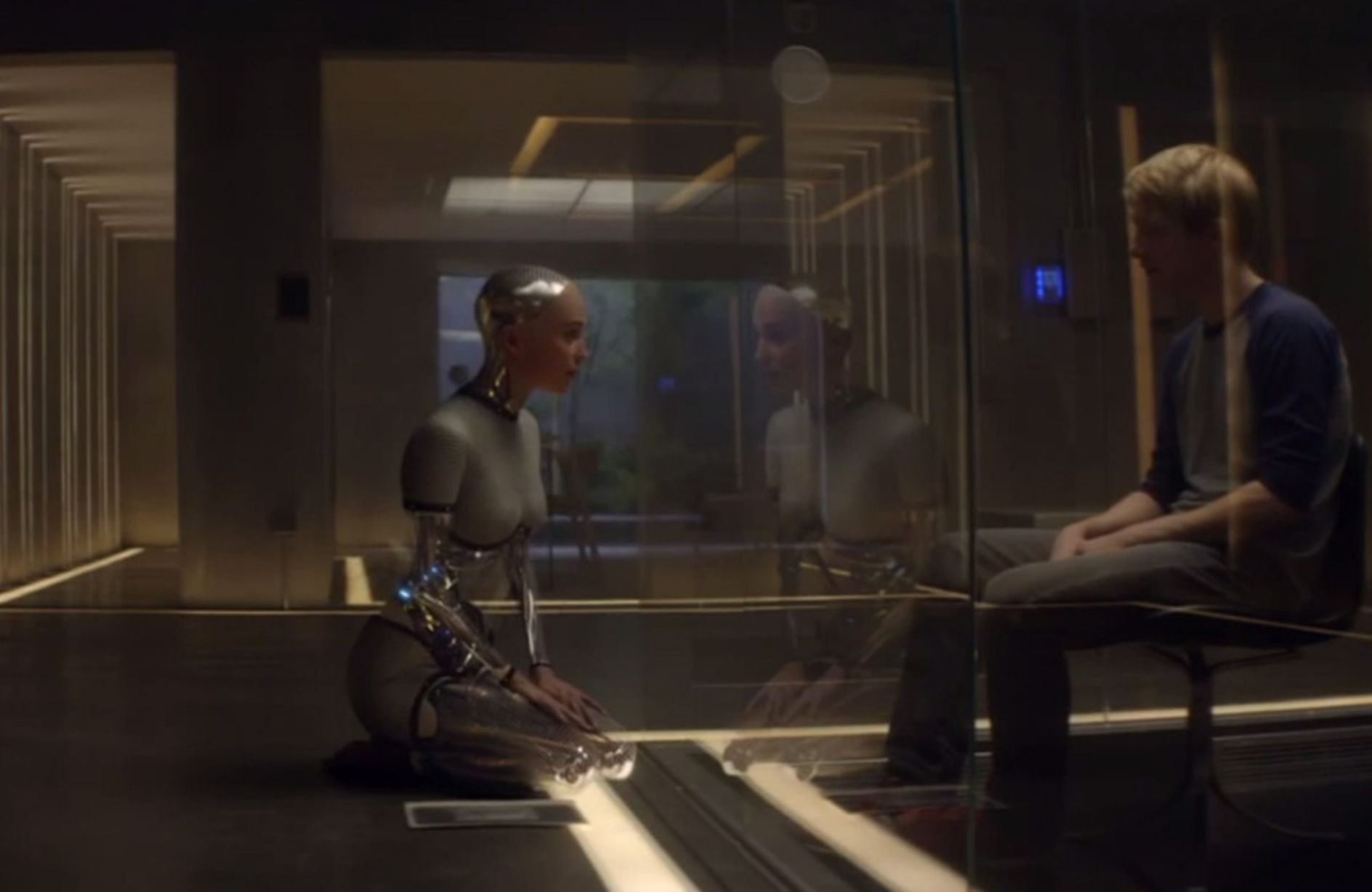
Caleb having one of his sessions with Ava (Alicia Vikander), to determine if Ava has human-like consciousness.

Caleb having one of his sessions with Ava (Alicia Vikander), to determine if Ava has human-like consciousness.

However, the lack of information given about Nathan is not the only element of Ex Machina’s plot that weakens it. The film is slow-paced; so much so, that for much of the movie one may wonder where the film is going. Moreover, the ending leaves itself open to scrutiny, not to mention out of kilter and jarring to the rest of the film. Nevertheless, one should not stress too much on the movie’s faults because so much of it is impressive.

Over-all, Ex Machina is an intriguing, weird, and noteworthy film. The movie is slow and the ending is questionable, but all the same Alex Garland has made a striking piece of work in his directorial debut. He deals perceptively and philosophically with important issues regarding AI. These are extremely pertinent considering mankind’s disconcerting hunger to further enhance AI. For heaven knows that these issues will not be isolated to the realms of science fiction films for much longer as it is likely that the world’s first Ava will be created in the not-too-distant future.

PG’s Tips

Review – Whiplash (15) [2015]

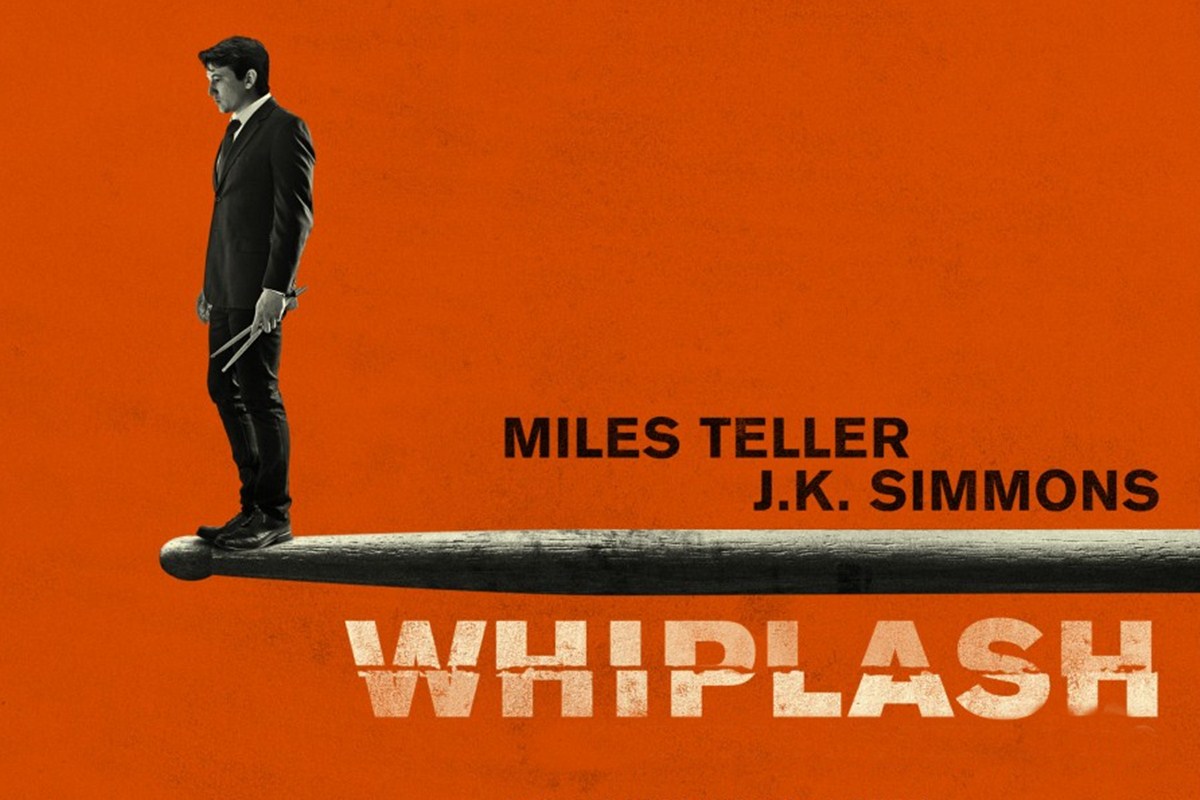
Whiplash - title banner2

Star Rating: 5/5

Director:

  • Damien Chazelle – Guy And Madeleine On A Park Bench, La La Land

Cast:

  • Miles Teller – Project X, 21 & Over, Divergent, La La Land
  • JK Simmons – Spiderman I-III, Harsh Times, Up In The Air, Terminator GenisysLa La Land
  • Paul Reiser – Aliens, Purpose, Life After Beth, 6 Miranda Drive
  • Melissa Benoist – Glee, Danny Collins, Billy Boyd
  • Austin Stowell – Dolphin Tale I & II, Love And Honour, Behaving Badly, Higher Power

Music Composer:

  • Juston Hurwitz – Guy And Madeleine On A Park Bench, La La Land

When one sees artistic greatness, whether it is in drawings, music, film, theatre, sport or otherwise, it is natural to gawp and marvel. Great artists, irrespective of their medium, always have stood and always will stand head and shoulders above their competitors. But what does it take to be an artistic great? How does one become a great in their respective field? Whiplash, Damien Chazelle’s absolutely brilliant film, may answer those questions.

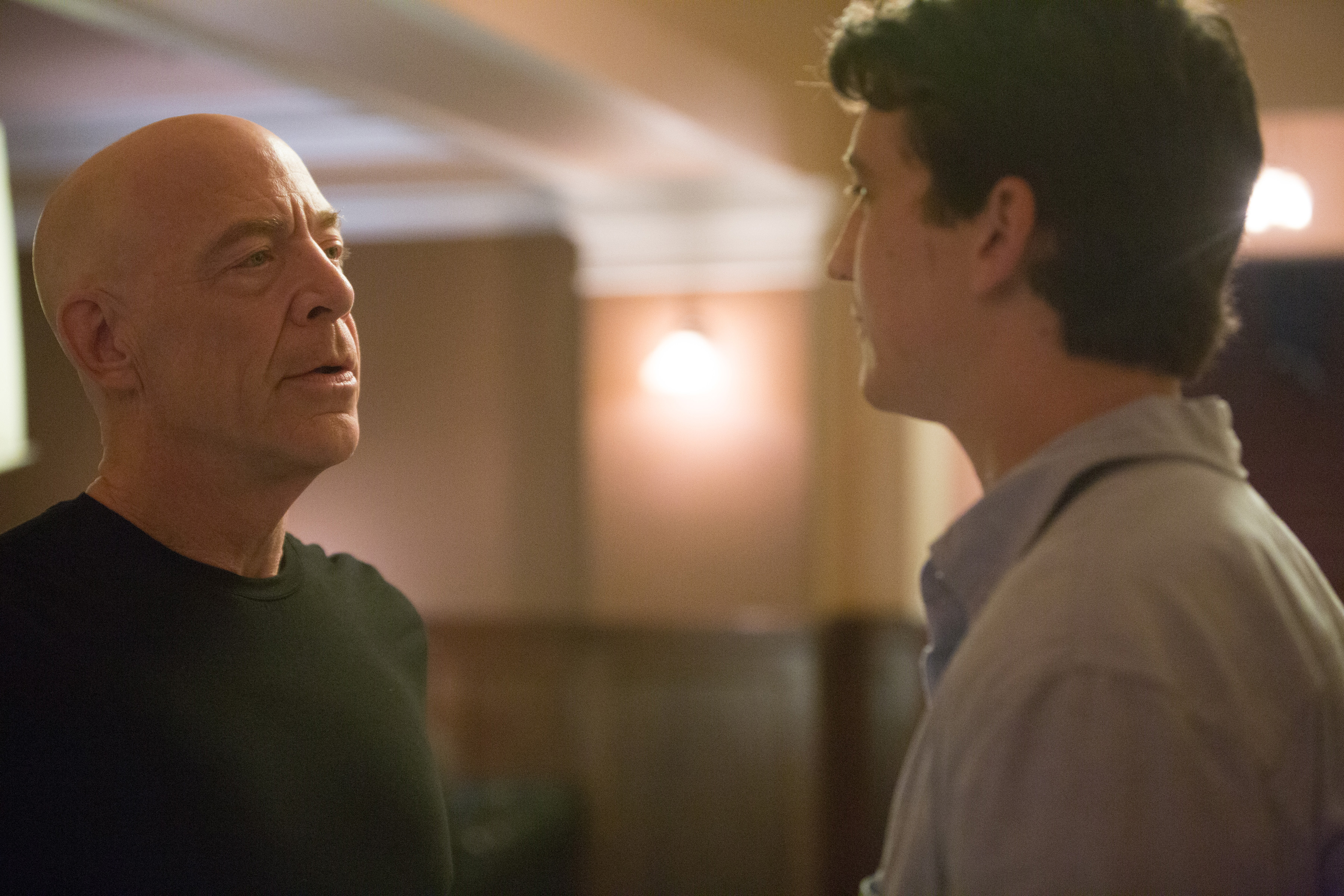
Andrew (Miles Teller) looking and listening to his mentor, the conductor Terence Fletcher (JK Simmons) as Fetcher gives him some advice.

Andrew (Miles Teller) looking and listening to his mentor, the conductor Terence Fletcher (JK Simmons) as Fetcher gives him some advice.

Whiplash is a drama, centred completely round Andrew (Miles Teller), a nineteen year old jazz-drummer who goes to Shaffer Conservatory, the best music school in America. There, he comes under the tutorship of conductor Terence Fletcher (JK Simmons), who pushes him hard, first, to enable Andrew to enter into his band, wherein they play a piece called ‘Whiplash’; and, second, in his attempts to make Andrew an artistic great.

Whiplash is an entertaining and pulsating film, with some exceptional performances. In an interview, Miles Teller spoke about the energy coming off the screen throughout the movie. And he’s right, although he also modestly downplayed his own role in making Whiplash come alive because Teller is superb as Andrew.

Samuel Delaney in About Writing explains that for one to achieve artistic excellence one must (metaphorically) punish oneself, make sacrifices, and suffer. In Whiplash, viewers witness Andrew punish himself, make sacrifices, and suffer as he pushes himself to breaking point to have a chance at becoming a great drummer. Better still, though, viewers feel Andrew’s agony as well as the sweat and blood dripping off him. It may have helped Teller that Whiplash was shot over nineteen (uber-intense) days, with him working eighteen to twenty hours under the camera’s gaze. When Andrew is exhausted and feeling the pressure it is probably genuine. At the same time, the intensity of the filming schedule could have hindered Teller. So, it is to Teller’s credit that he is able to perform to such a high standard under exhausting circumstances. He deserves his BAFTA nomination in the Rising Star category as, in part, he provides the energy that radiates from the screen during Whiplash.

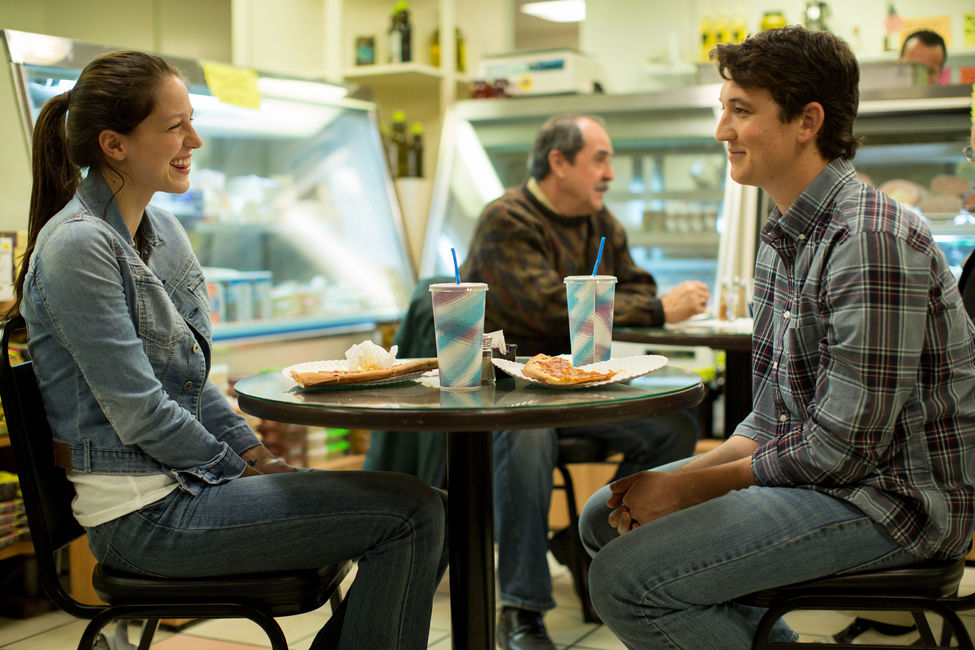
Andrew taking out Nicole (Melissa Benoist), and they discuss their respective ambitions in life

Andrew taking out Nicole (Melissa Benoist), and they discuss their respective ambitions in life

Yet, as good as Teller is, it is his character’s mentor who steals the limelight. JK Simmons is terrific as Terence Fletcher and it is no surprise that Simmons has been Oscar nominated for his performance as Fletcher. Fletcher is intelligent and passionate, yet he is also manipulative, nasty, vicious and utterly ruthless. When he walks into a room, one senses the fear he induces into his students. But is Fletcher a sadistic prick and a bully? Or is he a good mentor and an effective motivator? It would be easy to answer in the former. But Niccolo Machiavelli writes in The Prince that it is better for a leader to be feared than loved because fear forces people to go the extra mile when they wouldn’t otherwise. Additionally, one could believe that the motivational methods of Sir Alex Ferguson, the former Manager of Manchester United Football Club (MUFC), were not always too dissimilar to Fletcher’s, and the success Sir Alex achieved at MUFC between 1986-2013 was extraordinary. Therefore, one should bear in mind the writings of Machiavelli and the feats of Sir Alex before criticising Fletcher. There is logic behind his methods.

However, whatever one may think of Fletcher and his methods, it is worth noting that audiences only see him through Andrew’s eyes. In an interview, Simmons said that there were some scenes of Fletcher filmed without Andrew present. These (apparently) would have given audiences another perspective on Fletcher’s personality, but the scenes were cut from the movie so as to preserve Whiplash as solely Andrew’s story. Simmons suggests that the lack of these scenes does not detract from the film and even enhances it. This probably means that the scenes would not have significantly altered our understanding of Fletcher, so instead of wondering what these scenes beheld we should commend Damien Chazelle for having the resolve to take them out of the final cut of the movie.

The price Andrew pays in his attempts to make it to being a drummer of noteworthy repute: sweat and blood.

The price Andrew pays in his attempts to make it to being a drummer of noteworthy repute: sweat and blood.

Nevertheless, it is not just for taking those scenes out that Chazelle should be commended. He should also be applauded for writing vivid dialogue and for giving the actors room to improvise in scenes to make the scenes more realistic. Similarly, Justin Hurwitz should be clapped for writing some wonderful music that builds on the tension that Andrew (and the audience) endures in Andrew’s attempts to reach the dizzying heights of artistic greatness.

All-in-all, Whiplash is a flawless and exhilarating film, with two phenomenal stand-out performers. On the surface, the movie is about the relationship between a pupil and his mentor, seen exclusively from the pupil’s angle. Yet, Whiplash has a deeper layer. It illustrates the level of dedication and self-torture one must go through to become a great in one’s artistic field and the type of mentor that may be required to attain artistic superiority over one’s rivals.

PG’s Tips
Review – Exodus: Gods And Kings (12a) [2014]

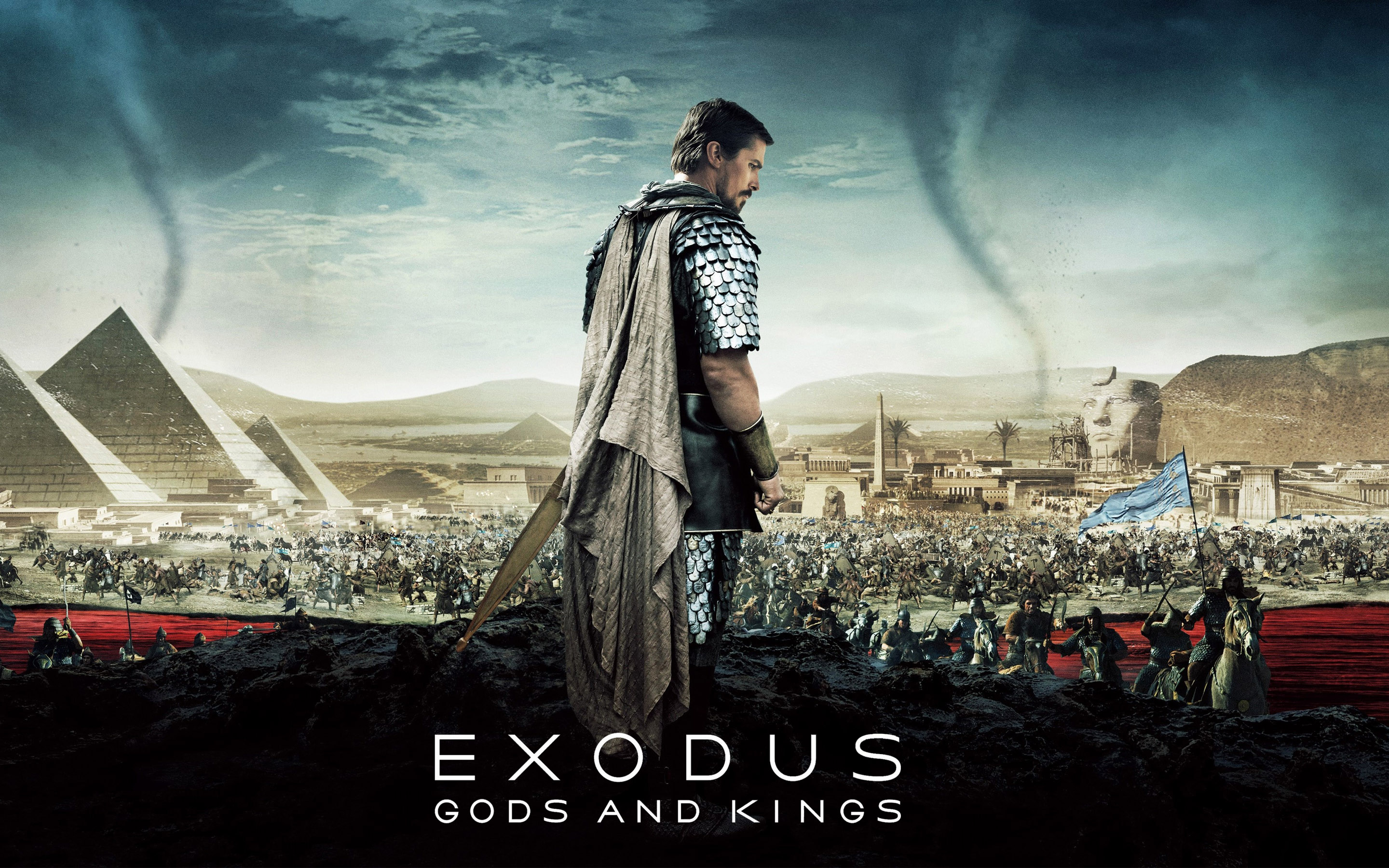
Exodus - title banner

Star Rating: 3/5

Director:

Cast:

  • Christian Bale – The Machinist, The Fighter, The Dark Knight I-III, American Hustle, The Big Short
  • Joel Edgerton – Smokin’ Aces, Warrior, Zero Dark Thirty, The Gift
  • John Turturro – Anger Management, Transformers I-III, The Taking of Pelham 123, Hands of Stone
  • Aaron Paul – Mission: Impossible III, The Last House On The Left, Breaking Bad, Need For Speed, Eye In The Sky
  • Sigourney Weaver – Alien I-V, Ghostbusters I & II, Paul, The Cabin In The Woods, A Monster Calls
  • Ben Mendelsohn – The New World, Killing Them Softly, The Dark Knight Rises, Mississippi Grind
  • María Valverde – Body Confusion, The Anarchist’s Wife, The Liberator, Broken Horses
  • Ben Kingsley – Schindler’s List, Prince of Persia: Sands of Time, Hugo, Iron Man III, The DictatorKnight of Cups
  • Indira Varma – Rome, Basic Instinct II, Silk, Game of Thrones, Caesar
  • Hiam Abbass – Munich, Lemon Tree, A Bottle In The Gaza Sea, Nothing Escapes My Eyes

Music Composer:

In my review of Prometheus in 2012, I wrote that since Gladiator came out in 2000 all of Ridley Scott’s films have not been good enough for a director who once made Alien, Blade Runner and Gladiator. Since 2000, Scott has consistently made disappointing films like Kingdom of Heaven, Robin Hood and Prometheus, while 2013’s The Counsellor was rotten to the core. So bearing in mind Scott’s portfolio over the last fourteen years, what could one expect with Exodus: Gods And Kings?

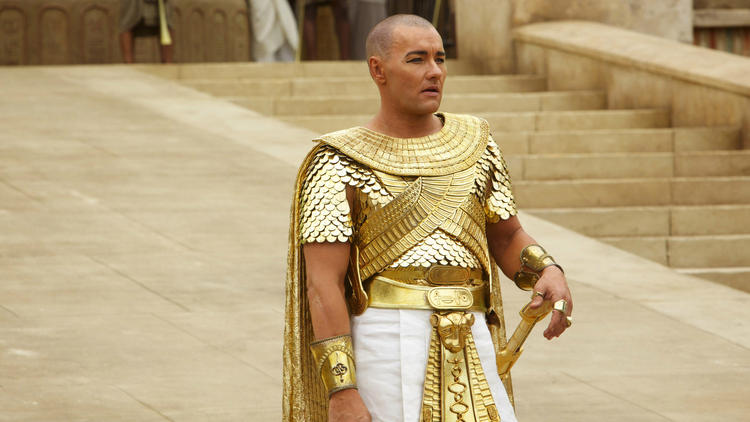
Pharaoh Rameses II (Joel Edgerton), the villain of the Exodus story, looking splendid and glorious.

Pharaoh Rameses II (Joel Edgerton), the villain of the Exodus story, looking splendid and glorious.

The film starts with (the anachronistic method) of a transcript, giving viewers the political context of the movie, as well as Moses’ position in Ancient Egypt. Subsequently, the film centres round Moses of the Torah and we follow him (Christian Bale) as a young adult living among the elites in Cairo; through his exile and marriage to Zipporah (María Valverde); to finally taking his place as the first leader of the enslaved Israelite/Jewish people and leading them out of Ancient Egypt via the Red Sea.

Exodus: Gods And Kings is a lively adaptation of the famous Biblical tale. The film is not absolutely historically accurate (especially if one swears by the Quran) and contains much artistic license. Some of the inaccuracies are avoidable, for example the number of years that the Israelites were enslaved for. But others inaccuracies are unavoidable and require the artistic license that Scott employs because there is no historical record of it; for example, where and what Moses did in exile.

If one can overcome these inaccuracies, one can appreciate many of the enjoyable elements of the movie. Scott impressively designs Ancient Egypt to give viewers a feel for how ancient Cairo and the slave city of Piton probably looked like; the battle at the start of the film is really good (although, strikingly similar to the battle in the opening scenes of Gladiator); the splitting of the Red Sea is refreshingly different from the conventional story (although, one recently saw a better example of what the film achieves in Interstellar); and the CGI plagues and godly miracles are emphatic and vividly memorable.

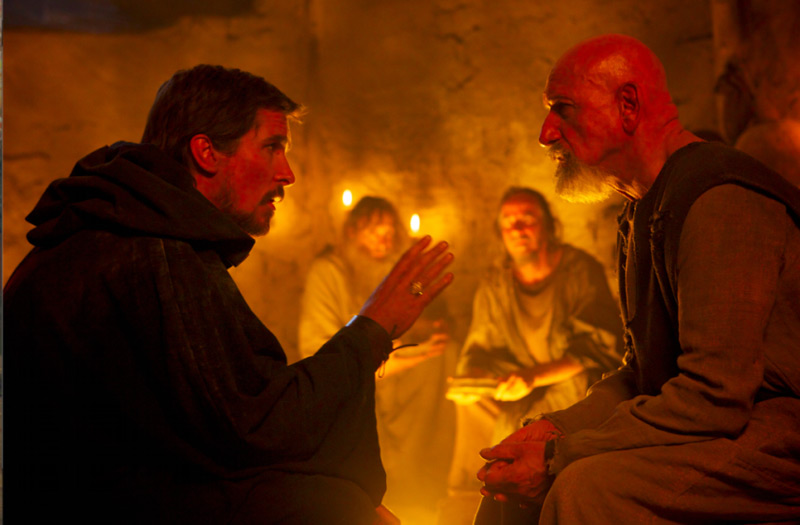
Moses (Christian Bale) speaking with Nun (Ben Kingsley), one of the enslaved leaders of the Jewish tribes in Piton, about the need to escape Egypt.

Moses (Christian Bale) speaking with Nun (Ben Kingsley), one of the enslaved leaders of the Jewish tribes in Piton, about the need to escape Egypt.

Furthermore, Exodus depicts Moses in an innovative and interesting way that is seldom discussed. This is important as Moses was a human being (who we know little about), so his (real or possible) flaws should be laid bare for us so we can assess what sort of a man he was. Exodus does this in a pseudo-intelligent manner and Scott should rightly be recognised for trying to do something different.

However, sadly, Scott undermines his idea of Moses, as well as the other key individuals from this period, with his poor choice of casting. Forget the racism issue (which Scott daftly fuelled with his lamentable responses); none of the actors in the main roles look their part. Christian Bale, Joel Edgerton, Ben Mendelsohn, Aaron Paul and Sigourney Weaver do not look like they are Ancient Egyptian or Mediterranean, and no amount of spray tan and make-up can change that. And, also, what was Scott thinking when he chose Christian Bale to be Moses? How can Batman be Moses? It just isn’t believable, and if viewers cannot believe in the characters, it is an uphill struggle for the cast to come across convincingly.

In fairness to the cast, they are handicapped by the wretchedly written script that relegates all, but Moses, to one-dimensional characters. The biggest victim of the script is the main villain: Pharaoh Rameses II, played by Joel Edgerton. If Scott’s intention had been to make Rameses be Exodus’s Commodus, Scott fails miserably. One may have loathed Commodus by the end of Gladiator, but that was only because Scott gave him/Joaquin Phoenix the chance to be loathed. Scott does not give Rameses/Edgerton such a chance, consigning Rameses to a pathetic, ranting idiot, who is unfit to rule. This is a shame (and gratingly frustrating) because it is a waste of a talent like Edgerton, because it is contrary to history, and most significantly because one feels nothing towards Rameses by the end.

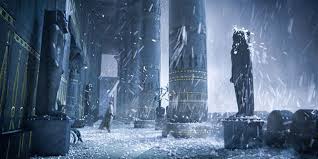
The plague of hail. This is one of the ten plagues that rains down on Egypt after Rameses refuses Moses' request to let his people go.

The plague of hail. This is one of the ten plagues that rains down on Egypt after Rameses refuses Moses’ request to let his people go.

Speaking of the end, it takes an Earth’s turn to get there. One cares so little for the characters in Exodus that the movie’s 150-minutes running-time feels like double that. To think that Gladiator, at 155-minutes, was longer than Exodus, is surprising as it felt shorter. This speaks volumes for just how much of a masterpiece Gladiator was, and how far Scott’s stock has fallen as a director since 2000.

Overall, Exodus: Gods And Kings is not a terrible film. One may object to the historical inaccuracies within the film, yet this cannot be helped due to the limited amount of source material available on the subject. Instead, one should enjoy the aspects of the movie that have been done well. That is, if one can overcome Scott’s glaring casting errors and the poverty of the script that leaves even Christian Bale, one of the most talented actors of the current era, struggling for conviction. But, then again, what did one expect from Exodus? Another film of Gladiator’s quality? Don’t be ridiculous! Just be grateful that Exodus is not another Prometheus.

PG’s Tips
Review – Big Eyes (15) [2014]

Big Eyes - title banner3

Star Rating: 4/5

Director:

  • Tim Burton – Edward Scissorhands, Mars Attacks!, Corpse Bride, Alice In Wonderland I & II

Cast:

Music Composer:

  • Danny Elfman – The Simpson’s, Spiderman I & II, Corpse Bride, The Next Three Days, Fifty Shades of Grey

When it comes to predatory animals, one knows to stay well away. Yet, when it comes to predatory people, for one reason or another, one does not always act with the same haste or caution. The consequences of this lack of haste or caution can be damaging to the predator’s prey. Tim Burton, back to his best with Big Eyes, shows what can happen to an individual who falls prey to a person with a predatory nature.

Walter (Christoph Waltz) standing over Margaret (Amy Adams) and admiring her work.

Walter (Christoph Waltz) standing over Margaret (Amy Adams) and admiring her work.

Big Eyes is a true story based on what happened to the artist Margaret Keane in America, in the 1950s and early-1960s. Margaret (Amy Adams), is a single mother to Jane (when small played by Delaney Raye; when older played by Madeleine Arthur), who draws children with unusually large eyes as a hobby to earn a bit of money.

At an art fair one day, Margaret meets the smooth-talking Walter (Christoph Waltz), another artist who claims that she has talent and that she could make fortunes from her work. Margaret becomes enchanted by Walter. Soon, they are married and work together to make serious amounts of money. But the more time Margaret spends with Walter, the more it becomes apparent that Walter is not all that he seems. Eventually, this leads to a courtroom battle over royalty fees for the drawings.

Big Eyes is a really enjoyable film. It has a well written script that is surprisingly humorous, and the two lead actors play their parts brilliantly. Amy Adams (as ever) plays her role convincingly; this time as a callow woman with low self-esteem, who is pressured into a situation whereby she allows herself to be downtrodden by her husband. Similarly, Christoph Waltz (as ever) is a joy to watch, despite being a domineering husband who takes advantage of a vulnerable woman for the sake of making a waterfall of money. The leering, Cheshire cat-like grin never leaves his face and the words that roll off his silver-tongue underlie why predatory people are as dangerous as their beastly cousins in the wild. (Both devour their prey, just in different ways.)

An example of the sort of drawings Margaret draws.

An example of the sort of pictures Margaret draws.

Nevertheless, it is not just the two lead actors that make Big Eyes so watchable. The film has the feel of a director who loved creating it. The topic of the movie is the perfect fit for Tim Burton. Several of his films, like The Nightmare Before Christmas, Mars Attacks!, James And The Giant Peach, Corpse Bride and Alice In Wonderland, all consist of characters with unusually (and creepily) big eyes. Consequently, Burton’s passion radiates from the screen, elevating Big Eyes to make it a more pleasurable.

One may feel Burton’s passion throughout the film, but that does not mean it is flawless, sadly. First, Burton uses the (jarringly) antiquated technique of a narrator at the beginning of the movie and at random points throughout it, to put forward information to the viewers. (If these pieces of information said by the voiceover are so critical to the story, why couldn’t they have been incorporated into the dialogue like everything else?) Second, certain elements of Walter’s life are never properly explored and are dropped as quickly as they are brought up. This is brow-raising to say the least.

Margaret, who by this point has drawn so many pictures with abnormally big eyes that she is beginning to them (maddeningly) in her own reflection.

Margaret, who by this point has drawn so many pictures with abnormally big eyes that she is beginning to them (maddeningly) in her own reflection.

And, third, although Big Eyes is based on a true story, there is no way that the scenes in the courtroom are what truly happened. The courtroom scenes are too ludicrous and too camp to have been true. But, in fairness to Burton, they are absolutely hilarious. And while one cannot ignore the unreality of the scenes, one must applaud Burton for his alterations as they enhance the scenes and the film’s enjoyment factor.

All-in-all, Big Eyes is a very entertaining and satisfying film. The movie is funny, has a good script, an even better cast, and a director who is in love with the subject-matter at the heart of the tale. Burton could have neatened Big Eyes further by using some more modern techniques to convey information, by tying up some of the movie’s loose ends, and by not making the film camp enough to slot into the 1980s.

But to focus on these matters too much is to do the film a disservice. Instead, one should focus on the primary moral of the story: notably, to stay away from predatory people because they can only have a detrimental impact on one’s confidence, one one’s self-esteem, and on one’s life in general, as Margaret Keane found.

PG’s Tips
Review – The Hobbit III: The Battle of the Five Armies HFR 3D (12a) [2014]

The Hobbit III - title banner

Star Rating: 2/5

Director:

  • Peter Jackson – Lord of the Rings TrilogyThe Lovely BonesThe Hobbit I & IIThe Adventures of Tintin II

Additional Writer:

  • Guillermo Del Toro – Pan’s Labyrinth, Hellboy I-III, Mama, Pinnochio

Cast:

  • Martin Freeman – The OfficeThe World’s EndSherlockFargo, Captain America III
  • Ian McKellen – Lord of the Rings TrilogyX-Men I-IIIX-Men: Days of Future Past, Mr Holmes
  • Cate Blanchett – Notes On A ScandalBlue JasmineCinderella
  • Richard Armitage – Captain America: The First AvengerBlack SkyInto The Storm
  • Aiden Turner – AlarmThe Mortal Instruments: City of Bones
  • Ken Scott – CasanovaCharlie Wilson’s WarOne Day
  • Graham McTavish – Rambo24: Day 8ColumbianaCreed
  • Benedict Cumberbatch – Tinker Tailor Soldier SpyStar Trek II: Into DarknessThe Fifth Estate12 Years A Slave
  • Orlando Bloom – The Lord of the Rings I-IIIThe Kingdom of HeavenThe Good DoctorZulu
  • Lee Pace – The FallTwilight IV: Breaking Dawn: Part IILincoln, Untitled Lance Armstrong Biopic
  • Evangeline Lilly – LostThe Hurt LockerReal Steel
  • Luke Evans – Clash of the TitansImmortalsThe RavenDracula Untold
  • Stephen Fry – V For VendettaAlice In WonderlandSherlock Holmes II: A Game of Shadows, Once Upon A Time In The Kitchen
  • Ian Holm – Lord of the Rings I IIILord of WarRatatouille
  • Christopher Lee – Lord of the Rings TrilogySeason of the WitchThe Girl From Nagasaki
  • Hugo Weaving – The Matrix TrilogyLord of the Rings TrilogyCaptain America: The First AvengerTransformers I-III, Strangerland

Music Composer:

  • Howard Shore – Lord of the Rings TrilogyHugoA Dangerous MethodThe Hobbit I II, Denial

(Please read my reviews of The Hobbit I: An Unexpected Journey and The Hobbit II: The Desolation of Smaug for context, as I won’t be going over points I’ve already made, such as the problems with the High Frame Rate, negotiations with the orcs, and the alterations that Jackson has made to the trilogy from the source material.)

Peter Jackson’s The Lord of the Rings (LOTR) trilogy was one of the greatest trilogies of all time. It was beautifully put together and held phenomenal emotional weight that made viewers care about the characters in the story. The same, however, cannot be said for the first two volumes of the prequel trilogy. Nevertheless, could the final volume of the prequel trilogy, The Battle of the Five Armies, redeem The Hobbit trilogy?

Smaug the Dragon (voiced thunderously by Benedict Cumberbatch) is our of the Lonely Mountain and torching Laketown.

Smaug the Dragon (voiced thunderously by Benedict Cumberbatch) is our of the Lonely Mountain and torching Laketown.

The Hobbit III starts where The Desolation of Smaug ended: with Smaug (voiced by Benedict Cumberbatch) unleashing his fury upon Laketown. But with the dragon now out of the Lonely Mountain, there is a huge treasure of gold to be had. The greedy leader of the dwarves, Thorin Oakenshield (Richard Armitage), may not want to share it, but the people of Laketown, as well as armies of elves, orcs, and other dwarves come for their share of the treasure all the same. Thus, the battle of the five armies begins…

The Hobbit III is the shortest of The Hobbit films at 144 minutes and that is one of the movie’s saving graces. Well, that, the opening scene when the Cumberdragon burns Laketown, and the ending itself. The desolation of Laketown is done well, particularly as it’s given the right length of time, as well as the right amount of comedy, action and special effects for it to be spectacular.

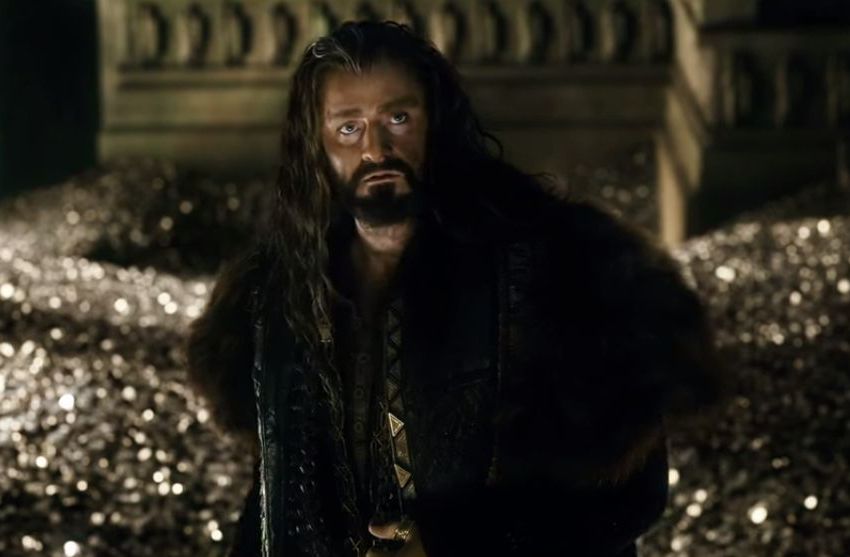
Thorin (Richard Armitage) looking for the Arkenstone within a vault of gold so deep he could swim in it like Scrooge McDuck.

Thorin (Richard Armitage) looking for the Arkenstone within a vault of gold so deep he could swim in it like Scrooge McDuck.

It is a shame that the ‘epic’ titular battle, itself, is neither spectacular nor given the right amount of time. It is 45-minutes of repetitive, pleasure-seeking action, devoid of the laws of physics, emotional weight, and should have been cut in half. One does not care what happens to the dwarves or the CGI orcs as they’re all synonymous and lifeless. Plus, if Jackson had comprehended the problems of the hour-long battle in Transformers III or the 40-minute fight in Man of Steel he would not have allowed his ‘epic’ battle go on for so long because it loses its sense of timing. Without the crucial ingredient of timing, the battle becomes snooze-inducing. But then again, the dwarves have always been synonymous throughout the trilogy, the (dark-skinned, deformed) orcs have been there merely to be slaughtered, and more or less every scene in An Unexpected Journey and The Desolation of Smaug went on for too long, had no sense of timing and ignored the laws of physics. So there really was no hope Jackson learning his lessons and making The Battle of the Five Armies an emotionally fulfilling, succinct masterpiece.

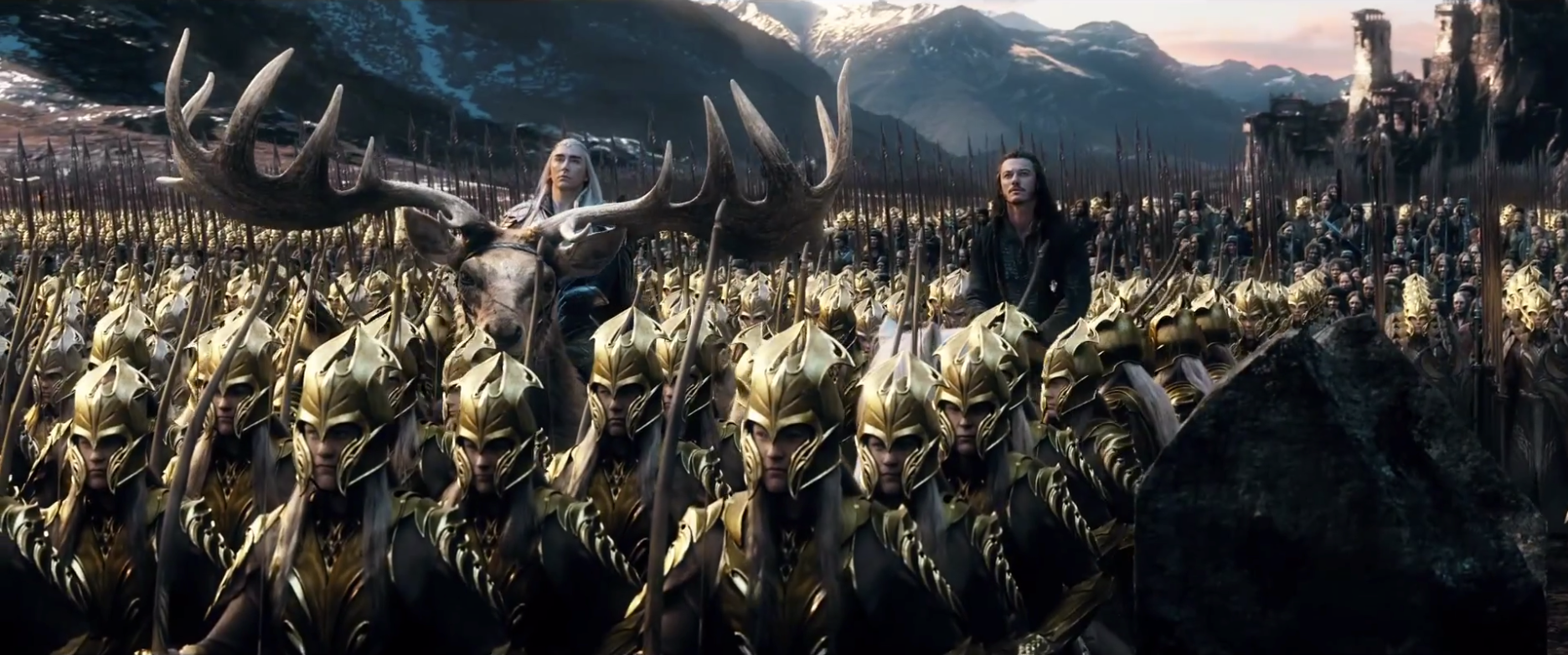
Bard (Luke Evans) on a mule and the King of the Elves, Thranduil (Lee Pace), on a... reindeer? Anyway, they have arrived among an army of elves and men to claim their shares of the treasures in the Lonely Mountain.

Bard (Luke Evans) on a mule and the King of the Elves, Thranduil (Lee Pace), on a… reindeer? Anyway, they have arrived among an army of elves and men to claim their shares of the treasures in the Lonely Mountain.

And like the muddled titular battle, the rest of The Hobbit III is dispiritingly all over the place. That The Hobbit has had a troubled production history might go some way to elucidating why The Hobbit III, in particular, is so bad. (A film based on The Hobbit book was supposed to have been written shortly after the successful conclusion of the LOTR in 2003, but didn’t materialise. Guillermo Del Toro was appointed to direct The Hobbit at some point in the late-2000s, but stepped down for unspecified reasons. Jackson, subsequently, came to the rescue of the project, only for Del Toro to come back on board in some capacity. And, then, after initially deciding to make two films out of the 300-page book, Jackson decided to split the second film in two and shoot new scenes in 2012/13 to make The Hobbit into a trilogy in post-production.) But is the film’s troubled history truly a reason for why the dialogue is so clunky; for why the aftermath of Laketown goes on for too long; for why storylines (unforgivably) do no conclude; for why the central premises of the film/trilogy are (inexcusably) forgotten; and for why the eponymous character of the trilogy, Bilbo Baggins (played with charm by Martin Freeman), feels like a peripheral figure in the concluding chapter of his own story, among other things? The Hobbit III is so unsatisfying that the answers cannot boil down solely to a troubled production history, especially as Viggo Mortensen (Aragorn) claimed earlier this year that the LOTR had a chaotic production too. This entails that the film’s/trilogy’s faults lie with Jackson, who has done nothing of significance since the LOTR and has now shown that he can muck up something he loves if he is not controlled.

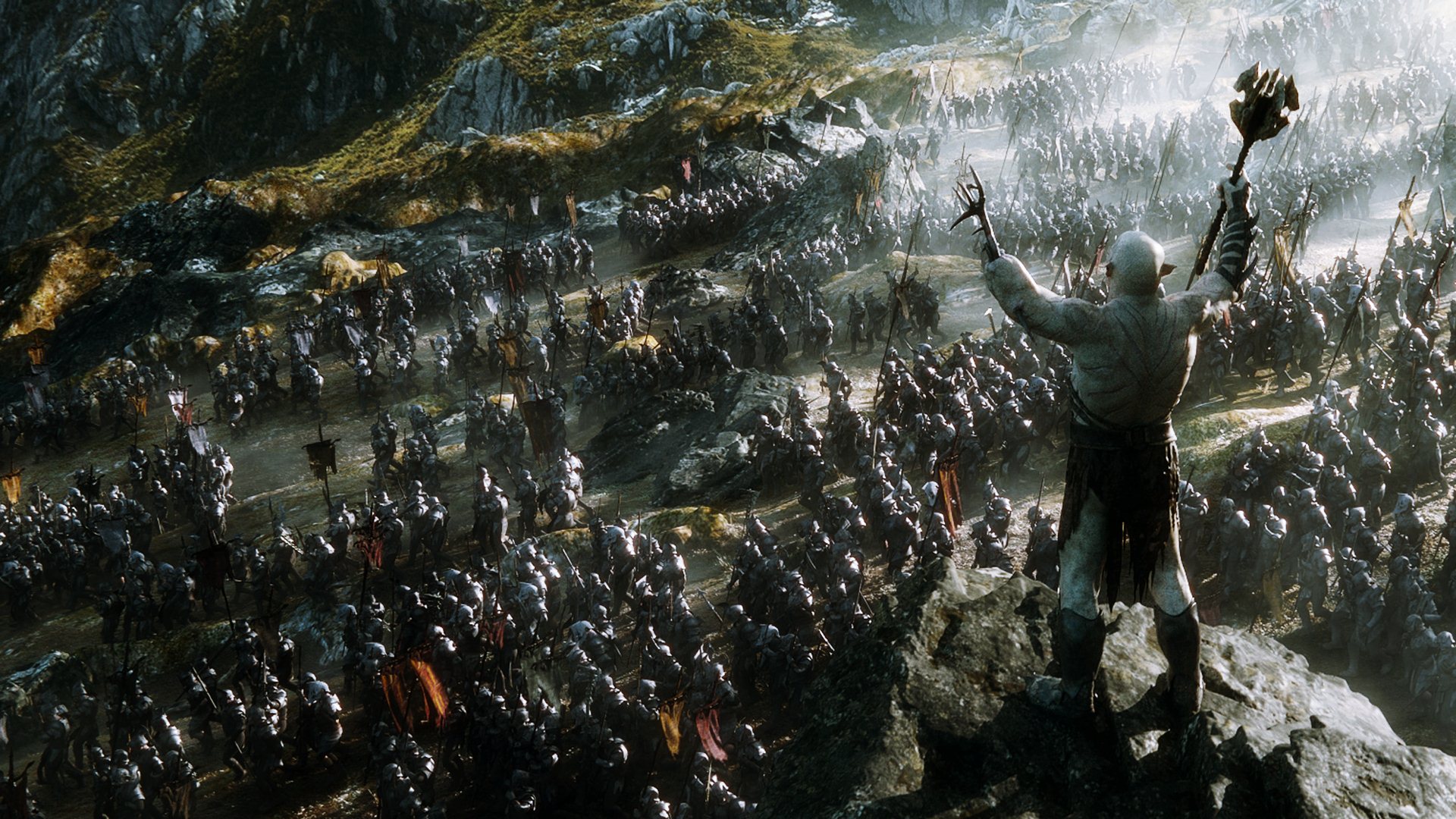
Azog the Defiler (Manu Bennett) roaring an army of orcs toward the Lonely Mountain to kill the dwarves and everyone else.

Azog the Defiler (Manu Bennett) roaring an army of orcs toward the Lonely Mountain to kill the dwarves and everyone else.

One might have pardoned Jackson for some of the aforementioned errors in The Hobbit III (and the trilogy as a whole) if he had added something innovative to Tolkien’s universe. It would have made for interesting viewing if he had given audiences details of the backgrounds, cultures and religions of the peoples of Middle-Earth that Tolkien, himself, failed to put into his stories, or put in a Machiavellian-style character (like Littlefinger from Game of Thrones). But no, Jackson (depressingly) doesn’t do any of this, meaning that people go away from this bloated film/trilogy knowing nothing more about the wizards, men, elves, dwarves and orcs of Middle-Earth than they did after the LOTR. Simply put: this is not good enough, Jackson.

Over-all, one can breathe a sigh of relief that The Hobbit trilogy is over. While The Battle of the Five Armies has a couple of good moments, like the opening scene and the end credits, it is a mess and suffers from the same issues as The Hobbit I & II: notably, its swollen length to accommodate the extreme self-indulgence, tedium and sameness. Whilst watching The Hobbit III, it feels like one is watching a glutton stuff his/her face, whilst the problems within The Hobbit trilogy as well as the problems surrounding the trilogy’s production illuminate before one’s eyes. Worse, The Hobbit III and the trilogy as a whole show up the problems within Tolkien’s works, including the LOTR. Peter Jackson, how could you go so wrong?

PG’s Tips
Review – Interstellar (12a) [2014]

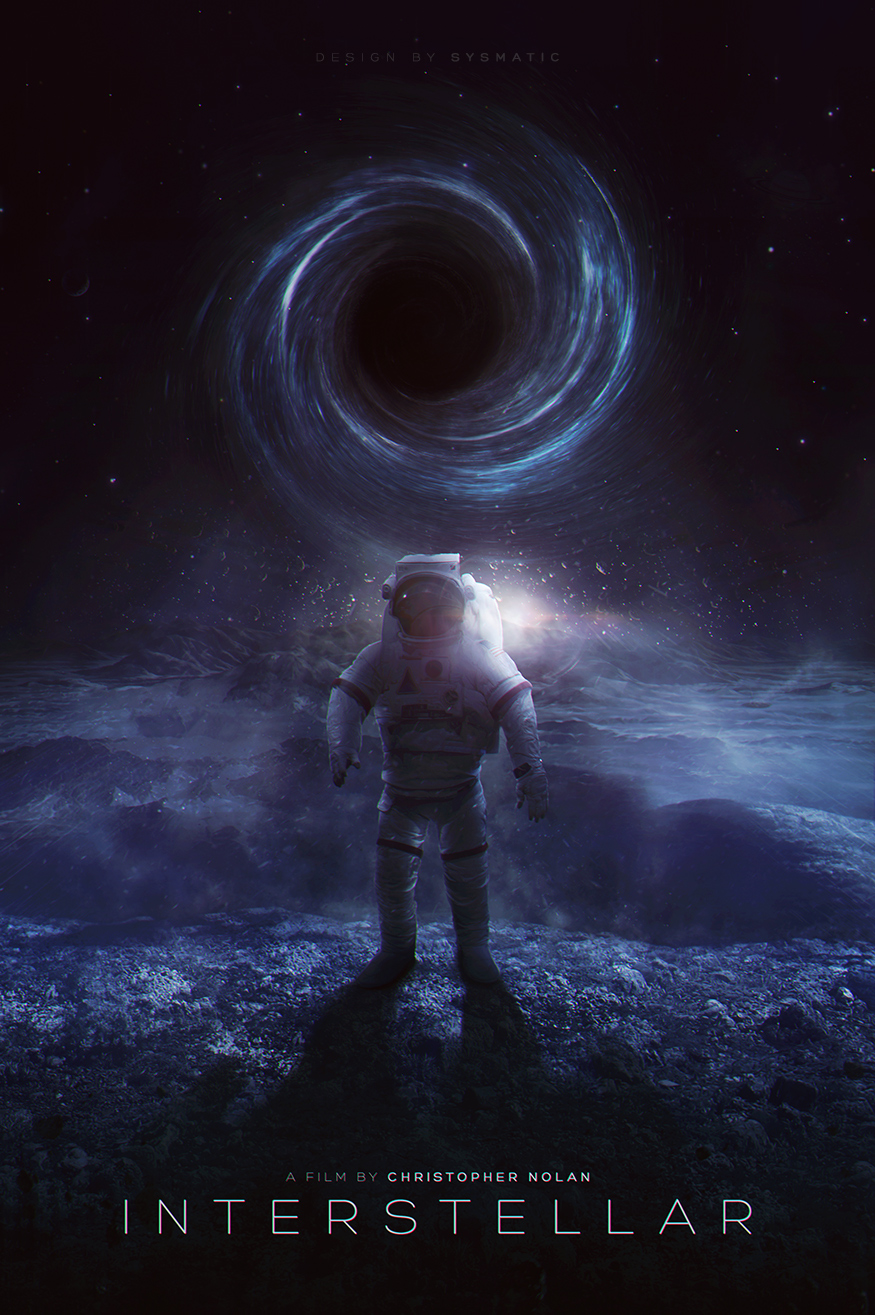
Interstellar - title banner

Star Rating: 3.5/5

Director:

Cast:

Music Composer:

There are some directors whose movies are simply a cut above the rest. Steven Spielberg, David Fincher, Alfonso Cuarón and Martin Scorsese do not necessarily make films often, but when they do their films are invariably of the highest quality. Christopher Nolan rightly has a place among these filmmaking giants and his latest movie, Interstellar, confirms this despite the film’s problems.

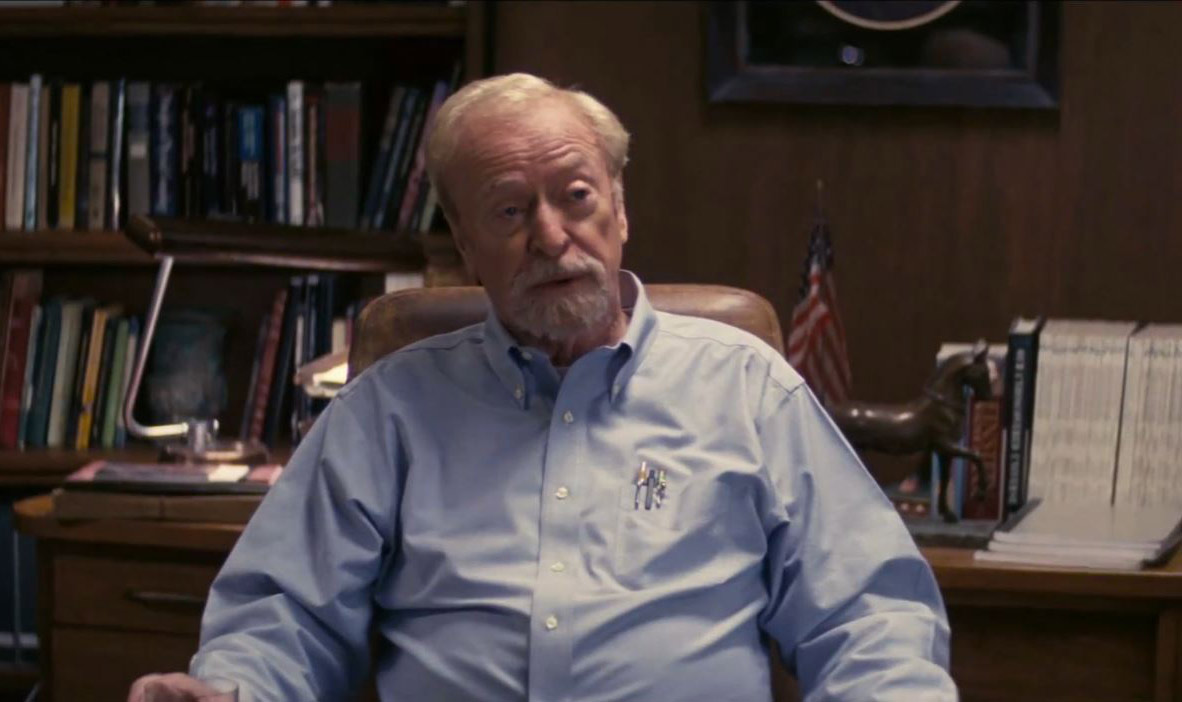
Professor Brand (Michael Caine) explaining the mission and its purpose to Cooper (Matthew McConaughey)

Professor Brand (Michael Caine) explaining the mission and its purpose to Cooper (Matthew McConaughey)

Interstellar is set in the not-too-distant future. The Earth will soon be unable to sustain life due to crop failures. Mankind needs to find a new planet in order to survive. With the situation desperate, Cooper (Matthew McConaughey) leads a team of astronauts into space so as to find another planet that can sustain habitable life.

Interstellar is an ambitious, innovative and stimulating movie. Like The Dark Knight Trilogy, The Prestige and Inception, Interstellar is a film full of ideas such as Murphy’s Law, gravity, love, and how time bends in space to name but four. These ideas keep viewers fully occupied throughout the film’s 167-minute running time. As in the above-mentioned films, Nolan again illustrates his intelligence by writing an ingenious script that holds much realism and does not fall into the generic (and dull) intergalactic ray-gun war between men and monsters. Nolan must be applauded for it and for not patronising his audience (harrumph Michael Bay).

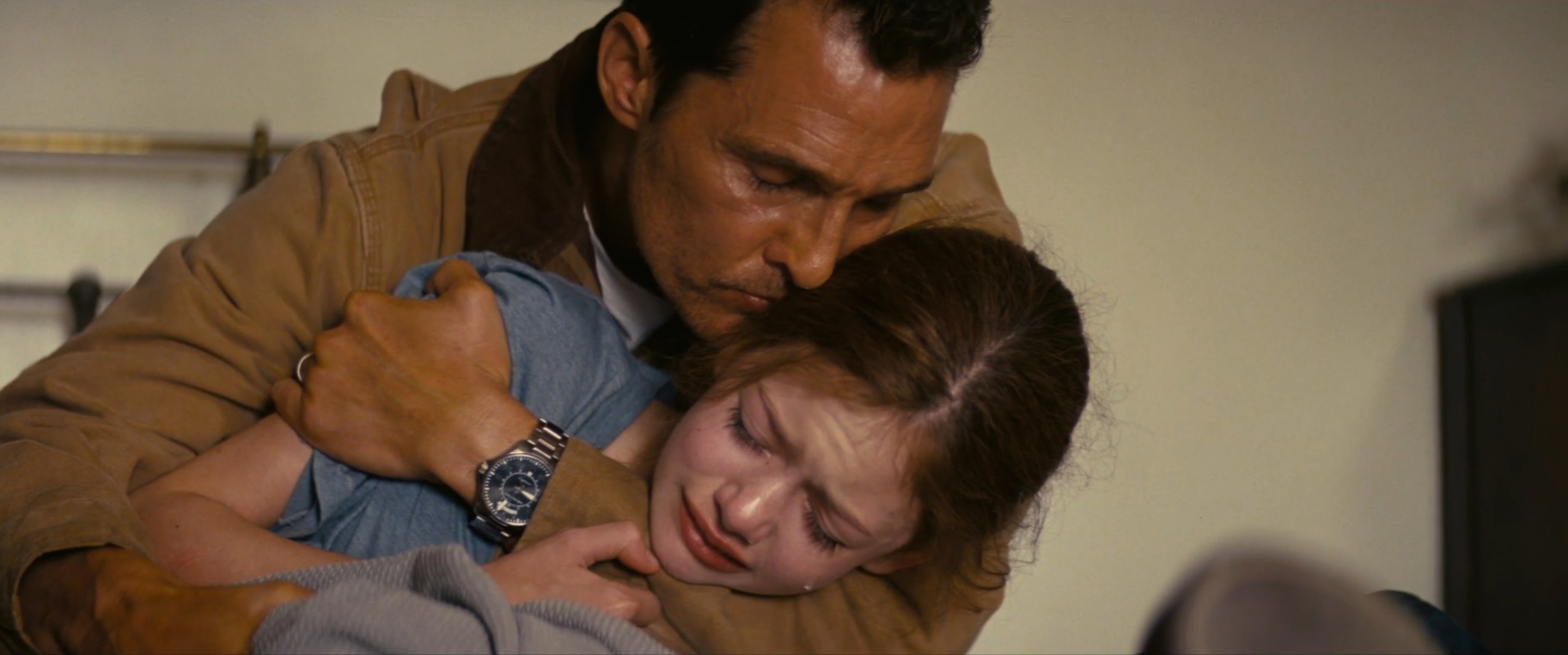
Cooper saying goodbye to his little daughter, Murphy (Mackenzie Foy) before he goes on the mission.

Cooper saying goodbye to his little daughter, Murphy (Mackenzie Foy) before he goes on the mission.

Granted, most viewers probably will not completely comprehend Interstellar’s dialogue as one may need to be a quantum physics professor and an astrophysics nerd for that. If viewers are neither of those and find the dialogue difficult to grasp, they can still easily enjoy the film simply by sitting back and admiring the awesome sceneries, the breath-taking special effects, and the phenomenal music. The CGI and the music, in particular, make audiences feel like they’re on a wonderful rollercoaster ride through space, and the length of the film enhances this riveting sensation.

However, not even this terrific sensation can override or conceal the gaping holes in Interstellar’s storyline (as a train could fit through them). These holes stem from moments of tension that are there solely for the sake of tension (and filler) rather than advancement of the storyline; and from the ending being too rushed and contrived for the movie to make sense. With most directors, viewers would generally accept these plot holes as par for the course. But with Nolan, viewers expect better. Scenes of tension in his previous films have had consequence(s) upon the storylines, and he has given us some of the most original, thought-provoking and satisfying endings in movie history. To see his film suffer from similar problems as those of (cheesy) action films and (second-rate) sci-fi movies feels wrong as Nolan is too smart a man to fall into such holes.

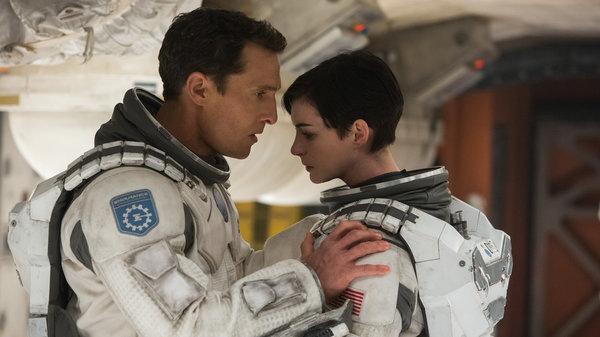
Cooper speaking with Amelia (Anne Hathaway) as they try to determine what to do next as they search for a habitable planet.

Cooper speaking with Amelia (Anne Hathaway) as they try to determine what to do next as they search for a habitable planet.

Yet, the above-mentioned holes are not the only issues staring back at Interstellar. Like Inception, Interstellar is so plot heavy it has no time for character development. For any film, it is excusable not to give peripheral characters proper story-arcs since that bloats the film’s running time unnecessarily and can render a film with a terribly swollen cast (like Interstellar) impractical to make. But what is not excusable for any film, including Interstellar, is for the major characters to not have proper story-arcs. This is because one of the most fascinating parts of a film is the journey the main characters go on and watching how the journey affects them, for good or ill. Without such story-arcs for the major characters, Interstellar feels like a large plate with little food on it: somewhat unsatisfying.

Over-all, Interstellar is a very ambitious, intelligent and challenging movie. Yes, it has plenty of plot problems. And, yes, it does not give its characters enough time for sincere character growth. On the flip side, though, the movie is made worthwhile by the stunning landscapes, the spectacular special effects, the spellbinding music, and the interesting ideas that are seldom explored in films. Suffice to say, Interstellar does not make for an easy 167-minutes and the film would have ended up as a total mess if it were to have been directed by anyone other than a master of his/her craft. This underlines why Christopher Nolan is such an extraordinary director and why he rightly stands among the best in the business in Hollywood.

PG’s Tips
Review – The Drop (15) [2014]

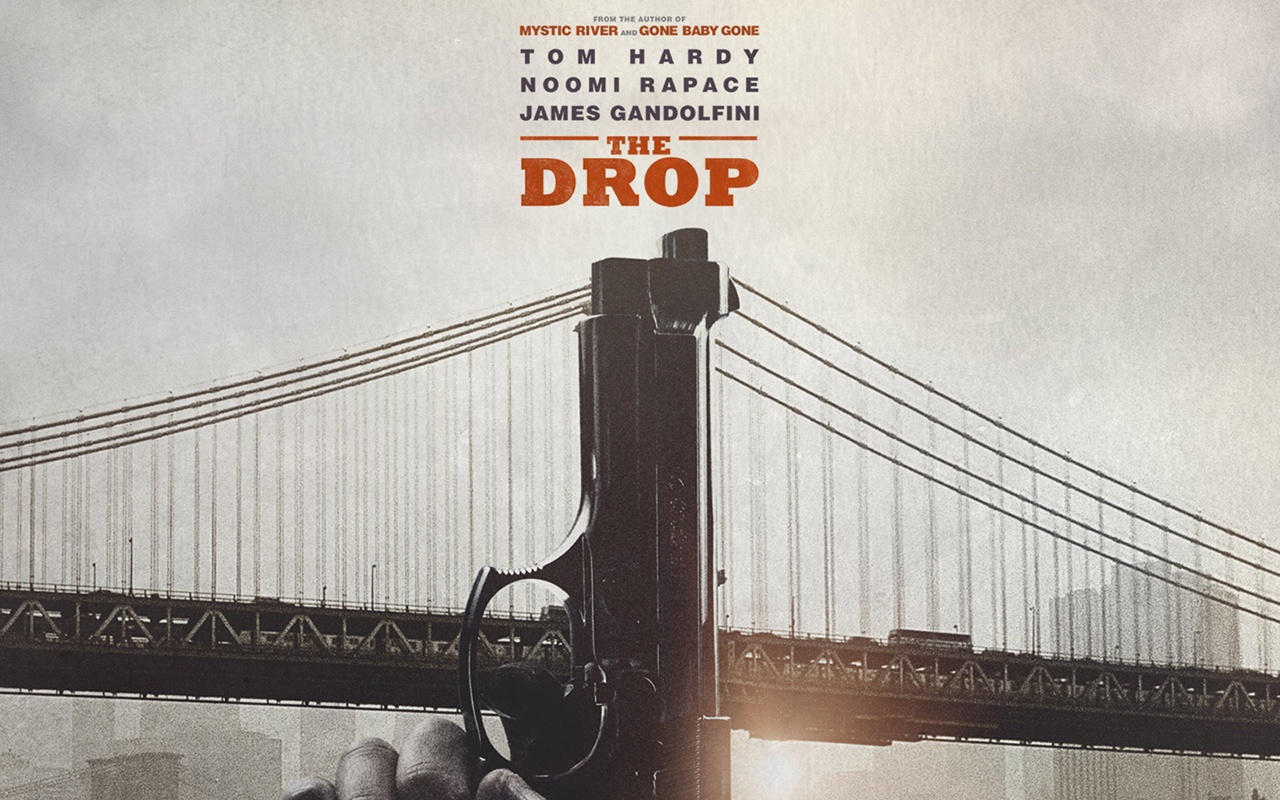
The Drop - title banner

Star Rating: 4/5

Director:

  • Michael R. Roskam – Bullhead

Cast:

Music Composer:

The engine to every story/film is its characters. Without characters, viewers have no means of entering the story and so cannot enjoy the story. But do characters have to be likeable for viewers to enjoy the story? Rust And Bone and The Wolf Of Wall Street demonstrated that characters could be repugnant, yet the story/film could still be enjoyed. Michael R. Roskam’s The Drop adds further evidence to this theory.

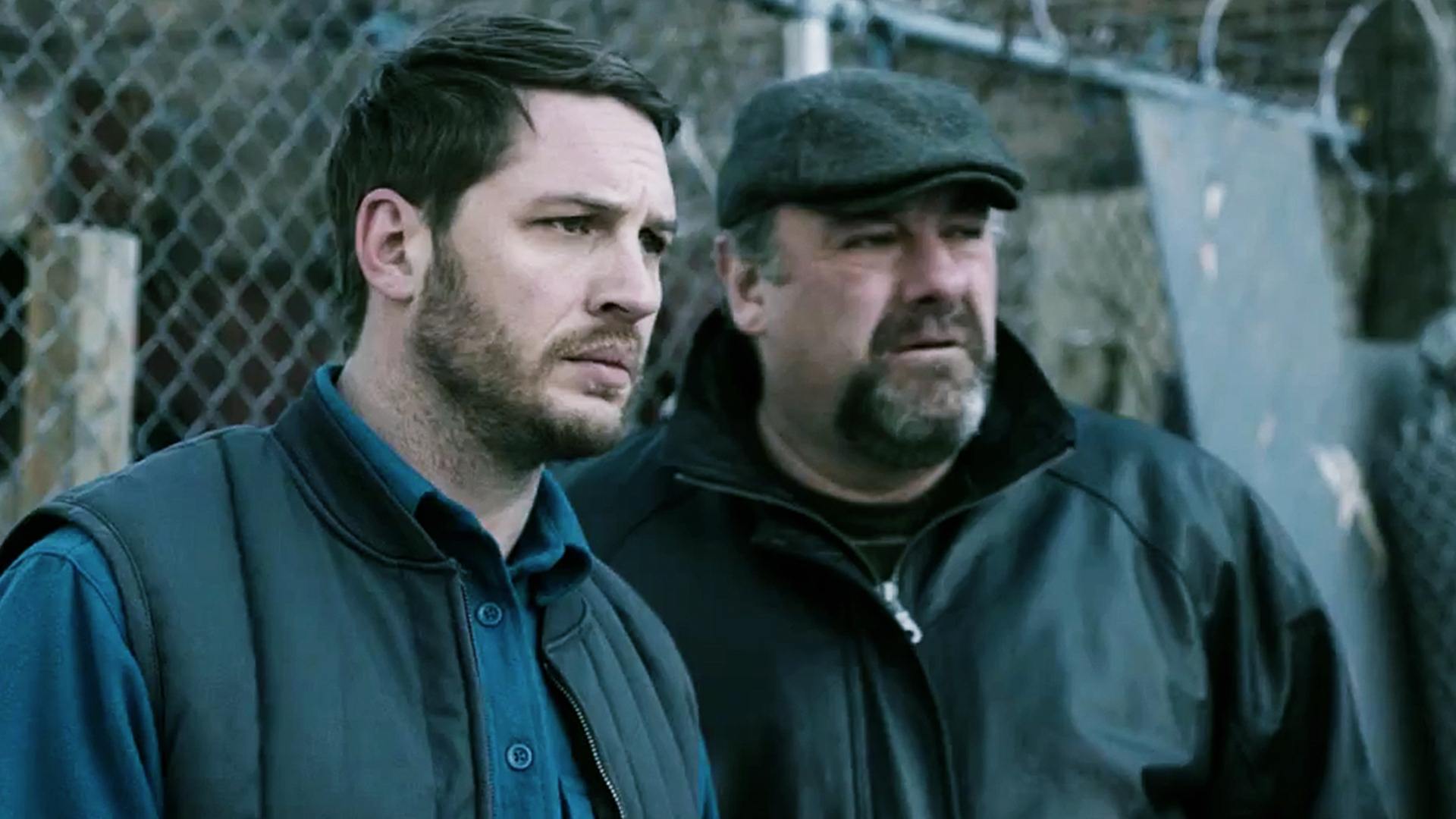
Bob (Tom Hardy) with his boss and cousin, Marv (James Gandolfini, in his final role before his death) outside the back of Cousin Marv's, listening to their Chechen gangster boss.

Bob (Tom Hardy) with his boss and cousin, Marv (James Gandolfini, in his final role before his death) outside the back of Cousin Marv’s, listening to their Chechen gangster boss.

The Drop is based on the short story Animal Rescue by Dennis Lehane. The film is about two intertwining stories that take place in a poor part of Brooklyn, New York. Bob (Tom Hardy) is a bartender who works for his cousin Marv (James Gandolfini) at the latter’s former bar. Cousin Marv, as the bar is called (even though Marv no longer owns it), is a drop box for local gangsters to put brown envelopes of cash into. However, one night, the bar is robbed by gunmen and Marv’s boss, a Chechen gangster called Chovka (Michael Aranov), wants to know where his money has gone. Or else.

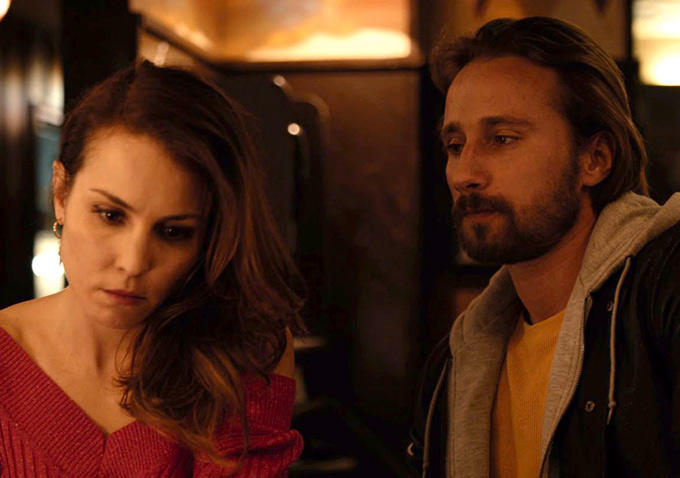
At the same time, Bob walks home from the bar one night, only to overhear a dog whimpering in the dustbin of a neighbour, Nadia (Noomi Rapace). Bob opens the bin to find a maltreated pit-bull puppy in it. Between him and Nadia, they take care of the puppy. Nevertheless, one day when Bob is playing with the dog in the park, the notorious Eric Deeds (Matthias Schoenaerts) finds him and tells him that the dog belongs to him. Bob insists that he is not giving up the dog, and that is when Eric tells him that if he does not pay him $10,000 by the next day for the dog, he promises to kill him, maltreat the puppy again, and do worse to Nadia.

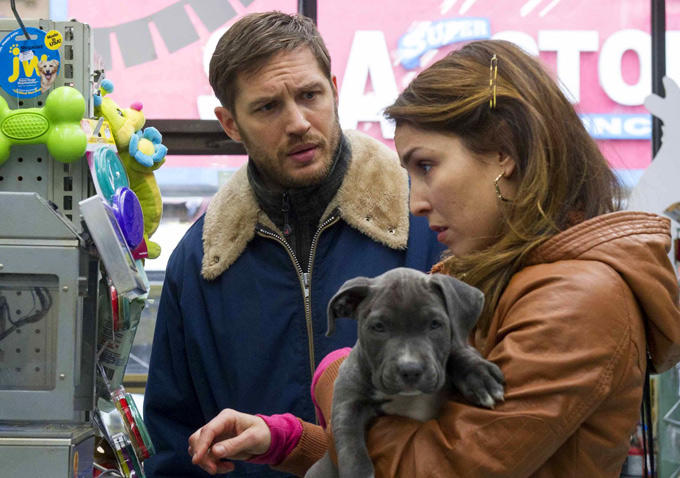
Bob with Nadia (Noomi Rapace), buying stuff for the pitbull puppy, Rocco.

Bob with Nadia (Noomi Rapace), buying stuff for the pitbull puppy, Rocco.

The Drop is a slow-burning, increasingly tense thriller. The film feels less like a Hollywood production and more like a British one due to the gloomy mood throughout the movie’s 106-minute running time. Indeed, if it weren’t for the accents and the design of the houses, one might have mistaken it for a British production due to the constant grim, grey sky and the run down state of the homes in the area. Such features are typical of British productions like Harry Brown, Tyrannosaur and the Channel 4 TV series Top Boy, and enable viewers to feel the brooding atmosphere of a place in which something nasty is going to happen.

One senses that something nasty is going to happen because the area in which The Drop is located in is full of nasty people, ready to do (and cover up) their dirty work. The nasty people are all brought to life vividly by a cast with less than a handful of redemptive features between them. Tom Hardy commands a strong performance in the central role. He personifies the brooding atmosphere of the film with his perpetual frown, and few actors have Hardy’s rare ability to convey so much with just a bland stare.

Of the rest of the cast, Noomi Rapace does a good job with Nadia, even if she does not have a lot to work with other than being low on confidence and insecure. Similarly, Matthias Schoenaerts plays well (and with worrying realism) in his familiar role as a scum bug. At least in Rust And Bone, Schoenaerts’ character had one redemptive feature. In The Drop, his character has none! Yet, none of the characters are as ostensibly interesting as the one performed by James Gandolfini in his final role. Gandolfini’s character, Marv, may not be a nice person. But he is the most layered and complex character in the film and this makes viewers want to see more of him/Gandolfini as, arguably, it is Marv that makes the movie tick.

Nadia, looking good but ditressed with Eric Deeds (Matthias Schoenaerts) at Cousin Marv's.

Nadia, looking good but ditressed with Eric Deeds (Matthias Schoenaerts) at Cousin Marv’s.

The setting and the acting are top-notch in The Drop. However, other than those (very important) elements, the film does not have much else to ride on. The plot raises several questions that go unanswered, which is annoying because the questions do not seem especially difficult to answer. Additionally, some of the key moments in the movie take place off-screen, which is again annoying. There is a rule in art: show, don’t tell. That The Drop ignores this rule is its major hindrance as otherwise it is a very solid film.

Over-all, The Drop consists of most things that one could want from a slow-burning thriller. For certain, it has some plot holes that could have been handled better. Nevertheless, the dismal and threatening atmosphere of the film; the gradual rise in tension; and the fine acting of the cast all make the movie thoroughly worthwhile and enjoyable. Thus, The Drop illustrates once more that a film with dislikeable characters can still be enjoyed.

PG’s Tips

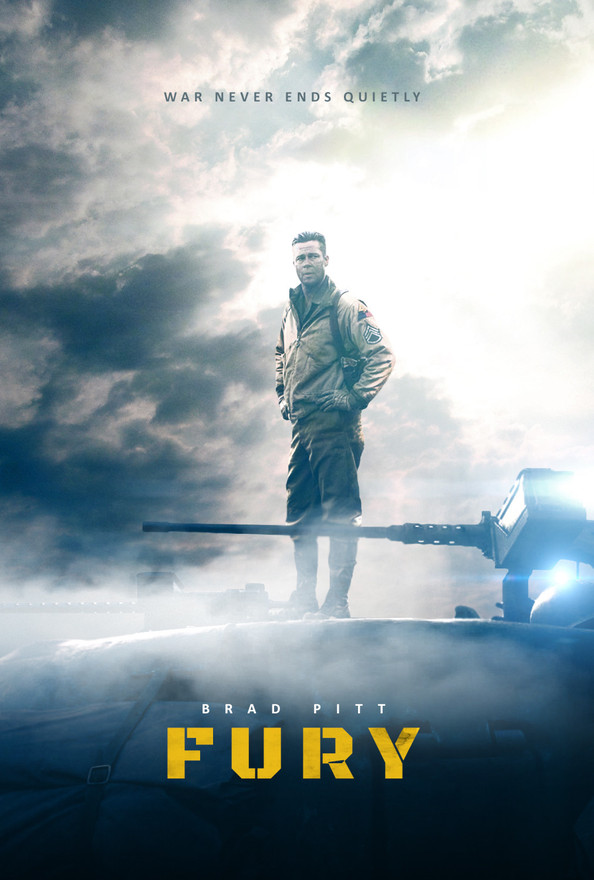
Review – Fury (15) [2014]

Fury - title banner

Star Rating: 3/5

Director:

  • David Ayer – Harsh Times, End Of Watch, Sabotage

Cast:

  • Brad Pitt – Snatch, Mr & Mrs Smith, 12 Years A Slave, The Big Short
  • Shia Lebeouf – Disturbia, Transformers I-III, Nymphomaniac I-II, Man Down
  • Logan Lerman – 3:10 To Yuma, The Perks Of Being A Wallflower, Percy Jackson I-II, Noah
  • Michael Peña – Crash, End Of Watch, The Lincoln Lawyer, The Martian
  • Jon Bernthal – The Air I Breathe, The Ghost, The Wolf Of Wall Street, Sicario
  • Jason Isaacs – Black Hawk Down, Windtalkers, Harry Potter I-VII(i) & VII(ii), Stockholm, Pennsylvania

Music Composer:

  • Steven Price – The World’s End, Gravity

The topic of World War II (WWII) is well trodden territory in Hollywood. Seeing stellar American soldiers gunning down Nazis and ‘Japs’ has been revisited on many, many occasions as Saving Private Ryan, Pearl Harbour, Band Of Brothers, Flags Of Our Fathers, and Red Tails testify, to name a handful. Unsurprisingly, after such a high volume of movies on the topic in the last two decades alone, there is a sterile and samey feel to WWII films, unless a new film adds something unseen to the genre. Alas, Fury does not do this.

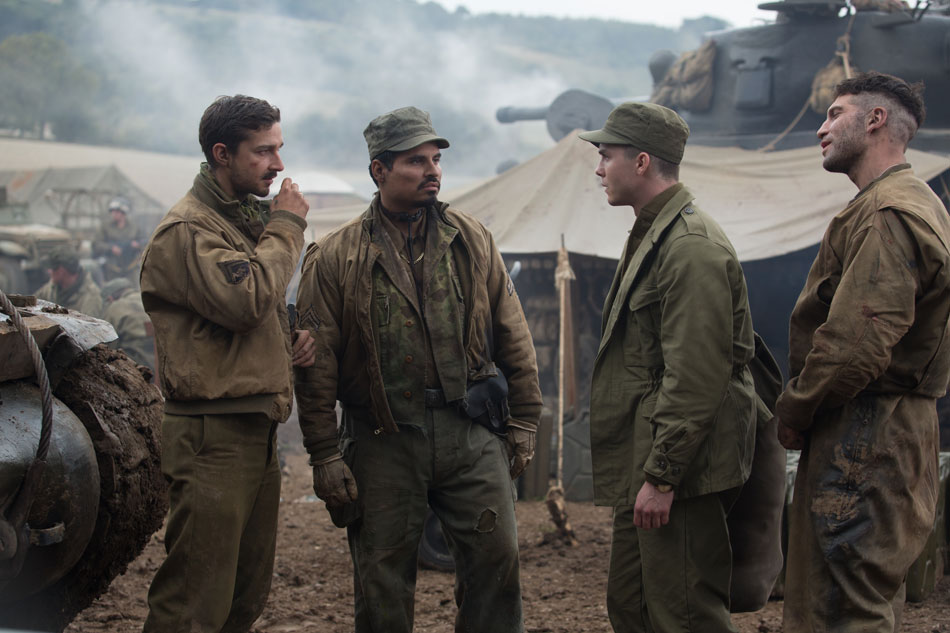
Young Norman Ellison (Logan Lerman, inside right) joining his crew of tank-men, and being derided for his inexperience by Boyd (Shia Lebeouf), 'Gordo' (Michael Peña) and 'Coon-Ass' (Jon Bernthal).

Young Norman Ellison (Logan Lerman, inside right) joining his crew of tank-men, and being derided for his inexperience by Boyd (Shia Lebeouf), ‘Gordo’ (Michael Peña) and ‘Coon-Ass’ (Jon Bernthal).

The film is fictional and begins in 1945. The Allies are advancing into Nazi Germany, and Fury, the name of the tank led by Sergeant ‘Wardaddy’ Collier (Brad Pitt), is in one of the regiments leading the assault into the Fatherland. Including Sergeant Collier, the tank consists of a five man crew: Boyd ‘Bible’ Swan (Shia Lebeouf), Grady ‘Coon-Ass’ Travis (Jon Bernthal), Trini ‘Gordo’ Garcia (Michael Peña), and newcomer Norman Ellison (Logan Lerman).

As the crew push deeper into Germany, Sergeant Collier takes it upon himself to educate young Ellison about the brutal nature of war and how to deal with it, as the personality of the enemy sinks to ever more depraved levels.

Fury’s premise is simple and the film sticks to it rigidly. Fury has a raw, muddy, and claustrophobic feel to it. One gains a true insight into what it must have been like (and probably still is like) for a group of soldiers inside a tank while fighting in a war. The movie shows how the crew’s situation turns from uneventful to frenzied chaos upon the rippling of a machine gun or the boom of an explosion. Suffice to say, there is plenty of both and all the action scenes are well done.

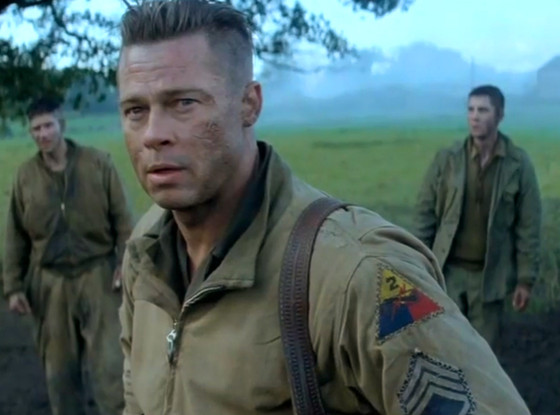
Sergeant 'Wardaddy' Collier (Brad Pitt) thinking over a key decision that he has to make.

Sergeant ‘Wardaddy’ Collier (Brad Pitt) thinking over a key decision that he has to make.

Another aspect of Fury that’s done well is the developing relationship between Sergeant Collier/Brad Pitt and Norman Ellison/Logan Lerman. This is because David Ayer’s script is good and the actors perform their roles well, particularly Pitt as the grizzled but caring war-veteran. To Pitt’s credit, in a film which he dominates, he manages to hold viewer’s attention, whether it is with Ellison, the other members of his band of brothers, other American soldiers, or Germans. Pitt’s/Collier’s character is most interesting and revealing when he is teaching Ellison/Lerman about the nature of the Nazi enemy as audiences get to see the complexities in his character.

Yet, as a corollary of Pitt dominating the film, the rest of the non-peripheral members of the cast don’t get enough screen time to illustrate that they are much more than (lazy) personifications of their nicknames. (Nevertheless, they do get time enough to praise Sergeant Collier/Brad Pitt. For which film starring Brad Pitt wouldn’t give the supporting cast time to applaud him?) That the other characters are not given adequate screen time is a bit of a shame as the actors all do good jobs with what they’re given; even, shockingly, the much-derided Shia Lebeouf!

Other than Fury being (yet another) glorification of Brad Pitt, the film lacks direction and the storyline does not go anywhere as a result. Arguably, the movie never intends to build up to a climax (although it half does); and, instead, merely goes out to highlight the grisly, ghastly and inhumane horrors of war, merely from the angle of tank crewmen. Yet, if this were the case, Fury does not go far enough. Many criminal elements and horrors of war/WWII are not shown in the film, especially in comparison to the harrowing Schindler’s List and The City Of Life And Death.

What a surprise! Sergeant Collier/Brad Pitt takes off his shirt, gives himself a wash, and shows off his abs to put most men to shame. Haven't we seen this before? (Fight Club? Troy?)

What a surprise! Sergeant Collier/Brad Pitt takes off his shirt, gives himself a wash, and shows off his abs to put most men to shame. Haven’t we seen this before? (Fight Club? Troy?)

Additionally, Fury lacks depth. There are several occasions when some of the cast talk about criminal acts they’ve committed during the war. They may talk about it with remorse, but no-one ever questions their actions. This renders the scene frustrating because the film misses the chance to explore the moral conscience of each character, and pointless because it means that such scenes have no consequence (positive or negative) on the rest of the movie.

Indeed, frustration and pointlessness sum up Fury. It is a film that has a lot going for it due to a good script; solid acting from all the cast; the a muddy set which enables one to feel what it must have been like (and what it probably still be like) to be inside a tank during war; and the graphic way that warfare is depicted is gruesome and sickening. However, ultimately, the above-mentioned positives of Fury are not enough to satisfy viewers, considering that WWII has been portrayed in films so many times over the last two decades alone. Thus, Fury has the sterile and samey feel of so many other WWII movies which not even the dominant display of Brad Pitt (and his abs) can overcome.

PG’s Tips
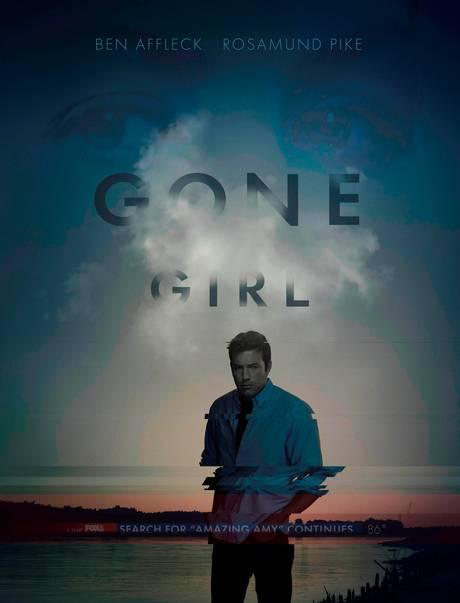
Review – Gone Girl (18) [2014]

Gone Girl - title banner2

Star Rating: 4.5/5

Director:

  • David Fincher – Fight Club, The West Wing, The Social Network, The Girl With The Dragon Tattoo

Cast:

  • Ben Affleck – Pearl Harbour, Paycheck, Argo, Batman v Superman: Dawn of Justice
  • Rosamund Pike – Die Another Day, An Education, Wrath of the Titans, Return To Sender
  • Neil Patrick Harris – Starship Troopers, Beastly, Cloudy With A Chance of Meatballs, The Good Dinosaur
  • Carrie Coon – The Leftovers
  • Tyler Perry – Why Did I Get Married?, I Can Do Bad All By Myself, Good Deeds, The Single Mom’s Club
  • Emily Ratajkowski – Entourage, We Are You Friends
  • Kim Dickens – Red, Lost, The Blind Side, Sons of Anarchy
  • Sela Ward – Independence Day II: Resurgence

Music Composers:

  • Trent Resner – The Social Network, The Girl With The Dragon Tattoo, Brainport: Soul of a City
  • Atticus Ross – The Book of Eli, The Social Network, The Girl With The Dragon Tattoo, Blackhat

When people get married, they make a vow to one another to stay together for life. At the time of making their vows, couples believe that their bonds are strong and that any hurdles they face in their marriage will be overcome. Nevertheless, there are some hurdles that cannot always be overcome, whether it is due to the behaviour of one or both of the spouses, or due to factors beyond a couple’s control. David Fincher’s excellent new film, Gone Girl, dramatically explores what couples maybe can and cannot endure in a marriage when certain fundamental aspects of any relationship/marriage are tested to the limit.

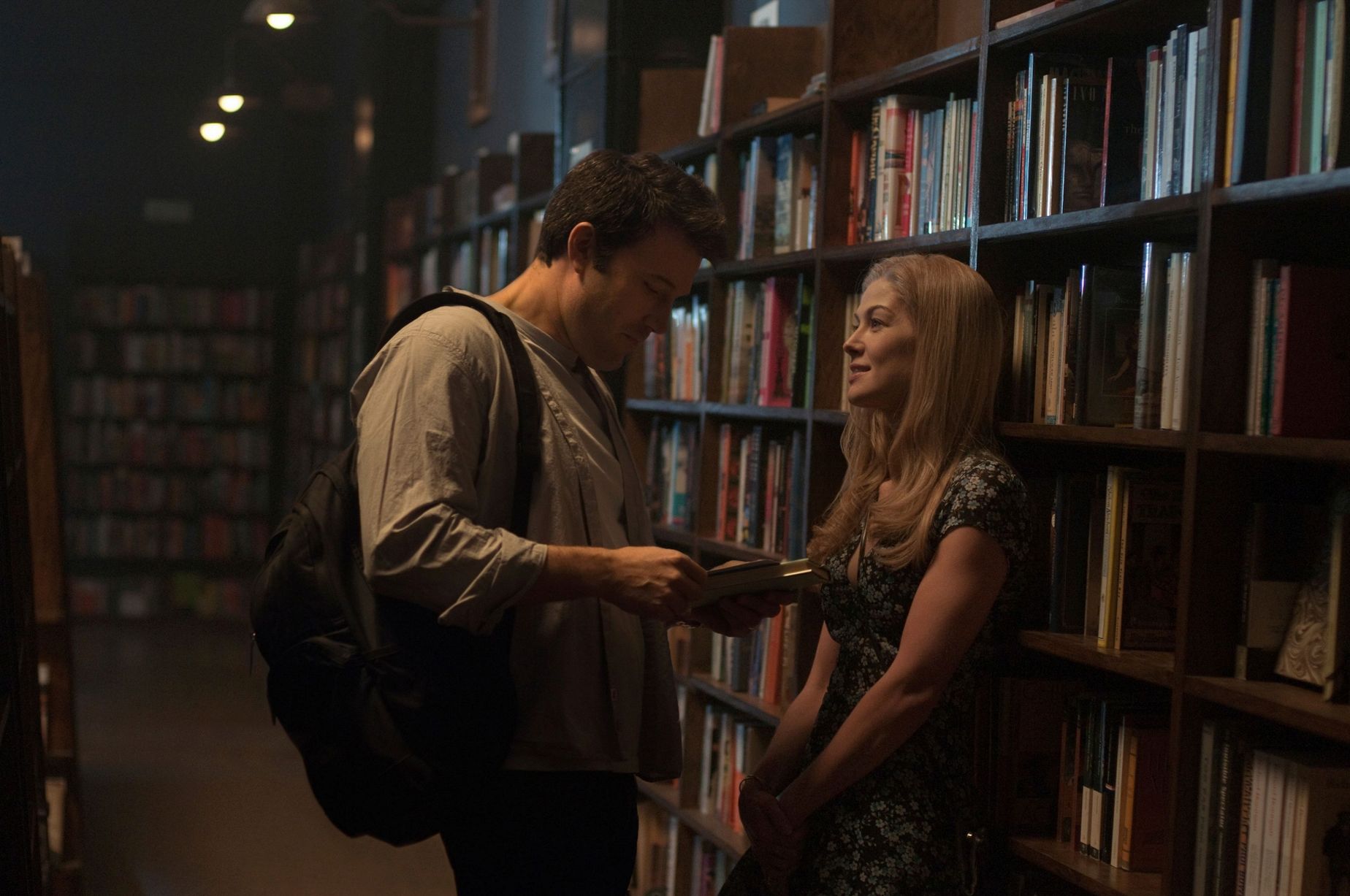
Nick (Ben Affleck) and Amy (Rosamund Pike) happily married, looking for books in a library.

Nick (Ben Affleck) and Amy (Rosamund Pike) happily married, looking for books in a library.

Gone Girl is a psychological thriller, adapted from the 2012 novel with the same title by Gillian Flynn. Nick and Amy Dunne are a young, happily married couple. But on the day of their fifth wedding anniversary, Nick (Ben Affleck) comes home to find that his wife Amy (Rosamund Pike) has vanished. Nick reports his wife as missing to the police. But as the investigation gets under way, the shadier sides of Nick’s personality are uncovered, leaving the police to question whether he is guilty of something sinister.

Gone Girl is a fascinating film that looks into Amy’s disappearance in detail. Like with Fincher’s critically acclaimed The Social Network, Gone Girl gives each side a fair amount of time to tell their version of events throughout its 150-minute running time. Cleverly, in between flash backs, the movie dangles carrots of information before viewers, so they jump to conclusions, only to be given new pieces of information that force them to rethink all that they previously knew (or thought they knew) about Nick and Amy. Impressively, this continues in a mature way right up to and including the final scene.

Nick going to the tavern to speak with his twin-sister, Margo (Carrie Coon), about how his relationship with Amy is almost non-existent.

Nick going to the tavern to speak with his twin-sister, Margo (Carrie Coon), about how his relationship with Amy is almost non-existent.

Suffice to say, Gone Girl is an intense movie in which one cannot go to the bathroom for a break at any point. Scenes move quickly; too quickly, perhaps. Yet, each scene is crucial, not just in terms of plot, but in terms of the important issues the film raises because they affect normal people in relationships/marriage. Issues such as trust in a partner/spouse, the extent that one can believe any side of a story, the façade of a happy marriage, the gradual change of personality in one’s partner/spouse, the strain of economic hardships on a relationship/marriage, the strain on a relationship/marriage of having to move city or country for one reason or another, the prejudices of the police during investigations, and the role other people and the media can play over local (and international) opinions. That the film handles these issues in a neutral, adult way is a credit to the film that will leave audiences enthralled and unsure as to who is the hero and who is the villain.
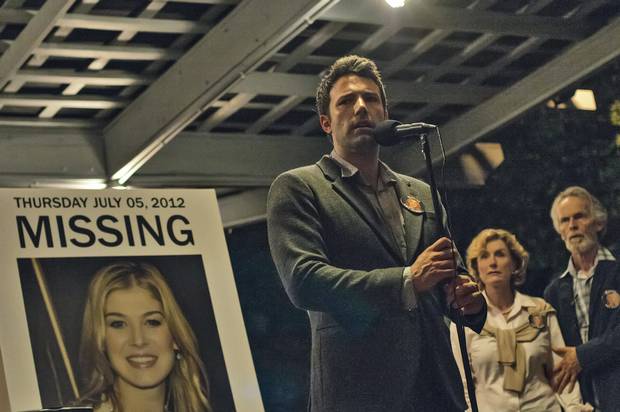
Two reasons why audiences will be enthralled is due to the quality of the dialogue and the acting. Fincher’s trademark fast-talking dialogue is pulled off with aplomb by the talented cast, all of whom play superbly well. Significantly, the two main actors, Ben Affleck and Rosamind Pike, are outstanding and have great chemistry together. Yet, of the two, it is Pike who steals the show with a career-changing performance. The film may rush Amy’s character development, but Pike handles this well enough to guarantee that anything that is missing from Amy’s nature is of inconsequence.

Nick appealing to the public to help him find Amy, with posters of her missing to raise awareness about the situation.

Nick appealing to the public to help him find Amy, with posters of her missing to raise awareness about the situation.

Pike and Affleck’s superb performances aside, what also keeps Gone Girl so vivid is the suburban setting of the movie and the movie’s music score. The ordinariness of the location and the raw feel of the music add to the unnerving quality of the film because they compound the sense that (at least some of) what happens to Nick and Amy could happen to absolutely anyone.

Over-all, Gone Girl is a terrific and thought-provoking film that has been cleverly executed by a world-class director. The film sensibly deals with some profound issues that can derail and break even the strongest of marriages. Indeed, the level of profundity is intensified by the film’s location, the film’s music, and the film’s grounded and absorbing performances from the cast; in particular, from Rosamund Pike. All of the above will ensure that audiences will remain mesmerised long after Gone Girl has ended as viewers will not only be wondering who of the cast was (more?) to blame for the situation that unfolds in the film, but also whether or not one’s own relationship/marriage would survive if he/she were faced with similar circumstances.

PG’s Tips