Tag Archives: review

Review – Prometheus 3D (15) [2012]

Star Rating: 2.5/5

With the exception of American Gangster, the last decade has been a poor one in terms of quality films for Ridley Scott, the three-time academy award nominated director/producer. Kingdom of Heaven, Body of Lies and Robin Hood are just three of many terrible movies that he’s created, even if he has made lots of money from them. Prometheus continues this downward trend, even though it is a return to the theme of his highly successful revolutionary 1979 movie Alien.
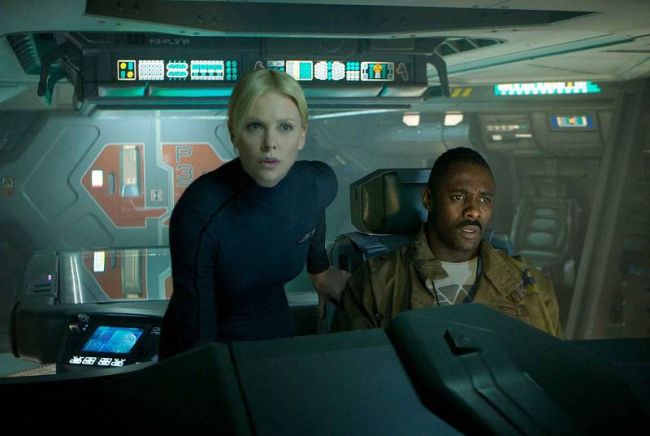
Meredith Vickers (Charlize Theron) with the captain of the Prometheus vessel, Janek (Idris Elba).

Prometheus is the prequel to Alien. In 2089, archaeologist love-birds Elizabeth Shaw (Noomi Rapace – The Girl With The Dragon Tattoo, Sherlock Holmes II: A Game of Shadows, The Drop) and Charlie Holloway (Logan Marshall-Green – Brooklyn’s Finest, Devil, Black Dog, Red Dog) discover a star map among several unconnected ancient civilisations. Believing that they can discover the origins of humanity, they join a crew on the space-vessel Prometheus bound for the moon where they hope to unearth the answers.

Piloted by David (Michael Fassbender – X-Men: First Class, Shame, 12 Years A Slave), a haughty human-looking android with supreme amounts of knowledge, the spaceship arrives at their destination. After being given a telegrammed video by the elderly Peter Weyland (Guy Pearce – The Hurt Locker, The King’s Speech, Iron Man III), the patron of the trillion-dollar expedition, and a speech by Meredith Vickers (Charlize Theron – Monster, The Road, Snow White and the Huntsman), a Weyland Corporation employee sent to monitor the mission, the crew set off to investigate the nearby mysterious site.

They are told to avoid contact with any unknown substances. But with some people falling behind, and other members of the crew deceiving others, the humans do come into with the unknown substances. And to dire consequences.
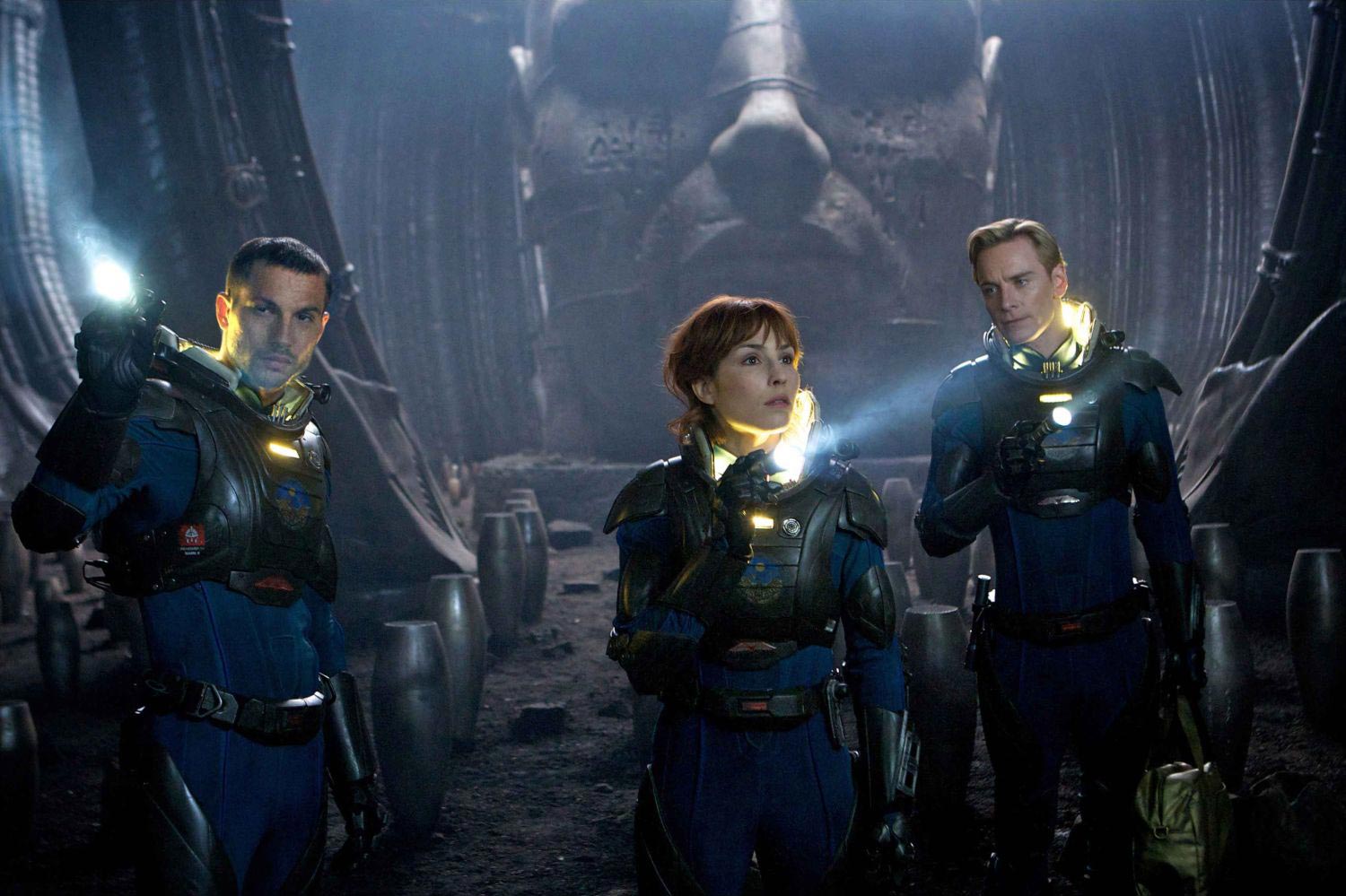
Charlie, Elizabeth and David exploring the cave to find the origins of humanity. Will the statue in the background give them their answers?

The premise on which Prometheus is based is not a bad one and there are some good, refreshingly 1980s-style sci-fi horror moments to keep one in suspense. In 1979, these were innovative, but now the Alien vs. Predator genre has become so abysmally cliché that all of the horror in Prometheus looks samey and unoriginal.

And as is typical of the above-mentioned genres, little of Prometheus’ dialogue or plot makes any sense. (Even Ridley Scott has admitted that the movie leaves some questions unanswered, which suggests that tying up loose ends was not half as relevant to him as making a fortune.) The very beginning of the film (which I have not mentioned) bears no relevance to the rest of the film; with the exceptions of Elizabeth and Charlie, the reasons and motives of the various crew members aboard the Prometheus expedition are unclear or not mentioned at all; and the very end of the movie is as biologically possible as mating a bear with a piranha and producing a wolf.

Worse, Prometheus gives us virtually no insight into the origins of Alien. For a movie that is a prequel to the series, it is inexcusable. Imagine if Christopher Nolan’s Batman Begins had not explained the origins of Batman? What would have been the point in it? The same questions must be asked here.

As Prometheus’ storyline nosedives, the cast do the same. All of the actors have poorly-explained, two-dimensional characters and none of them have any chemistry between them on set. They create such little empathy that viewers are unlikely to care when they start to drop off. Even Noomi Rapace, who was brilliant as Lisbeth Salander in the Swedish versions of The Girl With The Dragon series (aka The Millennium saga), struggles in Prometheus to keep audiences interested (despite spending a percentage of the movie running around wearing not much more than a tankini). Only Michael Fassbender, as the emotionless and enigmatic robot, has the ability to maintain viewer’s concentration. But Fassbender’s character has too many holes to be plausible.
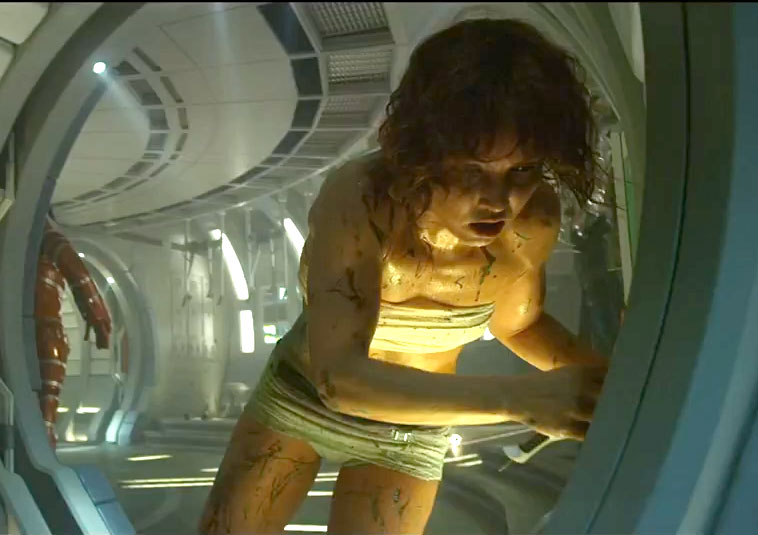
Wounded, Elizabeth is limping round the Prometheus vessel in little clothing to find some help.

Actors and characters aside, at least Prometheus has some decent sci-fi-style special effects. They are not spell-binding, though, because one has seen similar CGIs in God knows how many other movies in the genre before. What is a pity though is that the 3D is so pathetic. For a movie like Prometheus, there should have been more effort put into the 3D aspect of the film to make it worthwhile.

All-in-all, Prometheus is another appalling film to add to Ridley Scott’s recent movie-making collection. Almost nothing works in the film, from the storyline to the cast to the 3D. For a director/producer of Scott’s capacity, whose diverse range of films over the years have been of high quality, it is simply not good enough.

(PS. Read my review of 2014’s Exodus: Gods And King for more on Ridley Scott.)

PG’s Tips
Review – The Dictator (15) [2012]

Star Rating: 3.5/5

From a ‘Rude boy’ chav to a Khazakhstani envoy to a gay Austrian fashion designer, the array of eccentric characters played by Sacha Baron Cohen (SBC) never ceases to amaze. Now, as an Arab dictator, who is meant to be a mix of the late Muammar Gaddafi and Saddam Hussein, SBC has done it again in his latest intelligent and crude comedy, The Dictator.

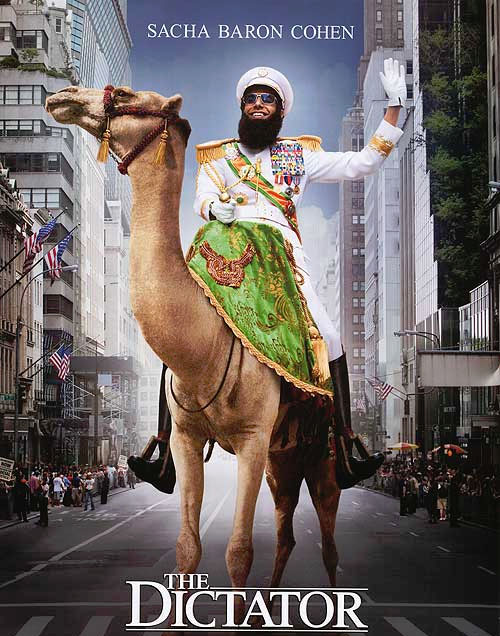
Admiral General Aladeen (Sacha Baron Cohen) riding in true Arabian style through the streets of New York to protest the international opprobrium aimed at his alleged plans to develop a nuclear weapon.

The Dictator is a partially-satirical, partially-dimwitted comedy set in the fictional Republic of Wadiya, based in North Africa. Admiral General Aladeen (SBC – Ali G Indahouse, Madagascar I-III, Les Misérables) is the leader of this oil-wealthy nation, who has ‘risked his life’ to ensure that democracy never comes to the country he so ‘lovingly oppresses.’ (At least he’s honest.)

With Wadiya developing ‘weapons grade uranium’ for ‘peaceful purposes,’ the United Nations (UN) threaten to intervene militarily. They believe that Aladeen has his sights on a nuclear bomb. Appalled at the (accurate) accusation, the Wadiyan leader travels to the UN to protest to the Security Council.

But once in New York, Aladeen’s treacherous uncle, Tamir (Ben Kingsley – Schindler’s List, Shutter Island, Iron Man III), has him kidnapped and exchanged for a double, Efawadh (also SBC). Now a stranger on the streets and devoid of his riches, Aladeen must find his way back into the UN and take back his rightful position as the Admiral General before his double declares Wadiya a democracy and Tamir sells the country’s oil to the West and China.

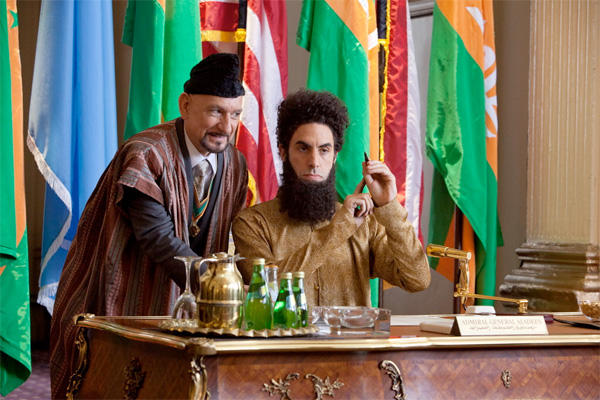
The treacherous uncle, Tamir (Ben Kingsley), ‘advising’ Aladeen to sign an agreement at the UN.

The Dictator’s plot is daftly amusing and silly, yet has some very intelligent undertones. When Aladeen has people executed for the most spurious of disagreements, one senses that this happens frequently in many Middle Eastern countries with their despotic rulers. Similarly, when Aladeen laughably talks about producing nuclear energy for ‘entirely civilian/peaceful purposes,’ it is not difficult to realise that SBC is mocking Iran.

In typical SBC fashion, much of the film has social and political undercurrents. But unlike the ‘mockumentaries’ Borat and Brüno, The Dictator does not set out to expose peoples’ prejudices by making antisemitic, racist, xenophobic and homophobic assertions. Yes, there are plenty of instances of all of those in SBC’s latest film, but they have been done with the intention of being humorous rather than offensive this time around. (Although, no doubt, many people will be offended.) That there is some truth behind most of the jokes ensures that The Dictator is not merely a crude and immature comedy, such as Your Highness or 21 Jump Street.

That does not mean to say that The Dictator does not have (many) obscene moments (which many would consider to be below the belt), but this is to be expected with SBC’s films. One may be surprised at how low SBC can stoop in his movies, but at least the instances of vulgarity are vastly outweighed by the amount of intelligent humour and satire.

The typical butch, left-wing anti-Imperialist, anti-Aladeen activist, Zoey (Anna Faris).

Whether the scenes are clever or obscene, the acting is decent enough throughout the film. SBC performs well in his uniquely unconventional way as both the comically psychopathic Aladeen, and as the senseless Efawadh. Ben Kingsley gives an average, two-dimensional performance as the deceitful uncle (which is exactly the same role he performed in Prince of Persia: Sands of Time). And Anna Faris (Lost In Translation, Scary Movie 4, Red Band), playing Zoey, Aladeen’s love interest, also gives an unspectacular display as the stereotypical, (annoying,) eco-friendly, left-wing activist. (Is SBC being satirical again, here, by making a wishy-washy liberal embrace a hardline, murderous tyrant?)

Regardless of the satirical messages and the quality of the acting, Erran Baron Cohen (Borat, The Infidel, Talhotblond) has ensured that the music, whether Arabic- or Western-style, is apt throughout The Dictator. The score enriches all of the scenes and adds to the laughter wonderfully.

All-in-all, The Dictator is another film that only SBC could have made successfully. The movie is obscene and farcical at times. Yet, in typical SBC fashion, The Dictator is also intelligent and sardonic, leading one to believe that the mad-clown Admiral General Aladeen is more real than one would like to admit.

PG’s Tips

Review – The Avengers Assemble 3D (12a) [2012]

Star Rating: 4/5

The Hulk, Iron Man I & II, Thor and Captain America: The First Avenger were all made to ready audiences for The Avengers Assemble, the culmination of Marvel’s superhero comic-books turned movies. But could throwing together a bunch of supernaturally-gifted souls work in practice? The Avengers Assemble demonstrates the folly of those who doubted the project.

Nick Fury (Samuel L. Jackson) at SHIELD, puts the Avengers Initiative into motion to save (or avenge) the world from Loki.

The film kicks off with Loki (Tom Hiddleston – Thor, Midnight In Paris, Black Wings Has My Angel) opening up a portal to Earth. After seizing control of the minds of Clint Barton/Hawkeye (Jeremy Renner – The Town, Mission Impossible IV, Mission: Impossible V) and the scientist Erik Selvig (Stellen Skarsgard – Angels & Demons, Thor, Romeo & Juliet), Loki steals the Tesseract, the translucent and supernaturally-powerful cube that belongs to King Odin of Asgard.

Fearing the worst for Earth, Nick Fury (Samuel L. Jackson – Star Wars I-III, Iron Man I-II, Captain America II), the director of SHIELD, reactivates the ‘Avengers Initiative’ to bring together a group supernaturally gifted individuals to save the world against foes beyond man’s conventional capacity. Natasha Romanov/Black Widow (Scarlett Johansson – The Prestige, Iron Man I-II, Her), Bruce Banner/the Hulk (Mark Ruffalo – Shutter Island, The Kids Are Alright, Thanks For Sharing), Tony Stark/Iron Man (Robert Downey Jr. – Iron Man I-III, Sherlock Holmes I-II, Due Date), Steve Rogers/Captain America (Chris Evans – Fantastic Four I-II, Captain America: The First Avenger, Captain America II) and Thor (Chris Hemsworth – Star Trek, Thor, Snow White and The Huntsman) all answer the call.

Despite their differences, the group must co-operate in order to defeat the onslaught upon Earth that Loki shall unleash with the power of the Tesseract behind him.

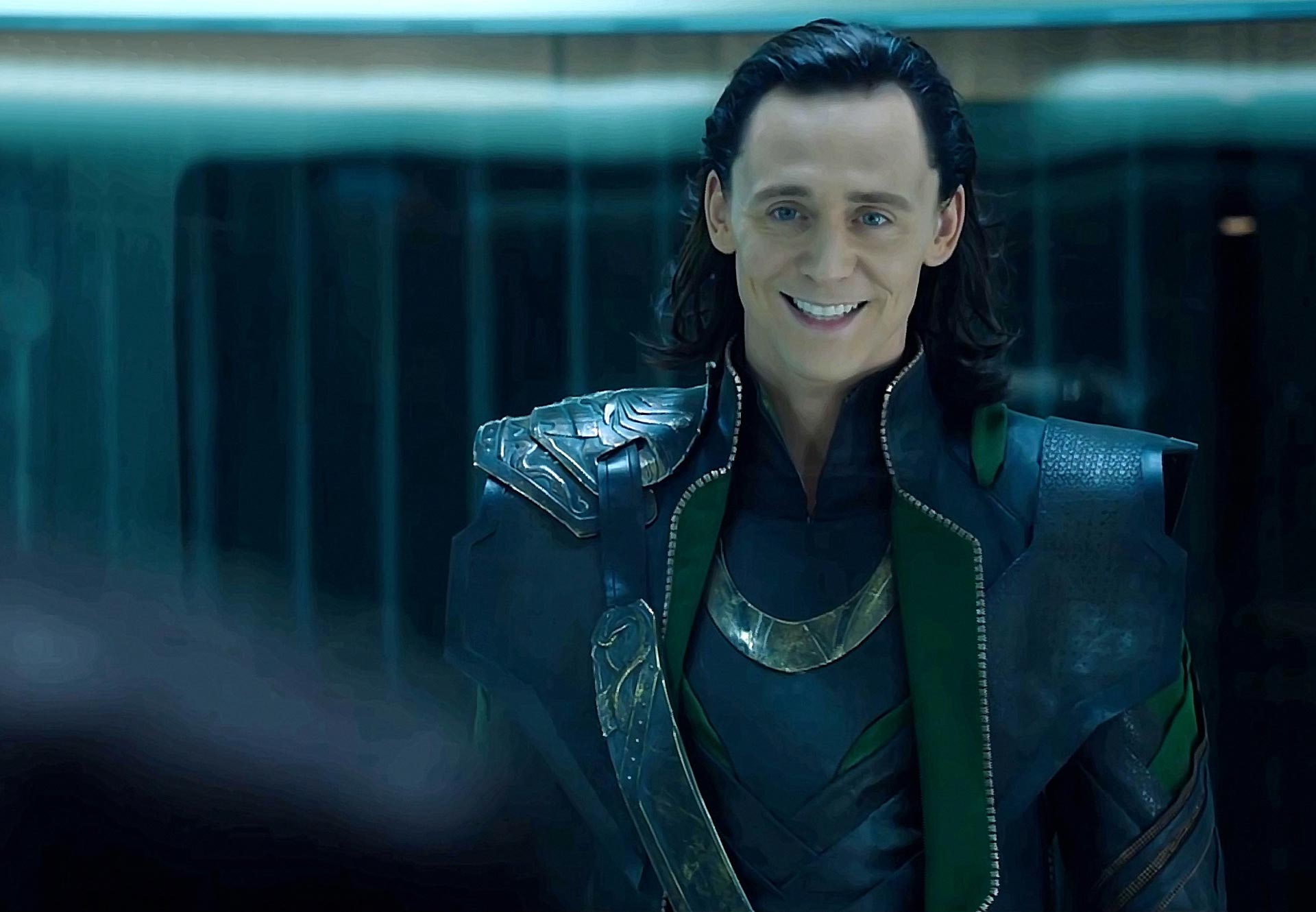
The villain, Loki (Tom Hiddleston), smirking as he tells Nick Fury that nothing can stop his plans from coming to fruition.

There is nothing remotely complex, original or realistic about the storyline for The Avenger’s Assemble. Nevertheless, it is greatly entertaining. It has plenty of action scenes and an amusing clash of egos (of Godly proportion) between Thor and Iron Man.

Without being a comedy, the film is littered with banter and jokes. This is because (thankfully), like in This Means War, none of the actors in The Avengers Assemble take their roles earnestly. Bruce Banner and Tony Stark would have looked utterly preposterous if they had tried to seriously discuss astrophysics before turning into a green beast or donning an iron costume.

The Hulk and Iron Man might be the most dominant characters in the film, but director Joss Whedon gives each member of the cast a chance to shine. He gives them all a back story as well. This does not mean that the protagonists in The Avengers Assemble are any less divorced from the society that they have promised to defend; and nor does it mean that they have the depth of the Bruce Wayne of Christopher Nolan’s Batman trilogy or some of the mutants in X-Men: First Class, such as Charles Xavier, Erik Lehnsherr and Raven. Yet, it ensures that Whedon’s comic-book heroes are not mere kick-busters in ludicrous outfits either.

The Avengers in action. Captain America, the all-American hero wearing the stars and stripes, leads the group as they attempt to defend the world from the metal monsters coming from outer-space.

Irrespective, though, of whether the narcissistic Tony Stark has come to like his assistant, Pepper Potts (Gwyneth Paltrow – Iron Man I-III, Contagion, Thanks For Sharing), as much as he likes himself, or if Bruce Banner explains the injustices that have led to him turning into a green monster when he gets angry, the special effects are consistently brilliant throughout The Avengers Assemble. Again, there is little new to behold (the highly destructive flying caterpillars have become standard among alien invasion movies since last year’s Transformers III), but the effects assist the action scenes remarkably well. Even the 3D works a treat!

Over-all, The Avengers Assemble is a thoroughly entertaining and humorous movie. It has an affable group of protagonists, who all seem to have great chemistry on set, plus fantastic fighting scenes and superb special effects. The film might not be original or complex, and it certainly has no deep moral message. Yet, The Avengers Assemble is everything that a light-hearted, comic-book, superhero movie should be. Bring on the sequel!

PG’s Tips

Review – Titanic 3D (12a) [2012; originally released in 1997]

Star Rating: 4/5

A century has passed since the White Star Line’s ‘unsinkable’ Titanic sank on her maiden voyage, taking down 1,503 souls with her to the watery abyss. It was a tragedy, but one that still fascinates people for so many reasons. The absorbing 1997 film, re-released in 3D for the centenary of the disaster, embodies why this is the case.

Titanic’s bow at the bottom of the Atlantic Ocean. Looks little more than a ghost ship now, with rusticles giving it an eerie feel.

Titanic centres round two central characters who board the ship as it takes off from Southampton for New York in April 1912. Rose (when old, played by Gloria Stuart; when young, played by Kate Winslet – Revolutionary Road, Contagion, Steve Jobs) is the daughter of a bankrupt aristocrat and is travelling in the luxuries of first-class. Against Rose’s will, her mother, Ruth (Frances Fisher – The Roommate, The Lincoln Lawyer, The Silent Thief), has set her up to marry Caledon ‘Cal’ Hockley (Billy Zane – Back to the Future I-II, The Roommate, The Employer), a wealthy businessman, to relieve the family of their crippling debts.

Jack (Leonardo DiCaprio – Revolutionary Road, Inception, The Wolf of Wall Street), on the other hand, is a dirt-poor artist journeying in third-class. After spending time in a variety of European cities, he is returning to America for a better life.

Whilst on the decks, Jack spots Rose on the higher levels and is instantly taken by her beauty. Yet, it is not until Rose is on the verge of jumping off the vessel’s stern that they meet. Jack urges her not to plunge to her death in the freezing waters and she follows his advice.

Subsequently, much to the envy of Cal, love blossoms between Jack and Rose… Until a cold, cloudless night when Titanic, running at full steam, strikes an iceberg.

For a film that is predominantly about a love story, Titanic is surprisingly gripping and abetted by a powerful music score, written by James Horner. Astonishingly, the film does not feel like it’s three hours and fifteen minutes long, since director/producer James Cameron (Alien, Avatar I-II, Sanctum) uses the time cleverly.

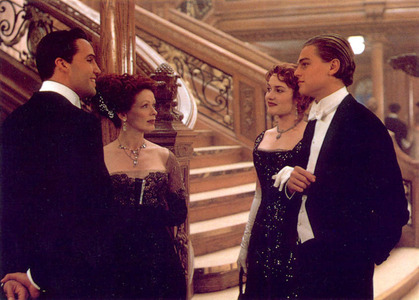
Cal (Billy Zane) and Ruth (Frances Fisher) reluctantly welcome Jack (Leonardo DiCaprio) to dinner in the glorious, first-class dining hall. Rose (Kate Winslet) accompanies him, drawing the ire of her fiancé and mother.

For the two hours or so before Titanic suffers its fatal wound, Cameron ensures viewers believe the false sense of security that passengers undoubtedly felt aboard the ‘unsinkable’ ship (even though audiences know the ship’s doomed fate), and gives the characters a (clichéd) 1912-societal role, depth and humour to maintain one’s interest.

Moreover, Cameron makes the vessel hit the iceberg with (approximately) an hour and a half to go. With Thomas Andrews (Victor Garber – Legally Blonde, Milk, Argo) stating that Titanic has less than two hours afloat, it feels like one watches the ship keel in real time, instead of in a quick, artificial manner. This not only means viewers can realise the anarchy that gripped the ship as she went under; it enables one to appreciate the heroics of individuals on the night, such as the officers who sent out distress signals until Titanic’s power failed, and the life-boat stewards, like William Murdoch (who has been incorrectly portrayed as a murderer by Cameron) and Harold Lowe (Ioan Gruffudd – Fantastic I-II, Sanctum, Mariah Mundi and the Midas Box), who lowered as many boats and got as many people into them as possible, amidst the chaos.

And because Cameron has so much time, he also properly shows us the cowardice of others, like Bruce Ismay (Jonathan Hyde – The Mummy, The Tailor of Panama, Spooks), who wanted headlines so badly he imperilled the ship he named (ironically immortalising Titanic), and Edward J. Smith (Bernard Hill – The Lord of the Rings II-III, Valkyrie, Paranorm), the reckless and dithering captain, who at least had the dignity to go down with the vessel.

On the whole, the actors play their parts well, particularly Kate Winslet (even though she recently came out saying that her acting could have been better and she has a point), Frances Fisher, Gloria Stuart, Billy Zane and Kathy Bates (Misery, Midnight In Paris, Starbright), as the ‘unsinkable’ Molly Brown.

However, the cast’s performances are often undermined by risible dialogue. The worst offender, by a distance, is Leonardo DiCaprio. (Not that Winslet does herself much credit by shrieking “Jack” frequently.) DiCaprio’s ability to spew out contrived lines in a desperate voice is almost an embarrassment to the victims of the disaster.

Dialogue may not be one of Cameron’s specialities (Avatar illustrated that), but as a director he cannot be questioned. The impeccable way Titanic has been filmed and flows are testimony to this. That the movie’s set is huge and that one hardly notices the numerous special effects give clout to this (apart from a couple of poor CGI shots of the bow’s nose).

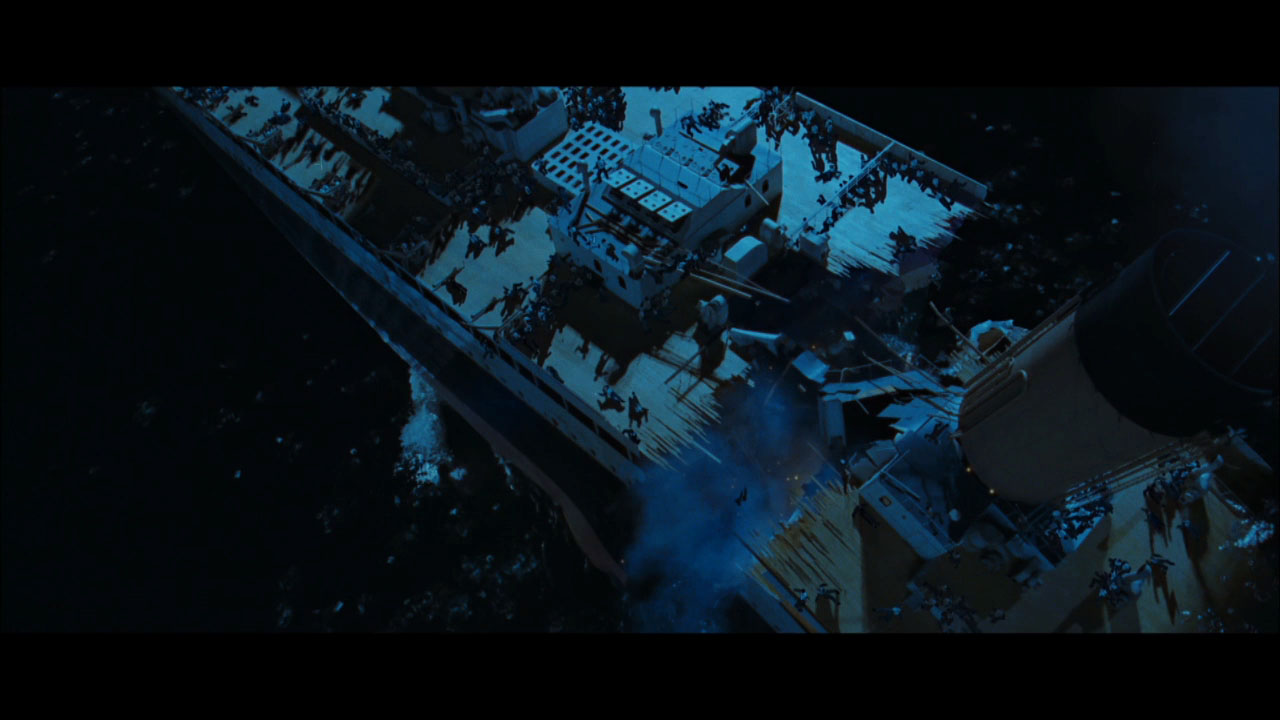
After sounding like a wounded animal as water flooded the bow and lower levels, the weight of the ship’s stern finally takes its toll on the vessel, breaking it in two.

Alas, the 3D does not effectively aid the film. It is not that effort hasn’t been put in. Rather, Titanic is not the type of film wherein the 3D can enhance scenes much, other than when people are falling from the stern as the giant propellers rise monstrously from the water.

All-in-all, Titanic is an enchanting film that gives us a window into a by-gone era. The film brilliantly details many of the complexities of early-twentieth century society, with moving music and special effects that are as magnificent as the ship that left Southampton. But the movie also does the tragedy justice, pointing out the valour of some and the pusillanimity of others. This is why the fate of the ‘unsinkable’ ship will forever have the power to captivate.

PG’s Tips

Review – Wrath of the Titans 3D (12a) [2012]

Star Rating: 2.5/5

The poverty of Clash of the Titans was so blatant, it was embarrassing. Yet, after making an astonishing near-$500million, Hollywood has (rather unsurprisingly) made a sequel. And with Jonathan Liebesman (Darkness Falls, Battle: Los Angeles, Ninja Turtles) replacing Louis Leterrier as director, Wrath of the Titans is a marked improvement on the first in the series.

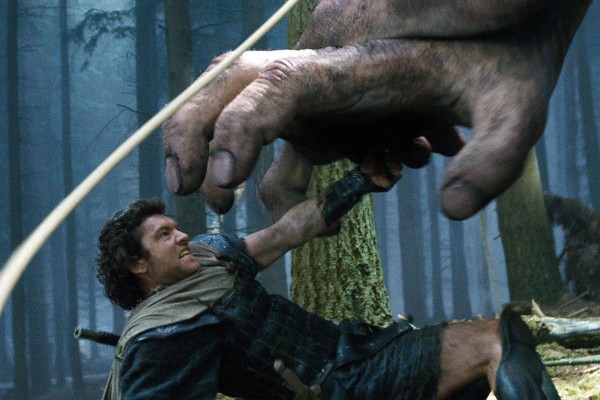
Perseus (Sam Worthington), the mortal son of Zeus, taking on a one-eyed giant. Perseus’s hand must be stronger than it looks to hold the giant’s strength at bay.

Wrath of the Titans takes place in ancient Greece, ten years after Perseus defeated the kraken. With his wife now dead, Perseus (Sam Worthington – Clash of the Titans, The Debt, Drift) has to bring up his son, Helius (John Bell – A Shine of Rainbows, Battleship, The Hobbit I-II), alone.

It is then that Zeus (Liam Neeson – Star Wars I, Clash of the Titans, The Dark Knight Rises), Perseus’s father, comes to Earth to warn his son that the gods need the help of the ‘half-gods’ to defeat the storm that is coming in the form of the vengeful titans. With treachery afoot in Tartarus, the underworld in which Hades (Ralph Fiennes – Clash of the Titans, Harry Potter VII(ii), Skyfall) is lord, it is only a matter of time before Cronus, the leader of the titans, unleashes his fury. Perseus will need the help of Hephaestus (Bill Nighy – Pirates of the Caribbean II-III, Harry Potter VII(i), I, Frankenstein), Queen Andromeda (Rosamund Pike – Die Another Day, An Education, Gone Girl) and her men, as well as the last of the gods and the ‘half-gods’ to defeat the evil that is to strike at ancient Greece.

Yes, the storyline is as ludicrous as that. When a film opens up with a narrator saying that the ancient world was ruled by “gods and monsters,” one has a fairly good idea that he/she is not going to be watching a classic, intellectually-stimulating film (to say the least).

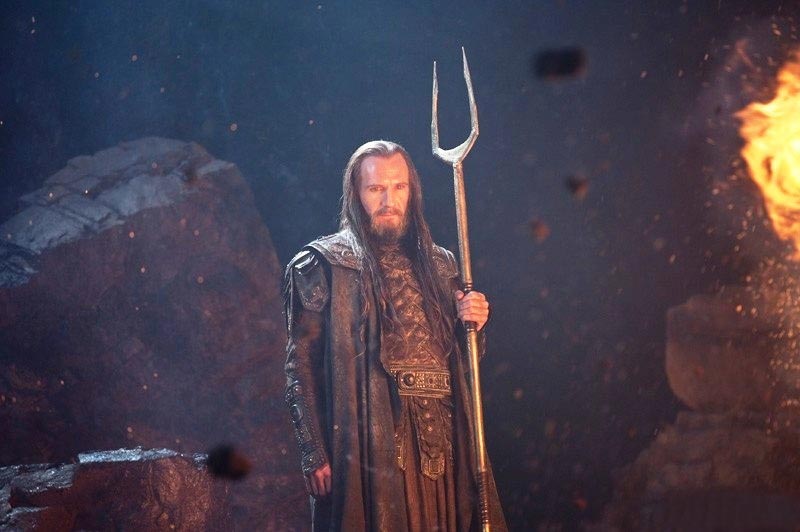
Hades (Ralph Fiennes), the younger brother of Zeus and Lord of the Underworld, holding his pitch fork. Will he side with the evil titans?

Nonetheless, Wrath of the Titans is far from a hundred minutes of painful viewing. To make up for the plot’s (abundant) deficiencies, the film has many fighting scenes and a plethora of pretty good special effects to keep viewers entertained. The clockwork-like structure of the city of Tartarus has been put together exceptionally well, with much creativity and imagination. If there is one redeeming feature of the movie, it is Tartarus. (And it would have looked even better had the producers bothered to put some effort into the 3D.)

In addition, Wrath of the Titans is surprisingly accurate when it comes to informing its audience on certain aspects of ancient Greek mythology, such as how Hades became Lord of the Underworld; and who made his forked-pitch, as well as Zeus’ bolt and Poseidon’s triton.

However, the parts of the movie that have been done well are likely to be forgotten amidst the paucity of the rest of it. The music sounds like a contrived version of the uplifting score used in Transformers I-III. And if the music and the storyline aren’t bad enough, the acting and the dialogue are wooden and shallow. Sam Worthington, Rosamund Pike, Edgar Ramires (The Bourne Ultimatum, Carlos the Jackal, Zero Dark Thirty), playing Ares, and Toby Kebbell (Match Point, Prince of Persia: Sands of Time, The East), playing Agenor, are all seemingly unfit for their respective roles (and it’s not as if Worthington hasn’t played a hero before either).

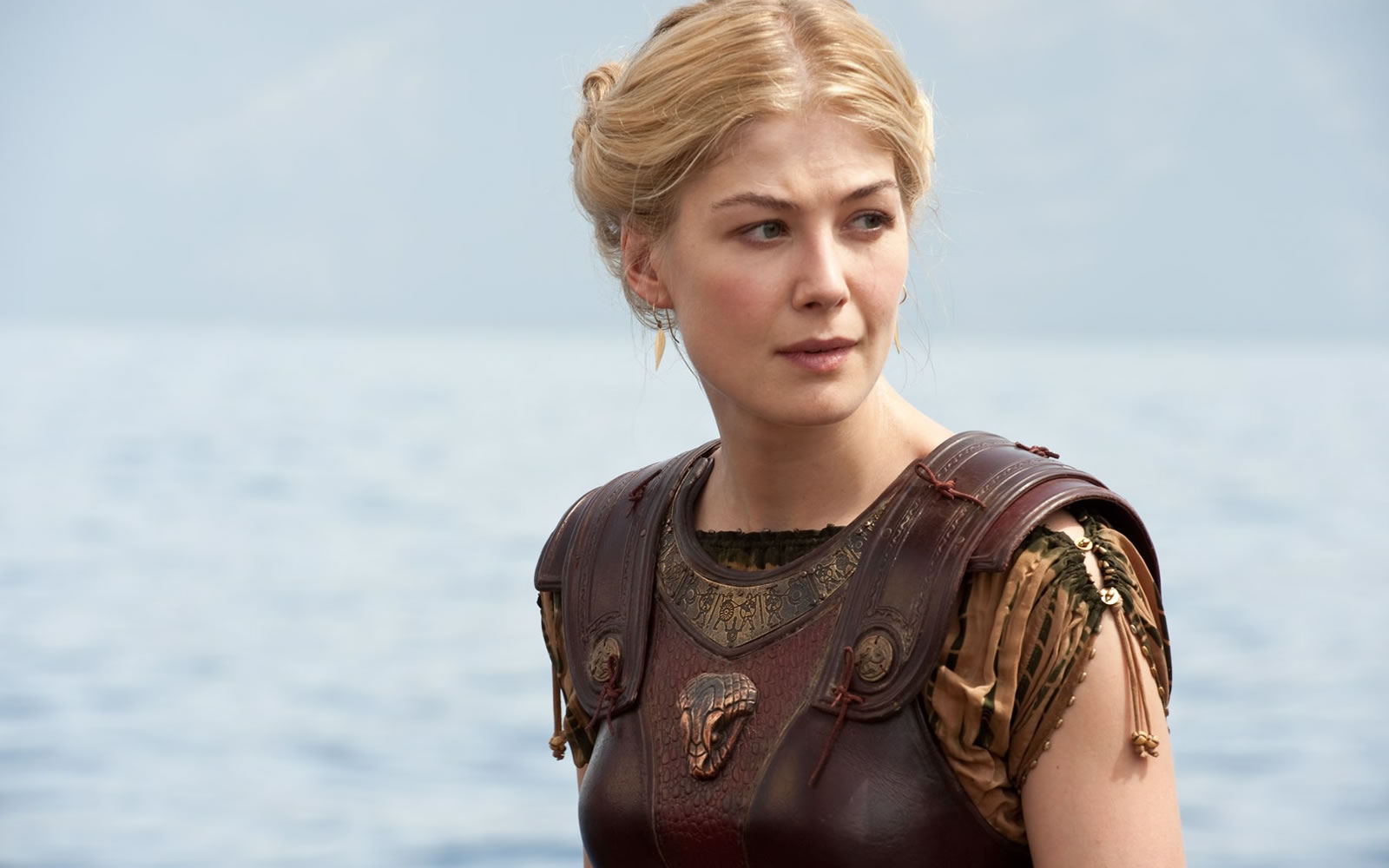
Andromeda (Rosamund Pike) looking good as a warrior queen in boiled leather. Will her army rally to her cause to save ancient Greece from the destruction that will be unleashed with the wrath of the titans?

Moreover, one must wonder why Liam Neeson, Ralph Fiennes and, to some extent, Bill Nighy, who reprises his bizarre Scottish accent that he used in Pirates of the Caribbean II-III, would accept such roles. One almost doesn’t want to see them in these sorts of films as they can only humiliate themselves by doing so. (Seriously, do they need the money that much?)

All-in-all, Wrath of the Titans suffers from similar insufficiencies as Clash of the Titans. The film has a ludicrous storyline, a cast that plays poorly, and an appalling script. Nonetheless, Wrath of the Titans is quite entertaining and an upgrade on the first in the series. Not that that is saying much.

PG’s Tips
Review – The Hunger Games (12a) [2012]

Star Rating: 3/5

Over the last decade, there have been a multitude of reality TV shows/series targeted for children and teenagers. Big Brother, The X Factor and The Apprentice are three such programmes that have gripped the nation, despite becoming sterile in recent years. Based on a similar, yet darker premise, The Hunger Games entertains its audience prior to running for too long.

Katniss (Jeniffer Lawrence) hunting in the woods to find food for her family, wherein she meets her childhood friend, Gale (Liam Hemsworth).

The Hunger Games is based on the book with the same title by Suzanne Collins. It’s based in a dystopian, post-apocalyptic country called Panem, which was once territory in North America. As punishment for a people’s rebellion, each one of the twelve now-impoverished districts has to put forward their boys and girls, between the ages of twelve to eighteen, to compete in a tournament called the Hunger Games. At random, one boy and one girl are chosen to compete in the games, which are watched by thousands throughout the country. The tournament, controlled by a repressive leadership, is a fight to see who will survive. Only one, out of the twenty-four chosen, will return home.

After her younger sister, Primrose (Willow Shields), is picked to compete in the tournament, 16-year-old Katniss (Jennifer Lawrence – Winter’s Bone, X-Men: First Class, X-Men: Days of Future Past) volunteers to take her sister’s place. Katniss has spent years illegally hunting with her friend, Gale (Liam Hemsworth – Knowing, The Last Song, Independence Day II: Resurgence), for food in the woods outside of District 12. Now, taken to the affluent capital for pre-tournament training, along with Peeta (Josh Hutcherson – The Polar Express, The Kids Are Alright, Red Dawn), Katniss must use her skills and learn other arts from her mentors, Haymitch (Woody Harrelson – No Country For Old Men, Friends With Benefits, Seven Psychopaths) and Cinna (Lenny KravitzThe Rugrats Movie, Precious, The Blind Bastard Club), to survive the games.

The plot for the film is quite accurate to the book, despite missing the Avox sub-plot and changing the skin-colour of some of the characters, such as Katniss and Rue (Amandla Stenberg – Texas Killing Fields, Colombiana).

Katniss’s main opponent in the games, Cato (Alexander Ludwig). He is vicious and ruthless.

Nonetheless, The Hunger Games is an interesting movie, not least due to its brutal, Orwellian premise. (Note how down-trodden and miserable the common people are in comparison to the powerful elites.) Moreover, the film offers a refreshing change to the fantasy/science-fiction genre by having an outwardly tough, mentally-strong woman in a combatant role as the lead character (unlike the feeble Bella from the Twilight series).

However, at 142 minutes, The Hunger Games is far too long. A movie needs to be something special to hold its audience for that length of time, and The Hunger Games loses its viewers almost as soon as Katniss enters the tournament. One feels little suspense during the games, and one also feels that Katniss is never in real danger (unlike in Game of Thrones, where one never knows how long any of the characters will live).

Furthermore, the film lacks the violence it deserves. In 2000, a Japanese film with a comparable theme, called Battle Royale, was released. (Suzanne Collins denies being influenced by the movie.) That film acquired an 18-rating, due to the vicious content. But, just as The X-Factor has to adhere to rules so minors can watch it (even if Christina Aguilera and Rihanna stuck two fingers up to those in 2010), director Gary Ross (Pleasantville, Seabiscuit, The Free State of Jones) had to make the violent aspects of The Hunger Games implicit to the movie’s detriment. It makes the film less realistic; and, by merely shaking the camera, Ross makes the fight scenes hard to follow.

Fighting for one’s life in a forest is what the games are about. Yet, Katniss appears remarkably relaxed throughout. One only has to watch Vietnam War films, such as Apocalypse Now and Platoon, to realise soldiers’ edginess whilst in the jungle. Katniss, though, not only sleeps well, she’s even willing to help out others (seemingly unbothered that they could kill her when she’s not looking or asleep). It is astonishing that for someone so mentally hard, she’s unwilling to do what’s necessary to survive.

Despite Katniss’s inherent contradictions, Jennifer Lawrence gives a credible performance as the lead character (who always looks lovely and clean after rolling around in the dirt). Likewise, Donald Sutherland (The Italian Job, The Eagle, Sofia), as the pitiless President Snow; and Woody Harrelson, as the alcoholic mentor, also perform decently. But the rest of the cast, including Josh Hutcherson, as the wimpy Peeta; Stanley Tucci (The Devil Wears Prada, Captain America: The First Avenger, The Company You Keep), as Caesar Flickerman, the daft-smiling hand of the president; and Alexander Ludwig (The Seeker: The Dark Is Rising), as Cato, Katniss’s nasty and fierce opponent in the games, give pathetic, one-dimensional displays.

Katniss, looking much like Tulisa Contostavlos, in tightly-fitted leather, training before the games with Peeta (Josh Hutcherson). She and him are receiving advice from Cinna (Lenny Kravitz) on how to beat Cato and his gang.

It is a shame that most of the actors give poor performances. The movie has been put together nicely, James Howard (Love And Other Drugs, The Tourist, Snow White And The Huntsman) has composed a respectable score, and the special effects are brilliant. Panem’s capital has been wonderfully constructed and is a sight to behold.

All-in-all, The Hunger Games has a strong, but flawed, main character, with an intriguing, 1984-like basis to a reality TV show. But, ultimately, the movie has been hamstrung to cater to children and teenagers. Consequently, it is predictable and, like most reality TV shows/series, the film peters out before it ends.

PG’s Tips

Review – In Darkness (15) [2012]

Star Rating: 4.5/5

In Jerusalem’s Holocaust Memorial Museum, Yad VaShem, there is a section honouring the Righteous Gentiles/the Righteous Among The Nations. During World War II (WWII), it is known that almost twenty-four thousand non-Jewish people risked their lives in Nazi-occupied Europe to hide and save Jews from Hitler’s murderous Final Solution. Leopold/Poldek Socha was one such courageous individual. In a powerful but unflattering portrayal of Poldek, the Jews he saved, and the era, In Darkness commemorates the bravery of this unconventional hero.

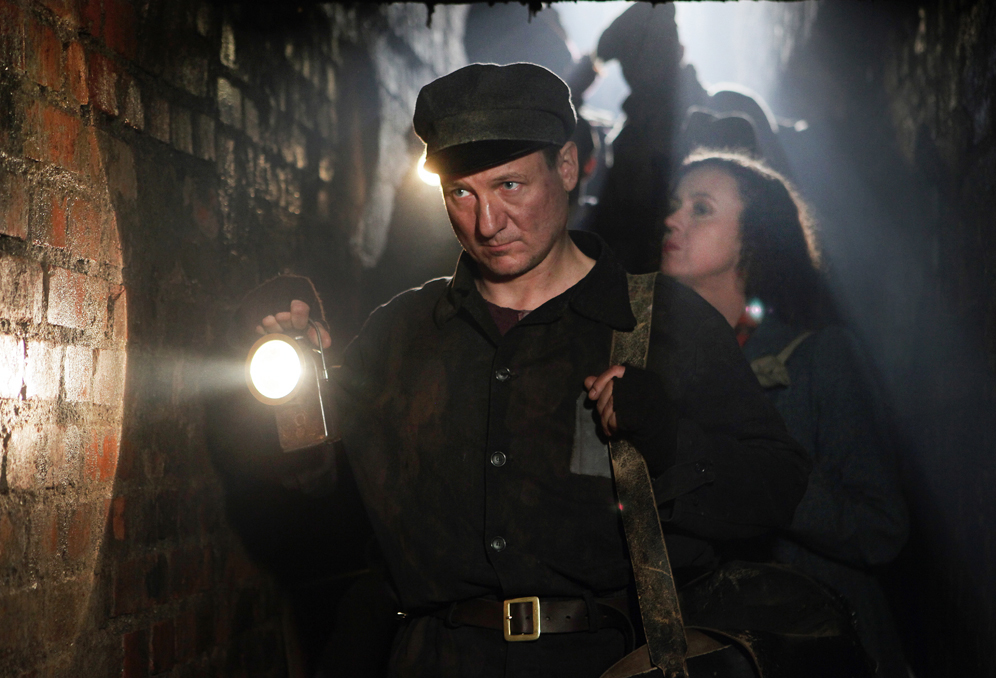
Poldek Socha (Robert Wieckiewicz) leads thirteen Jews through the caverns of the stinking sewers to find them a safe haven from their Nazi persecutors.

In Darkness is a low-budget Polish film that centres round Poldek Socha (Robert Wieckiewicz – The Dark House, Zero, Lech Walesa), a Polish sewer worker in Lvov. Using his extensive knowledge of the town’s sewer system, he hides thirteen Jews in the sewers just before the Lvov Ghetto is liquidated by the Nazis. For fourteen months, Poldek cares for his Jews. He brings them food and other essentials, until the Soviets liberate Lvov in July 1943, when he leads them to safety.

The storyline for In Darkness is straightforward and well put together. At 145 minutes, the film might seem a little long and repetitive, but the distressing nature of the movie ensures that it is not tedious at all.

The intensity of the Jew-hatred, the noise of rapid firing machine-guns and the sight of brutality against innocent people creates an intimidating atmosphere. Like tension in a string, one can feel the Jews’ fear of the Nazis and the local Polish population. The darkness of the sewers and the shaking of the camera enhance the film’s edginess by making the movie seem claustrophobic. At times, notably when Poldek moves the Jews from one excrement-running tunnel to another, the movie becomes almost unbearable to watch.

Poldek's friend, Bortnik (Michal Zurawski). Bortnik is the feared leader of the Ukrainian Nazis in Lvov.

Yet, the ending is probably the most awful and poignant part of the film. As the euphoria of saving the thirteen Jews is at its height, one learns how Poldek died and what was said at his funeral. It should leave anyone with decency sickened! Alas, it’s as unsurprising as it is shocking; a reflection of the profound levels of antisemitism in pre- and post-WWII Poland.

But was Poldek not part of the same society? In Darkness sheds light on his personality and shows him to be a very different kind of hero to Oscar Schindler (played superbly by Liam Neeson in the brilliant 1993 film, Schindler’s List). Whilst Schindler was the dashing businessman who became horrified by the Nazis’ treatment of the Jews, Poldek was not handsome and was quite indifferent to the cruelty dished out by the Nazis. Indeed, director Agnieszka Holland (The Secret Garden, The Wire) reveals on numerous occasions during the film that Poldek was just an ordinary man doing his mundane job and held deep-rooted antisemitic views.

It is not even clear why Poldek ends up hiding and saving the thirteen Jews. Is it because they pay him nicely, so he can afford jewellery for his wife, Wanda (Kinga Preis – The Dark House)? Is it because Poldek knows the unspeakable fate that awaits him and his family if he informs the authorities of the Jews? Or is it out of a sense of moral righteousness? Perhaps not even Poldek, himself, knew. Robert Wieckiewicz vividly captures Poldek’s constant vacillations, as well as his fear of being found out by the local Poles and the Nazis, both of which are always eager to turn in more Jews and their collaborators.

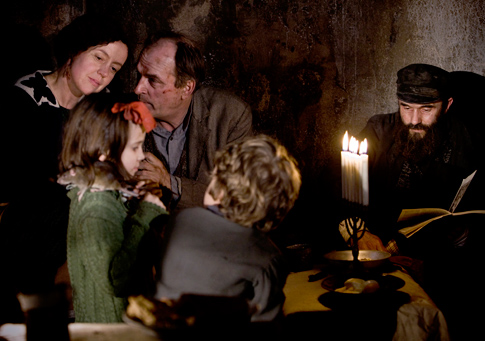
They may be holed up in the dank sewers, but the Jews still manage to celebrate the festival of Hannukkah right under the noses of the Nazis.

Although the cast play very well, Poldek, the people of Lvov and the Nazis are all given critical depictions throughout the movie. But what is more interesting is that Holland has not left the terrified Jews off the hook either. She shows them to be people who are grateful and ungrateful to Poldek; treacherous and edgy among themselves; plus lustful, amongst other things. Hence, In Darkness portrays the thirteen Jews as real people, feeling the pressures of their situation. Again, this is a stark contrast to the Jews in Schindler’s List and other Holocaust movies, like The Pianist or The Boy With The Striped Pyjamas, which depicts them as models of immaculate behaviour.

Over-all, In Darkness is an exceptional but harrowing film. It not only enables us to understand the period, it forces us to experience the torment that the thirteen Jews in the sewers endured for fourteen months. Above-all, In Darkness points out why Poldek Socha should be immortalised among the Righteous Gentiles in Yad VaShem. Despite his antisemitic sentiments and morally dubious reasons for initially hiding the Jews, he showed himself to be a hero. Not a fashionable hero like Oscar Schindler, but one who was willing to stand up to evil and put his, and his family’s, life on the line to save innocent people. Amen!

PG’s Tips

Review – 21 Jump Street (15) [2012]

Star Rating: 2/5

Last year’s The Inbetweeners Movie was a genuinely funny comedy. Whilst lacking in subtlety, it had a fine mix of intelligent and dim-witted humour, as well as realistic characters and a (semi-)plausible storyline. But in recent years many ‘comedies,’ like Due Date and The Hangover: Part II, have lacked much of what made The Inbetweeners Movie so enjoyable. 21 Jump Street, despite a few instances of amusement, very much goes into the latter category of ‘comedies.’

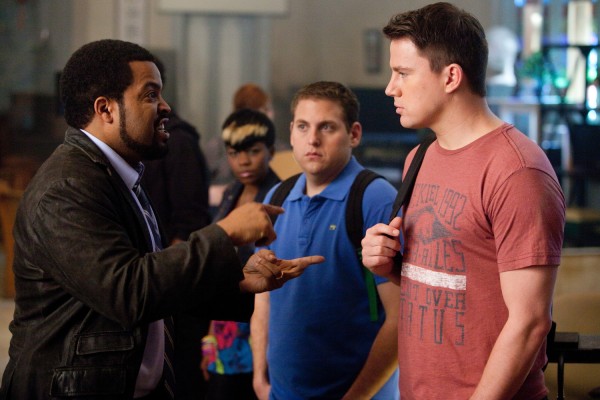
Jenko (Channing Tatum) bullying Schmidt (Jonah Hill) in their high school days. They did not get on at all whilst they were in the same class.

21 Jump Street is loosely based on the 1987-91 TV series with the same title, which starred a young and then-little known Johnny Depp. 21 Jump Street is about two very dissimilar 1980s former high school classmates. Jenko (Channing Tatum – The Eagle, The Vow, Side Effects) was the well-liked, yet brainless jock, whilst Schmidt (Jonah Hill – Superbad, Moneyball, The Wolf of Wall Street) was the smart, but unpopular nerd.

Despite their differences, Jenko and Schmidt quickly become friends after enrolling in the police academy. Once they finish their course, they become partners on patrol.

However, Jenko and Schmidt are hopeless at their jobs. Subsequently, they are sent to an undercover unit, located on 21 Jump Street. It is there that they’re ordered by their new superior, Captain Dickson (Ice Cube – Ghosts of Mars, XXX2, Rampart), to discover who is behind a drug network that is allegedly based in their former high school. So Jenko and Schmidt go back to their old stomping plain (to find, to their shock, that what was popular in the late-1980s is not anymore), posing as students, to bust the drug dealership before it spreads to other schools.

The plot for 21 Jump Street is simple as well as amusing on a couple of occasions. In addition, the friendship between Jenko and Schmidt keeps viewers interested, due to the chemistry that the two actors share; and the shoot-out scenes are a good laugh and surprisingly gory as well.

Schmidt and Jenko, now friends and cops, apparently dressed as teenagers before going undercover into their old high school. Captain Dickson (Ice Cube) ordering them not to get with any school-girls or teachers.

Yet, there are fewer action scenes than one would have predicted; and, alas, the overwhelming majority of the humour revolves round repetitive, mindless jokes between the two main characters; swearing; and vulgarity. Of course all of this can be tolerable and hilarious in moderation. But the directors, Phil Lord and Chris Miller (Cloudy With A Chance Of Meatballs), have taken it all (shamefully) to the point when even the crude Steven Stifler (played by Sean William Scott in the American Pie series) might call a halt.

Combined with such coarseness in 21 Jump Street are the performances of Channing Tatum and Jonah Hill as Jenko and Schmidt,  respectively. The pathetic and overly immature nature of their attempts to behave in a ‘high school manner’ is embarrassingly terrible. Compared to them, Jay Cartwright (played by James Buckley in The Inbetweeners TV series and movie) is a relative grown up! Both Tatum and Hill can do better than this, as the former demonstrated in Coach Carter, and the latter in Superbad and Moneyball.

The poverty of the acting in 21 Jump Street is not Tatum’s and Hill’s alone. Ice Cube; Dave Franco (Superbad, Fright Night, Warm Bodies), playing as Eric, the ‘cool-guy’ of the school; and Brie Larson (Scott Pilgrim vs. The World, Rampart, Relanxious), playing as Schmidt’s love interest, are all insipid and far from funny. The only noteworthy performer is Johnny Depp (Pirates of the Caribbean I-IV, The Tourist, Transcendence), who makes a surprise cameo appearance as his old character, DEA Tom Hanson. That was a clever move by the directors to bring him in. With the film dragging on for a hundred and ten minutes, Depp gives the movie some much needed unpredictability and impetus.

Likewise, it was intelligent of Lord and Miller to alter the dynamics of Jenko’s and Schmidt’s former high school. This entailed that the two main characters had to adapt to virtually new surroundings, which could have given Jenko and Schmidt another dimension to their, otherwise, shallow personalities.

Schmidt sitting with Molly (Brie Larson), the object of his fascination, as he tries to find a breakthrough and unearth who the drug suppliers are.

Yet, the directors badly under-developed these because they give little feel for how the school has changed. Worse, viewers are likely to ascertain almost no appreciation for this particular school or the American high school environment in general; especially, if one compares 21 Jump Street to the excellent Saved By The Bell series, or even the ‘chick flicks’ Mean Girls and John Tucker Must Die. All of those illustrated the different (albeit stereotypical) cliques, and the types of personalities within those cliques, that tend to exist in American high schools. But 21 Jump Street has almost none of it to the detriment of the movie.

Over-all, 21 Jump Street is a light-hearted film with two likeable main actors, who play daftly below their capabilities. The movie has a handful of laughable moments, but they’re overshadowed by the incessant obscene crudity that ruined ‘comedies’ like Due Date and The Hangover: Part II. Neither of those films made audiences cry with laughter as much, or as often as The Inbetweeners Movie. The same can be said for 21 Jump Street.

PG’s Tips
Review – This Means War (12a) [2012]

Star Rating: 3/5

Films like Fantastic Four I & II, Salt and Immortals take themselves preposterously seriously. Whilst watching such movies, one is entitled to think that the films would have been better if the actors had not taken their roles with such (laughable) sincerity. Thankfully, This Means War does not take itself remotely seriously. As a corollary, and for other reasons, the film is highly enjoyable and amusing.

Tuck (Tom Hardy) doing his bit to make sure that Lauren (Reese Witherspoon) chooses him as her man.

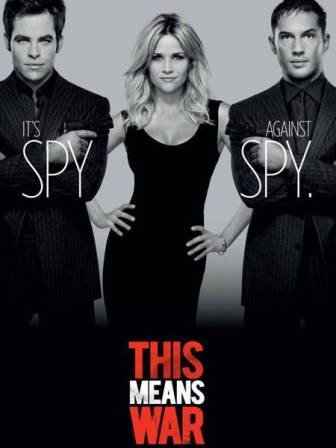
This Means War is about two CIA agents, FDR Foster (Chris Pine – Star Trek I & II, Unstoppable, Rise of the Guardians) and Tuck (Tom Hardy – Tinker Tailor Soldier Spy, Warrior, The Dark Knight Rises). They are the best of friends, work opposite one another, and have fought alongside each other in dangerous operations for America’s secret services.

But then they discover that they’re both dating the same girl, Lauren (Reese Witherspoon – Cruel Intentions, Walk The Line, Mud), who cannot make up her mind on who she likes more. Neither FDR nor Tuck are willing to pass and let the other have Lauren, so they decide to compete against one another to see who will woo her, using all kinds of equipment and tricks to achieve their objective.

Meanwhile, a Russian agent, called Heinrich (Til Schweiger – Inglorious Basterds, New Year’s Eve, The Courier), is on his way to America. Heinrich wants revenge against FDR and Tuck for killing his brother in a mission in Hong Kong.

FDR (Chris Pine) on a date with Lauren to win over her heart and triumph over Tuck, his friend and colleague.

The plot for This Means War is entertaining and easy to follow. There might be fewer action scenes than one might think, and certainly in contrast to the Die Hard series, Black Hawk Down, and Iron Man I & II. But This Means War compensates for this with the hysterically absurd lengths that FDR and Tuck go to so as to win over Lauren’s heart.

Just like with The Expendables, Knight And Day and Mission: Impossible IV, none of the cast take themselves seriously in the slightest. The main difference between those films and This Means War is that the latter movie has much better dialogue; almost every other line is a joke, and the banter between the actors is extremely humorous.

In a similar vein, the acting is ideal for this type of film. It is most unlikely that any member of the cast will get prestigious award nominations come January-February 2013, but all of the actors revel in their disingenuous roles, from the cocky, smooth-talking and good-looking Chris Pine; to the confident, yet level-headed (English CIA agent) Tom Hardy; to the indecisive and cute (noticeably revamped) Reese Witherspoon; to Lauren’s know-it-all, contradictory-advice giving sister, Trish (Chelsea Handler – Cattle Call, Hop, Fun Size).

Trish (Chelsea Handler) advising Lauren, as ever, to make up her mind and choose one of the two men she is simultaneously dating.

Despite the heavy focus on the dialogue and the acting, director McG (Charlie’s Angels, Terminator Salvation, Guilty) adopts conspicuously little by way of special effects. This is not necessarily a bad thing. Many action films, like Wanted, Captain America and Season of the Witch could have done with less CGIs and better dialogue and acting. The only problem for McG is that the few instances of special effects in his movie are done quite poorly; especially, when compared to the quality of those in Mission: Impossible IV.

Over-all, This Means War is a light, amusing and entertaining film. It has a cast that acts well for this type of film; that has great chemistry on screen; and that are easy on the eye. Perhaps directors in the future will learn a lesson from This Means War and inform their casts not to take their roles overly seriously when it is not necessary. Otherwise, audiences are destined to watch more movies where the actors appear unconvincing and hollow, like in Fantastic Four I & II, Salt and Immortals.

PG’s Tips

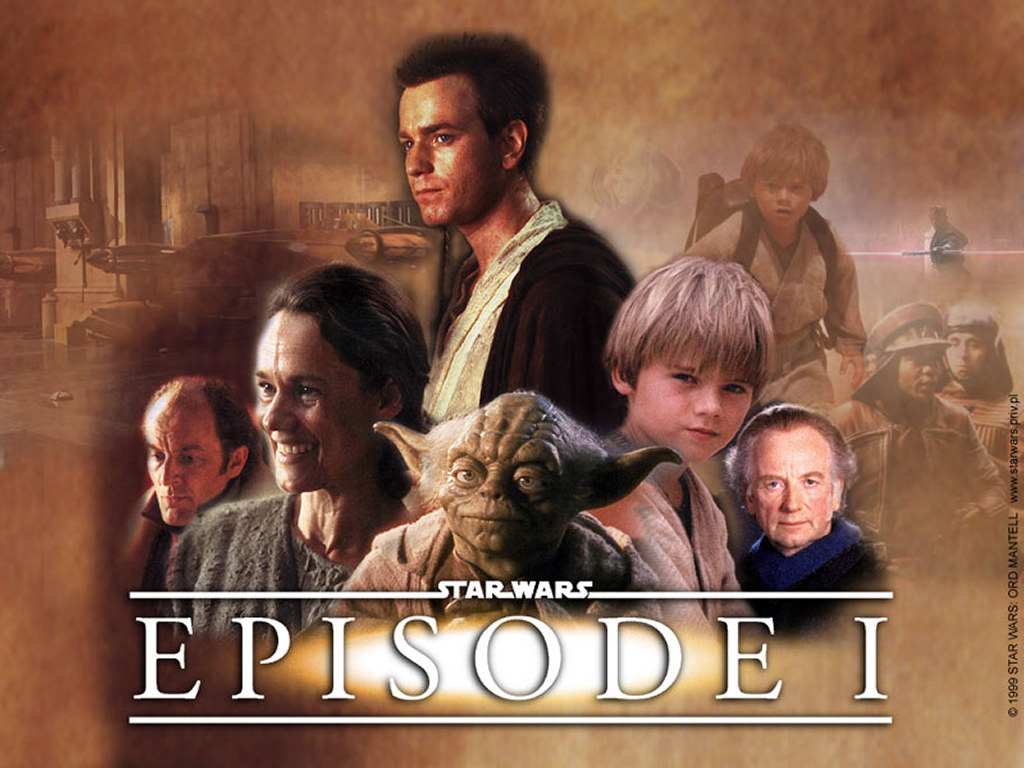
Review – Star Wars: Episode I: The Phantom Menace 3D (U) [2012; originally released in 1999]

Star Rating: 2.5/5

Star Wars, the saga that revolutionised special effects, has returned to the cinema. Thirteen years after it left the big screens, and now poorly adapted into 3D, Episode I: The Phantom Menace provides viewers with a convenient excuse to review the franchise from the beginning, and once more enjoy enlarged lightsaber v sith duels and mesmerising sci-fi-style battle scenes. (Warning, spoilers in this review.)

Young Anakin (Jake Lloyd). It is hard to see him as the masked villain of the saga at this point.

The Phantom Menace begins with turmoil engulfing the Galactic Republic. The Trade Federation has put up a blockade around the planet Nabu, due to a new taxation in trade routes. The Trade Federation wants to bring Nabu’s queen, Amidala (Natalie Portman – Black Swan, Thor, Lawless), to her knees and make her yield to their demands, using any means at their disposal.

Unknown to the Trade Federation, the Jedi Council have sent two Jedi knights, Qui-Gon Jin (Liam Neeson – The Next Three Days, Unknown, Wrath of the Titans) and his apprentice, Obi-Won Kenobi (Ewan McGregor – Star Wars I-III, Beginners, The Impossible), to rescue Amidala. That way she can bring her case to the Senate. Yet, as they fly past the blockade, their starship is damaged and they are forced to land on Tatooine to repair the ship.

On Tatooine, a planet outside of the republic’s orbit, Qui-Gon and Amidala come across a cute, little slave boy, called Anakin Skywalker (Jake Lloyd – Jingle All The Way, The Pretender, Madison). Qui-Gon sees something in Anakin, believing him to be the one who will bring balance to the Force.

After buying Anakin’s freedom, via the young boy’s pod race success, Qui-Gon takes him to the Jedi Council, where he hopes the council will allow him to train Anakin as his second apprentice. But the council is wary of Anakin. Yoda (Frank Oz – Star Wars I-VI, Sesame Street, Monsters University) and Mace Windu (Samuel L. Jackson – Star Wars I-III, Coach Carter, The Avengers Assemble) sense ‘great fear’ in him. They’re not wrong because Anakin fears for his mother’s survival. But, still, fear can only lead one way: the dark side.

Simultaneously, the unknown (phantom-like) Sith Lord and future emperor, Darth Sidious (Ian McDiarmid – Star Wars I-III & VI, Crime & Punishment, Margaret), urges his stooges in the Trade Federation to find Qui-Gon and Obi-Won. When they fail, Darth Sidious orders his apprentice, Darth Maul (Ray Park – X-Men, Heroes, Avarice), to find and kill the Jedi knights.

Queen Amidala/Padmé (Natalie Portman) leading from the front in the fight for the freedom of her planet.

The plot for The Phantom Menace is enjoyable and surprisingly intelligent. The film has a thrilling pod race tournament and the second best lightsaber v sith battle of the franchise (second after the epic duel between Obi-Won and Anakin/Darth Vader in Episode III: Revenge of the Sith); yet, the disputes over the trade blockade also make for a fascinating insight into the political workings of the republic.

More than anything, the disagreements in the republic reveal the cunning of Senator Palpatine (also Ian McDiarmid), as he slowly lays down the foundations for his arrogation of power. Behind the scenes, Palpatine commands the Trade Foundation (which will become the Separatist movement later in the series) to declare war on Nabu. To Queen Amidala, though, his advice is to go to the Senate and urge Chancellor Valorum (Terence Stamp – Wanted, The Adjustment Bureau, Big Eyes) to take action against the Trade Foundation. But knowing that the chancellor is incapable of doing that, due to being hamstrung by ‘bureaucrats’ (most likely Palpatine’s cronies), Palpatine recommends Amidala to call for a vote of no confidence in Valorum in the Senate to pave the way for a ‘stronger’ chancellor. (And guess who Palpatine might mean by that? Isn’t it a coincidence that he just happens to be voted in next?)

At the same time, Palpatine promises young Anakin that he will ‘watch over’ his Jedi training and be a father-like figure to him. The kindness of the gesture is unsettling to watch, knowing that Palpatine intends to exploit Anakin’s vulnerabilities to groom him as his long-term apprentice.

Ian McDiarmid plays well as the duplicitous Palpatine, despite the character’s crudeness. Yet, the star of the film is undoubtedly Liam Neeson. Even the most ridiculous of lines seem (almost) plausible when he speaks, and nothing looks (overly) contrived either. The same cannot be said for Natalie Portman or Ewan McGregor, who both give very poor and detached displays; whilst Jake Lloyd’s performance is passable at best. His enthusiasm and confidence (obnoxiousness) is refreshing at first, but becomes repetitive and annoying after a while.

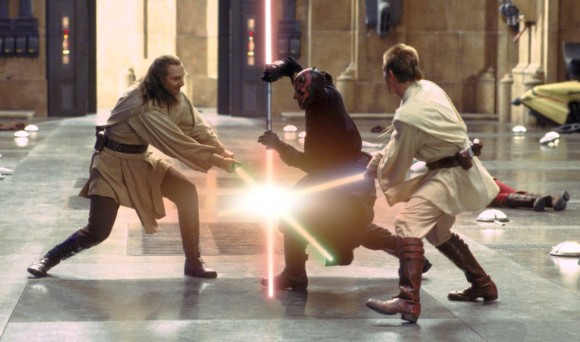
The fantastic three-way fight scene between Qui-Gon, Obi-Won and Darth Maul. Who will not survive?

The acting and dialogue may not be noteworthy, but the special effects are enthralling (even if they’ve been touched up considerably since 1999). It is just a shame that the 3D is hardly visible. The three-way duel at the end would have been even more of a spectacle had it been properly adapted; especially, with the atmospheric theme ‘Duel of the Fates’ for accompaniment.

Although the 3D is inadequate, The Phantom Menace is an entertaining movie. Once more, audiences can enjoy the impressive battle scenes and pod races; be dazzled by the special effects and lightsabers; and be intrigued by the way Palpatine abuses his powers for his ultimate goals. But most importantly of all, The Phantom Menace starts to explain how and why Anakin becomes Darth Vedar.

PG’s Tips