Tag Archives: film

Review – Spectre (12a) [2015]

Spectre - title banner

Star Rating: 3/5

Director:

  • Sam Mendes – American Beauty, Revolutionary Road, Skyfall

Cast:

  • Daniel Craig – The Trench, Casino Royale, Quantum of Solace, Defiance, Skyfall
  • Ben Whishaw – The International, Cloud Atlas, Skyfall, Suffragette, The Danish Girl
  • Naomi Harris – Trauma, Pirates of the Caribbean II-III, The First Grader, Skyfall, Our Kind of Traitor
  • Ralph Fiennes – Harry Potter IV-VII(i) & VII(ii), Coriolanus, Wrath of the Titans, Skyfall, Hail, Caesar!
  • Léa Seydoux – Inglorious Basterds, Robin Hood, Mission: Impossible IV, Blue Is The Warmest Colour, Gambit
  • Monica Bellucci – The Matrix II-III, The Passion of the Christ, The Sorceror’s Apprentice, On The Milky Road
  • Christoph Waltz – Inglorious Basterds, Carnage, Django Unchained, Big Eyes, Tarzan
  • Dave Bautista – WWE Smackdown, WWF Raw, Guardians of the Galaxy, Warrior’s Gate
  • Andrew Scott – The Scapegoat, Pride, Alice In Wonderland II, Denial
  • Rory Kinnear – Quantum of Solace, Broken, Skyfall, Penny Dreadful, Trespass Against Us
  • Jesper Christensen – Casino Royale, Quantum of Solace, The Debt, The King’s Choice
  • Judi Dench – Bond 17-23, Shakespeare In Love, Notes On A Scandal, My Week With Marilyn, Philomena, Tulip Fever

Music Composer:

What is the role of secret agents, and in particular, James Bond in the current era? Sir Ian Fleming, the author of the Bond novels, wrote Casino Royale in 1952. That was at the height of the Cold War between the USA and the USSR, when espionage involving personnel was at its zenith. But in 2015, the USSR no longer exists and espionage involving personnel has been downgraded due to technology. So, again, what is the role secret agents/James Bond nowadays? Spectre, Bond’s 24th outing, deals with this question in typical Bond fashion.
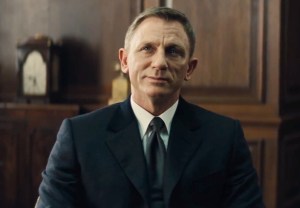
James Bond (Daniel Craig), looking worn and tired after an eventful trip to Mexico, gets a dressing down from M (Ralph Fiennes) upon his return to London.

James Bond (Daniel Craig), looking worn and tired after an eventful trip to Mexico, gets a dressing down from M (Ralph Fiennes) upon his return to London.

  Spectre opens up in Mexico City, wherein James Bond (Daniel Craig) acquires a ring bearing an octopus insignia. Upon returning to London, M (Ralph) demands that Bond explain what he was doing in Mexico. Bond refuses to explain, which leads to M indefinitely taking him off duty as a secret agent. Upon returning home, Bond re-watches a recording from his former superior, reminding him about a mysterious organisation called ‘Spectre.’ Despite having been removed from duty, Bond leaves London to unearth more about this shadowy organisation.

Meanwhile, in London, M:I-6 has a new intelligence officer, C (Andrew Scott). C has his own plans to take M:I-6 forward; one of which is to dismantle the ‘00’ programme, putting him on a collision course with M.

Spectre, in many ways, is an archetypal Bond movie. Does it have a spectacular opening sequence? Yes. Is there a trademark song afterward it? Yes. Does Spectre have some witty (touché) dialogue? Yes. Does the film have a glamorous-looking cast along with breath-taking locations? Yes. Does the movie have some brilliant stunts, action sequences, and cool explosions? Yes. Does it have a weak storyline in which viewers have to suspend their disbelief to go through with it, without laughing at it? Absolutely! Therefore, Spectre delivers on its (formulaic) expectations for a Bond movie.

Dr Madeleine Swann (Léa Seydoux), looking glamorous, joins Bond for dinner.

Dr Madeleine Swann (Léa Seydoux), looking glamorous, joins Bond for dinner.

However, in two ways, Spectre differs from most other Bond films. One, it makes enough references to other Bond films for it to be an homage to the Bond franchise; particularly, to those of the Craig era. And, two, Spectre is conspicuously slow-burning. Bond films tend to be fast-paced and filled with action to keep viewers interested during the supposedly less interesting parts of the film i.e. when Bond travels from one dazzling place to another, to find out information for the mission. Yet, at 150-minutes, Spectre has so much (often pointless) travelling that even the action sequences cannot keep viewers interested. In short, the movie needed to be cut by 30-45 minutes, especially during the middle hour where little happens. But because it has not been edited sufficiently, Spectre borders on boring at times, which is very unlike a Bond film.

Nevertheless, during these ‘boring’ parts, one gets to explore a different (vulnerable?) side of Bond’s character; notably, whether James Bond actually enjoys being James Bond. Not only is this elucidated adeptly, but due to Daniel Craig’s aging appearance it seems entirely apt to have these questions raised. Indeed, Craig looks old and worn in Spectre, as if the strain of being Bond has taken its toll on him. Still, he is marvellous, tough and wryly humorous as Bond; probably more so than in Skyfall.

Likewise, Ben Whishaw is a joy to watch as the funny and smart Q, as is Christolph Waltz as the mysterious, villainous Oberhauser; and as is Ralph Fiennes as the serious M. Léa Seydoux plays quite well, too, as Bond’s temperamental love-interest, Dr Madeleine Swann. Surprisingly, she has been given considerable character depth for a Bond Girl. Seydoux may lack chemistry with Craig on screen, but her character often drives Bond and the plot forward in interesting ways.

Bond's cunning nemesis, Oberhauser (Christoph Waltz), the shadowy figure at the head of a clandestine organisation, known as 'Spectre.'

Bond’s cunning nemesis, Oberhauser (Christoph Waltz), the shadowy figure at the head of a clandestine organisation, known as ‘Spectre.’

Between her and Bond, and M and C), Spectre tries to intellectually tackle important questions that have become extremely relevant to Western politics since 9/11. Fascinatingly, the movie discusses the role of secret agents and technology, hinting at how times have changed since the Cold War; and how much power spy organisations should be given regarding the surveillance of ordinary citizens. Granted, Spectre only tackles these questions on superficial levels (and with answers that one could have guessed from a Bond film). But at least the movie brings up these questions. They also add a layer of depth to the storyline, which is always welcome.

Over-all, Spectre is an all right James Bond movie. It is quite long, but fun and entertaining in ways that are reminiscent of so many other, previous films in the franchise. Nonetheless, Spectre differentiates itself from other Bond films by winking at fans with self-reference; by giving Bond and the other characters some depth; and, most notably, by trying to address complex issues that have plagued Western governments since the turn of the 21st-century. Spectre makes some valid arguments on the role of spies, technology, and the extent to which security organisations should be permitted to use surveillance in the current era. All of which enrich the Bond experience and will leave audiences thinking about them after the film has ended.

PG’s Tips
Review – Suffragette (12a) [2015]

Suffragette - title banner

Star Rating: 2.5/5

Director:

  • Sarah Gavron – Brick Lane, Village At The End Of The World

Writer:

Cast:

Music Composer:

The right to vote is an emotionally charged subject. In the UK, the right to vote is a birth-right for citizens of eighteen and above. But we must not forget that this was not always the case, and women had to fight harder to acquire this right.

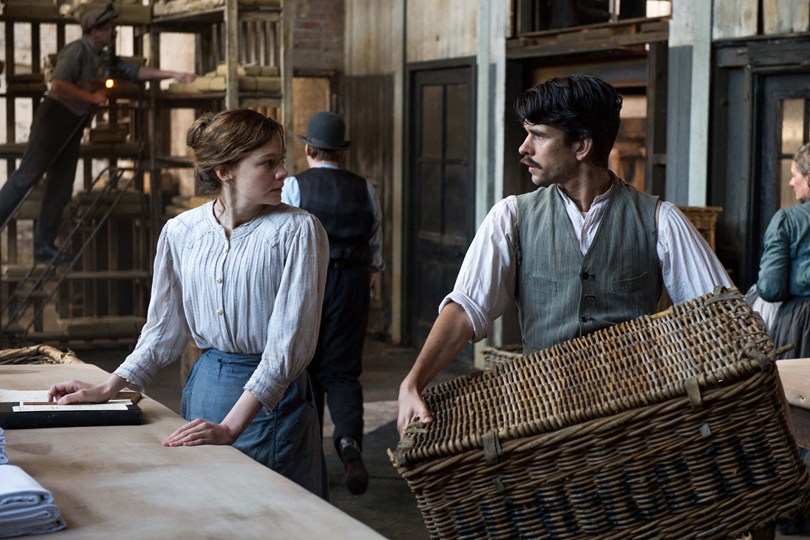
Suffragette - Maud and her husband in the factory

Maud (Carey Mulligan) working in the grimy laundry factory with her husband, Sonny (Ben Whishaw).

At the turn of the twentieth-century, most men could vote in the UK but women could not. Rightly, this caused tension and gave rise to the Suffragette movement, headed by Emmeline Pankhurst. The Suffragettes used ‘direct action’ to bring attention to the injustice of women being unable to vote. Suffragette focuses on this movement, and the consequences these women suffered to bring the injustice of women being denied the right to vote to the forefront of the world’s attention. But, sadly, none of it is done particularly well.

Suffragette is set in London between 1912-13. It is based around real events but our protagonist, Maud Watts (Carey Mulligan), is fictional. Maud works in a laundry factory, struggling to make ends meet. Appalled at the working conditions and the treatment of women by her boss, Norman Taylor (Geoff Bell), Maud joins the Suffragettes and gradually becomes more and more involved in the movement, despite the consequences of doing so.

Suffragette is a surprisingly bland and uninteresting film. The movie starts off with a funereal drum beat, plus some misogynistic quotes from British politicians taken out of context. This sets the tone for a highly unsophisticated, puerile and uneventful outlook of the era and the movement. Alas, the film does not improve as it goes on. Worse, the film becomes sterile, making its 106-minute run time seem considerably longer.

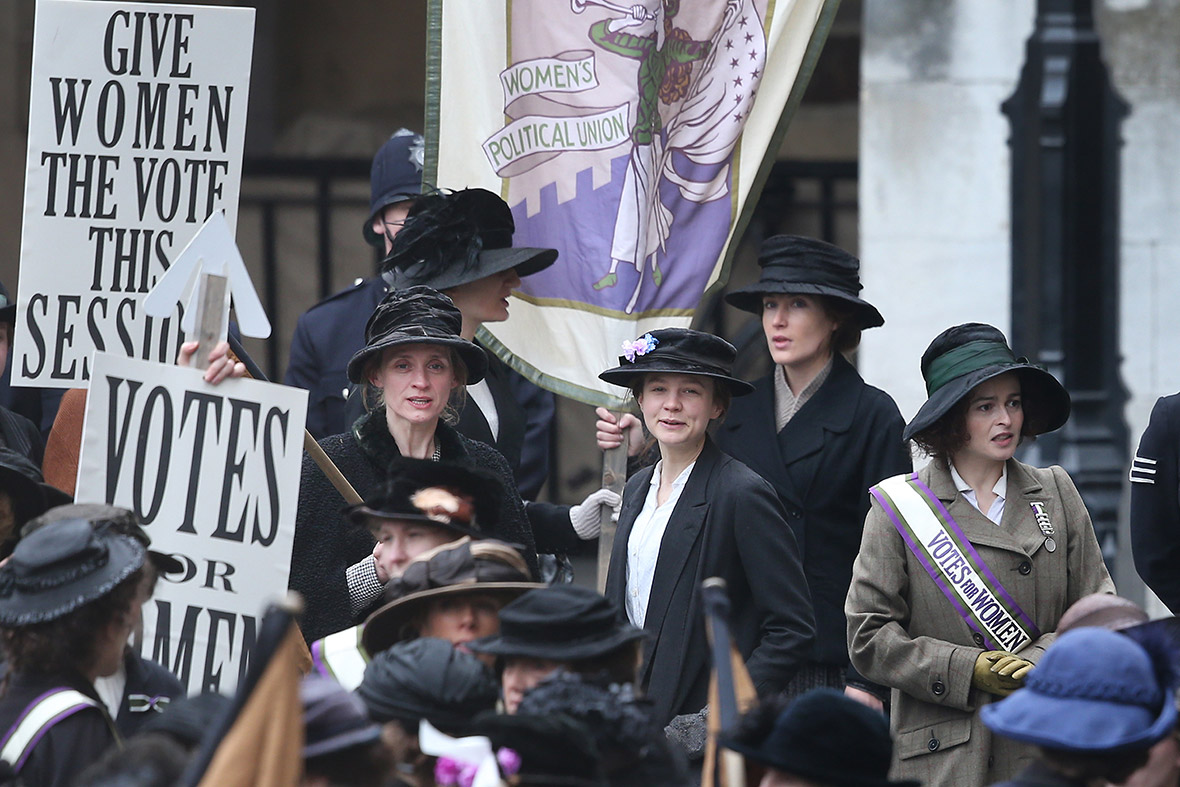
Maud at a demonstration for women's right to vote with Violet Miller (Anne-Marie Duff, left) and Edith Ellyn (Helena Bonham Carter, right).

Maud at a demonstration for women’s right to vote with Violet Miller (Anne-Marie Duff, left) and Edith Ellyn (Helena Bonham Carter, right).

For all the film’s sterility, Suffragette grapples well (and not so well) with some of the issues plaguing the era. The film successfully shows us that conditions in factories were horrible back then; that people were much more patriotic back then toward the monarchy and the country compared to nowadays; that women, their offspring and their properties were controlled by their (abusive) husbands; that the Suffragettes adopted dubious, violent, and borderline-terrorist methods to get their message heard; and that the Suffragettes were treated harshly in prison. This gives us some insight into the mindset and workings of pre-World War I British society, which is interesting.

But, alas, all of the above is tackled only at a shallow level in the film. Moreover, by the end of Suffragette, one learns little else about the era, other than that all the men were ignorant, misogynistic, lying, woman-beaters, and that all the women were heroines monolithically united in their struggle to get the vote. This is woefully unrepresentative of the era and unacceptably simplistic. If anything, this tells us more about script-writer Abi Morgan than about the era she wishes to portray. It is almost as if Morgan is more interested in imposing her opinions (propaganda) upon her audiences than portraying history fairly. Then again, this is not the first time that Morgan has imposed her views on viewers and portrayed history unfairly. She did it in The Iron Lady by riding roughshod over Margaret Thatcher. So should viewers really have gone into Suffragette expecting an honest portrayal of the Suffragette movement and the era, with Morgan having written the movie?

The lack of objectivity in the film means that the cast of Suffragette have one hand tied behind their backs from the outset. In spite of this, however, Carey Mulligan, Helena Bonham Carter, Anne-Marie Duff and Natalie Press (who plays Emily Davison) all perform decently. Also, Meryl Streep puts in a solid cameo as the fire-brand Emmeline Pankhurst.

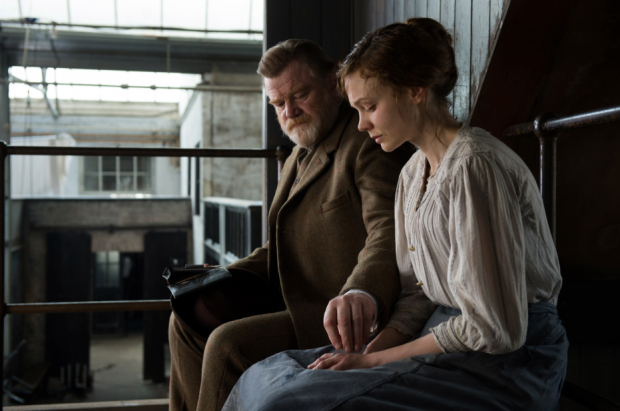
Maud being counselled in custody by Inspector Arthur Steed (Brendan Gleeson).

Maud being counselled in custody by Inspector Arthur Steed (Brendan Gleeson).

Nevertheless, the cast are further let down by clunky dialogue and by the lack of depth in their characters. Both of these have the knock-on effect of rendering the cast unsympathetic and lifeless. And when a predominantly female cast comes across as unsympathetic and lifeless about a subject as emotive and justifiable as the right for women to vote, something is seriously wrong with the film.

Over-all, Suffragette is a very disappointing movie. Yes, the film effectively highlights that women in the UK did not have the right to vote at the turn of the twentieth-century and that the Suffragettes brought the issue to the world’s attention with their antics. All the same, though, the film portrays the era and the Suffragette movement in an inexcusably one-dimensional, immature manner. Consequently, the movie is dull and if it wasn’t for the cast, the movie would have been duller still.

Considering that the issue Suffragette deals with has such emotion behind it, it is stunning how little emotion Suffragette evokes. This is an injustice to the women (Suffragette or otherwise) who put their lives on the line back then to win the right to vote in the UK; and it is an injustice to all women in the world who still put their lives on the line to win such rights today.

PG’s Tips
Review – The Gift (15) [2015]

The Gift - title banner2

Star Rating: 4/5

Director:

  • Joel Edgerton

Cast:

Music Composers:

  • Danny Bensi – Martha Marcy May Marlene, Enemy, Last Days In The Desert, Christine
  • Saunder Jurriaans – Martha Marcy May Marlene, Enemy, Last Days In The Desert, Christine

In the last dozen years, there have been a string of actors who have turned themselves into creditable directors. Sofia Coppola directed Lost in Translation in 2003 (and was nominated for two Oscars for it). While George Clooney directed and starred in The Ides of March in 2011 and Ben Affleck did the same in Argo in 2013 (and won an Oscar for it). Joel Edgerton seems to be the latest actor to try his luck behind the camera, and his directorial debut is a gem.

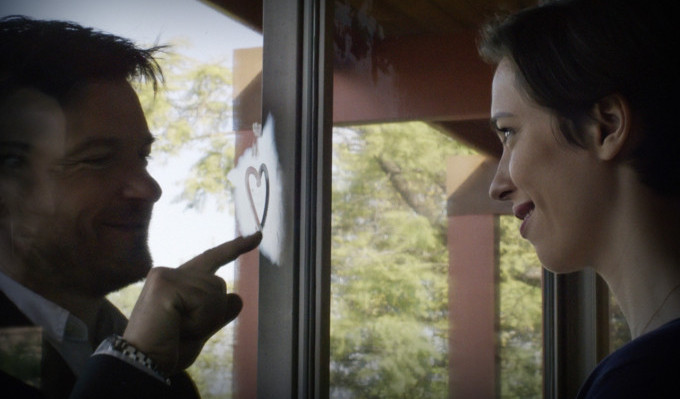
The happy couple. Simon (Jason Bateman) showing affection to his wife, Robyn (Rebecca Hall) whilst convincing her that this is the right house for them to make a home.

The happy couple. Simon (Jason Bateman) showing affection to his wife, Robyn (Rebecca Hall) whilst convincing her that this is the right house for them to make a home.

Edgerton’s film, The Gift, centres round an ostensibly happy couple, Simon (Jason Bateman) and Robyn (Rebecca Hall). They have just moved from Chicago to suburban Los Angeles because Simon got a new job. One evening, when they are at a shop buying supplies for their new home, they bump into Gordon ‘Gordo’ Moseley (Joel Edgerton). Gordo remembers Simon from their high school days and is keen to become friends with Robyn and Simon. Simon, though, is not so keen since he remembers how much of a weirdo Gordo was back then. (Simon even boasts that he and his peers called Gordo ‘the Weirdo’ back in school because he was so weird.)

Nevertheless, Gordo goes to their new house when Simon is not around and starts giving them gifts, despite neither Robyn nor Simon asking for any. Soon, Gordo’s behaviour begins to trouble Simon and Robyn. It puts a strain on their marriage, especially as Robyn suspects that Simon is not telling her something…

The Gift is a slow-burning psychological thriller. Not a lot happens for much of the film. Yet, it is a tense watch. This is primarily because Director Joel Edgerton (thankfully) does not use loud, sudden noises to artificially inject jump-scares into his viewers. Rather, he uses the natural spookiness of the suburban area to good effect and creates a scenario that nobody would want to experience. The combination induces an organic and ethereal tautness into the audience, thereby making The Gift an uncomfortable watch.

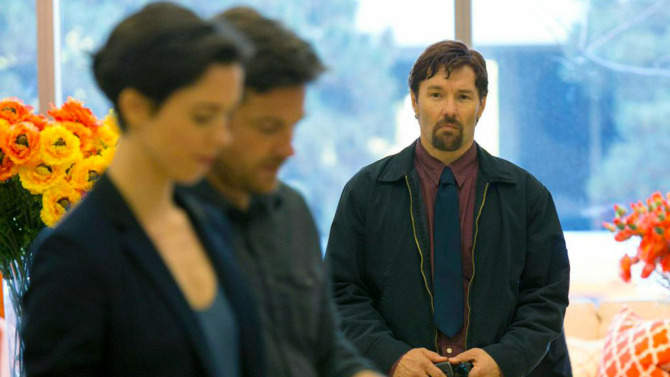
Gordo (Joel Edgerton) staring with unsettling intent at Simon and Robyn at the store.

Gordo (Joel Edgerton) staring with unsettling intent at Simon and Robyn at the local supply store.

Central to The Gift being an uncomfortable watch is Edgerton as an actor. Edgerton is really good as the unsettlingly weird Gordo. With just a look (or a gift), he can make viewers feel like ants are crawling under their skin. Edgerton’s/Gordo’s weird behaviour is one of the reasons for this; the other is due to the phenomenal (and subtle) job that the cosmeticians have done to his face. They have transformed Edgerton from a pleasant, amiable-looking guy into someone that no-one would ever want to come across, whether in a supermarket, a social gathering, on the train, or in a dark alley at night. (Especially not in a dark alley at night!)

Edgerton/Gordo is undoubtedly the star of the film. He activates the tension and his behaviour gets unnervingly weirder and weirder the more The Gift goes on. Yet, one cannot ignore the roles played by Rebecca Hall and Jason Bateman either to making the movie tense. Hall plays plausibly well as a woman who seems fine on the surface, but has psychological issues brooding under the surface; while Bateman plays decently as his seemingly usual, (semi-)comic, supercilious self. Nevertheless, neither Hall nor Bateman have the same weight on screen as Edgerton. One spends much of the time when Edgerton is not on screen waiting for him to reappear as one knows that something strange and unsettling is likely to occur.

Edgerton gets a lot right as an actor in The Gift. He also gets a lot right as the director and writer of the film too. He captures the cinematography of a suburban town well (with all its beauty and mundane scariness), and uses relatively long shoots to enable viewers to feel the normality (and tension) of the situation unfolding for Hall’s and Bateman’s characters with impressive skill.

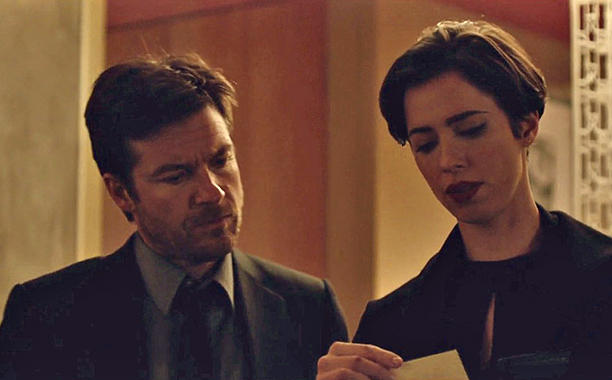
Simon and Rebecca find a gift awaiting them at the house upon returning from some friends. Guess who its from...?

Simon and Rebecca find a gift awaiting them at the house upon returning from some friends. Guess who its from…?

Additionally, Edgerton has written a very good script that has believable dialogue and a solid storyline. It is only in the climactic scene at the very end of the film that one or two elements of the dialogue and script don’t work. Indeed, they seem entirely at odds with the realism of the rest of the movie. But to put too much stress on the (eye-raising nature of the) end would be to do The Gift and Joel Edgerton a disservice. As an actor and as a director, Edgerton emphasises that he has talent akin to Sofia Coppola, George Clooney and Ben Affleck.

Over-all, The Gift is a well-executed psychological thriller. The final scenes may be questionable. But the film is tense and suspenseful in an entirely naturalistic and refreshing way. Undeniably, Edgerton is the shining light of this film as an actor, the writer and the director. He is creepy as the main supporting actor; intelligent in his script-writing; and neat in his directing. Edgerton is highly unlikely to be nominated, let alone win, an Oscar for his directing The Gift. But this is a great directorial debut from him, and one looks forward to watching what he writes and directs next.

PG’s Tips

Review – Mission: Impossible V – Rogue Nation (12a) [2015]

MI-V - Title banner

Star Rating: 3.5/5

Director:

  • Christopher McQuarrie – The Usual Suspects, Valkyrie, Jack Reacher, Edge of Tomorrow

Cast:

  • Tom Cruise – Eyes Wide Shut, Valkyrie, Mission: Impossible I-IV, Jack Reacher I & II
  • Jeremy Renner – SWAT, Mission: Impossible IV, The Avengers Assemble I & II, , Captain America III
  • Alec Baldwin – The Aviator, To Rome With Love, Blue Jasmine, Still Alice, Caught Stealing
  • Rebecca Ferguson – Drowning Ghost, The White Queen, Hercules, Despite The Falling Snow
  • Ving Rhames – Pulp Fiction, Surrogates, Mission: Impossible I-IV, Operator
  • Simon Pegg – Big Nothing, Mission Impossible III-IV, Paul, Star Trek I, II & III
  • Sean Harris – Harry Brown, The Borgias, Prometheus, ‘71, Macbeth
  • Simon McBurney – The Last King of Scotland, Harry Potter VII(i), The Borgias, The Theory of Everything
  • Tom Hollander – Enigma, Pirates of the Caribbean II-III, American Dad!, Jungle Book: Origins
  • Jens Hultén – The Border, Skyfall, Ragnorak, Johan Falk: Lockdown

Music Composer:

  • Joe Kraemer – The Thirst, Confession of A Gangster, Jack Reacher, Titans of Justice

What has become of the Mission: Impossible franchise? The first film was a proper espionage thriller with a tough mission and the odd elaborate action stunt to give credence to the film’s title. But by the second film, the espionage element had given way to entertaining, if unfeasible action stunts and the veneration of Tom Cruise’s alter ego, Ethan Hunt. And by the fourth film, the storyline had given way to even more entertaining, unfeasible action stunts and venerated Tom Cruise’s alter ego to the point of deification. So what could one expect from Mission: Impossible V – Rogue Nation (M:I-V)? Well, more of the same really!

Ethan Hunt (Tom Cruise) and William Brandt (Jeremy Renner) working together to uncover the Syndicate.

Ethan Hunt (Tom Cruise) and William Brandt (Jeremy Renner) working together to uncover the Syndicate.

M:I-V centres round Ethan Hunt (Tom Cruise, who else?) hunting down the Syndicate, an international criminal organisation, and its leader Solomon Lane (Sean Harris). However, the Impossible Mission Force (IMF) that Ethan is part of is being closed down by CIA Director Alen Hunley (Alec Baldwin). The CIA believes that the Syndicate does not exist and that the IMF is causing embarrassment to the CIA/America due to its unorthodox methods. They want Ethan to turn himself in.

But rather than hand himself in, Ethan chooses to go rogue so as to uncover the Syndicate and to find Lane, himself. And he will start by going after Ilsa Faust (Rebecca Ferguson).

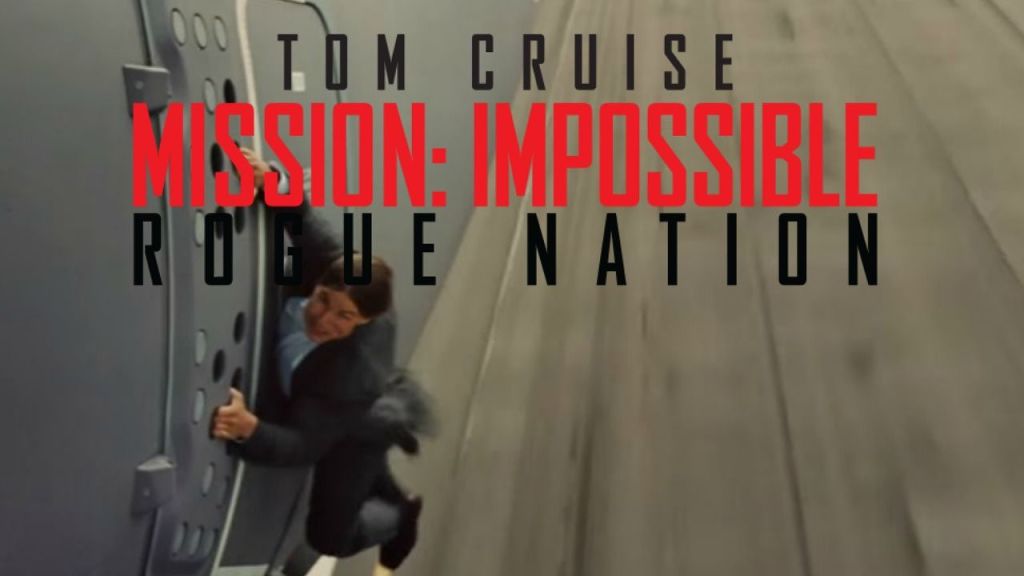
That is the vague outline of M:I-V’s plot. But, in truth, M:I-V has no plot. The film flagrantly does not care for the spy thriller ingredient that made the first film so interesting. Instead, M:I-V prefers to go from one entertaining, over-the-top action stunt to another. Indeed, it wouldn’t matter which order the action stunts occurred as the storyline and the dialogue make no sense at all; although, having the first stunt as the one where Ethan hangs off a taking-off aeroplane does set the tone for the rest of the movie. And, astonishingly, Director Christopher McQuarrie manages to maintain this tone for its entire duration. The stunts get ever more outlandish and creative to the extent that one has to question who came up with these ideas (and how) because they are ingenious.

Isla Faust (Rebecca Ferguson) on a bike and in possession of something Ethan needs. Thus, a high-speed bike chase is about to begin...

Isla Faust (Rebecca Ferguson) on a bike and in possession of something Ethan needs. Thus, a high-speed bike chase is about to begin…

However, M:I-V does not solely consist of ingenious, if totally unrealistic action stunts. The film consists of a good amount of banter between the protagonists (more so than in previous instalments), and gives viewers the sense that a family unit is developing within the IMF now that Tom Cruise and Ving Rhames has been in all five films, Simon Pegg has been in them since the third one, and Jeremy Renner since the fourth. Each member of the team has a particular role and whether it is Cruise as Action Man come again and the mastermind who exposes the movie’s villain(s); Rhames as Ethan’s reliable sidekick Luther; Simon Pegg as Ethan’s reliable but goofy, tech-nerd Benji; or Renner as Ethan’s boss Brandt (who Ethan regularly disobeys to ever positive results), each one of them looks like they are enjoying their roles and they make some funny puns whilst they’re at it as well.

Unsurprisingly, Cruise, Rhames, Pegg and Renner all play well in M:I-V even if they do nothing spectacular. Rather, it is the newcomers that arguably make the most impressions on viewers. Rebecca Ferguson, as the ambiguous Ilsa Faust, makes the greatest impression of them all. She is beautiful, sexy and can kick arse! That she holds up against Tom Cruise (and may, heaven forbid, outshine him in his own film) speaks volumes for her talents as an actress.

Yet, the rest of the cast do not have the same impact on viewers. Sean Harris plays decently as the main villain, Solomon Lane. Harris/Lane is cold, unflinching and meant to be scary. But because he is given little screen time or background story, audiences don’t get the chance to feel much for him by the end. For similar reasons, one feels little for Alec Baldwin as the CIA director and Simon McBurney as the head of the British secret services, even if neither of them play badly with the material or time they’re given.

Solomon Lane (Sean Harris), the ice-cold, sociopathic villain at the head of the Syndicate.

Solomon Lane (Sean Harris), the ice-cold, sociopathic villain at the head of the Syndicate.

It would have been intriguing to learn more about these characters as they seem, ostensibly, to have depth and more to say for themselves. But to explore them would have meant that the film-makers would have had to come up with a genuine storyline and spent less time showing us how awesome Tom Cruise is. And that would have defeated the whole purpose of M:I-V.

Over-all, M:I-V is a highly enjoyable action film. It has little place for clever espionage and has a veneer of a storyline that does not work at any level. Nevertheless, the movie glorifies Tom Cruise; has plenty of action sequences; several implausible action stunts; good chemistry and humour from the returning cast; and includes a gorgeous, strong female character that could fit seamlessly into any Marvel comic-book film. Thus, M:I-V delivers unashamedly on everything it sets out to achieve.

PG’s Tips

Review – Spooks: The Greater Good (15) [2015]

Spooks - title banner

Star Rating: 3.5/5

Director:

  • Bharat Nalluri – Killing Time, The Crow, Spooks, The Player

Cast:

  • Kit Harington – Pompeii, A Testament of Youth, Seventh Son, Game of Thrones
  • Peter Firth – The Hunt For Red October, Pearl Harbour, Spooks, Risen
  • Jennifer Ehle – The King’s Speech, The Ides of March, Contagion, Zero Dark Thirty, A Quiet Passion
  • Tuppence Middleton – Cleanskin, The Imitation Game, Jupiter Ascending, War And Peace
  • Elyes Gabel – Game of Thrones, World War Z, A Most Violent Year, Scorpion
  • Tim McInnerny – Spooks
  • Eleanor Matsuura – Alan Partridge, The Love Punch, Residue, Burn Burn Burn
  • Michael Wildman – Family Affairs, A Bunch of Amateurs, Act of Godfrey, London Has Fallen
  • Lara Pulver – Spooks, True Blood, Edge of Tomorrow, A Patch of Fog
  • David Harewood – The Ruby In The Smoke, Homeland, Grimsby

Music Composer:

  • Dominic Lewis – Free Birds, The DUFF, The Player

When one watches a TV series from the beginning, one usually becomes emotionally invested in the characters. Whether it is Jack Bauer from 24, Homer Simpson from The Simpsons, the inbetweeners from The Inbetweeners, or the leading police officers from 21 Jump Street, viewers usually acquire affection (or disdain) for the characters, and normally they carry their sentiments on into the film adaptation(s) or spin-off(s). But what if one has not watched the TV series that a film is based on? Can one still enjoy the film to the same extent as if one had watched the show? Spooks: The Greater Good may give us an answer.

Harry (Peter Firth) convincing Will Holloway (Kit Harington), an ex-agent, to trust him and to rejoin M:I-5.

Harry (Peter Firth) convincing Will Holloway (Kit Harington), an ex-agent, to trust him and to rejoin M:I-5.

Spooks is based on the British TV series with the same title that aired between 2002-11 (although it was also called M:I-5 in some circles). The film is a spy thriller. At the start of the movie, Adam Qasim (Elyes Gabel), a terrorist wanted by US authorities, is in the hands of M:I-5. He is on his way to being handed over to the CIA in London when the vehicles driving him are attacked in a heist. Threatened with the deaths of agents in the streets, M:I-5 orders the agents to hand over Qasim to the armed attackers.

Now free, Qasim plans a terrorist attack on London. While M:I-5 looks for him and determines what he intends to do, Harry Pearce (Peter Firth) disappears. He is convinced that there is a traitor in M:I-5 who let Qasim free, and he re-recruits Will Holloway (Kit Harrington), an ex-agent, to help him find out who the traitor is.

Spooks is a solid espionage thriller. The film is quite grounded and beguiling with good acting and humorous dialogue. For one who has not watched an episode of Spooks the TV series, there are probably some subtleties that go unseen. But not seeing these does not make the film any less entertaining. Furthermore, the film is written in such a way that the allegiances (and rivalries) between key personnel in the upper echelons of M:I-5 are spelled out quite early on in the film. So, one should not have a problem understanding who is on whose side… until they switch sides, of course. But that happened in the TV series regularly, like in 24, and is also part and parcel of the spy genre in general. How much emotional investment in Spooks one needs prior to watching the film is debatable.

June (Tuppence Middleton), an M:I-5 agent, going in with a fellow agent to take out some terrorists.

June (Tuppence Middleton), an M:I-5 agent, going in with a fellow agent to take out some terrorists.

Yes, it may have helped to know what the shifty Harry Pearce, played well by Peter Firth, is like before going into the film in the same way it may have helped to watch The Simpsons on TV to appreciate what makes the blundering Homer Simpson so endearing before watching The Simpsons Movie. Similarly, watching Spooks the TV show may have helped to get to know supporting cast members played by Tim McInnerney and Lara Pulver. Both reprise their roles from the show well but are given little screen time during the movie (especially compared to Peter Firth’s character).

Nevertheless, for every actor reprising their character, there are a handful of new characters. Jennifer Ehle, Tuppence Middleton, Eleanor Masuura and, chiefly, Kit Harington were never part of the TV series. Suffice to say, all of them have a role in the film and add something different to the plot. Fans (and non-fans) of the show cannot have known these characters or anticipate their motives prior to the movie. This means that the film is going to deviate from the show and that whatever happened previously in the TV series is unlikely to be crucial.

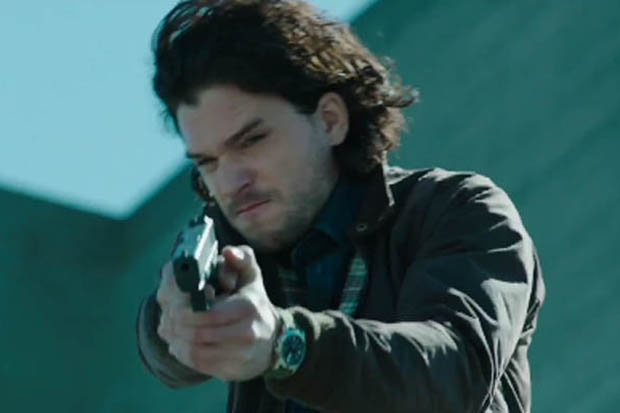
Jon Snow... I mean, Will Holloway being the hero and using a gun to take out a foe instead of a sword.

Jon Snow… I mean, Will Holloway being the hero and using a gun, instead of a sword, to take out a foe.

Yet, if fans (and non-fans) are arguing over how alike Spooks the film is to Spooks the TV series, they are arguing over the wrong issue. How closely the film resembles the show pales in comparison to the problem of the film’s tone. Director Bharat Nalluri cannot make up his mind if he wants the film to be taken seriously, like Tinker Tailor Soldier Spy, or as a spoof, like Kingsman: The Secret Service. Bearing in mind the title of the movie reads and sounds close to ‘spoof,’ it may have been logical to make the film as a satire, as James Bond was pre-Daniel Craig. (Or maybe that conclusion is borne from not watching the TV series?) Either way, Spooks’ tone is confusing. Add in the (numerous) implausible plot twists and it is understandable that viewers get into a fuddle as to what sort of a film they’re watching.

Over-all, Spooks is an enjoyable spy thriller. It has been put together well enough to ensure that viewers who have not watched the TV series that preceded the movie are not worse off than those who did. The tone of the film may be puzzling and some of the Byzantine-like scheming makes no sense. However, Spooks: The Greater Good has got good acting, dialogue and intrigue, with semi-grounded action. Thus, like any film with such ingredients, Spooks is a decent movie and worth a watch.

PG’s Tips
Review – The Falling (15) [2015]

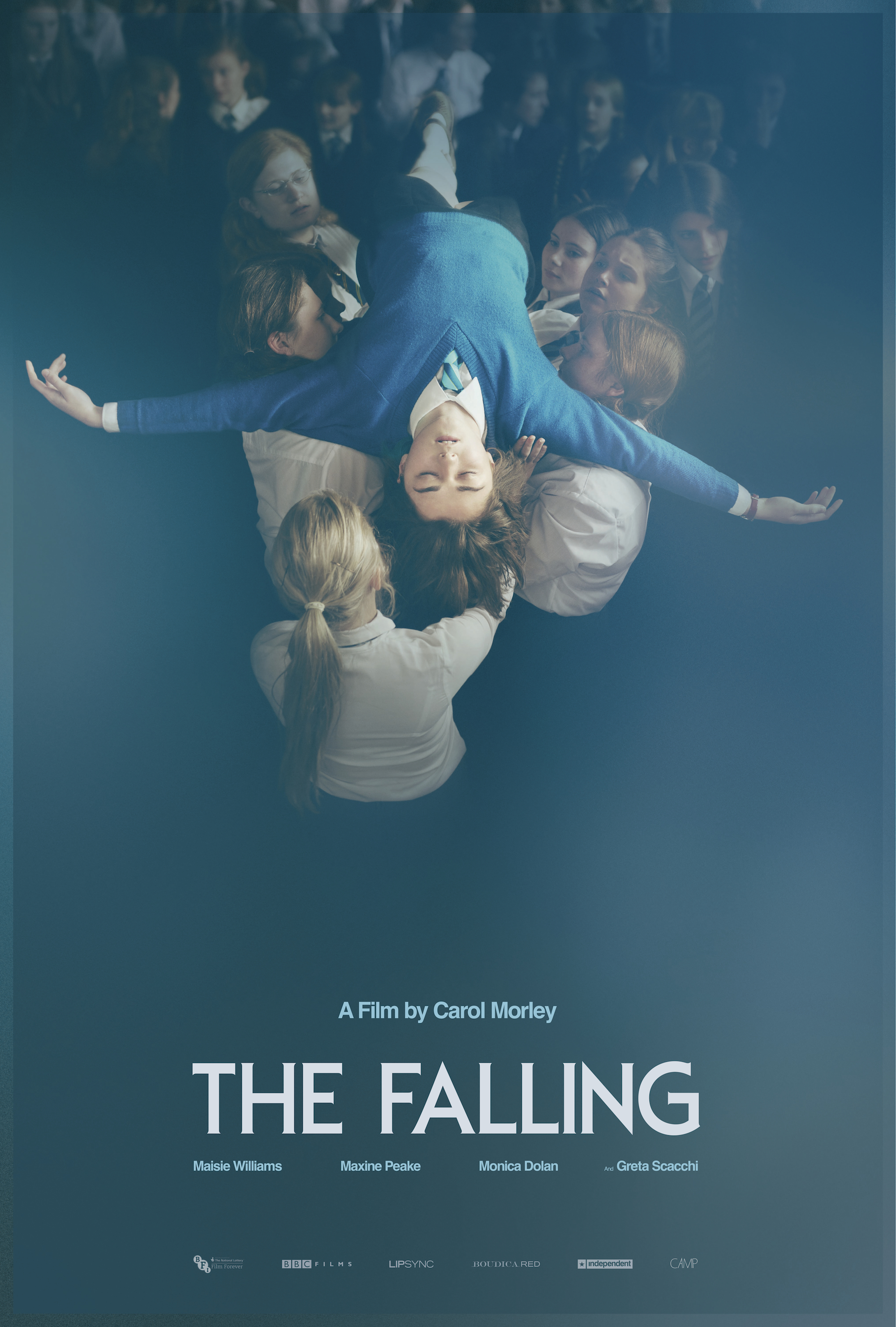
The Falling - title banner

Star Rating: 4/5

Director:

  • Carol Morley – The Alcohol Years, Edge, Dreams Of A Life

Cast:

  • Maisie Williams – Game of Thrones, Heatsroke, The Devil And The Deep Blue Sea
  • Maxine Peake – Shameless, Edge, The Theory Of Everything, Hamlet
  • Florence Pugh
  • Anna Burnett – Ripper Street
  • Greta Scacchi – Baltic Storm, Ways To Live Forever, AD The Bible Continues, War and Peace
  • Morfydd Clark – Madame Bovary, The Call Up, Love & Friendship
  • Joe Cole – Now Is Good, A Long Way Down, Pressure, Callow In Their Eyes
  • Rose Caton – Last Knights
  • Monica Dolan – Eye In The Sky
  • Ellie Bamber – Nocturnal Animals

Music Composer:

  • Tracy Thorn

Adolescence is a tricky period in one’s life. One experiences changes in the body while having to deal with the stresses of trying to achieve good grades at school and appeasing one’s peers who may (or may not) be at a more advanced stage in their hormonal growth. Carol Morley’s The Falling deals with some of the issues that many girls go through as part of their adolescence.

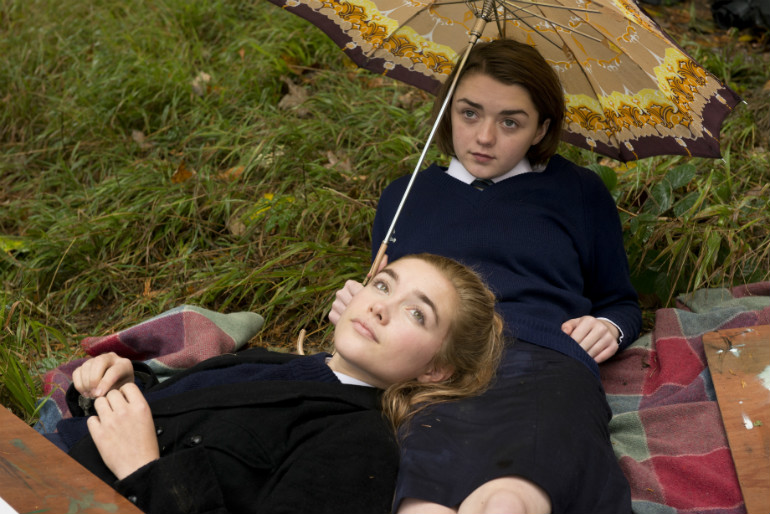
Best friends, Abby (Florence Pugh) and Lydia (Maisie Williams) lying on the grass in their school uniforms, drawing a tree.

Best friends, Abby (Florence Pugh) and Lydia (Maisie Williams) lying on the grass in their school uniforms, drawing a tree for their art class.

The film is based in a village in England in 1969 and centres round Lydia (Maisie Williams). She lives with her agoraphobic mother (Maxine Peake) and her ill-educated brother (Joe Cole) in a small, rundown house. While Lydia’s life is not great, she has a good group of friends at a private, all-girls school. One of whom, Abby (Florence Pugh), is exploring her sexuality.

However, as Lydia is coming to terms with her developing body, she begins fainting inexplicitly. Soon, Lydia’s friends start fainting too. But the school administration does not take the matter seriously, not believing that it is an epidemic. Lydia tries her hardest to convince the administration that something is wrong with her and her friends.

The Falling is an innovative and interesting movie that has been well directed by Carol Morley. On a small budget, she has put together a solid film with a fine balance of charm and sincerity. Devoid of special-effects en masse, Morley relies on cinematography to create the wonderful ambiance of a repressive all-girls high school in a small, provincial area, with some odd sorts of people (and behaviour) that can be the norm in such communities in 1960s England or even today.

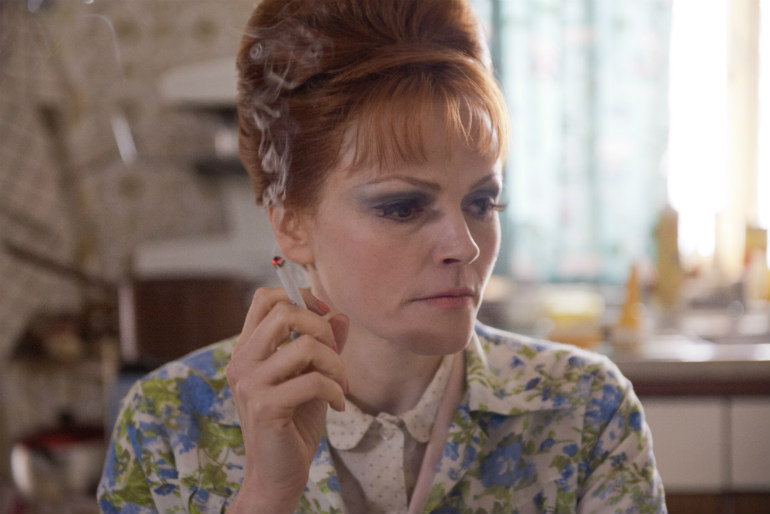
Eileen (Maxine Peake) smoking. She is Lydia's hair-dresser mother who suffers from Agorophobia.

Eileen (Maxine Peake) smoking. She is Lydia’s hair-dresser mother who suffers from Agorophobia.

Other elements of The Falling that work in Morley’s favour are the dialogue and the acting. Both are very good, honest and plausible. One can imagine (in the main) adolescent girls, and the adults that surround them, behaving in the manner that the film portrays. In the lead role, Maisie Williams is terrific and captivating to watch. Like Arya Stark, her character in Game of Thrones, her character in The Falling is strong-willed and tenacious (if more vulnerable, messed up and curious). But Williams, here, gives a more rounded performance as Lydia is more vulnerable, messed up and curious than Arya Stark is ever likely to be.

The rest of the cast are not given the time or detail afforded to Lydia/Williams’s character. Nonetheless, they all play their roles strongly and with a genuine naturalness that is highly believable.

Yet, for all The Falling’s genuineness and believability, it is a strange film. Its central premise has echoes of the hysterical contagion/the June Bug Epidemic that affected an American textiles factory in 1962; only, The Falling probably exaggerates the issue. Curiously, the fainting syndrome in the movie becomes so normal (and repetitive) that characters and audiences alike fail to bat an eyelid after a while. This is an abnormal reaction because the normal response to seeing someone faint is either to run over to the person who has fainted, or to call for help/an ambulance.

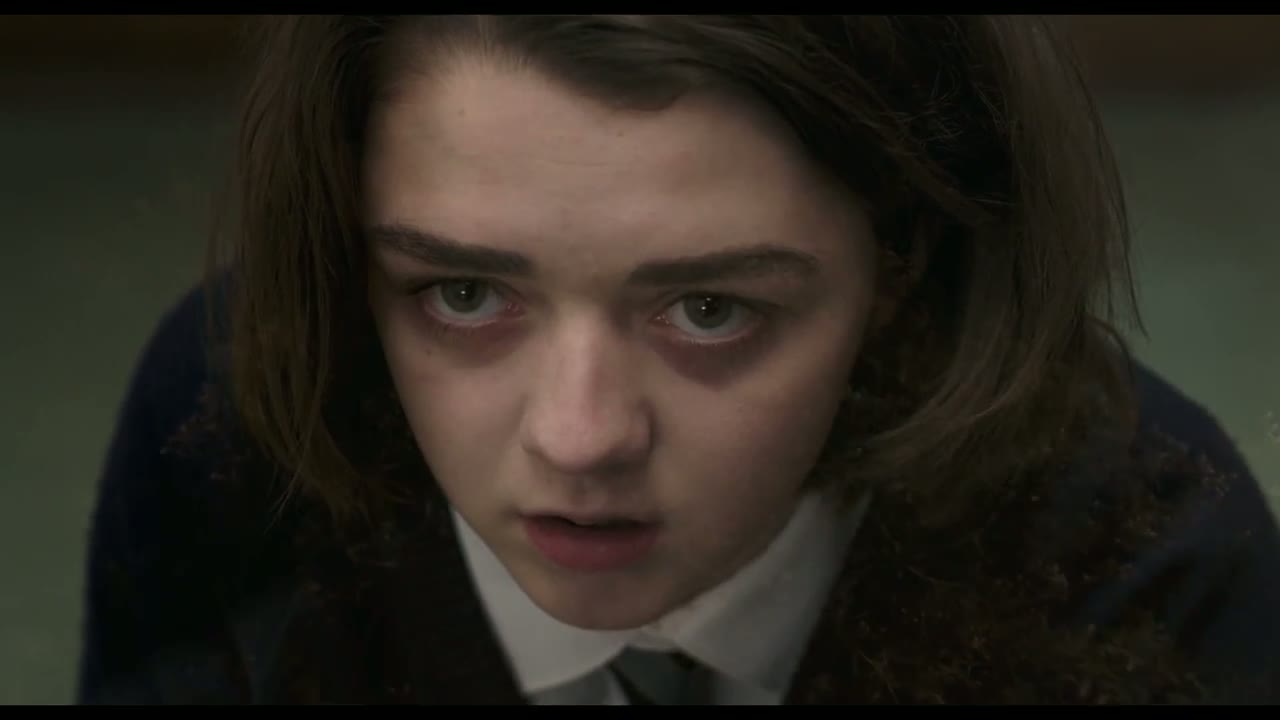
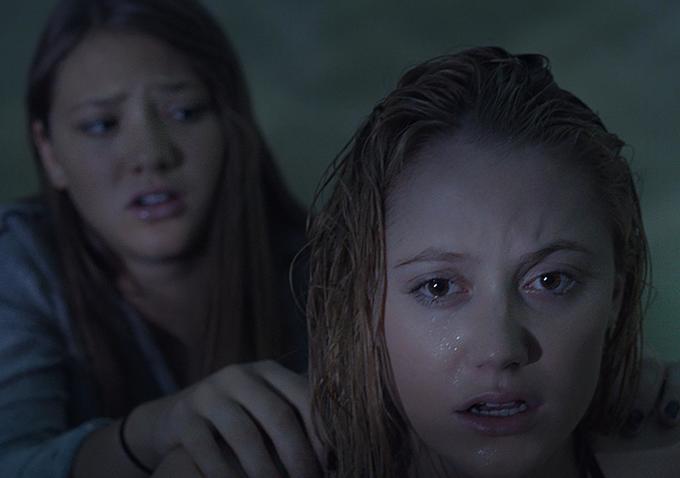
Lydia looking terrible, haunted even, as she tries to convince her teachers that the fainting epidemic is real and that she and her friends are not making it up.

Lydia looking terrible, haunted even, as she tries to convince her teachers that the fainting epidemic is real and that she and her friends are not making it up.

This leads on to the main issue at the heart of the film: is the fainting an epidemic among the girls? Is it something celestial or paranormal? Or is it just frustrated, adolescent girls crying out for attention (and an outlet) in a repressive environment? These questions are very pertinent as they can give viewers an insight into the stresses that adolescent girls often endure in high school. That is if one does not focus too much on certain, side-matters in the film that are remain ambiguous right to the end. Or if one can get past the perplexing, out of sync music. Or if one does not get an epileptic fit from the fast-flicking flashbacks that are unfathomable and add nothing to the plot. Nevertheless, if one can ignore these issues, one can greatly enjoy The Falling.

All-in-all, The Falling is an entertaining film in a stimulating and peculiar way. The movie may not resolve all its issues. But it is well-shot, has wonderful cinematography, and has marvellous acting to go with a good, solid script that brings out the best in Maisie Williams. Where The Falling succeeds most is in showing viewers the problems and pressures that most teenage school-girls face, even if it is in an environment and in a time slightly removed from conventional stories on the subject. Carol Morley must be credited for this because her film is original and demonstrates the dangers of repressing adolescent girls too much.

PG’s Tips
Review – Seventh Son (12a) [2015]

Seventh Son - Title Banner

Star Rating: 1.5/5

Director:

  • Sergey Bodrov – Prisoner of the Mountains, Nomad: The Warrior, Mongol: Rise of Genghis Khan, Fool’s Game

Cast:

  • Julianne Moore – The Big Lebowski, The Hours, Maps To The Stars, Still Alice, Freeheld
  • Jeff Bridges – The Big Lebowski, Iron Man, True Grit, RIPD, The Emperor’s Children
  • Kit Harrington – Game of Thrones, Testament of Youth, Pompeii, Spooks: The Greater Good
  • Olivia Williams – The Sixth Sense, Maps To The Stars, Anna Karenina, Man Up
  • Ben Barnes – The Chronicles of Narnia II & III, Dorian Gray, By The Gun, Sons of Liberty
  • Alicia Vikander – A Royale Affair, Anna Karenina, Testament of Youth, Ex Machina, The Danish Girl
  • Djimon Hounsou – Gladiator, Eragon, Blood Diamond, Guardians of the Galaxy, Furious 7
  • Antje Traue – Pandorum, 5 Days of War, Man of Steel, Woman In Gold

Music Composer:

There are some films that can be boxed into the category of ‘laughably terrible.’ Batman & Robin, Birdemic, Season of the Witch, Conan The Barbarian, Sharknado, and Pompeii are all awful films, yet they all have the saving grace of being amusing in their awfulness. Sergey Bodrov’s Seventh Son is another such movie.

Mother Malkin (Julianne Moore), having returned, she is now back at home, planning her evil ambitions for the world.

Mother Malkin (Julianne Moore), having returned, she is now back at home, planning her evil ambitions for the world.

Seventh Son is based on the first book in The Wardstone Chronicles (although it is called The Last Apprentice series in America) by Joseph Delaney. Delaney’s website, Spooksbooks, defines the plot for Seventh Son as: ‘In a time long past, an evil is about to be unleashed that will reignite the war between the forces of the supernatural and humankind once more. John Gregory (Jeff Bridges) is a Spook, a person who fights against the Dark, who had imprisoned the malevolently powerful witch, Mother Malkin (Julianne Moore), centuries ago. But now she has escaped and is seeking vengeance. Summoning her followers of every incarnation, Mother Malkin is preparing to unleash her terrible wrath on an unsuspecting world. Only one thing stands in her way: John Gregory.

‘In a deadly reunion, Gregory comes face to face with the evil he always feared would someday return. Now he has only until the next full moon to do what usually takes years: train his new apprentice, Tom Ward (Ben Barnes), to fight a dark magic unlike any other. Man’s only hope lies in the seventh son of a seventh son.’

Yes, the plot is that laughable. It is plodding and silly, with predictable twists and a waterfall of fantasy clichés thrown into the mire. Indeed, there are so many fantasy clichés in Seventh Son that it is hard to believe that the film is anything other than an inferior derivative of other (better) fantasy stories. But unlike with other (irredeemably bad) fantasy films, like Reign of Fire and Rise of the Shadow Warrior, at least with Seventh Son one can enjoy pointing out where James Delaney/Sergey Bodrov have gained their inspiration from. In some scenes, the inspiration is so blatant one might as well re-watch or reread the works JRR Tolkien, Susan Cooper and David Eddings, and Dungeons & Dragons and Season of the Witch for good measure (to name but five). Some of the ideas in those stories might be bad or badly executed by today’s standards. But they were originals, if not classics, in their time.

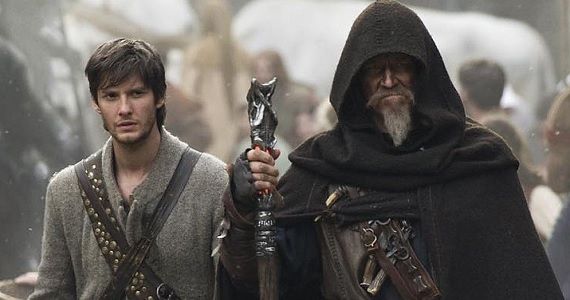
Tom (Ben Barnes) and John Gregory (Jeff Bridges), pupil and mentor, going from place to place in classic fantasy style.

Tom (Ben Barnes) and John Gregory (Jeff Bridges), pupil and mentor, going from place to place in classic fantasy style.

Yet, if one thought the storyline for Seventh Son was the most ludicrous element of the movie, it pales in comparison to the dialogue. Unsurprisingly, the dialogue is lazily-written, clunky and hackneyed. But, at times, it is delivered with a campiness that one cannot help but laugh at, with Jeff Bridges being the Offender-in-Chief. Playing a cross between Gandalf and Rooster Cogburn, Bridges is barely comprehensible. Yet, he has a smile on his face for the entire film and looks like he is enjoying himself enormously in spite of (or maybe because of) the paucity of the script.

The same, however, cannot be said for the rest of the cast. Julianne Moore, habitually brilliant (and particularly so in the recent Still Alice), is shockingly dreadful as the one-dimensional, wicked witch. Appearing as a cut-rate cross between Queen Ravenna from Snow White and a latex rip-off of Melisandre from Game of Thrones, Moore looks bored at best and embarrassed at worst whenever she is on screen. Olivia Williams, Kit Harrington, Alicia Vikander, Djimon Hounsou and Ben Barnes all wear similar expressions during Seventh Son. It is as if this predominantly talented cast all know that they’re in a movie that stinks to the stratosphere and are just pleading for their scenes to be over so they can pick up their pay-checks and move on.

Alice (Alicia Vikander) rising seductively in the lake to entrance someone (I wonder who?) with her beauty.

Alice (Alicia Vikander) rising seductively in the moonlight to entrance someone (I wonder who?) with her beauty.

Likely, the cast had moved on and forgotten about this car-crash of a movie… until it returned to haunt them with its release in cinemas recently. Seventh Son was filmed in 2012 and was in post-production for more than two and a half years. The movie was supposed to have come out in 2013 and then in 2014, but was delayed on three occasions due to post-production troubles. Oddly, though, Seventh Son does not feel like a troubled production (unlike Transformers II, The Wolverine and The Hobbit III). It just feels wretched, pitifully comical and cheap, especially when it comes to the CGI. For a film which cost Legendary studios near $100million to make, one expects to watch a better movie, and consequently it is no surprise that the film has flopped. (Legendary studios expect to make an $85million loss on the movie.)

All-in-all, Seventh Son is an all-round awful film. From the script, to the acting, to the CGI, the movie is abysmal and filled with enough fantasy clichés to stuff a duvet. Nevertheless, the film has one saving grace: it is unintentionally hilarious. Thus, Seventh Son can be boxed into the category of ‘laughably terrible’ and can be enjoyed for the atrocity that it is alongside Batman & Robin, Birdemic, Season of the Witch, Conan The Barbarian, Sharknado, and Pompeii.

PG’s Tips
Review – Still Alice (12a) [2015]

Still Alice - titler banner

Star Rating: 4.5/5

Directors:

  • Richard Glatzer – Grief, The Fluffer, The Last of Robin Hood
  • Wash Westmoreland – The Fluffer, Totally Gay!, The Last of Robin Hood

Cast:

  • Julianne Moore – Nine Months, Children of Men, The Kids Are Alright, Seventh Son
  • Alec Baldwin – Pearl Harbour, The Aviator, Blue Jasmine, Mission: Impossible V
  • Kristen Stewart – Jumper, Twilight I-V, Snow White and The Huntsman, Clouds of Sils Maria
  • Kate Bosworth – Remember The Titans, 21, Straw Dogs, Before I Wake
  • Shane McRae – All Over Again, Killer Pad, The Help, Stereotypically You
  • Hunter Parrish – Steal Me, Freedom Writers, It’s Complicated, Hell Of A View
  • Stephen Kunken – The Girl In The Park, Extremely Loud & Incredibly Close, The Wolf of Wall Street, Bridge Of Spies

Music Composer:

  • Ilan Eshkeri – Layer Cake, Kick-Ass, Coriolanus, Black Sea, Don Verdean

Some films have scenes that are genuinely heart-breaking. When Brooks Hatlen (James Whitmore) hangs himself in The Shawkshank Redemption, when Oscar Schindler breaks down in Schindler’s List, and when Simba tries to awaken his fallen father in The Lion King, viewers cannot help but weep at the poignancy of the scenes. Yet, these are only particular scenes that last so long. Still Alice, on the other hand, makes one feel like weeping for pretty much the movie’s entire run time as it is so heart-breaking.

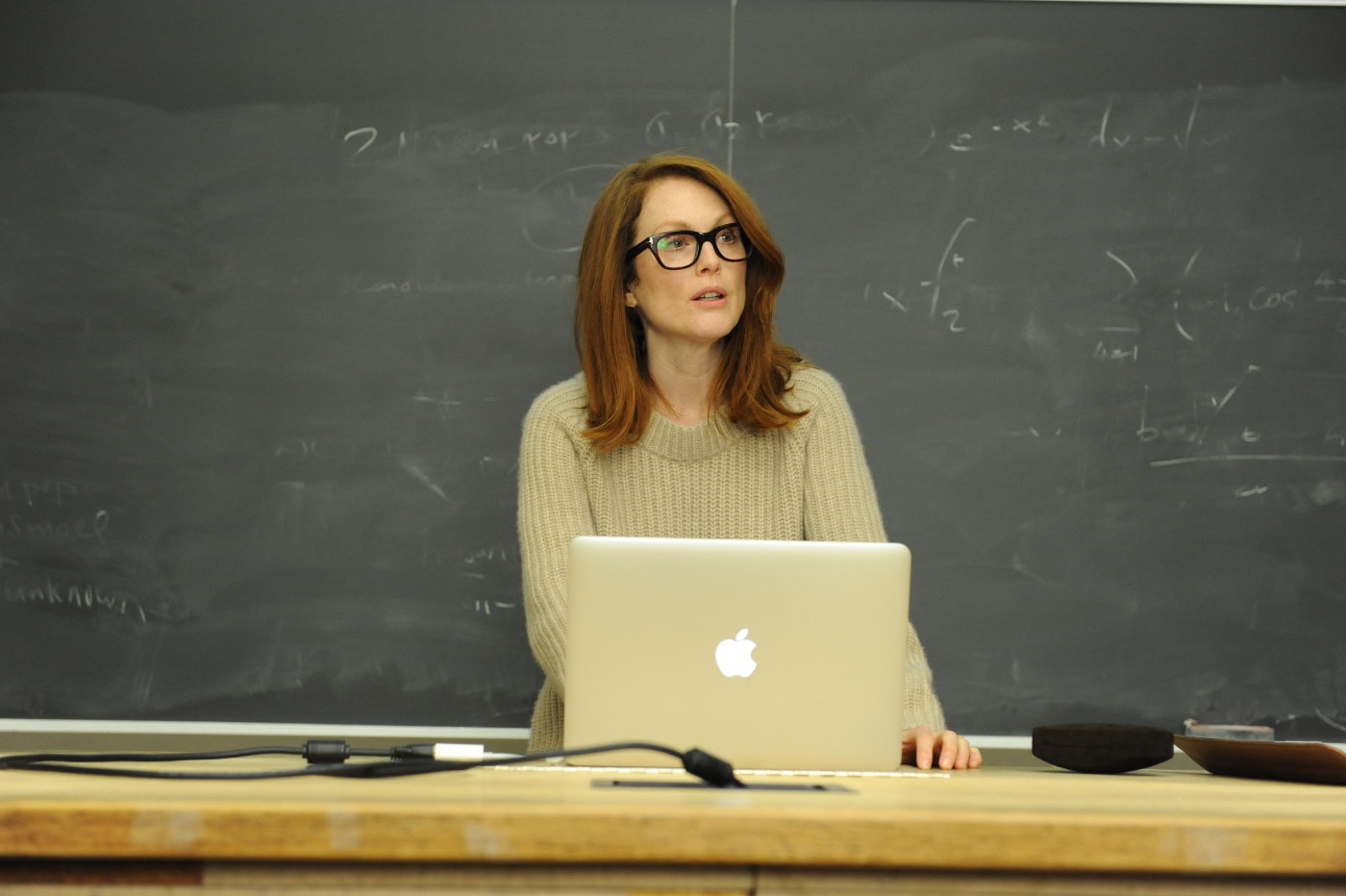
Professor Alice Howland (Julianne Moore) lecturing  her students at the start of the film.

Professor Alice Howland (Julianne Moore) lecturing her students at the start of the film.

Still Alice is based on the book with the same title by Lisa Genova. The movie revolves round Alice Howland (Julianne Moore), a phenomenally intelligent and knowledgeable linguistics professor at Columbia University. She is happily married to John (Alec Baldwin), and between them they have three children: Anna (Kate Bosworth), Tom (Hunter Parrish) and Lydia (Kristen Stewart). They live in a nice house in a good suburb in New York and they have a summer beach house too. Then, at the age of fifty, Alice is diagnosed with Early On-set Alzheimer’s Disease and her world rapidly falls apart.

Still Alice has a simple plot that is expressed exceptionally well. Directors Richard Glatzer and Wash Westmoreland have uniquely concentrated (with the exception of one scene) on how the disease affects the victim from the victim’s point of view. To illustrate the moments when the Alzheimer’s is hitting Alice, the world around her fades into fuzziness and she forgets where she is and who she is talking to. This makes for painful viewing as Alice was once an intelligent woman. And the pain viewers feel is enhanced by the superb dialogue that explains what Alice is going through in her (failing) mind. More often than not, the dialogue is so painful, one cries as hard as one did in The Shawshank Redemption, Schindler’s List and The Lion King. Indeed, somehow, every time the word ‘Alzheimer’s’ is mentioned, it feels like a blow to the heart, and the blows hurt even more when we learn that the disease is hereditary.

Alice and John (Alec Baldwin) trying to enjoy some good time together whilst Alice is still herself.

Alice and John (Alec Baldwin) trying to enjoy some good time together whilst Alice is still herself.

Undoubtedly, the key to why Still Alice hurts so much is because of Julianne Moore as the titular Alice. Moore has a rare, graceful beauty which works in her favour in, arguably, the performance of her career. (And that is saying something coming from her extraordinary portfolio). Suffice to say, Moore is fully deserving of her triumphs at the Golden Globes, the Baftas, the Screen Writer’s Guild Awards, and the Oscars because she stunningly encapsulates the problems facing a person with Alzheimer’s. Anyone who has seen a relative, friend or family friend suffer from Alzheimer’s (or Dementia or Parkinson’s) knows what is coming for Moore’s character, and one watches with horror as the disease rapidly robs Alice of her memory, her intelligence, her grace and her dignity. Toward the end of the film, there is a scene wherein one can see the contrast between Alice’s/Moore’s graceful appearance at the beginning of the movie and her appearance toward the end of it. Again, it makes for painful viewing and highlights why Moore was the perfect person for the role.

The rest of the cast take on a supporting role (quite literally) throughout the film. Of all the supporting cast, Kristen Stewart is given the most screen-time and exposition. It is easy to sneer at Stewart due to her numerous Golden Raspberry nominations and victories, her terrible acting in the Twilight Saga and Snow White and The Huntsman, and her affair with Rupert Sanders whilst dating Robert Pattinson (and on top of that she plays a failing actress in Still Alice). Nevertheless, Stewart actually plays her role in Still Alice really well and with enough subtlety and nuance to hint that critics may not always have a field day with her in the future.

Stewart might be the most noteworthy member of the supporting cast, but she is not the only one to play with subtlety and nuance. Alec Baldwin, Kate Bosworth and Hunter Parrish all play their parts with equal skill too, to portray the Howlands as a normal, (dys)functioning family. Their character’s, like Stewart’s, may not have anything of note to say, and nor do they add much to the story. But this is not a problem because Still Alice is about how the disease impacts upon Alice, and not how it impacts upon her family.

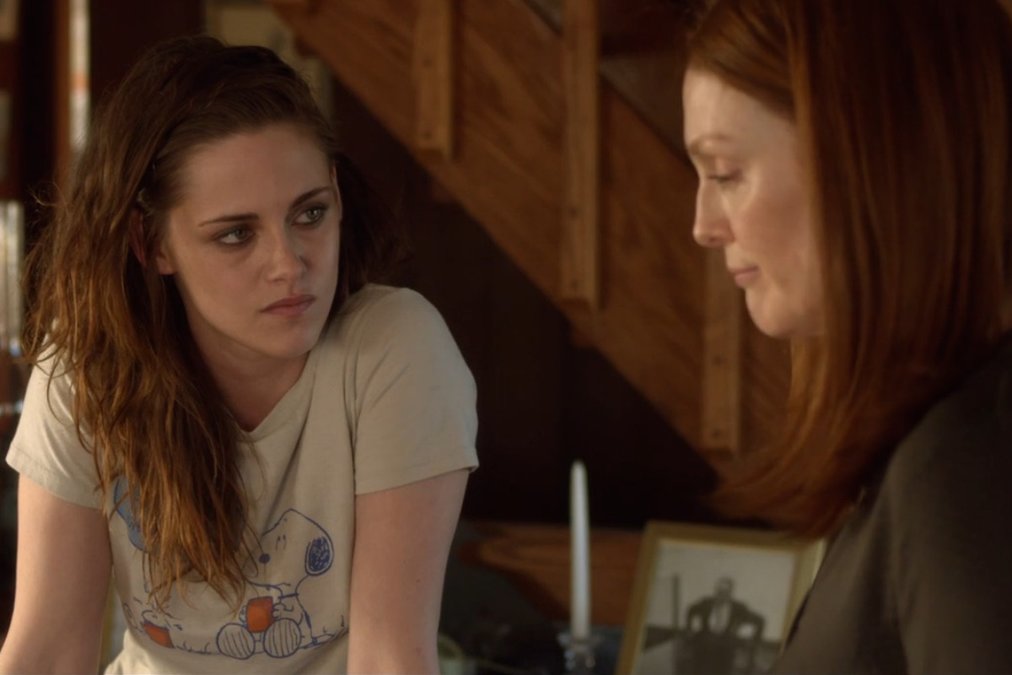
Alice explaining to Lydia (Kristen Stewart) what it is like for her to have Alzheimer's.

Alice explaining to Lydia (Kristen Stewart) what it is like for her to have Alzheimer’s.

No, the movie’s biggest problem is its ending. The final scene just ends anti-climactically, as if Glatzer and Westmoreland ran out of ideas and decided enough was enough. (One hopes that that was not the case, but it feels like it.) Another issue, perhaps, is that the film’s music is unmemorable and that it has been heard before in other films. However, these are relatively small matters, and backhandedly highlight the brilliance of Still Alice.

Over-all, Still Alice is a poignant film that makes for heart-breaking and teary viewing. Due to the acting and the dialogue, the movie superbly demonstrates and elucidates upon how a person with Alzheimer’s Disease sees the world. Central to the film, is Julianne Moore’s incredible performance as the eponymous Alice as it enables viewers to feel the pain that a victim of the disease goes through. In turn, this leaves viewers devastated long after Still Alice concludes.

PG’s Tips
Review – It Follows (15) [2015]

It Follows - title banner2

Star Rating: 2/5

Director:

  • David Robert Mitchell – The Myth of the American Sleepover

Cast:

  • Maika Monroe – At Any Price, Labor Day, Echoes Of WarIndependence Day II: Resurgence
  • Keir Gilchrist – Dead Silence, Just Peck, The Heyday Of The Insensitive Bastards, Dark Summer
  • Olivia Luccardi – The Rewrite, Like Sunday, Like Rain, Ironwood
  • Jake Weary – Fred: The Movie I-III, Altitude, Zombeavers, Pretty Little Liars
  • Lili Sepe – Spork
  • Daniel Zovatto – Beneath, Innocence, Revenge, Primal/Ethereal

The basic principle of a horror film is that it should scare people for much, if not all of the film. Why then, with the exception of last year’s The Babadook, have so many recent horror films not been scary in the least? Simply, watch It Follows and find out.

Jay (Maika Monroe) tied up and in an abandoned car park, after her sexual encounter with Hugh (Jake Weary).

Jay (Maika Monroe) tied up and in an abandoned car park, after her sexual encounter with Hugh (Jake Weary).

It Follows centres round nineteen-year-old Jay (Maika Monroe), who lives in the suburbs of Middle America. She goes out on a date with Hugh (Jake Weary) and has sex with him in the back of his car (classy, I know). While taking a break from having sex, Hugh puts a handkerchief wet with chlorophyll over Jay’s mouth and she passes out. When Jay wakes up, she is tied to a chair in an abandoned car park and Hugh tells her that he has passed on to her an STD (a sexually transmitted demon) that will follow her until, either, she has sex with another person or it kills her…

The premise for It Follows is a terrifying one. The threat of acquiring an STD (a disease, that is, as opposed to a demon) is enough to make all sensible people carry protection with them at all times. So, to change the disease element to a demon could have made for really interesting (and frightening) viewing.

Unfortunately, Director David Mitchell has ruined a very good premise with bad execution in several different ways. First, he employs the scene-fading technique too often to dizzy his audience into disinterest. Second, he has too many pointless and uninteresting scenes that add nothing to the plot. Third, the movie is boring and one rapidly becomes impatient for the film to end.


Jay and her friends going into an abandoned, derelict house. Why? Because that's what people do in horror films.

Jay and her friends going into an abandoned, derelict house. Why? Because that’s what people do in horror films.

Part of the reason why It Follows is boring is because there is no suspense. The ethereal, atmospheric music that the director employs can only induce terror into viewers when it is timed correctly and if they care about the characters. Alas, Mitchell turns the music on and up to eleven when it is not needed so it never has the desired effect (unless the desired effect is to give audiences a thumping headache); and the characters are so vain and stupid that even if Mitchell had used the music correctly, it would not have heightened one’s sensations as no-one cares about the characters. Jay and her (chemistry-less) friends are so daft, viewers almost pray for the demons to devour them so we can go to the bathroom sooner.

In fairness to Mitchell, he has the right ideas in place to make (what should have been) a scary horror movie. He has taken the right approach by making his characters the central focus of the story (unlike, for example, The Woman In Black where James Watkins made the silly ghost the driving force of the story). Indeed, if Mitchell had made his characters a tad more interesting, perhaps It Follows may have made pulses race after-all.

Kelly (Lili Sepe) attempting to calm Jay down upon the latter seeing a demon closing in on her.

Kelly (Lili Sepe) attempting to calm Jay down upon the latter seeing a demon closing in on her.

Additionally, the suburban setting is apt (if cliché) for a scary horror film as suburban areas can create a naturally tense and creepy atmosphere, like in The Babadook. Except, It Follows is neither tense nor scary, and seeing the setting merely reminds one of how good The Babadook was and how much of a let-down It Follows is.

Over-all, It Follows is a dull film. Director David Mitchell may have some good concepts upon how to make a decent film (and one awaits to see what he comes up with next). But his first horror film can only be described as a failure. It Follows does not make viewers feel on-edge or afraid for the characters within the story. Furthermore, the movie wastes its petrifying premise with bad execution. And there is only one crime in film worse than bad execution: boredom. Oh wait, It Follows has that too.

PG’s Tips
Review – Kingsman: The Secret Service (15) [2015]

Kingsman - title banner2

Star Rating: 3.5/5

Director:

Writer:

Cast:

Music Composer:

Matthew Vaughn and Jane Goldman make an awesome screen-writing couple. Together, they wrote the hilarious Kick-Ass and the first-rate reboot of the X-Men franchise. Now, they are back in comical fashion with the secret service spoof, Kingsman: The Secret Service.

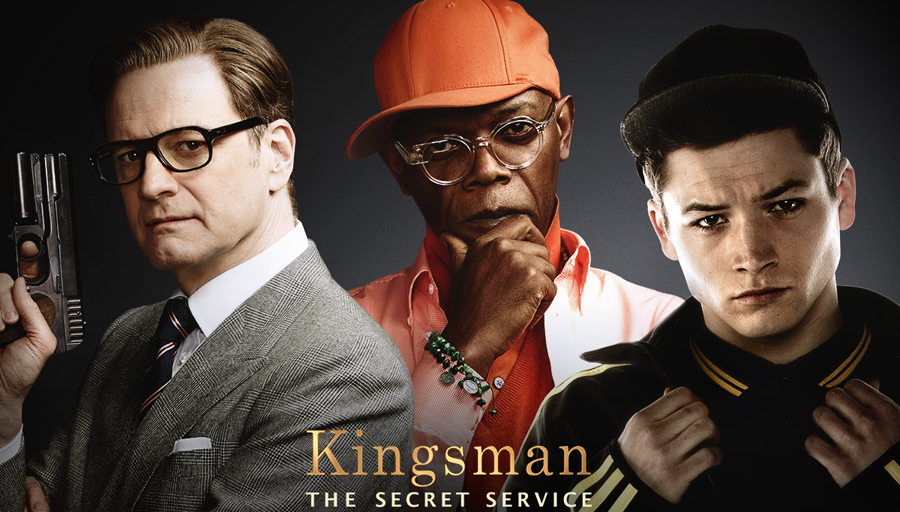
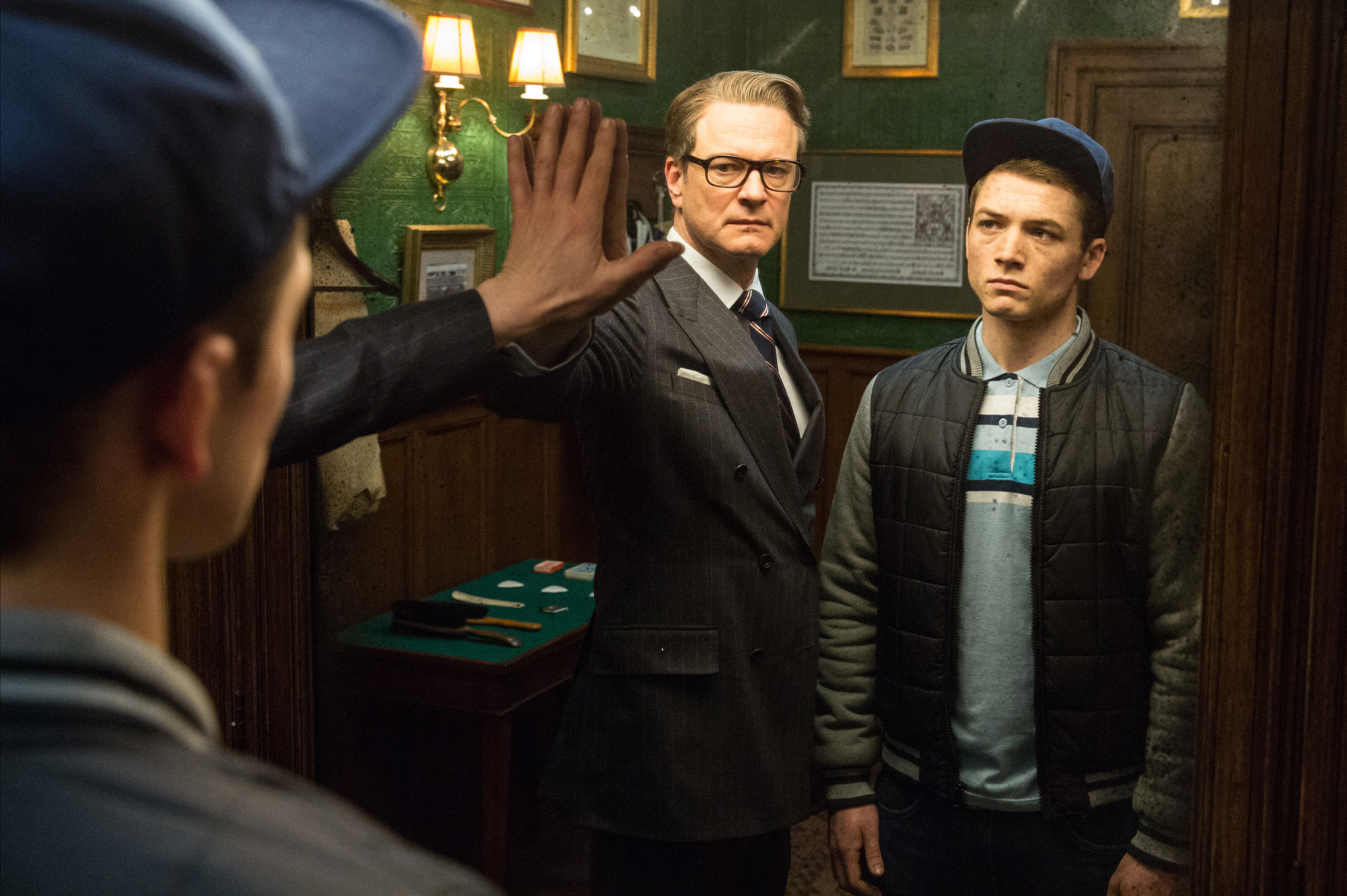
harry (Colin Firth) showing Eggsy (Taron Egerton) the secret way of entering the world of a Kingsman.

harry (Colin Firth) showing Eggsy (Taron Egerton) the secret way of entering the world of a Kingsman.

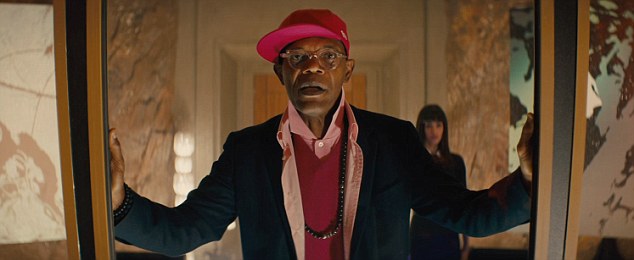
Kingsman is based on the comic-book by Mark Millar. It is about a young man from South London called Eggsy (Taron Egerton), who is descending into a life of violence, drink, drugs and crime when secret agent Harry (Colin Firth) pays him an unexpected visit. Harry offers him the chance, which Eggsy accepts, to train and become a secret agent/Kingsman to stop Valentine (Samuel L Jackson) from making the world anew with his new invention.

Kingsman is a stylish and entertaining film. At its core, the movie is a satire on the spy thriller genre and James Bond in particular (which, itself, was a satire on the world of espionage until Daniel Craig’s Bond hijacked the franchise). Yet, Kingsman has a (charming) stick-two-fingers-up attitude that most spy thrillers and James Bond films would never dare employ. This attitude has a strangely endearing quality and hints at why Vaughn turned down directing X-Men: Days of Future Past in favour of making Kingsman. This attitude not only makes the film worthwhile-viewing, it reminds audiences of why they loved Kick-Ass so much back in 2010.

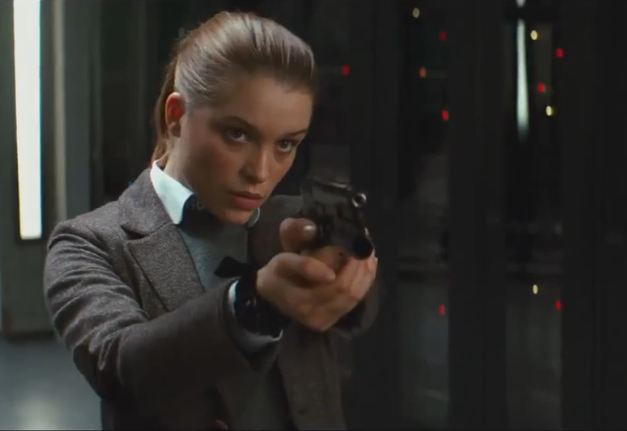
Roxy (Sophie Cookson), the obligatory babe, trying her luck to become a Kings(wo)man.

Roxy (Sophie Cookson), the obligatory babe, trying her luck to become a Kings(wo)man.

It also helps that Kingsman is ludicrously funny. Vaughn and Goldman have an impeccable understanding of the most essential ingredient for comedy: timing. As a result, the numerous jokes, touché lines, exaggerated action sequences, and amusing special effects all work throughout the film’s 129-minute running time. Indeed, one is likely to be so amused by the ridiculousness of the movie that one is unlikely to care that the plot is cliché and overblown, or that the actors take themselves as disingenuously as their counterparts did in Knight and Day, Mission: Impossible IV and This Means War.

Valentine (Samuel L Jackson) looking laughably ridiculous as the utterly camp villain, wanting to start the world anew.

Valentine (Samuel L Jackson) looking laughably ridiculous as the utterly camp villain, wanting to start the world anew.

No-one epitomises the preposterous nature of the storyline and the acting as much as Samuel L Jackson (SLJ), as the camp, 1980s-dressed, lisp-impaired villain of the film (named Valentine to cap it all). When one is used to watching SLJ as the stern and authoritative Coach Carter and Nick Fury, one has to blink repeatedly (and with disbelief) to remember that Valentine is the same man. But credit to SLJ: he performs insincerely admirably as Valentine without disgracing himself. The same can be said for Colin Firth, Michael Caine, Mark Strong, Taron Egerton and Sophie Cookson, even if their roles are far less humiliating than SLJ’s.

Over-all, Kingsman: The Secret Service is an enjoyable film, provided it is taken with a handful of salt. The movie is absurd and over-the-top in all departments. But it is a very funny and entertaining spoof on James Bond and the spy genre in general. Thus, like with Kick-Ass and X-Men: First Class before, Matthew Vaughn and Jane Goldman have scored again with Kingsman, and long may they keep scoring.

PG’s Tips